
(revised 4-11-14) (The following essay was built out of a segment of a speech that I gave at the Idle No More rally in Helena, Montana, on February 18, 2013.)
“If we do not save the environment, then whatever we do in civil rights…will be of no meaning, because then we will have the equality of extinction.” –James Farmer, Jr.
During the 1960s, while the focus of many activists for social change was on equality and racial justice, some of us asked a very important two-word question: “Equally what?” Equally materialistic and consumptive? Equally ruthless, dishonest and unethical in business? Equally corrupt in government and disregardful of the people whom we are elected to serve? Equally destructive to the environment (the word we used then—now I say the planet, the biosphere, or life itself)? For many Americans of color, both then and now, the major victories and small social reforms brought by the Civil Rights and anti-racism movement of the 1960s meant greater chances for economic and social “upward” mobility. For some of the more traditional Native Americans living on reservations, equality was not as important of a goal as maintaining tribal sovereignty, treaty rights, and cultural preservation, but, for the increasing number of urban Native Americans at that time, and for many reservation people as well, being free from racial discrimination and being allowed equal rights and opportunities for “success” in the larger American society was also a major concern. Many people from historically marginalized and oppressed groups in the U.S.—African Americans, Native Americans, Latinos, Asians, southern Euro-American sharecroppers, Appalachian coal miners, and the low-wage working people of all colors—were focused mainly on issues of economic inequality and economic injustice, as they attempted to overcome the obstacles that hindered them from full participation in the modern industrial, consumption-obsessed, capitalist society of the United States. To such Americans of the first generation to get hooked on television, lacking a developed critique of imperialism, and imagining endless expansion of the industrial “frontier” of raw material resource extraction—extending even into other planets in outer space—their critique of capitalist society did not generally extend far beyond the fact that they had not been allowed to fully participate in all of its possibilities and fully benefit from all of its real or imagined perks. This limited understanding of our socio-economic system and our collective history, and the consequent limited sense of purpose in life still prevails among the majority of United Statesians from all historic and cultural backgrounds to this day, although a concurrent thread of “alternative consciousness” and differential thinking, with a sense of better, more sustainable, more life-nourishing purposes and possibilities has also been in development for the last five decades and is rising.
This alternative thread of higher creative consciousness was clearly present during the 1960s among many of the people, of all kinds, who decided to intentionally live by a different set of values than the American majority and to try to either transform American society or create alternative socio-economic systems and other ways of life within their own small social or cultural enclaves. “Returning to ancestral traditions,” “conserving nature,” and “getting back to the garden” were some catch phrases of that movement, along with a whole new wave of activists for the earth. The corporate-controlled mainstream media, along with some historians whom the corporate powers have also bought and influenced, want us to dismiss what is called the “hippie movement” as nothing more than a hedonistic, drug-addled, directionless, misguided conglomeration of disjointed, experimental social activities. That may be a good description of the masses of effectively-programmed, young, popular-culture-conformist, industrio-techno consumers of that era, but we who were there know that there was also something much deeper, much more vital and essential to the current plight of life on Earth going on adjacent to all of that other “youth culture” commercial consumer nonsense.
As a teenager, coming of age in California in the 1960s, I found the alternative consciousness or alternative perspectives and ways of life movement to be very appealing. I sensed then, and am aware even more clearly now, that the prevailing cosmology or world view of so-called “western” (west of what?), modern industrial, unlimited consumption-oriented society is fundamentally wrong. I first became suspicious of Western Civilization as a young teenager, watching scenes from the Civil Rights protests in the South on the nightly TV news. Watching and listening to the unabashed, virulent racists, my earliest questions ran along the lines of “what the heck is wrong with those people?”, soon followed by rampant, wholesale questioning of the society that produced them. What began as a nagging sense of doubt and discomfort, followed by cautious investigation, developed over time into my current understanding that the socio-economic and paradigmatic status quo of what is also strangely called “the developed world” is basically toxic and unsustainable for life on Earth. I only understood that intuitively back in the Spring of 1970, when I gave away most of my earthly possessions, including my car, and hitchhiked north from Los Angeles, with no specific destination except “maybe Canada” (I was non-compliant with the draft). Nothing certain but “North,” and away from a society to which I did not want to belong. Knowing all that I know now (based on real science and professional historiography), and only having a vague suspicion about it way back then, I now think that I was really onto something.

Photos by David Penchansky
The directions of thought and action that I took during my teenage years were not based in any direction from my parents and family of origin, who strongly believed in the pursuit of equality in both economic opportunity and material consumption. My family and my ancestors are very diverse: a mixture of Native American, African, and European peoples of many tribes and nations. But, unlike many “people of color” from historically oppressed groups in the U.S., my immediate family participated broadly in much of the mainstream consumptive activities and were what sociologists might call “upwardly-mobile middle class Americans.” Both of my parents, two of my grandparents, and one great-grandparent were college-educated. My Dad was an industrial engineer (aerospace/military-related product design) who made enough money for my Mom to not need to work. We had a swimming pool in the backyard, always had plenty to eat, and nice, shiny new cars and clothes. Therefore, I did not have the same motivation to “escape poverty,” or become a “player” in “The Man’s” economic game, or get a “piece of the action,” that many other people from a similar historical and cultural background had, and some still have today. I had seen what “the game” can do to people and I’d had a decent share of “the action,” and found it all to be ultimately empty and unappealing.
Another element that contributed to the forming of my alternative consciousness was the experience of attending central and west Los Angeles schools back when that part of L.A. was still largely integrated, during the early stages of the “white flight” to the suburbs. In that social context, when I began to deeply question the status quo during the 8th grade, I naturally began to bond with the few other people in my peer group/age cohort who were asking similar questions: the mostly Jewish and Euro-American young “hippies” and “lefties.” So, besides all of the direct experience I had of the emptiness of material comfort, I shared the moral outrage and angst about an unjust, racist, materialistic, easily-manipulated, militaristic, environmentally toxic, imperialist society of my high school hipster peers. Like many of my peer group of that era, my extreme differences in cosmology from my parents’ generation often brought me into conflict with them that was amplified beyond what most people in America would consider normal. So, when my Dad, who had to struggle against blatant racial discrimination—from serving in a racially segregated U.S. Army and seeing German POWs treated to better accommodations than his so-called “colored regiment,” to routinely seeing Euro-American engineers that he helped to train get promoted above him—told me, “Son, if you want to be treated as an equal in this society you can’t just show that you are as good as the white man, you have to be better than him,” I thought to myself (but did not dare say it to him out loud), “Go to all that trouble to be equally what?”
As an American historian and observer/participant in this unbalanced society, I am fully aware that my life experiences and the familial and societal contexts in which I was raised, in the era in which I was raised, were exceptional and not “normal” in the U.S.A. I also understand how others who struggled against greater obstacles than I had, in pursuit of the so-called “American dream,” or at least a decent living, might be thrilled and pleased with themselves to have a college degree, a skilled professional career, property and nice possessions, be able to travel to conferences and stay in fancy hotels, eat at nice restaurants, earn awards and recognition or even just little pats on the back, etc., etc. That is all just fine, and in synch with some very natural human traits, as expressed in this societal context. But, one of the great ironies of human history, repeated through the ages, is how oppressed people often admire the lifestyles of their own oppressors, and, to varying degrees, aspire to attain similar wealth and power over others. During the American Colonial era, the vast majority of Europeans who immigrated to North America were indentured servants from the landless, tenant farmer, or “peasant” class and their ancestors had been in that social class for centuries. They were subject people, with little or no human rights, subject to the whims and dictates of the monarchs and their titled peers—the two to five percent of the population who claimed ownership to all of the vast tracts of land in Europe, and all resources and species who dwelt upon those lands, including their human tenants. Those immigrants to America signed their indentured labor contracts and took passages on ships bound for a world that was new to them, suppressing their fear of the unknown, in hope of attaining something that their ancestors never could: land ownership, freedom, human rights and upward social mobility. Indentured servitude was what I call, “slavery: for a limited time only.” They were not free to come and go as they pleased and runaway indentured servants were pursued and re-captured just like runaway slaves. These servants were unfree laborers, bound to contracts for an average of seven or eight years, and if they ran away from their servitude they faced some prison time and/or more years added to their contracts. Many were promised that at the end of their servitude they would receive land grants in the colonies of 40 or 50 acres. The great irony regarding these formerly oppressed people is that many of those newly-minted colonial landowners (and land-stealers) went on to become landlords and masters of other indentured servants and eventually holders of permanent slaves, exacting cruel and oppressive treatment upon their fellow humans, equal to or greater than all of the horrors that they and their own ancestors had experienced themselves. Now to the relevant question: Would you call such a person a “success story” or an exemplary “role model?” What if we change the person’s skin color and slightly alter the context to that of an African American former slave in early 19th-century Louisiana who was freed by his French master/father and granted some land and slaves of his own, which he gladly accepted? Or, we could take our time machine into the future and imagine a Native American officer in the U.S. Space Force ordering her troops, regarding the “alien life forms” on some resource-rich planet in another galaxy, to “round `em all up and march them over to the reservation” so that the industrialists can plunder the rest of their homelands. Would you call that “progress” or “quite an accomplishment?”
How do stories of “upward mobility” and “economic success” like those above differ substantially from a story like Condoleeza Rice’s or Clarence Thomas’s, whose journeys to “equality” culminated in affinity and collusion with the multinational oppressors of the American military-industrial complex? Is being allowed to join that club indicative of “success?” Or, how about the many “successful” actors and comedians who got to their positions of popularity and material reward by taking on roles that portrayed their people in degrading and stereotypical ways, thereby reinforcing racist norms that contribute to keeping our society divided and conquered? If you call such people “successful,” then I must ask you, “successfully what?” Is “rising to equality” always a good thing, or a goal sufficient unto itself? What good is “equality” if it is used to make us engines or gears in a monstrous machine, keeping destructive social mechanisms in motion?
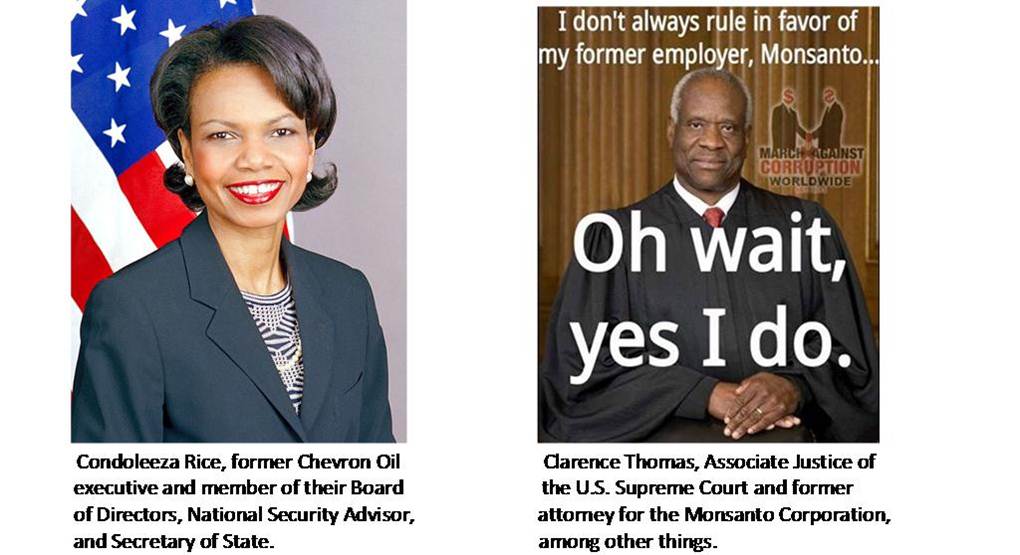
I realize, of course, that many historically oppressed people who value the feeling of accomplishment and the material perks of upward social mobility may also be employed in rather benign professions that cause relatively little to no harm, and that many occupations actually do some social good. Some equality-seeking, upwardly mobile people might also be opposed to much of the corruption and injustice in our society, and might even actively protest and resist a lot of it. But, by my technically unscientific observations based on a lifetime of experience, there seems to be a limit to most of their criticism of society, especially regarding the industrial technological aggressively competitive economic systems, that I, and many others who are often labeled as “radicals,” do not share. Most people who wear the labels “liberal” or “progressive” tend to think that the system just needs a little tweaking or adjusting, and that we can create a “just society” with general equality of “economic opportunity” within the same basic structure of this current socio-economic system. In contrast to that view of the world, others of us think that the basic, prevailing socio-economic systems (whether capitalist or large-scale socialist, like China) are locked into a very destructive and, ultimately, lethal pathway of unlimited extraction and consumption of Earth’s finite resources, a path which is very resistant to change, and that, therefore, we need to create new or thoroughly-transformed, sustainable socio/economic systems (yes, plural and small-scale) as soon as possible, due to our current state of industrial consumption-created climate and earth-poisoning disaster. This current, world-wide crisis (which I will not describe in detail in this essay, but instead urge my readers to study the scientific community’s dire warnings—immediately, thoroughly, and critically) brings me to the heart of why questioning “equality” as a goal sufficient unto itself is such an urgent matter. We are living in a time unlike any other in human history—not only a time of great danger, but what could rightly be called a radical time, requiring radical movement away from business as usual and from casual acquiescence to status quo norms. The moderate/liberal “band-aid” approach to solving social problems may be reasonable in “normal” circumstances, but not in this time of extreme planetary crisis. The normal approach would lead only to small, insufficient reforms that do not threaten or interrupt the pursuit of excessive consumption, and do not fundamentally change systems and practices—or toxic thinking—to a degree or at a pace that would be sufficient to save this planet of living beings from continued destruction and, ultimately, mass extinctions.
As a lifelong educator, working largely with young Americans “of color” and many low-income Euro-Americans, I must now carefully re-examine how I continue to provide non-judgmental guidance and encouragement to students on their various upwardly-mobile career paths. Feeling compelled to affirm and praise them for their accomplishments, I am also compelled to encourage them to continue asking questions about the value and potential—positive or negative—in the academic or career paths before them, and to remain curious, skeptical, and inquisitive, as life-long learners. As you pursue equality, how will you use your equality? As a lifelong advocate for social equality and human rights, joined in close affinity with many dear people over the decades, working together on so many of those types of issues, it is not easy for me to bring this message, which says, essentially, that something else is now a much more important issue. I certainly do not mean to belittle or demean all of the great work for equality that has been done, nor to deter people from the fact that there is still much left to do. I will and do continue with such work. But we cannot do our work without a healthy, habitable planet, in which the biosphere systems that nourish all species are still intact and functioning. If those systems are indeed breaking down and all living species, including our own, are in near danger of extinction due to the activities of the societies that we are complicit in, as 99% of scientists in climate-related fields now say is the case, then that issue must become our most urgent priority. Even if our current situation was not so dire, we should always question any definition of “success” that includes becoming instrumental in systems and activities that cause pain, harm and destruction to life itself.

