a true story from the natural world
Part One: early August, 2026
We grow a lot of hazelnuts here at LifeGiving Farm. To be a little more accurate about that, I should say that the hazelnut trees grow a lot of nuts with a little bit of help from us, and much help from sun, soil, water and our fellow nurturers of all species—including the squirrels. I am having a little difficulty right now with accepting that our squirrel co-inhabitants of this beautiful land and ecosystem that we live upon should be included on the list of nurturers. Are the squirrels nurturing the hazelnut trees when they harvest their nuts long before they are ripe, eating only a small portion of what they drop on the ground? They also break off many of the tips of the branches and cast those down, too. Why? How does that improve the life of the nut trees? Why do I not understand these and some other things that the other people (or “species”) in this ecohood do? There is actually a battle going on now between my colonized mind and my indigenous mind which is bringing up many significant questions.
It is now mid summer, the middle of August, moving rapidly towards the peak of harvest season, and the first nuts will probably be ready for harvesting in about two weeks, maybe less, depending on the weather. Our “farm” does not practice monoculture and is really very biodiverse—a blending, or interface, of many species of plants, trees, shrubs, herbs and grasses, native and cultivated, annuals and perennials. Because of that rich reality, we harvest many different species of food and medicine plants throughout the warm, non-winter months in the northern Rocky Mountains. Harvesting hazelnuts is one of my favorite things to do, besides roasting and eating them. During and after this year’s hazelnut harvest, I expect that many of my questions about squirrels, their relationship to this land (which goes back many thousands of years before our family arrived here a mere 41 years ago), my relationship to this land and to all of the other species of life that we share this place with, how this sharing was meant to work and what it should look like, and many questions about why I think the way that I do and why I have so many questions about the ways of natural life. Why didn’t I learn these things beginning in my infancy? Because I was raised (for the first eighteen years of my life) in a large American city by people who did not know the old ways of Earth’s living system or their particular ancestral local ecosystems.
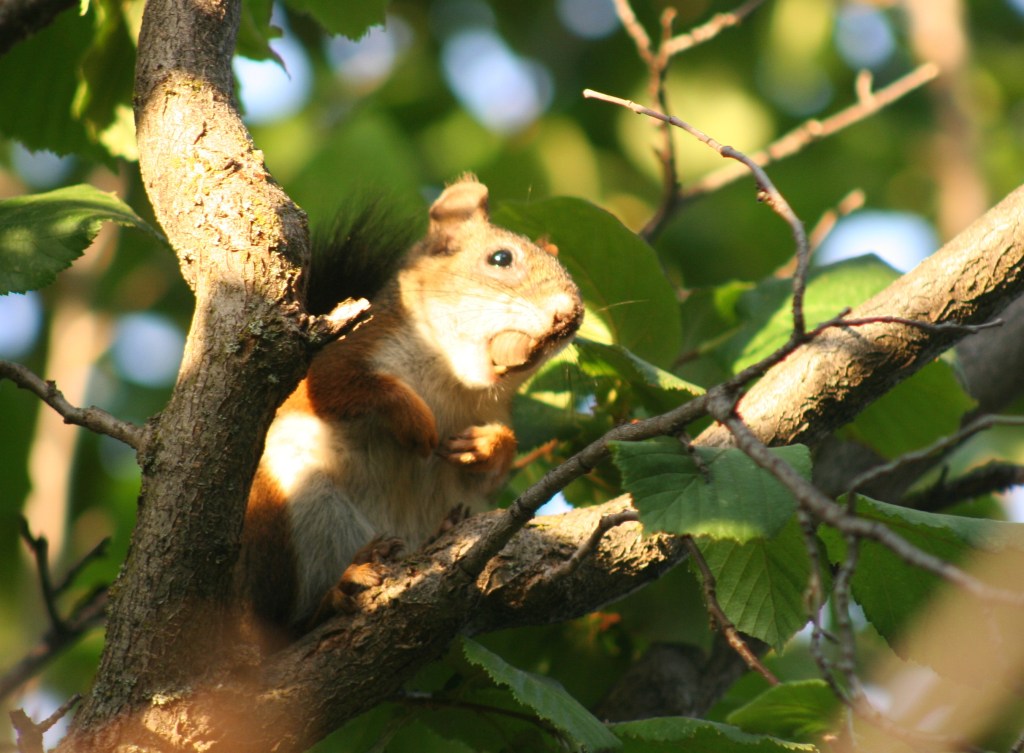
Something very unusual happened here a couple of weeks ago that initiated this query into the behavior of squirrels and our proper natural relationship with them, as co-inhabitants of the same homeland ecosystem. I was weeding one of my corn and melon patches and heard a squirrel chattering loudly and energetically in a nearby pine tree, while looking directly at me. One of my several remaining goals in life is to learn how to understand and communicate with our relatives of other species. At that moment, I felt like my squirrel neighbor was trying to communicate with me, so I walked slowly towards that pine tree. As I got closer to the squirrel (who was still looking directly at me, but no longer speaking), I began to speak to the squirrel in a vocal language that I do not know, spontaneously, without forethought. I felt like the language sounds that I was making expressed the following message from within me: “Hey, my friend! What’s up? We’re cool, right?” After I said that, the squirrel climbed a little higher in the tree and then along a big branch stretching to the left, towards the other pine trees, and at that point I lost sight of him or her and returned to my gardening. That was in the morning. Around mid-afternoon, I began to see that a major change had come to our little farm that I had not seen before in 41 years of being here.
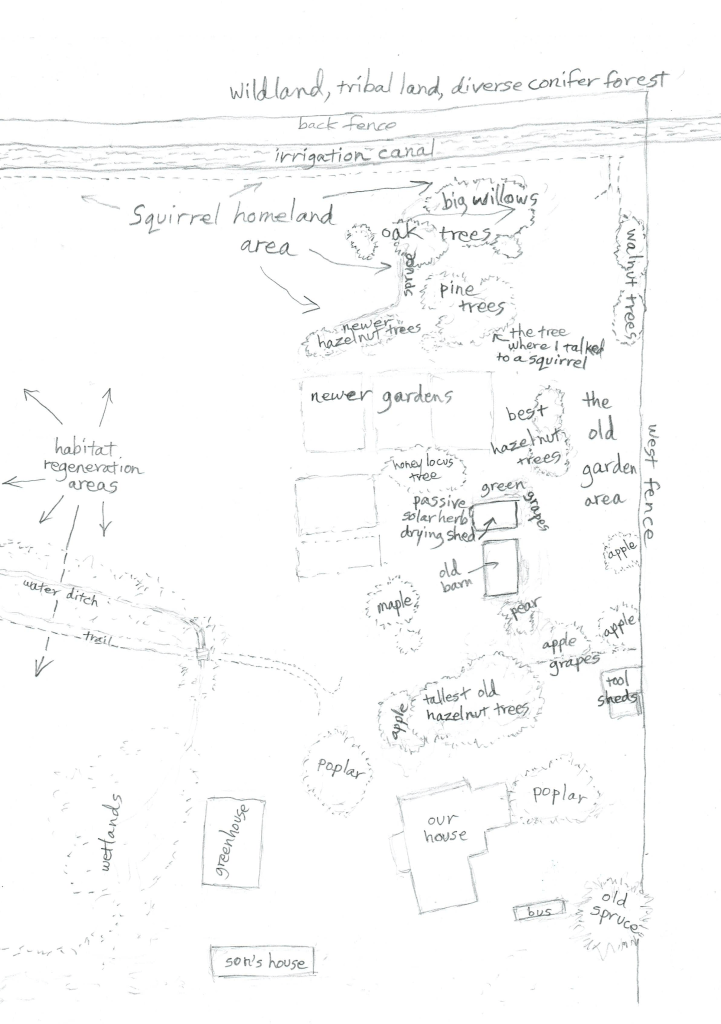
During those 41 years, the squirrels, which had never been very numerous here, always stayed in and around the pine, willow, and oak trees at the south end of our place and in the wild hills beyond the fence (please look at the map below). Only very rarely did any of them venture closer to our house, or even the gardens in between our house and their houses, than that. They have plenty of their favorite foods—mainly acorns and pine nuts—and comfortable nesting spots, in that area. But that afternoon in early August I noticed a few squirrels in our back yard, in and around the big hazelnut shade trees that we like to sit under when the weather is really hot. By the end of the day, it seemed like much more than just a few, and on the next day there were even more. Why was this happening? Was it really something I said? Or was there more to it than that?
Part Two: responding, watching, listening, and learning
Sometime last spring I began reading Derrick Jensen’s very enlightening and challenging book, The Myth of Human Supremacy. I have been opposed to anthropocentric thinking for at least the last couple of decades, but I know I still carry some anthropocentric baggage in my mind, just because I have lived within (or adjacent to) an anthropocentric society all of my life (75 years). You could say that I am infected with it, even though I constantly struggle to find a cure and cast that way of seeing the world off, permanently. I think that going deep local in this wondrously beautiful place where I live, rarely ever leaving the farm or the “wild” hills and forests behind our home, ever since I retired from teaching eight years ago, has helped me very much in this struggle, this quest for right natural being. The concept of human supremacy (belief in the superiority of human beings over all other species of life) is deeply intertwined with anthropocentrism (putting human interests and concerns above all others) in all “western” or colonialist cultures and just as pervasive. Academia, where I spent several decades as both student and teacher, is drenched with it. It is like the air that everybody breathes there. The events that have happened here since that communication with that squirrel in the pine tree in early August, when I was about halfway through reading that book, have brought me to a point that feels like the verge of a great learning experience with the squirrel people, and maybe with everybody else, too.
My first responses to that sudden “invasion” of the squirrel people into the backyard area behind our house brought out my latent and my spouse’s not-so-latent, deeply-conditioned human supremacy. Intellectually, or in the part of my mind where “reason” is said to prevail, I know that us humans, being the much more recent arrivers in this place are the real “invaders” into the homelands of the squirrels, chipmunks, rabbits, bears, coyotes, bobcats, raccoons, weasels, beavers, and many others who live here. But, try telling that to the colonialized, “western civilized” part of my mind. Fears and other sorts of thoughts arose about the potential loss of something human people call “property” and something they call “the fruits of our labor.” The specific items of concern were the hazelnuts, and a little less so—the grapes. Such thoughts even drove me to briefly respond to the squirrels with violence. Looking back on some of my first responses, I am now a little shocked and ashamed.
Before I describe those early responses, I should first provide a little historic background information. During those decades before the squirrels moved close to our house, we had chipmunks living in this space. They sometimes ate hazelnuts (a.k.a., “filberts”) and grapes, but their population around our house was usually too small to make much of a dent in the volume of those crops. But there were about two years out of the forty-one in which the chipmunks became numerous enough to reduce our harvest of those gifts of Nature by a considerable amount. It was during those times that I decided somehow that I had a right to “manage” or reduce the chipmunk population to what I considered to be something “sustainable,” or “more reasonable.” Unlike a total, full-blown human supremacist, my reasons (or justifications) did take into consideration what might be best for the chipmunks and this habitat we share, to some degree, but not nearly to the extent that I would do so today. At present, I question whether or not I have any right to moderate or control the populations of other species at all. (More on that later.) So, in summary, what I ended up doing was killing some chipmunks, using rat traps. In the years that followed that act, the chipmunk population stayed at or below the levels that we had seen in the previous decades that we have lived here. After the squirrels moved into the backyard area this summer, the chipmunks have stayed out of, or occasionally on the fringes of, that space.
So, when the squirrels suddenly appeared in numbers that seemed to be greater than what the normal chipmunk population used to be here—and when I considered that a squirrel is about 33% larger than a chipmunk and therefore probably eats about 33% more than a chipmunk eats—I guess I sort of panicked. We like our nuts, and we also are trying to live directly from the food that we grow and gather from Nature, instead of using money to buy food from stores and markets (as much as we possibly can). So, thoughts about “managing” the squirrel people came into my head and my wife didn’t need to think about it much at all before urging me to take action, like I had done in the past with the chipmunks. I agreed with her that something should probably be done, but I didn’t want to start killing our little neighbors this time. I decided to just try to discourage the squirrels from being too bold and aggressive in their pursuit of “our” hazelnuts or the grapes. I decided to just assault some of them with what some humans call “non-lethal force,” in hopes that would get them to slow down and back off a bit. I do not have any guns that fire rubber bullets or any tasers, so I decided to use my bow and target arrows, which have rounded, not sharp, points and to not pull back on the string very much—just enough to kind of give them a little sting and a reason to re-think whether moving into our backyard nut trees was really a good idea (even though they might have thought that I invited them to do so when I spoke on that first day). I also figured that if I ever accidentally killed one of them while doing this, I could give their meat to the dog or the cats for food. Well, long story short, that didn’t work. Most of the time I missed and, when I did actually hit one, they would just jump or flinch and run a little ways and then just go right back to what they were doing. Sometimes they didn’t run or move at all, but just sat there staring at me like they were thinking, “WTF! What’s that guy trying to do?” A few times they started chattering in a manner that seemed to me like they were cussing me out.
Next, our daughter’s boyfriend, an expert hunter, who supplies us with most of our wild meat, loaned me his bb rifle air gun, after I turned down his offer to use something stronger. The only difference that made was that I didn’t have to go searching for bbs when I missed, like I had to do with the arrows. I would pump up the rifle fully with air, but the bbs did not seem to ever penetrate the squirrels’ fur or skin when I hit them. Most of the time, the squirrels had already moved on while I was pumping up the gun to take another shot, after missing. It was pathetic. I eventually realized that “hunting” squirrels takes a lot of time (as does real, actual hunting), and I had a lot of other, better things that I needed and wanted to do with my time. I then realized that it was time to stop acting and start observing and listening a little more.
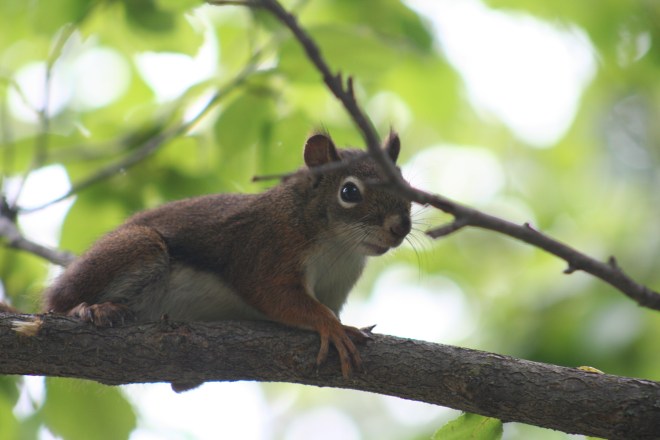
The two tall hazelnut trees in our backyard area provide most of the shade in that space. Being under their low, long branches is almost like entering into a cool cave or other type of small shelter. We have a nice table set up on the grass between those two trees with room for about seven or eight people to sit around the table and it is one of our favorite places to sit on a hot summer day. Sometimes we eat and talk and sometimes we use the table to sort and work on the various plant crops that we harvest. About a week after I stopped trying to shoot the squirrels, it was time to harvest and tend to some of the corn. We like to sit there at that table when we work on the corn, and this year was the first time that we had a number of squirrels running back and forth in the branches above us, chattering, singing their songs, gathering nuts, and watching us. While the squirrels watched me, I also watched them, engaged in the process of mutual learning. That process continues to this day, nearly three months later, as we continue to share the same spaces and the fruits of this land. I am not sure what the squirrels have learned about me, but now I can write some things that I have learned from observing them.
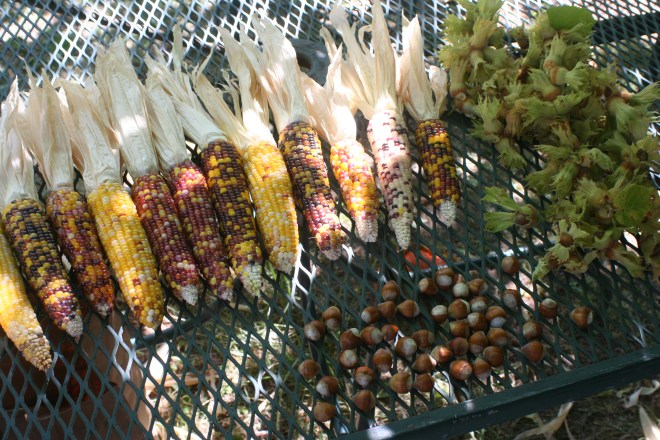
Did the squirrels ever take revenge or strike back against me for hitting them a few times with blunt arrows and bb pellets? No, they never did. Sometimes, I imagined that their vocalizations when looking at me, or running around on the branches of the trees above me were expressions of anger or disdain, but as the days passed and it became clear that I no longer would attempt to do them any harm, that seemed to be less likely. In retrospect, it seems to me now that, even during the days that I was shooting at them, and probably even more so after I stopped, they probably thought of me as some sort of a joke—less of a danger or threat and more of a pathetic fool. Or, so I imagine. During those early days of our time together in this space, I sometimes feared that they might jump on me from the branches of the nut trees above me and maybe bite me or scratch me with their little claws, especially while I was sitting and working at the table, but also as I walked by the various trees and structures of our place that they constantly run all over. But they never did and probably never will. I have observed that squirrels are not violent people. I have not seen them fight with or attack each other or any of the other species that live here, and they seem to have strictly vegetarian diets (but a young man from New Mexico recently told me that where he is from they have observed squirrels occasionally killing and eating chipmunks. He thought that might be because they live in a semi-desert environment and the squirrels there did not have as many vegetable food options as they have here).
The squirrels are also playful people and they spend lots of time chasing each other, back and forth and to and fro. I have even recently observed a squirrel and a Steller’s blue jay playing with each other. At first it seemed like the squirrel was just trying to keep the jay from taking some of the hazelnuts that the squirrels had buried in shallow little holes in the grass or under the leaves. That might have been part of what was going on, but after over a week of watching this, several times a day—and I think I have been watching the same jay and the same squirrel—at the same spot, and in the same tree above that spot, it seems to have turned into a friendly game. Chase and return, chase and return, and sometimes actually picking up nuts. No wrestling, no feathers or blood flying, and both of them keeping one eye surveying the area for our three large cats, who are known to often make feathers, fur, and blood fly. The squirrel and the jay make some similar vocal sounds, too, which gets me thinking about inter-species communication again. Besides the vocal communication, it is clear that much non-verbal, body language types of communication occur regularly, between all the peoples of different species. The advent of literacy, and its usefulness for controlling, deluding and oppressing others, is probably one reason that our species puts more emphasis on words.
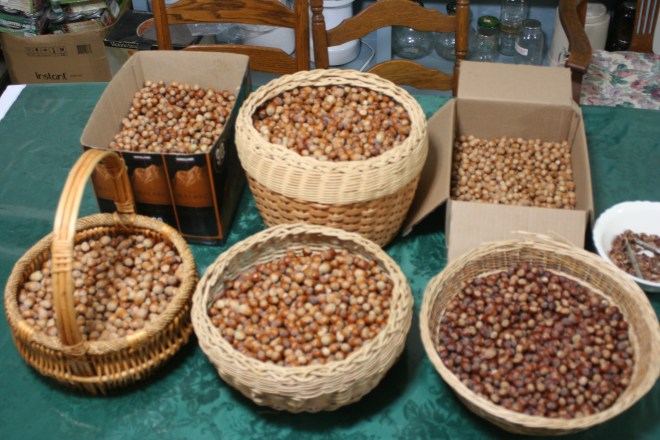
The hazelnut harvest began (for us humans, anyway, who wait until the nuts actually become ripe) during the last week of August, and continued on until about the last day of September. It is our custom to always leave some of the smallest nuts on the ground for the chipmunks, squirrels, jays, and our other non-human neighbors, rather than take every nut we see. So, the squirrels and others (including that same blue jay) are still finding some nuts out there now, in the first week of November. I see some nuts here and there, when I rake up the autumn leaves to put in the compost and on the planting beds, which, along with the moving of the nuts that our non-human neighbors do, is why little newborn nut trees always pop up here and there, in the spring and early summer. After our nut harvesting was done, we were able to assess the impact of having many more squirrels and much less chipmunks (nearly none) in our backyard nut trees this year. Last year’s nut harvest was our biggest one ever and this year’s was just a little less than that, maybe about ten percent less. Here are a couple of photos from the two harvests. They are not exactly equivalent representations, since the one from last year was taken on October 5th, right at the end of harvest, before many of them had been eaten, and this year’s photo was taken on November 6th, after many of the nuts had already been eaten.
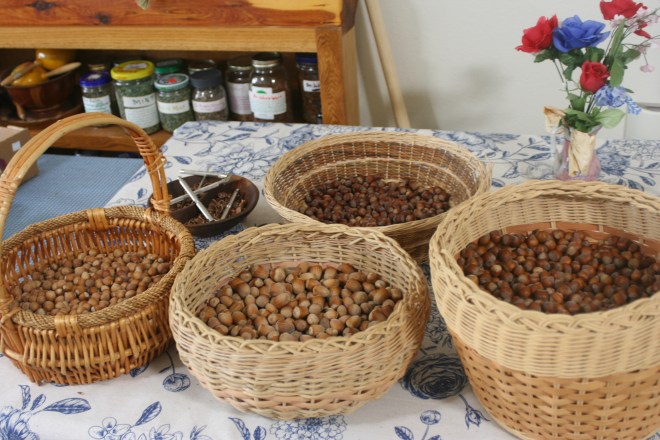
The 2026 nut crop, on November 6th, after some of the crop had already been eaten or gifted away.
So, even though this year’s nut harvest was a little smaller than last year’s record-breaking bumper crop, it was still well above our average. I would therefore conclude that the squirrels’ impact on our quantity of nuts was relatively small, maybe less of an impact than the chipmunks made when their population was large.
The squirrels also made some impact on the grape harvest, but the extent of that impact is difficult to determine since we know that the bears and raccoons also raided the grapes at night. We found ample evidence of that on our trail cam. Squirrels don’t carry grapes or other moist fruits to their caches, where they store their dry nuts, since they are intelligent enough to know that the fruit would rot and spread mold to everything else in the cache. Squirrels also like mushrooms and they are known to lay out their mushrooms that they wish to save for later on large tree limbs to dry before putting them in a cache. So when they go after grapes or other moist fruit it is just to eat directly, not for winter storage. But when they do get grapes it looks like they drop many or most of the grapes on the ground and only eat some of them. If we don’t pick those up off the ground soon enough, they go to the hornets, the ants, birds, and others. It is not that unusual to get stung by a hornet while picking grapes, on the vines as well as from the ground, especially towards the end of the season or when moving too fast to be mindful and really enjoy the process.
So, did the squirrels do us much harm? That is a debatable question, but I would say not much, if any. I think that the better, more vital question is, “Whose nuts (or grapes, etc.) are those, anyway?” If a human and a squirrel were both walking through the woods, on what the humans call “public land” (as opposed to what they call “private property”) and they both arrive at a nut tree at the same time and start picking nuts, the human would probably not have any objection to the squirrel’s right to freely take what has been freely given to both of them. I have never heard a fruit or nut tree, or any other non-human person on our planet say, “that will be five dollars, please.” But if a human from a “civilized,” monetary-based culture took the same nuts that he just freely received from a nut tree by picking them (either from branches or off the ground) and took those nuts to a public market to impart small portions of those nuts to other humans, he would see no reason not to say (and insistently demand), “that will be five dollars, please,” for each small portion released. Why? How were the nuts magically transformed from a free gift of Nature into a commercial, monetary-value commodity somewhere on the road from the woods into town? Did the man’s “labor” cause that transformation, even if he had enjoyed casually working at his own pace, in very pleasant weather, in a very beautiful place, getting some very healthy exercise without having to pay a gym fee? Was that work or recreational activity? Sometimes it is hard to tell the difference. But, when human labor is difficult and painful does that change the whole picture and somehow justify the commodification of Nature and the perpetuation of unnatural and unjust human monetary economic systems? I see no reason why it should. The old Indigenous ways of working and harvesting the gifts of nature, before the invention of money or forced subjection to monetary economics, involved gratitude to Earth, group bonding through shared labor, voluntary non-monetary economic sharing and gifting, as a cultural tradition based in the character value of generosity, and commitment to treating all life on Earth with the care and concern necessary for sustaining and regenerating Nature’s life-giving systems. There was trade between humans before the invention of money, but it was more focused on bonding through generosity, gifting and mutual, unmeasured exchange. But nowadays, “civilized” monetary economics have become so normalized and unquestioned that many people are deluded into even thinking that money is natural!
When people live directly from the gifts of Earth, without money, and are dependent upon the continued smooth operating of Earth’s symbiotic, life-sustaining system, then that is what they will cherish, protect and preserve. When people live in a monetary economic system and are dependent on the accumulation of that unnatural, imaginary form of “wealth” for the sustaining of their lives, then that is what they will protect and endeavor to perpetuate. The very existence of a monetary economic system creates a circumstance in which those who can accumulate the most currency, by whatever means possible, are then empowered to rule over others in their society who have less money. No matter what laws exist in the society to attempt to regulate the unjust accumulation of monetary wealth, those people who have acquired the most monetary wealth and power will always find ways, both “legal” and illegal, to preserve and expand that wealth and power. That has turned out to be the case, in actual practice, regardless of whether the monetary system is capitalist, socialist, communist or something else, regardless of ideological intentions or beliefs. (For more on this topic, please see the essay in this blog, titled, The End of Money: The Need for Alternative, Sustainable, Non-monetary Local Economies)
What about the concept of the free gifts of Nature being human property? Does the fact that we paid a little money to a tree farmer for four hazelnut trees, took those trees home, dug holes and planted them, watered and nurtured them for several decades (or even for one day) mean that we have the right to claim any nuts that those trees gladly and freely share with all who come to them as our exclusive, personal property? According to human laws that is so, but what about Nature’s laws? Long ago, for many thousands of years, our species used to know and follow those laws (called by some First Peoples today, “the Original Instructions”). Now, few humans have ever heard that there are such laws, and few would follow such laws or try to live in Nature’s ways if they did hear! The human belief that we can justifiably call the ground that we walk upon and the land that gives us life our “private property,” just because we signed some “talking papers” (a.k.a., “legal documents”) and transferred money to a bank that claimed to be the legal owners of that land must be questioned. Is the concept of owning land the same as a tribe or other community of humans protecting and caring for homeland and all of the living beings who dwell there together? Not at all.
So, whose nuts are those? Maybe the nuts rightfully belong to the trees, who did the most to produce them. If the trees decided to make those nuts free to all, what right do we have to tell them that is wrong? To understand the validity of that question, we must let go of our anthropocentric, human supremacist perspectives (even if only for a few minutes). We then would also need to set aside the notion that human rights are the only rights that matter or even the only natural rights that we can even imagine existing. It would also help if we would learn something about the intelligence and character of the other species of life that we share this planet with, as symbiotic interdependents, a subject that Derrick Jensen covered very well in that book that I mentioned earlier, with many scientifically confirmed examples.
It is now the second week of November and we have been living in close proximity with the squirrels for a little over three months. We have finished all of our harvesting, except for a few items in the greenhouse, and the squirrels have been carrying various materials to their several winter nesting places, which now include a couple of the rafter spots at one edge of our roof, where swallows and starlings have lived each spring and summer for many years. We are getting along with the squirrels just fine now, and even enjoying their presence sometimes. Their increased numbers never really became overwhelming. It was just a big surprise. I still wonder what I said to that squirrel, right before the big change happened, or how the squirrel interpreted it. Was the lesson I was meant to learn from this event, “Never speak in a language that you do not understand!” I really don’t think that was it. I think that I am in a process of learning about the natural rights of all species, including humans, to participate together, reciprocally, in the ways and gifts of Nature (a.k.a., Earth, Gaia, etc.). I am also learning what it means to be a human, while unlearning all that it doesn’t mean. This has brought me into a deeper exploration of the concepts of “equality,” and “diversity” as something way beyond the usual focus on only human equality and diversity.
As I continue to contemplate all of this, we are experiencing the annual invasion of flies into the house as they seek warmth during the rapidly cooling Rocky Mountain autumn. I am now wondering if I will eventually stop swatting flies and stop vacuuming them up with the little hand-held vacuum machine. Some people do not want to hear this but it is really not possible to live on Earth without killing some of our fellow Earthlings, mostly by accident, especially the smallest, most unnoticed (by us) little beings, like the insects beneath our feet as we walk, and the micro-beings that we unknowingly ingest and consume when we breathe, or squish when we scratch ourselves. And we also have to eat some things. So, I guess the best that we can do is to avoid doing unnecessary harm when we can, treat all life with equal respect, and pay attention to Earth’s messengers, in whatever form they come to us. What will we learn next?