
(A little bit of prologue: I began researching for and writing this double book review essay about three years ago. I did not know then that I would not finally complete it and have it ready to post until February of 2025, nor did I know that the collapse of the U.S., the nation I was born and raised in, would occur in that same year. This essay provides a little bit of explanation for that collapse, but mainly tells a much bigger story about the roots of all of the national and biological collapses that are unfolding now, at this climactic moment in human and Earth history.)
(Last edited: July 5, 2025. I just added a brief summary description of each of the “Nine Planetary Boundaries” and corrected a few typos.)
“Wow! This looks like a lot of writing. Where might this ‘rabbit hole’ take me, if I decide to dive in and read it?” This double book review will discuss, explain, and provide some answers to the following questions:
- What is the biggest real threat to all life on Earth that we currently find ourselves needing to face and respond to?
- How did we arrive at our current predicament?
- Why can’t we continue with a growth-dependent, competitive economic system and simultaneously reverse the life-destructive, self-destructive course that we currently find ourselves propelled upon?
- Why can’t our available and developing technologies save our customary ways of living and simultaneously preserve Earth’s living system?
- Will we ever find a “Planet B” and is it worth sacrificing the only beautiful, generously life-giving planet that we actually still have in a futile attempt to try to find and actually travel to such a place?
- What is Mother Earth asking us to consider and to do now? (the most important question of all)
Preface: a statement of purpose and intent
Why am I writing this? Do I think that the facts, analysis and arguments that I present here will change anybody’s (or some significant number of persons’) mind, priorities or actions? Considering the widespread increase in misinformation, combined with the growing cultural tendency (in many human cultures, but especially in the U.S.) to value beliefs over facts and to even ascribe social honor to people who “stand steadfast” in whatever beliefs they hold, regardless of facts, I do not expect whatever I end up writing here to provoke much change. For many reasons, I do not expect that this piece of writing can help much to propel the necessary massive change in human behavior and status quo institutions quickly enough to avoid the severe, life-extinguishing consequences of human ecological overshoot already set into motion and already occurring increasingly all over the planet. Even so, I still feel compelled to make the effort. One reason for that is, based on the experiences of myself and many others whom I know surrounding sudden, tragic loss of the lives of dear ones, I anticipate that the increasing disastrous occurrences that the world is now facing will cause more and more people to ask these three very difficult questions: 1) Why is this happening to us? 2) What could we have done differently to prevent it? 3) What can we do now to move forward, into a better, healthier way of life? I hope that I can provide some degree of comfort or consolation to people by providing some legitimate, fact-based answers to those questions.
Once those first three questions are addressed, another question naturally arises: If people already knew about these things that are happening to our world now and their potential consequences fifty or more years ago, why didn’t they tell everybody and why didn’t governments do more about it back then, when it might have made a more significant difference? Well, many people actually did speak up, explaining the situation and proposing possibly appropriate actions or responses—including, William R. Catton, Jr., the author of the two books discussed in this book review/essay—and many people heard it and began taking some appropriate actions right then, but apparently not nearly enough.
Do I think that answering the “why” questions, even if that could help a large majority of humans come to understand the actual predicament in which we now find all life on Earth, will actually be enough to provoke the actions necessary to significantly slow down or reverse the currently accelerating trajectory of destruction? Probably not, for many reasons that I will elaborate on in the following pages. Nevertheless, I continue to communicate and try to help people around the world prepare for any possibly viable, sustainable paths forward in the face of the collapse of familiar societal structures and regional ecosystems, throughout planet Earth. I do this not because I think that I have any particular powers of persuasion or even any adept abilities with the written word. On the contrary, most of what I have written in the past on these topics seems to mostly inspire doubt, dismissal, and possibly disgust. That might be an overly negative conclusion, but I can only guess at that because very, very few people ever comment upon or engage with me in discussion of my writings at all. Maybe it is just the topic itself that is too repulsive or overwhelming for most people to engage with. Ironically, it is that very phenomenon of all that is unknown—what I do not know about the effectiveness of my attempts at communication and what I actually do not know about future possibilities for life on Earth—that also compels me to continue with my efforts, “just in case.”
Another reason that I keep hacking away at this endeavor is that I just cannot sit back and do nothing while I witness so much suffering (for all species, especially the innocent victims who have not contributed much at all to creating our dire circumstances), or when I consider the possibility that some may be spared some of the pain due to something that I might possibly be able to do or say for them. Beyond the act of writing or the use of words, another thing that I have found I can do that might be helpful is to show people how my family and I have been living and learning with the natural world for most of the last 53 years, especially in the last 20 years. We can teach ways and practices that could be useful and beneficial to humans and simultaneously beneficial to the other living beings whose ecosystems we share, both now and post-collapse. Maybe I am just writing this for some potential benefit for the future survivors.
Diving In: William R. Catton, Jr. and the circumstantial context in which he wrote, Overshoot: The Ecological Basis of Revolutionary Change (first edition published in 1980)
The environmental sociologist, William R. Catton, Jr. (1926-2015), was by no means the only person in the 1970s, researching, analyzing and writing about the actual predicament of life on Earth, but many people writing and thinking on that topic today cite Catton’s Overshoot as the first or most important book that they ever read explaining the real causes and actual severity of our current global ecological crisis. I will cite some of the other writers and thinkers of that era who worked on the same subject in my links, but for now I will just say that the list includes the co-authors (Donella H. Meadows, Dennis l. Meadows, Jorgen Randers, William W. Behrens III) of the groundbreaking 1972 report, The Limits to Growth, and the several works of that decade by Paul R. and Anne H. Ehrlich (post 1968’s controversial, The Population Bomb). As monumental as those works were, many leading ecological writers of the last thirty or so years cite Overshoot as the pivotal or most influential book to help clarify their understanding of our complex, multi-faceted ecological and societal crises. Even so, the vast majority of humans, even those of Catton’s own country (the U.S.), and probably most of those who call themselves “environmentalists,” have never heard of William Catton, his book, Overshoot, or even the concept of overshoot itself! Why is that so? We will discuss some reasons for that in what follows below.
Overshoot was published in 1980 and Bottleneck was published in 2009. I will begin with Overshoot and follow that with a brief discussion of Bottleneck that will include some comparative referrals back to the earlier book. I read the books in that order and found such comparisons to be both fascinating and informative. William Catton was a man of my father’s generation, born in 1926 (one year before my father). Catton was 83 when he self-published Bottleneck and had been retired from academia for 20 years at that time. There were several things that I noticed while reading Bottleneck which probably would never have occurred to me had I not had some experiences similar to Catton’s, within academia, after retirement, in the liberating experience of self-publishing, and in the experience of aging. I will describe and elaborate on some of those experiences and thoughts within that section of this double book review, along with a little more biographical information about William Catton.
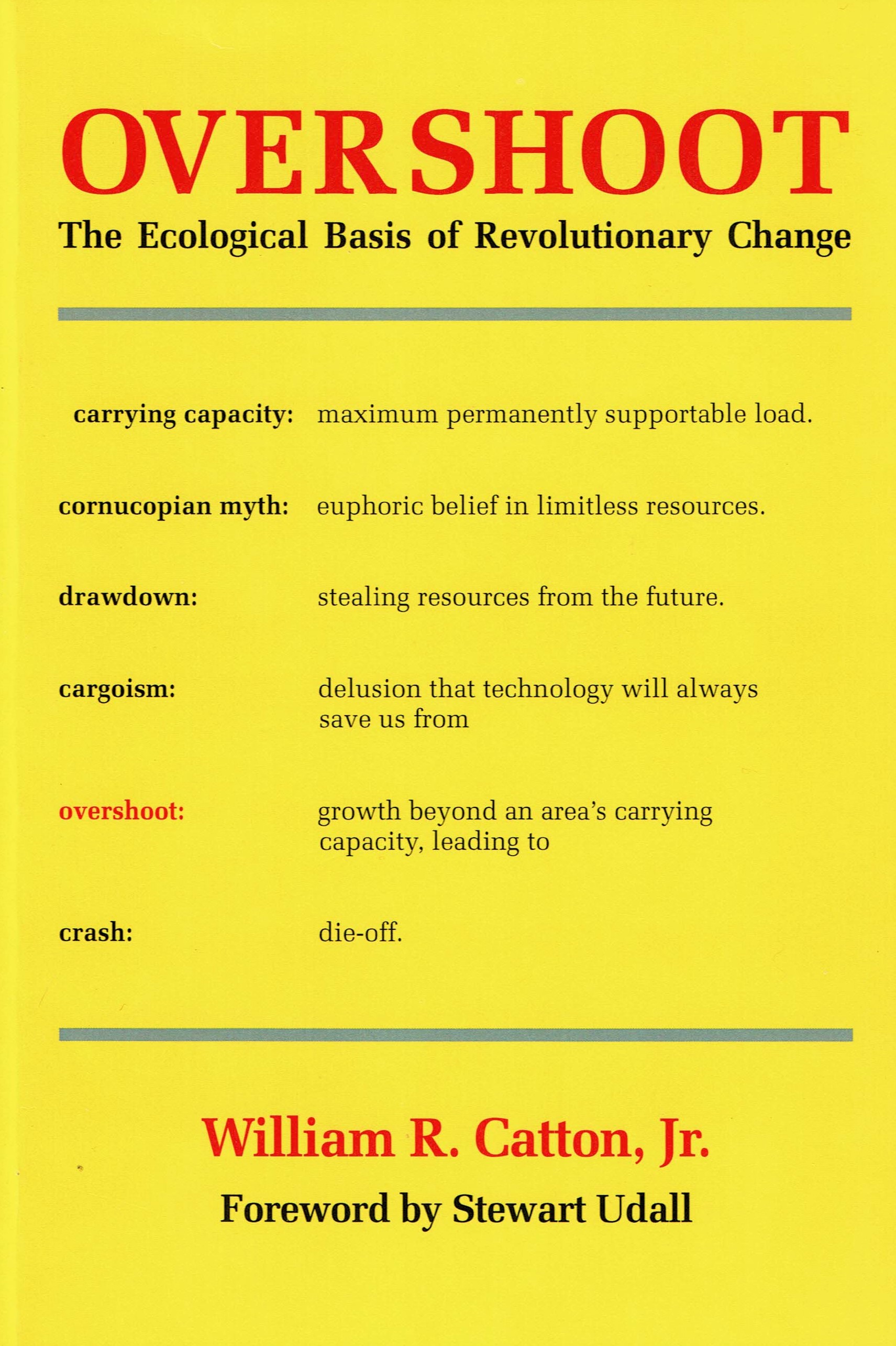
As can be seen in the cover image of the book, Overshoot, it is the only book I know of which begins its text on the cover instead of on its pages within. There, on the cover, we find six extremely important terms, along with their definitions, which are all elaborated upon further in the pages within, and are essential to understanding the author’s main points. While reading this book, long before I had finished it, it became very clear to me that unless a person understands the relevance of those six terms to our current global ecological predicament, they have completely missed the point and do not understand our actual predicament at all! More on that as I go through my analysis of the book and its message.
We also see on the cover the book’s subtitle, “The Ecological Basis of Revolutionary Change.” Sometime after I finished reading the book, while I was contemplating further why Catton had not seen any need to spend much time at all directly critiquing capitalism within its pages (more on this later), I received a possible revelation about that subtitle. I had wondered why Catton had not used the word “for” instead of “of” before the phrase “Revolutionary Change.” After all, he was writing the book during the 1970s, when there was still a good number of people going around proclaiming the need for and justifications for revolutionary change, or for revolution itself. Having been personally acquainted with that movement at that time, I just naturally wondered why Catton had not used that word. Eventually, it became clear to me that Catton was not talking about any type of human-devised revolution. Although humans have contributed greatly to creating the conditions for the “revolutionary” changes which Catton perceived to be coming upon our whole world, he also saw that this revolution was not intended by or consciously devised by humans. The revolutionary changes which Catton foresaw and wrote about in Overshoot are the natural consequences of human excess and misdirection—the violation of natural laws and the exceeding of the carrying capacities of our local and global ecosystems. In a sense, this current global crisis (overshoot and crash) could be described as Earth herself “revolting” against the ability of humans to carry on with their life-destructive ways any further. But it could be more accurate to describe it as Catton did: that finite Earth’s long-ago-established interactive laws, limits and the natural consequences of breaking those laws are the ecological basis of the revolutionary changes to Earth’s life systems that we are now observing with accelerating frequency, intensity and damage, not only to living species and ecosystems, but also to the infrastructures of human societies. The overheating of Earth’s atmosphere, the increasingly intense weather events, the droughts, fires, floods, hurricanes, tornadoes, rising sea levels, ocean acidification, dramatic reductions in biodiversity, and losses of habitat, are all revolutionary changes that have an ecological basis that existed prior to human or anthropogenic violations of natural law. The consequences for those violations were already built into Earth’s system. The early human societies, and many Indigenous peoples to this day, had/have many stories that refer to the “Original Instructions,” or natural laws, including our symbiotic, mutually beneficial relationships with all Earth Life, and warnings about the consequences of violating those laws and breaking those relational connections (more on this later). William Catton perceived that this natural revolution will, ultimately, supersede or overrule any human attempts at either revolution or reforms, or at preserving the societal status quo, and will ultimately determine the limits, possibilities, successes or futility for all human plans and ambitions.

So much for the book cover, the title, and the table of contents. Now we can go on to discuss the rest of the book. 🙂 Don’t worry. Of course this book review will not attempt to cover every page or even every chapter of the book. I only intend to cover some parts of the book which expound upon the six terms on the book’s cover in ways that will address the six vital questions that I raised at the beginning of this book review essay. Along the way, I will bring in material from the works of more recent writers and researchers which have confirmed and expanded upon the findings and ideas that William Catton brought forward so long ago. Citations for those works can be found in the hyperlinks, to help facilitate your own research and further understanding. I think that I should mention here that Overshoot has an index but, unfortunately, Bottleneck does not, probably because it was self-published (I learned from my own self-publishing experience that indexing is a very difficult process and expensive to hire somebody else to do it).
William Catton did not invent the concept of overshoot, nor was he the first to “discover” it. If he were here today, I think that he would agree with me that it is much more urgent for people to understand Earth overshoot than to become familiar with Catton’s biography. Therefore, I will dive right into the topic of overshoot now, and interweave a little more of the relevant biographical information on Catton wherever it seems appropriate within the context of this essay. Probably, the most relevant biographical material would revolve around how he came to see that sociologists should pay more attention to a society’s relationship to the planet upon which we live and depend on for our biological needs, and our interactions with the particular ecosystems where we are located.
Carrying Capacity and Overshoot
Humans can easily understand that a drinking glass has a limit to how much liquid can be poured into it, or the limited number of dinner guests that can be adequately served by the meal that the chef already prepared. But it seems to require exceptional, sometimes strenuous, effort for most humans in this modern, alienated-from-nature world to grasp that a living system as large as Earth can also have maximum limits or capacities. In the first chapter of the book, Catton provides us with a more detailed definition of carrying capacity than the brief one on the book’s cover:
An environment’s carrying capacity for a given kind of creature (living a given way of life) is the maximum persistently feasible load—just short of the load that would damage that environment’s ability to support life of that kind. Carrying capacity can be expressed quantitatively as the number of us, living in a given manner, which a given environment can support indefinitely.
What is not clearly stated in that definition, but is mentioned by Catton elsewhere, is that local ecosystems on Earth (what he calls “environments” here) never contain only one species of life. But, for the purpose of illustration, it is sometimes easier to explain carrying capacity using one species, with certain specific types of behaviors, and then add in other species and behaviors to illustrate the more complex aspects of carrying capacities within actual, bio-diverse ecosystems. Another thing that complicates determining the carrying capacity of a particular place or ecosystem for accommodating human residents is the widely varying behaviors of humans when they are present in an ecosystem. Unlike more compliant-with-nature or behaviorally predictable species, such as deer, for example, whom we can confidently predict will confine their behavior to activities such as grazing, browsing, drinking water, sleeping, protecting their young, etc., and never destroy forests or build parking lots, humans are very different. Some humans might behave very recklessly, selfishly, and destructively in their approach to life and relationships with other life forms in their ecosystem, while other humans can behave nearly as harmlessly as a deer, with a broad spectrum of attitudes and behaviors in between those extremes. Consequently, when attempting to assess or quantify the carrying capacity for humans in a given place, it is essentially important to clarify what types of humans, with which types of behaviors, would be living in that place.
There is one type of behavior that both humans and non-humans can and do sometimes engage in which can very significantly impact the carrying capacity of their homeland: excessive reproduction, to the point of overpopulation. Even if all of the other behaviors of the inhabitants of an ecosystem are compatible with the living system of a particular place, overpopulation by itself can lead to overshoot. When a species has overshot the carrying capacity of their homeland for their particular species, they will eventually run out of food and experience “die-off” or “crash” (extreme population reduction, or local extinction). Some members of the overpopulating species might migrate to another location before crash can occur. Both of those paths (die-off or migration) are ways that Nature brings an overload of a particular species back to a level that is sustainable for local carrying capacity. Most of the disastrous human-caused errors that significantly affected the history of our species, are rooted in humans living in ways that try to mitigate overshoot and avoid death or migration using practices and devices that oppose natural laws and systems. Catton’s books and my comments in this essay will show in some detail examples of how that has occurred. It is also important to realize that the impacts of overshoot caused by one species are never limited to that one species, alone, since all life in any place is interconnected and interdependent to some degree.
What Catton meant in the above definition of carrying capacity, when speaking about an “environment’s ability to support” certain forms of life and their associated behaviors “indefinitely,” is referred to by most people who speak on the topic these days as an ecosystem’s ability to “regenerate” itself, perpetually. That is what ecosystems do naturally, unless one or more of the species residing within the system reaches overshoot, through over-population, over-consumption, excessive production of waste, or some combination of all of those. That brings us to another, or just re-worded, definition of overshoot, found in the glossary at the end of the book:
OVERSHOOT: (v.) to increase in numbers so much that the habitat’s carrying capacity is exceeded by the ecological load, which must in time decrease accordingly; (n.) the condition of having exceeded for the time being the permanent carrying capacity of the habitat.
At the time that Catton was writing Overshoot, the “increase in numbers,” or human over-population, was at the forefront of the minds of most of the relatively few researchers who were giving overshoot any serious consideration at all. The global human population reached 4 billion in 1974, which was double what it was in 1925 and quadruple the world population in 1805. Although the population doubled again in 2023, hitting 8 billion, the annual global rate of growth (currently, 0.8%) and the global fertility rate (GFR) have both declined significantly over the last several decades and many scientists project that GFR will fall below replacement level (2.1 births per woman—we are currently at 2.3, were at 3.0 in 1992 and 5.3 in 1963) within the next ten to twenty years. As global birth rates have fallen and death rates risen, some demographers estimate that human global population will peak sometime between 2040 and 2080. During the same time that those population dynamics have come into play, human material extraction, consumption, and waste production have continued to rise at very high rates. For example, during the last five decades, in which the population doubled from 4 billion to 8 billion, the rate of energy usage tripled. I will expound on those human industrial and consumptive behavior issues more later, but for now what is important to realize is that overshoot, both locally and globally, can, in some cases, be more a result of human behaviors (what type of humans live in a given location) than just human numbers.
Some scientific methods for looking at and precisely measuring carrying capacity and overshoot have been developed over the last thirty years by the Global Footprint Network, based on work done in the early 1990s by William Rees and Mathis Wackernagel. I do not know those two men personally, but I have heard that their work was inspired in part by William Catton’s Overshoot. Rather than just focus upon CO2, climate change and the “carbon footprint,” GFN collects, analyzes, and publishes data on all human activities that impact the entire regenerative biocapacity of Earth system, in pursuit of answers to the prime question, “How much do people take compared to what the Earth can renew?” Here, from the GFN website, is a brief summary description of the vital work that their organization does:
Global Footprint Network’s key strategy has been to make available robust Ecological Footprint data. The Ecological Footprint continues to be the only metric that comprehensively compares human demand on nature against nature’s capacity to regenerate. It is based on simple, straightforward accounting – not on arbitrary scoring. Since its inception, Global Footprint Network has calculated Footprints of countries for each year that UN data has been available. Since 2019, these national calculations are produced by York University under the governance of the Footprint Data Foundation (FoDaFo). Currently the accounts cover 1961 to 2022. Together with partners, we, and now FoDaFo, have made every annual edition more transparent and more accurate. This has included rigorous reviews by government institutes and advisory committees, including the Science Advisory Council of FoDaFo.
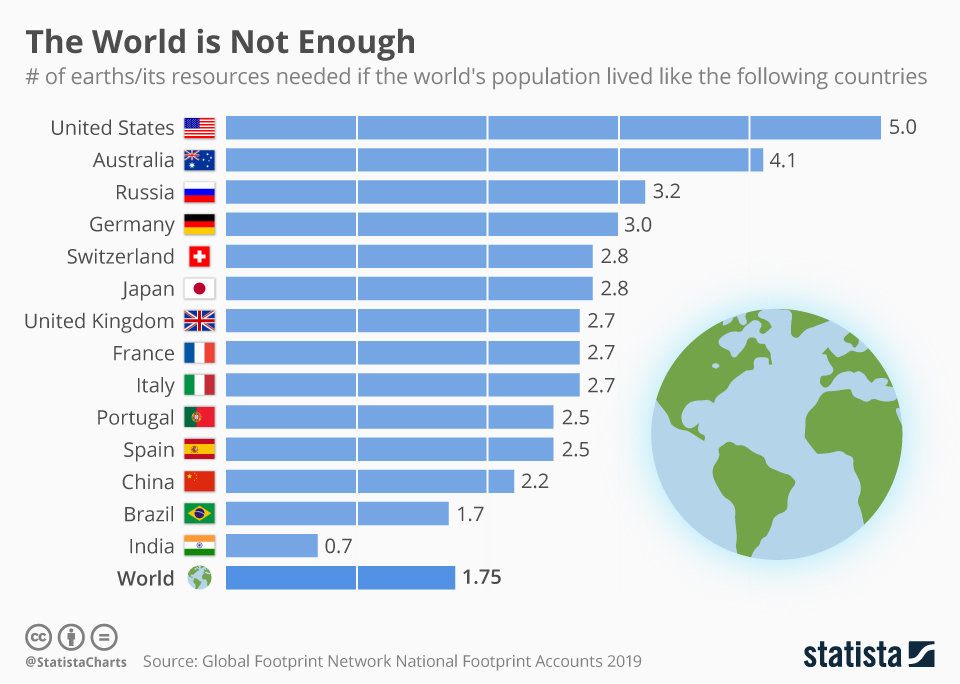
What I find most useful about the work of the Global Footprint Network, for clearly communicating to people the depth of Earth’s current crisis, is their calculations regarding how many additional planet Earth’s we (all of humanity) would need to maintain our current human behaviors, or “ways of life,” and simultaneously allow our biosphere to regenerate its life systems (if that was even possible). Currently, from their 2023 report, the most recent number that the GFN has computed for that is 1.75 planet Earths, for all of humanity combined. What does that mean? When we overshoot Earth’s ability to regenerate at the pace that we are extracting and consuming from her and to process and absorb the many megatons of waste, of all kinds, that we are excreting upon her lands, waters, and atmosphere, biological life on Earth is gradually destroyed. If Earth’s ecosystems are not allowed to regenerate, they then begin to degenerate. Natural life does not remain static. It keeps moving along, fulfilling its particular symbiotic purposes, or it decays and dies (which fulfills another symbiotic purpose, unless deaths become excessive). In light of that biological reality, a vital question that the GFN and other ecological researchers are probing is how much overshoot can our planet and our species take? How long can Earth accommodate our species with an eco-footprint of 1.75, 2.0 or 2.5 Earths?
The GFN also has provided us with figures for the ecological footprints of over 200 individual nations, which vary greatly, and the number of Earths needed for the whole world to live in the average manner of the people of each particular nation. Notably, the number of additional Earths needed will always increase, as long as our species continues to live in ways that require additional growth in consumption, production, waste, and population. GFN has compiled and made freely available detailed data on that and many other factors contributing to overshoot, sorted by country, individuals, cities, corporations, and other categories. Here (below) is a chart with summaries of the footprint data from 14 of the over 200 countries studied. The complete list and detailed breakdowns of the data can be found on their website.
The following GFN chart is a timeline showing at what point our species reached and then exceeded planetary overshoot (about 1969-70), with the types of human over-consumption and excess waste compiled into six, color-coded categories:
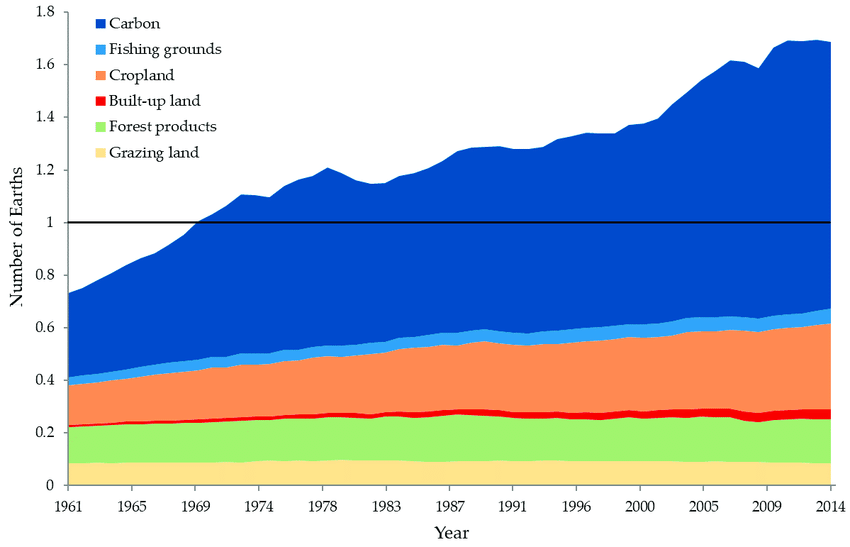
While the data accumulated and reported by the GFN is much more extensive and detailed than what appears in that chart, the chart clearly suggests that CO2 emissions are the largest single contributor to Earth overshoot. Industrial petro-chemical agriculture (labeled here as “cropland”) plays the next largest role and the trajectories for both of those contributors continue to rise now, in 2025. Another category of human activity that continues to expand and increasingly contribute to overshoot is the item on the chart labeled “built-up land” (the red section on the chart). It seems that there must be some better label for that, but what “built-up land” refers to is all of the land that is transformed by humans from natural or wild habitat into infrastructure for human social habitat, such as new buildings, paved roads, parking lots, waste treatment facilities, factories, etc. Maybe the phrase should be “additional human infrastructure projects,” or the “de-naturalization of land.”
Seeing on the GFN timeline chart how large a role “Carbon” (the blue area) plays in overshoot, a not-fully-informed, “green” technology optimist might speedily conclude that all we need to do is switch from fossil fuel burning energy use to electric energy devices, in order to live regeneratively, in synch with our one Earth. What is generally overlooked or intentionally ignored by such simplistic, wishful thinking is how much fossil fuel-powered industrial equipment is currently necessary and preferred by industrial capitalists (mainly for competitive reasons) in order to mine the materials, conduct the manufacturing, transport, install, and maintain the enormous “green” energy infrastructure that would be necessary to continue with our unsustainable, over-consumptive, and ever-growing “needs.” Nearly all of the factors contributing to overshoot have been made possible by the enormous industrial, economic and technological infrastructure that has been powered increasingly by fossil fuels over the last 250 years, as William Catton details in his books and we shall discuss further, below. There is a considerable amount of human impact on Earth’s life-giving systems that is not mentioned or accounted for in this chart, like impacts from mining, pollution of surface water sources, and the drawdown of underground aquifers, just to name a few. If those and many other anthropogenic (human-caused) impacts were included in the chart, the blue “Carbon” area would make up a much smaller proportion of the whole, and thereby provide us with a more accurate picture of the causes of ecological overshoot.
The GFN openly acknowledges the gaps and shortcomings in their data collection process, and they say that most of that is due to their long ago decision to rely completely upon United Nations scientific data, in order to avoid suggestions of bias or “cherry picking” data that supports pre-conceived notions. Consequently, another limit that proceeds from that decision is that the UN data only covers impacts from human use demands upon the “biosphere’s (or any region’s) regenerative capacity.” Human demands and impacts upon Earth’s non-renewable or non-regenerative resources found in the geosphere, such as fossil fuels and rare metals, along with many other chemical and mineral entities, are not included in that data set. Neither are the needs of and uses by non-human beings who share the same ecosystems and regions with the humans. The GFN therefore encourages people to look to other research data sources to fill such gaps and they welcome criticism and communication on how they might improve their work. (Ecological Footprint Accounting: Limitations and Criticism, Global Footprint Network research team, 1 August 2020 – Version 1.0) The GFN recently formed a collaborative partnership with York University in Canada which they expect will greatly improve their ability to do more robust research on overshoot and the Ecological footprint and continuously fill more of the data gaps. Regarding the limited data that they have had to work with up until this recent change, the GFN made this potent realization: “…the real biocapacity is even smaller than our estimates. On the Footprint side, not all demands are included because not all are documented in UN accounts. Hence the real footprint is larger.”
Before I return to directly examining William Catton’s books, I will briefly describe another university-affiliated research center with an even larger number of researchers probing into anthropogenic impacts on Earth system that are contributing to overshoot. I am referring to the Stockholm Resilience Centre at Stockholm University in Sweden. There are many new “climate studies” programs springing up at universities around the world, but the GFA program at York and the SRC at Stockholm are the only two programs that I know of which are focused on Earth system overshoot, instead of just climate. I hope that there are actually many more than just those two, or that there will be soon. Some urgent questions that researchers need to explore and publish data for, ASAP, include:
- How much fossil fuel will likely be burned (globally) in the attempt to mine, manufacture and install so-called “green energy” infrastructure replacements for fossil fuels?
- What is the extent of damage to Earth’s life system, to date and annually, being perpetrated by the mining industry and how much might that increase through a global “green energy” transition?
- What is the extent of damage to Earth’s life system, to date and annually, being perpetrated by the smelting of steel, copper, cement, and glass?
- At current rates of increase in industrial activity, globally, by what near-future year (or decade) will we have made certain that the “Sixth Great Mass Extinction” will occur? (Have we already reached that point?)
The SRC has identified nine categories or types of ecological processes that “are critical for maintaining the stability and resilience of Earth system as a whole.” Those nine categories, commonly referred to as the “nine planetary boundaries,” are identified in the chart below and defined in detail in their reports. As of August, 2023, SRC research and analysis has found that human activities impacting Earth system have now exceeded what they call “the safe operating space for humanity” in six out of the nine categories. As stated in their 2023 report:
The planetary boundaries framework delineates the biophysical and biochemical systems and processes known to regulate the state of the planet within ranges that are historically known and scientifically likely to maintain Earth system stability and life-support systems conducive to the human welfare and societal development experienced during the Holocene. Human activities have now brought Earth outside of the Holocene’s window of environmental variability, giving rise to the proposed Anthropocene epoch.
Earth system is a dynamic, life-sustaining, regenerative interaction between the geosphere, the biosphere (which includes what we could call the “aquasphere?”), and the atmosphere, along with the vital contributions from the sun and our moon. Before about 1950, humans were simply part of the biosphere, but around that point in time human impact upon Earth system had become so significant that it was (and is now) a powerful force in determining Earth system’s continued functional well-being. Some people (both scientists and non-scientists) now refer to this phenomenal magnitude of impact as the “anthroposphere.” Unlike the other spheres of Earth system, the anthroposphere is much more destructive to life than sustaining or regenerative in its impact. To only assess the well-being of Earth system by measuring the CO2 content of Earth’s atmosphere (as many now seem content to do) ignores and obfuscates the extensive damage being done by humanity to Earth system as a whole. The following recent chart by the Stockholm Resilience Centre illustrates the nine planetary boundaries and does a much better job than the GFN chart above of showing which aspects of overshoot are causing the most harm to life on Earth, and what greater dangers and losses lie ahead:
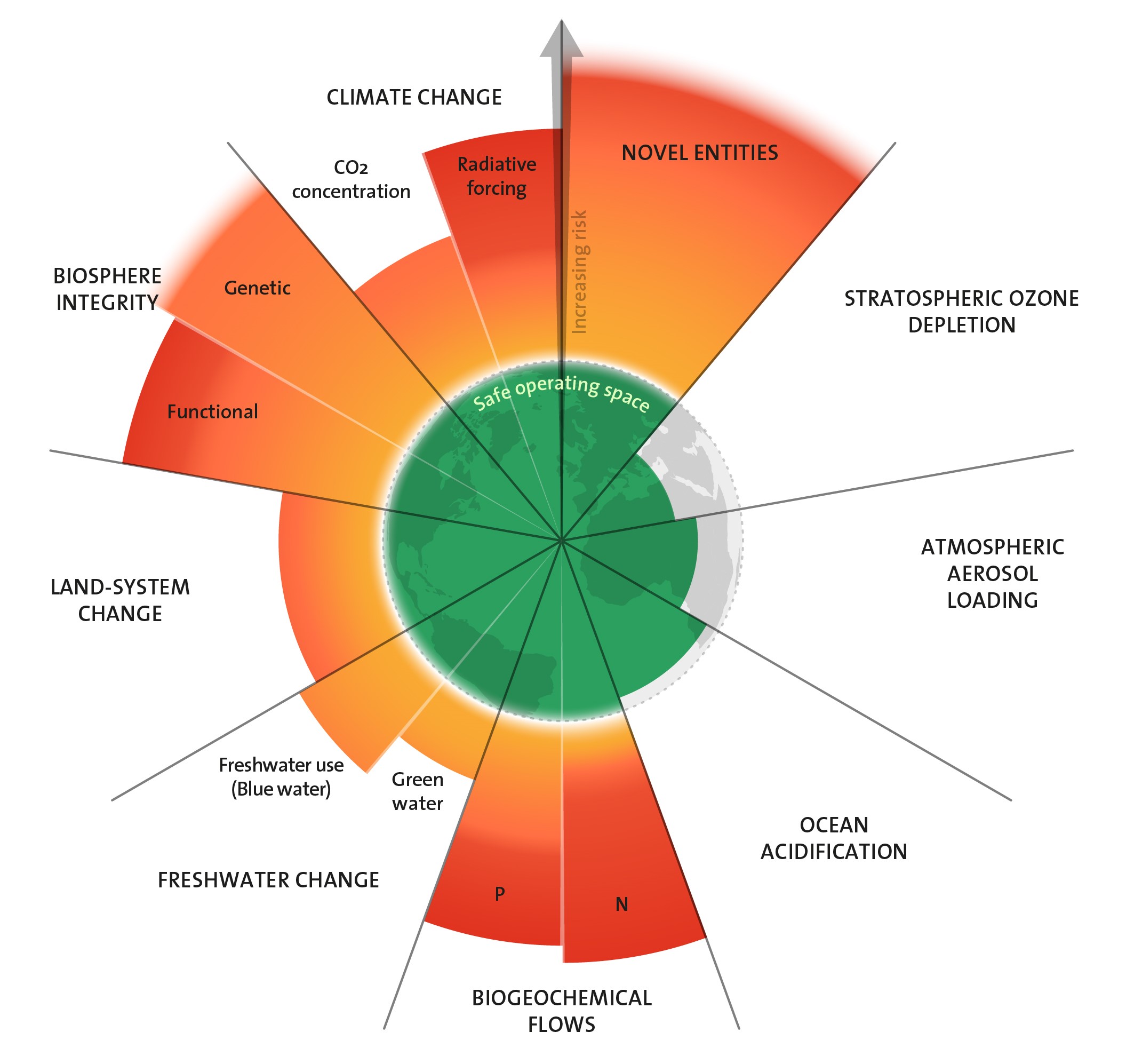
Credit: “Azote for Stockholm Resilience Centre, based on analysis in Richardson et al 2023“
Here is a brief summary of the 9 planetary boundaries and how far we have exceeded or are close to exceeding each one:
Biosphere Integrity, Climate Change, Novel Entities, Stratospheric Ozone Depletion*, Freshwater Change, Atmospheric Aerosol Loading*, Ocean Acidification*, Land System Change, Biogeochemical Flows
*= the three boundaries that have not yet been transgressed
1. Biosphere Integrity-
This boundary is perhaps the most significant and also happens to be the one that humans have exceeded to the furthest extent. According to the scientists who authored the planetary boundaries report: “The planetary functioning of the biosphere ultimately rests on its genetic diversity, inherited from natural selection not only during its dynamic history of coevolution with the geosphere but also on its functional role in regulating the state of Earth system. Genetic diversity and planetary function, each measured through suitable proxies, are therefore the two dimensions that form the basis of a planetary boundary for biosphere integrity.” The most obvious indicators of violation of this particular planetary boundary are the rising extinction rate and the loss of biodiversity throughout our planet. According to the authors, “Of an estimated 8 million plant and animal species [other scientists estimate between 9 and 10 million species], around 1 million are threatened with extinction, and over 10% of genetic diversity of plants and animals may have been lost over the past 150 years.” Those facts do not mean much to most modern humans, who are not aware of the symbiotic connections, interrelatedness, and interdependency of all life. Prevailing human cultures tend to believe that life consists of unrelated individuals (among all species) who live in a state of ruthless, predatory competition with each other. The concepts of “survival of the fittest,” unregulated capitalism, anthropocentrism, and racial supremacy are all compatible with that belief paradigm of separateness and disconnection. Scientific researchers recently discovered that the total weight of all of the materials made and currently used by humans (1.15 trillion tonnes) recently surpassed the total weight of all biological life on Earth (1.12 trillion tonnes)! Humans make up just 0.1% of Earth’s biological life, or “biomass,” and we are just one of between nine and ten million different species of animals. What right do we have to extract and reconfigure so much of Earth’s material substance? To return to a way of life that is conducive to biosphere integrity, humans need to find out what would actually be our sustainable, regenerative share of Earth’s material substance and return to a one Earth footprint manner of living.
2. Climate Change-
This planetary boundary is currently the most popular, or well-known. For most present-era humans it is the only one of the 9 boundaries that people are aware of or concerned with (with the possible exception of some types of toxic pollution, such as water, air and plastics, which are covered in a few of the other planetary boundaries, such as “Novel Entities” and “Freshwater Change,” as we shall soon discuss). Why are people more comfortable dealing with Climate Change than the other planetary boundaries? Could it be because the capitalists have convinced them that it is solvable through buying more manufactured technological products (solar panels, lithium batteries, windmills, etc.) that would thereby allow them to keep their over-consumptive, addictive way of life?
The evidence that we have blown way past this boundary is abundant: 430 ppm CO2 in the atmosphere, and rising, when the safe zone max is 350 ppm; we have surpassed 1.5 degrees C warmer than pre-industrial era avg. temps; breaking more and more temperature records every year; ocean warming; coral ecosystems dying; increasing weather catastrophes and anomalies; loss of habitat forcing migrations and extinctions; permafrost and glaciers melting; sea levels rising; acceleration of symptoms; tipping points, etc.
3. “Novel entities”-
What this boundary refers to is “truly novel anthropogenic introductions to Earth system. These include synthetic chemicals and substances (e.g., microplastics, endocrine disruptors, and organic pollutants); anthropogenically mobilized radioactive materials, including nuclear waste and nuclear weapons; and human modification of evolution, genetically modified organisms and other direct human interventions in evolutionary processes. Novel entities serve as geological markers of the Anthropocene However, their impacts on Earth system as a whole remain largely unstudied. The planetary boundaries framework is only concerned with the stability and resilience of Earth system, i.e., not human or [individual, particular, local] ecosystem health. Thus, it remains a scientific challenge to assess how much loading of novel entities Earth system tolerates before irreversibly shifting into a potentially less habitable state.”
Humans will never be able to create or form something out of nothing, but (unfortunately?) we can extract or gather materials from Earth and transform them into something that does not exist in that form naturally, or without human intervention. Such things are what these scientists call “novel entities.” The creation of novel entities is more impactful than the combining of particular materials commonly used as food in new ways, or inventing recipes. Novel entities are wholly original anthropogenic substances that have been introduced by humans into Earth system that have the potential to alter or interfere with the proper, life-sustaining functions of Earth system and its component ecosystems. Anthropogenic materials that are non-biodegradable are prime examples of that, as are the hundreds of thousands of synthetic chemicals that are routinely produced by human industry and released into the environment. Recent scientific research has revealed to us what might be the most pervasive and highly destructive type of “novel entity” on our planet: PFAS, which stands for Polyfluoroalkyl substances, a combination of carbon and fluorine, the strongest bond in chemistry. PFAS were invented in the early 1940s for the purpose of safely containing uranium in nuclear bombs. They are the most unbreakable, non-biodegradable materials created by humans yet, and so widely-used in manufacturing all types of products, that they have dispersed into air, water, and the bodies of all living organisms. These poisons are also found in our blood, giving us cancers and a host of other diseases. Just like pharmaceutical companies putting new drugs on the market that have not been adequately tested for safety, diverse other industries have long been digging up all kinds of things from under Earth’s surface, combining them, smelting them, and otherwise transforming them into all sorts of unnatural forms, without much regard for potential harm or any respectful consideration of what Earth would rather have us do with those things—like just leave them in the ground where they have always belonged, playing their own particular necessary roles in the functions of Earth system. The belief that there are “things” within or upon Earth’s surface that are “doing nothing,” or are worthless until humans devise some use for them is one of the most significant conceptual errors in the whole history of our species. Along with the conjoined belief that humans can just do whatever they want to non-human “others,” tremendous harm has been done.
I cannot think of any novel entities that are confirmed to be ecologically benign. As the scientists said, “…their impacts on Earth system as a whole remain largely unstudied.” So, it is difficult to assess how far this planetary boundary has been exceeded, but the scientists suspect that the violation has been very substantial, just based on what little we do know about the damage that has been done to life on Earth by these entities, especially PFAS, plastics, nuclear radiation, and genetically modified organisms.
The recommendation of the report’s authors is, “…for novel entities, then, the only truly safe operating space that can ensure maintained Holocene-like conditions is one where these entities are absent unless their potential impacts with respect to Earth system have been thoroughly evaluated.” In other words, don’t mess around with Earth’s gifts without permission from Earth, especially if you have no idea what the heck you are doing, or the harm that the consequences of your actions might cause!
4. Stratospheric ozone depletion-
This particular planetary boundary is the only one that was previously exceeded (about 40 years ago) and has since been corrected to a level slightly below the boundary. According to the authors, “Stratospheric ozone depletion is a special case related to the anthropogenic release of novel entities where gaseous halocarbon compounds from industry and other human activities released into the atmosphere lead to long-lasting depletion of Earth’s ozone layer.” Unlike some other attempts to mitigate exceeding of planetary boundaries, such as using solar panels and wind turbines, the threat to Earth’s stratospheric ozone later was successfully reduced to a safe level without resorting to the use of assumed technological “fixes.” Instead, due to an international cooperative agreement made in 1987, the emissions of gaseous halocarbon compounds was reduced by actual reduction in the use of materials that produce those compounds. The mitigation was accomplished by actually ceasing to continue with the human behavior that created the problem in the first place! What a novel, brilliant idea! Why don’t we try that type of mitigation on the climate problem? The trajectory of release of CO2 into the atmosphere has only moved downward twice in this 21st century: during 2008, when the global economic crisis greatly reduced industrial economic activity, and for a few months in 2020 during the economic activity reduction due to the Covid 19 pandemic. Shutting down and ceasing to continue with toxic industrial activity is the only solution that has proven to work toward reversing (not just slowing down) the rise in atmospheric carbon!
5. Freshwater change-
The planetary boundary called “freshwater change” is concerned with anthropogenic modifications of Earth system functions of freshwater, in particular with deviations from pre-industrial, Holocene era normal extent of variability. The scientist who study and assess this boundary consider changes across the entire water cycle over land. They have divided freshwater into two categories: “blue water” (surface and groundwater) and green water (plant available water found in root-zone soil moisture). “The green water component directly accounts for hydrological regulation of terrestrial ecosystems, climate, and biogeochemical processes, whereas the blue water component accounts for river regulation and aquatic ecosystem integrity. Both components, due to anthropogenic interference, transgressed their planetary boundary safe zones, early in the 20th century. In the United States, before the Clean Water Act was passed in 1972, it was customary for all kinds of industrial manufacturers to dump their waste materials into nearby rivers, lakes, or the ocean.
6. Atmospheric aerosol loading
Atmospheric aerosols are fine particles of various types in the atmosphere, which, in certain quantities, can impact Earth system. Aerosols occur in the atmosphere naturally, from sources such as dust storms, smoke and soot from forest fires, and ash from volcanic eruptions. Anthropogenic aerosols are the particulate matter cast into the atmosphere by human industrial, domestic, and recreational activities, which includes items like smoke, exhaust, evaporated liquid waste products, dust, and airborne “novel entities.”
One common impact on Earth system caused, at least in part, by an overload of aerosols in a region of the atmosphere is disruptions and reductions in annual monsoon rains. Between 14,000 and 5,000 years ago, the Sahara Desert was a well-vegetated region with forests, wetlands, and many lakes. It is now the largest source of atmospheric dust on our planet, and the least conducive region for supporting biotic life. What happened there? Desertification has both natural and human (or anthropogenic) causes, which can create a reinforcing cycle of feedbacks. The natural ways that can occur include severe drought that causes vegetation die-off, leading to an increased chance of wildfires, which put the aerosols smoke, ash, and soot into the atmosphere. Lack of vegetation (which becomes exacerbated by animals over-grazing the reduced supply) and extreme drying of the soil creates more dust, another aerosol blown into the atmosphere by wind. To complete the cycle, the heavily-increased amount of aerosols in the atmosphere disturbs, reduces, or even cancels the annual monsoon season, leading to more drought, etc. That, along with a little bit of anthropogenic activity, like the use of fire, is probably how the Sahara became a desert.
Since the beginning of the industrial era, a whole slew of additional anthropogenic contributions to aerosols in the atmosphere has led to the desertification of many regional areas around the world. Global heating, as a result of increased CO2, has also played a major role in desertification. Ironically, the increase in aerosol particles in the atmosphere has also had a slight muting effect on the increase in global warming. The planetary boundaries scientists have tentatively concluded that we are still in the “safe operating zone” for atmospheric aerosol loading, while cautioning us that there is much more that needs to be discovered and applied for this topic (such as anthropogenic impacts on the natural production of aerosols). The scientists make many such statements about the uncertainties due to so many unknowns about the interactive functions of Earth system in their discussions of each of the nine planetary boundaries. Earth system science is still a relatively new academic field of study. That makes me wonder if the human species is about to exit the realm of life on Earth just when we are on the verge of learning so much more about how Earth system actually operates. But can knowing, alone, change our ways of being?
7. Ocean Acidification
Ocean acidification is one of the three boundaries that the scientists estimate have not yet been surpassed. Of those three, ocean acidification appears to be the closest to being transgressed next. To measure anthropogenic contribution to ocean acidification, the control variable that the scientists use is the carbonate ion concentration in surface seawater. They tell us that, “anthropogenic ocean acidification currently lies at the margin of the safe operating space, and the trend is worsening as anthropogenic CO2 emission continues to rise.” It was just reported today that atmospheric CO2 just reached 430 ppm. 350 ppm is the safe limit for that, and the trajectory under the machine of industrial technological civilization is continued acceleration.
8. Land System Change
This is the one about the importance of the trees. According to the authors of the report: “This boundary focuses on the three major forest biomes that globally play the largest role in driving biogeophysical processes, i.e. tropical, temperate, and boreal. The control variable remains the same: forest cover remaining compared to the potential area of forest in the Holocene.” Deforestation is the key indicator in measuring that this boundary has been clearly transgressed. One of the best examples is that the Amazon forest recently (2023?) moved from being one of Earth’s largest carbon sinks to now being a source for CO2 emissions. According to these scientists, deforestation has been ongoing in most forested regions on Earth since 2015. With the help of satellite images, which are used to make land cover classification maps, this planetary process is rather easy to observe and analyze. Land use conversion, for industrial and agricultural access to Earth “resources,” and for creation of more human urban habitat, are the primary causes of deforestation, besides the increase in wildfires.
9. Biogeochemical Flows
I will begin this one by quoting directly from the report: “Biogeochemical flows reflect anthropogenic perturbation of global element cycles. Currently, the framework considers nitrogen (N) and phosphorus (P) as these two elements constitute fundamental building blocks of life, and their global cycles have been markedly altered through agriculture and industry. Anthropogenic impacts on global carbon cycling are equally fundamental but are addressed in the climate and biosphere integrity boundaries. Other elements could come into focus under this boundary as an understanding of human perturbation of element cycles advances. For both N and P, the anthropogenic release of reactive forms to land and oceans is of interest, as altered nutrient flows and element ratios have profound effects on ecosystem composition and long-term Earth system effects. Some of today’s changes will only be seen on evolutionary time scales, while others are already affecting climate and biosphere integrity.”
The greatest harm done by these anthropogenic releases or flows of phosphorus and nitrogen is the eutrophication of freshwater ecosystems. Eutrophication occurs when excessive buildup of nitrogen and phosphorus in freshwater systems generates excessive reproduction of algae and aquatic plants to the point where oxygen is greatly reduced in the water, causing die-off of fish, aquatic insects, shellfish, and many plants. This process has been long in play throughout the world, caused mostly by runoff from chemicals used in agriculture, but also from industrial pollution. Scientists estimate that this planetary boundary has been exceeded globally and in many locales since about 1988 and it is now the second most transgressed of the planetary boundaries, after biosphere integrity. Novel entities is in third place, followed by climate change (fourth), land system change (fifth), and fresh water change (sixth). Of the three planetary boundaries that are still in the safe operating zone, it appears that ocean acidification will most likely become the seventh planetary boundary to be crossed, since it is now just barely in the safe zone. Considering how long it takes for scientific data to be analyzed and results to be verified, along with how rapidly human-caused biosphere degeneration is accelerating, the ocean acidification boundary might already have been transgressed.
Regarding the possibility for mitigation or healing of a transgressed planetary boundary, there is one very important point that we need to be deeply aware of. Due to the interdependent relationship of all nine aspects, or “boundaries,” within Earth’s symbiotic living system, it will never be enough to only mitigate one, four, or even five of the six planetary boundaries that have already been breached. Because of their interconnectedness, and the fact that, as these scientists say, all 9 aspects or processes of Earth system “are critical for maintaining the stability and resilience of Earth system as a whole,” we need to live ways of life that will maintain the safe operating functions of all nine. If our species continues to live in ways that keep us on, or recklessly accelerate, our path of destruction of our only viable planet home, and we eventually violate all nine planetary boundaries, we will not be able to return to Holocene era, pre-industrial safe operating conditions if we only mitigate eight of the boundaries. If we do not mitigate or restore all nine, all of the other boundaries would be affected and eventually atrophy back into their previously transgressed state.
In many scholarly and journalistic articles over the last three or four years, I have observed a steadily increasing awareness about overshoot and the need to greatly reduce and/or abandon much of our production, consumption, and waste, rather than try to maintain current levels or continue to increase them while somehow “switching” to the use of electronically powered technological devices. No matter what we power it with, human overshoot of Earth’s carrying capacities will ultimately lead to crash and mass extinctions, if we do not cease from the behaviors and technologies that generate overshoot. We also have not yet even invented (much less actually produced) the types of electronic technological devices or machines that can “successfully” replace, compete with, or surpass the power density levels that are available to industrial extraction, manufacture, and transport through burning fossil fuels. In an economic system and culture that demands aggressive competition in nearly every human endeavor, and prioritizes competitive economic success over the survival of natural life systems, humans bound to such systems and cultures will continue to use fossil fuels until they simply are no longer available, or their way of life has completely crashed, whichever occurs first. As the crisis of overshoot becomes more acute and undeniable, we shall likely soon see data on our actual predicament published everywhere, along with the predictable, desperate attempts to refute, misinterpret, censor or suppress the information. Unfortunately, human beings who favor beliefs and personal comfort over factual, scientifically-proven reality have an incredible ability to deny just about anything.
William Catton’s transformation into an environmental sociologist
Now, back to Catton and his books (more directly, that is—I actually never really left that). As can be seen in the 2014 GFN chart, it is estimated that we reached Earth overshoot, or what one planet Earth can handle from our unsustainable human behaviors, around 1969. The first “Earth Day” in the U.S. took place shortly thereafter, on April 22, 1970, more as a response to recent horrific incidents of industrial pollution (including the massive oil spill on the coast of Santa Barbara, California in January 1969, and the polluted Cuyahoga River near Cleveland, Ohio catching on fire during the summer of that same year) than any significant public awareness of overshoot. This brings us to some observations about the social, professional and experiential context in which William Catton began researching and writing Overshoot, around that same time. Since no book-length or complete biography of Catton’s life exists, my ability to interpret Catton’s response to that context is limited mainly to what we can find in his own writings and in a few interviews. The most revealing account of Catton’s transition from “mainstream” sociologist to eco-sociologist during the early 1970s was written by himself and published in 2008, in an academic journal called, Organization & Environment. The title of the article is, “A Retrospective View of My Development as an Environmental Sociologist.”
William Catton was a professor of sociology at the University of Washington, from 1957 through 1969, a time of enormous change in U.S. social culture (as it also was in other similar societies), mostly in the area of reassessing and attempting to correct deeply-rooted, long-standing societal injustices. The academic field of sociology was understandably focused on those types of issues, both then and long since then. As awareness and concern for environmental issues rose in the late 1960s and early 1970s, progressive social activists and sociologists who were engaged with the two most vital issues that preceded the environmental movement—anti-racism and anti-war—sometimes suspected that environmental concerns were a distraction from those issues, which seemed so much more important to them at that time. Some people thought environmentalism might even be an intentional decoy devised by their opponents. Besides paranoia, perhaps the primary reason for that was Americans and most citizens of modern western societies during the 1970s, whether on the political left or the political right, were anthropocentric in their world view, as the vast majority still are today. Anthropocentric people see human need issues as being of higher priority than issues concerning the well-being of the vast multitude of other species in the natural world, and they generally fail to understand that the basic, essential biological needs of all living beings who share this planet are symbiotically intertwined. Besides being anthropocentric, being urbanized and alienated from nature leads some people to prioritize human justice and relational issues over seemingly abstract concerns regarding a nebulous something called “nature” or “the environment.” When such people are concerned about environmental issues, they generally lean towards “environmental justice” issues, such as impacts from industrial toxic waste deliberately occurring disproportionately in communities of color. In light of that piece of socio-cultural context, I wondered if Bill Catton had ever been criticized or verbally attacked during those times for his attempts to move the field of sociology in a more environmentally-focused, or at least “environmentally aware,” direction. If such conflict did indeed occur, nothing in Catton’s “Retrospective View” article mentions it, even though he does elaborate upon several reasons why he was compelled to resign from his position at UW in 1970 and move himself and his large family all the way to New Zealand to take up a sociology teaching position there, at the University of Canterbury.
What Catton does make clear in his “Retrospective View” article, is that the late 1960s and early `70s was a time of major change for him, professionally and personally, and that he began writing Overshoot during the three years (1970-1973) that he lived and taught in New Zealand. As Catton described it,
Early in 1970, discouraged by effects of the overgrowth of the University of Washington, where enrollment had doubled since I first came to that institution, and disheartened by adverse social effects of population increase in the Puget Sound region, I resigned from the UW sociology faculty and moved my family to Christchurch, New Zealand, an environment significantly resembling an earlier (less populous) version of western Washington.
While it may be interesting to learn more about those “adverse social effects of population increase in the Puget Sound region” and what specifically bothered Catton most about that, I think that it is more relevant to this book review to probe more deeply into what influenced Catton towards a more eco-centric world view. Bill Catton had long been a “nature-lover” and somewhat of a hobby biologist. During his time in Seattle, he and his family frequently visited and camped in the national parks and forests of that region, especially Mount Rainier National Park, which seems to have been his favorite place (cite interview). As the park became more frequently used by weekend visitors during the mid-1960s, Catton got his work schedule changed so that he could engage in some of his scholarly duties on the weekends and get two or three days off at the beginning of the week to take his family camping at Mt. Rainier when the place was much less crowded. He really enjoyed seeing the carloads of people leaving the park on Sunday, while his family entered and then had the park nearly to themselves. During the last six years of the 1960s, Catton wrote several sociological articles on how people use the national parks and wilderness areas, some of which were co-written with professional foresters and professors of forestry. Besides plunging him into a vast realm of new knowledge and information, those collaborative experiences and explorations assisted Catton in making his transition toward a more ecological worldview.
William Catton’s transition to environmental sociologist completed itself during those three years in New Zealand. In the “Retrospective View” article, Catton describes what he calls his “aha! experience.” It happened in a visitor center in a New Zealand national park. As the Catton family often did in the U.S., soon after arriving in NZ, they began exploring that country’s national parks and always spent plenty of time checking out the educational exhibits in the visitor centers. At Westland National Park, Catton found an exhibit on the topic of succession. Succession is a biological process within ecosystems in which one species in an ecosystem declines in numbers or completely disappears, due to the ways in which the habitat has been altered by the uses and practices of the diminishing species and/or other species, as well. The diminishing species is eventually succeeded by another species, which has found the ecosystem to have become more beneficial for its own use due to the ways in which it was altered by the preceding species. Catton provides his own definitions for succession in the glossaries of both books, but I think that this definition from the glossary in Bottleneck is clearer and more useful than the one in Overshoot:
SUCCESSION: an orderly and directional process of change in the composition of a biotic community, resulting from effects of its life processes upon its environment. As former member species dwindle and die out they are replaced by other species (with access to that locality but not previously living there) which happen to be better suited to the changed conditions.
A natural question for a modern industrial/technological, alienated-from-nature and well-socialized human to ask at this point might be, “what do biotic communities have to do with sociology, which is the study of human societies?” After years of exploring human societies’ impacts on natural places, especially regarding over-population and overuse, Catton was beginning to explore questions about nature’s pressures and limits upon human societies. Bill Catton’s “aha! moment” at the Westland National Park visitor center convinced him that sociologists need to become more cognizant of the fact that human societies are still subject to Earth’s natural laws and limits, in spite of modern humanity’s so-called “technological advances” and displays of alleged “mastery over nature.” In resistance to the conventional thinking of not just a particular academic discipline, but an entire society that evidently believed that humans had transcended nearly all subjection to natural laws and ecological limits and are therefore exempt from any consequences for violating such laws, Catton applied the principle factors leading to succession of non-human species in biotic communities to human societies and their interactions with local ecosystems. Re-examining human social interactions and human history from an ecological perspective can enlarge and improve sociology and bring many vital, big picture connections to any academic field of study.
Sociologists of the 1970s, when examining the reasons for the displacement or extinguishment of many human societies, throughout history—from small villages to vast empires—typically considered the causes to be most commonly related to interference or invasion by another human society. Sometimes, usually in the case of fallen empires, internal corruption among the ruling class was considered to be a prime culprit. Catton considered such analyses to be short-sighted, limited by an unfortunate blind spot within his profession which led to the subject of human community succession being “too long misrepresented in sociological literature as an invader-driven process.” According to Catton, the prevailing understanding among sociologists, that “invaders were imagined to be succession’s driving force, pushing out prior occupants who supposedly might otherwise have thrived forever on a given site” made them “oblivious to the important fact that occupants of a site may make it unsuitable for themselves after a time by the use they have made of it.” Catton summed up his point on succession in Overshoot with the following cogent words: “industrial man’s impact upon his habitat might make it unsuitable for industrial man.” In summarizing his “aha! moment” at the visitor center, Catton said, “It was clear to me now that if a national park could be damaged by overuse, so could a continent—or even a whole planet.” Speaking of the new perspective on sociology that he came to during his three years in New Zealand, Catton describes a “growing conviction that sociology needed to pay more attention to some of the biogeochemical processes and other factors traditionally deemed nonsocial and `irrelevant’ to sociology.” What could be more relevant to sociology than to examine the common social processes by which a society can actually destroy their natural source of life?
It has become increasingly evident over the last twenty or more years, especially in about the last ten years, that Mother Earth will soon have the final say regarding the ultimate destiny of modern industrial technological human societies. Having spent the largest segment of my career teaching the survey course in Native American Studies and living in an Indigenous community for the past 39 years, I came to that conclusion as much through my learnings on traditional indigenous world views as I did through my relatively recent (but enthusiastic!) study of ecological science. I agree with Bill Catton’s view that not only sociologists, but everybody else of all professions should look at the world from an ecological, rather than anthropocentric, perspective (more on this when we get into Catton’s critique of narrow professional specialization in Bottleneck). I put the well-being of Earth’s life-giving system above all else, and I would like to see other humans come to the same view. That is why I need to briefly explain now why I have a little problem, not with Catton’s view on the natural reasons for succession of human communities, but with how insensitively he presents that view to those among his readers who are descendants of human communities that were succeeded by unnatural forces not of their own making, such as colonialism or genocide. Rather than ignore, omit, or deny this problem, I am dealing with it now because I anticipate that many people (especially some of my former students and my grandchildren) might also have a problem about the way that Catton says some things, along with some important things that he omits saying (which young “woke” people would expect and almost require him to mention), and I do not want that to keep them from reading his books.
It seems to me that, while “swinging the pendulum” in this other direction, away from the usual emphases within sociology on succession of human communities being the result of brutal or unjust treatment of the prior inhabitants of a place by a succeeding community, toward a more ecological explanation, Catton made a very common human error. He did not acknowledge any points at which the views of those whom he was correcting were also correct. For example, often in the course of history the succession of a human territory or homeland by another group of humans was indeed due to the processes of brutal, violent invasion, colonialism, and other forms of injustice. Acknowledging some points at which opponents in a debate are correct usually helps to build a stronger and more persuasive argument, and I think that William Catton likely knew that. So, I wonder why he did not acknowledge that particular, rather obvious point in his book. Did he not realize that by doing so he could possibly make it more likely that other sociologists, many faculty in other fields of study, many students and many non-academics who held similar views of history (critical of prevailing power structures and practices) would listen to his own views? I wonder if Catton was even concerned at all with changing anybody’s mind or winning anybody over to his way of thinking, or did that seem pointless to him in the face of what he may have perceived to be an inevitably doomed society? These questions and issues arise again during his historical discourse regarding what he calls the “cornucopian myth” and also in the section on “cargoism.” Other than those matters, I really have no problem with Catton’s books, except for what I perceive to be his failure to adequately address capitalism’s role in creating the present global ecological crisis (more on this later, as well). I expect my young friends might also have a little problem with Catton’s repeated use of male pronouns, such as “mankind” or “man” to refer to all humanity as a species. Maybe they can find it excusable as merely a product of the culture and era in which Catton was raised, realizing that most other writers from that era, including some with whom they may agree or admire, also used the same linguistic practice?
The “Cornucopian Myth”
Through the concept of the “Cornucopian Myth,” William Catton provides some social and ecological history of the roots of overshoot, or how we arrived at our present global predicament (some possible answers to question number 2 at the beginning of this book review essay, “How did we arrive at our current predicament?”).
Old Mother Hubbard
Went to the cupboard
To give her poor dog a bone.
But when she got there
The cupboard was bare
And so the poor dog had none.
Many (probably most) people in the affluent societies of this modern industrial, technological, over-consuming world have never experienced a completely bare food cupboard or a totally empty refrigerator, except as newly-purchased furniture. Whenever the supplies become low, even just low on a few essential items, these people have ways to go out and purchase or acquire not only the items in short supply, but usually a few other desired non-essential items, on impulse. Such repeated experience of endless supply, combined with a lack of experience of destitution, helps to create and sustain a grand delusion within modern human minds of infinite supply on an actually finite planet. But, beyond individual personal experiences, the grand delusion of this “cornucopian myth” is also something that we members of modern affluent societies inherited from thousands of years of societal “wrong turns,” and misguided thinking that created ruptures and complete breaks from previously harmonious, or at least sustainable, relations with various ecological homelands. Catton also elaborates on how the cornucopian delusion was helped along by the use of some artificial, temporary and unsustainable extensions of local carrying capacities, such as: taking over other people’s homelands, dependence on trade and imports, and monoculture agriculture.
I will say more about the thousands of years of delusion later, but in Overshoot, William Catton is more focused on just the last 500 or so years of delusion-building. One notable exception to that is found in chapter 2, “The Tragic Story of Human Success,” in which Catton points out that the greatest expansion of human population occurred between 10,000 and 6,000 years ago, after humans discovered the ability to cultivate plants from seeds and eventually turned that discovery from permaculture and subsistence horticulture into agriculture. During that period of time, the human population multiplied by a factor of ten, from approximately 8,000,000 to nearly eighty million. Although the development of agriculture was an extremely significant step towards promoting human hubris and anthropocentrism regarding our place and our powers within Earth system, it was not humanity’s first experiment with “managing a portion of the biotic community,” as Catton claimed. Long before the advent of agriculture, human “hunter/gatherers” (a.k.a., “foragers”), in all ecosystems of the world that they inhabited, had already developed some considerable methods of habitat and species “management,” which they combined with their practices of symbiotic co-usage with the other species. Examples of pre-agricultural biotic management include: groups of hunters pushing herds of prey animals into traps for selective culling of those herds; controlled burns in both grasslands and forests, which (after the rains) created fertile grazing lands of fresh, high-protein grasses, preferred by many prey ungulates, and thus simultaneously creating more likely areas for easier hunting; maintaining regeneration and availability of many “wild” (not planted by humans) plant foods and medicines through various selective, careful, and respectful gathering practices; along with many other small eco-footprint habitat “management,” or, “engagement” practices. I do not blame Catton for not knowing all of that, since he was not an anthropologist and even most anthropologists of his era had very little accurate information at all (and even less understanding) about Indigenous and early human cultures, beliefs and practices.
Another important point that needs clarification is that when humans first took up the practice of subsistence horticulture, at the various times and locations, they continued with hunting and gathering while just supplementing those traditional practices with small-scale, subsistence cultivation of crops. While the proportion of subsistence gained through cultivating plants increased more rapidly in some places than in others, early humans, generally, did not make a sudden switch from foraging to exclusive or predominant use of agriculture (contrary to what Catton suggests and many others still assume). Such combined methods of subsistence continue among many Indigenous peoples to this present day.
So, when and how did the cultivation of food plants become a problem? At various points along the way, over these last 10,000 years, some human communities exceeded the amount of cultivation that was sustainable or regenerative to their home ecosystems, at which point horticulture, or something like “permaculture,” morphed into agriculture. Those points in time roughly coincided with three other major wrong turns for humanity: loss of appreciation for our symbiotic interdependence with other species on Earth’s system; dependence on long-distance trade; and the advent of money. All three of those wrong turns, combined, spawned the commodification of the natural world. Humans tend to protect and preserve whatever they depend upon economically. When a human society is economically dependent on maintaining a generously life-supporting, symbiotic, regenerative relationship with their local ecosystem (homeland), then that is what those people will care about most and seek to preserve and protect. Human societies that depend on artificial, unnatural, monetary and trade-based economies will care most about and seek to preserve that.
As new technologies made the artificial, unnatural and anti-natural ways of living easier (including agriculture, but not just that), humans became more dependent upon and more likely to protect the new status quo activities made possible by each new technology. The new ways of thinking and living generated by those early wrong turns created wealth and power imbalances, including the creation of nation states, empires, colonialism and capitalism, which also forced many traditional, ecosystem-based early peoples into submission to the new human systems. When fossil fuels came into common usage, especially within agriculture in the 20th century, the ecological problems resulting from commercial agriculture increased rapidly. A notable example is how the increased application of plowing massive tracts of land, enabled by the new fossil fuel-powered tractors during the 1920s, contributed to the “Dust Bowl” disaster in the 1930s American Midwest “farm belt.” It must also not be forgotten that, about 40 years prior to the advent of the gas engine tractor plow, those lands of the Great Plains had already been severely degraded by the genocide and removal of the American Bison, who had played a major biological role in the natural regeneration of those lands for many thousands of years.


Catton begins his genesis of the cornucopian myth with the “discovery of a second hemisphere” of planet Earth by Europeans crossing the Atlantic in the late 15th century. Without naming names or dealing much with their motives, ideologies or beliefs, Catton dives directly into the consequential cause and effect relations and impacts of colonialist physical behaviors and practices upon the natural lives of humans and non-humans in colonized places. On the surface, it looks like Catton’s only concern about colonialist ideologies is the development of the belief in infinite harvest on a finite planet, which is the essence of what he calls the “cornucopian delusion.” His primary concern here is with the impact of the colonialist activities on the colonialists themselves (cornucopian delusion-building and “cargoism”), and therefore he says very little about colonialism’s impact on the other human victims of colonialism—the Indigenous first peoples of the lands taken by colonialists, and the Indigenous people from central western Africa who were captured and forcibly removed from their homelands to be used in the western hemisphere as enslaved laborers. Catton’s ultimate concern in his eco-centric telling of world history is to assist people with understanding how we eventually came to our present global ecological predicament. Rather than contribute further to the prevailing sociological and historiographic practice of focusing on the numerous examples of victimization of particular human groups and individuals, along with assigning culprit status to the various particular forces of social injustice or predatory exploitation of humans by other humans, Catton sought to expose and describe what he observed to be usually overlooked and neglected: the biological, experiential, and conceptual root causes of global calamity (past and present) affecting all living species, besides and including humans. The resulting omissions in his story may be somewhat disturbing for those of us who are used to focusing on the human victims and multigenerational damage incurred from colonialism, until we begin to see why his focus was so different. Catton was looking, from an eco-centric, rather than anthropocentric perspective, at a much bigger picture of human history than is commonly perceived by most highly-specialized and narrowly-focused academic historians and sociologists.
The cornucopian delusion conceives of Earth as an endless supply of both necessary and unnecessary (or extravagant) material “resources,” “there for the taking,” whether by just or unjust means. Acting upon that delusion leads to the same biological result, regardless of human intentions and whatever methods, laws, and limits human societies impose upon themselves without first observing nature’s laws and limits: overshoot, collapse, and succession of species (including ours) by other species. Under Catton’s ecological analysis of the roots of our predicament, the various individual examples and particulars of human activity are not nearly as important as the consequentially disastrous biophysical outcomes of human actions and large-scale misdirection themselves. Large-scale human cultural assumptions, then, developed and perpetuated over hundreds or thousands of years, and how they either conformed to or conflicted with biophysical ecosystems, weigh more in determining root causes than the particular identities, methods and offenses of individuals, nations, corporations, economic systems, or other human entities. For example, a socialist nation can be just as guilty of over-consumption and pollution of Earth’s living systems as a capitalist or fascist nation can, and can bring forth the same disastrous results. Both the former Soviet Union and present-day China have provided us with a multitude of examples for that point. By making some effort to let this particular perspective “sink in,” one might then be better able to understand how, while insightfully explaining the cornucopian myth, Catton could simultaneously make statements that might seem very insensitive (or “unwoke”) to people from another, perhaps more anthropocentric, perspective, such as the following:
We have come to a time when old assumptions that compel us to misunderstand what is happening to us have to be abandoned. We and our immediate ancestors lived through an age of exuberant growth, overshooting permanent carrying capacity without knowing what we were doing. The past four centuries of magnificent progress were made possible by two non-repeatable achievements: (a) discovery of a second hemisphere, and (b) development of ways to exploit the planet’s energy savings deposits, the fossil fuels. The resulting opportunities for economic and demographic exuberance convinced people that it was natural for the future to be better than the past. For a while that belief was a workable premise for our lives and institutions. But when the New World became more populated than the Old World had been, and when resource depletion became significant, the future had to be seen through different lenses. Assumptions that were once viable but have become obsolete must be replaced with a new perspective, one that enables us to see more effectively and to understand more accurately.
I spent decades telling students not to use such long block quotes unless absolutely necessary and that such cases should be extremely rare. This is one such rare case, because the context for the few understandably offensive phrases within that long quote is so important. To the point: nobody needs to tell me that there is a Eurocentric tone and an apparent obliviousness toward the ravages and horrors of colonialism within Catton’s statement. I taught, lectured and wrote about Eurocentrism, white supremacy, the privilege that allows for obliviousness towards the sufferings of others, Manifest Destiny, institutional racism, genocide, slavery, resistance, class privilege, and all the rest for 33 years. Yes, I really did cringe with anxiety and nausea when I first read that passage (which appears early in the book, on pages five and six). Thoughts like, “magnificent progress for who?”, “a workable premise for whose lives and institutions?”, and, “did he really just use the `discovery of a new world’ trope uncritically?” raced through my head. But, instead of just putting the book down (or throwing it across the room, as one of my dear former colleagues used to do when encountering passages like that) or dismissing it altogether, I read on and tried to understand how a man (even a sociologist!) who was so clearly “woke” about our Earth’s actual predicament could make such apparently “un-woke” statements as those. As I continued to read and think about the book, my patience, openness and persistence soon more than “paid off.”
Besides his insights into the cornucopian myth, William Catton had much else to say in answer to question number 2 at the beginning of this essay (“How did we arrive at our current predicament?”). In order to believe in infinite harvest on an actually finite planet, humans first had to believe that Earth is either not finite within its bounds (carrying capacity) or that humans and the other species we share this planet with could never become so numerous and voracious as to exceed Earth’s amazing bounty (or, “cornucopia”). Just by looking at the many “hockey stick” timeline charts that science has made available to us in the last few decades, which show the rapid increases in human population and pollution (excess CO2 being just one of the many pollutants), along with the increases in consumption of all sorts of “natural resources” (Earth’s gifts of life) over the last 200+ years, compared to the steady state in those numbers for thousands of years prior to that sudden rise, it becomes clear that for most of human existence we had little reason to fear or even ponder global exhaustion of Earth’s supply for life’s essentials. Living in small societies, with very localized experiences and perspectives, most humans understood temporary shortfalls, due to things such as droughts, natural disasters, or limited access caused by warfare or human oppression of other humans, but they also understood that they could always migrate to somewhere else, or import resources from somewhere else, if their local worlds became unlivable. Catton describes several other historical circumstances and human practices that contributed to human obliviousness about Earth’s limits, including what he calls the “takeover” method (colonialism, or taking over other peoples’ homelands and resources); “drawdown” or “stealing from the future”; “cargoism,” meaning dependence upon technology to always come to our rescue; and the very powerful (and very finite, non-renewable and temporary) use of fossil fuels. All of those practices have the common thread of enabling the cornucopian delusion by creating what Catton calls “phantom carrying capacity.”
Phantom Carrying Capacity and Ghost Acreage
Here is Catton’s definition of “phantom carrying capacity” found in the glossary of Overshoot (pg. 278):
illusory or extremely precarious capacity of an environment to support a life form [species?] or a way of life; that portion of a population that cannot be permanently supported when temporarily available resources become unavailable.
In other words, a phantom carrying capacity is not a real carrying capacity (as defined earlier) for a specific “environment,” ecosystem, or homeland because it requires the people living there to acquire resources from outside of their home environment. A true carrying capacity is renewable and regenerative in its place, if its inhabitants live within its means and care for that place according to Nature’s laws and limits. Regenerative ecosystems are also, typically, very biodiverse, which allows the inhabitants of such places to have many dietary choices available, even if there arises a temporary shortfall in one or two of their customary foods. That regenerative biodiversity also allows the inhabitants of such a place to not have to depend upon imports or long-distance trade. As further illustration, Catton refers to the concept of “ghost acreage,” that he found in a book titled, The Hungry Planet, by food scientist Georg Borgstrom. Ghost acreage is land or waters outside of the homeland that a society, community, or nation depends upon for its subsistence. Having such invisible, or out-of-sight, acreage available for access (through colonialism, trade, long-distance foraging, or any other means) allows human communities to imagine that they can extend their actual local carrying capacity to basically anywhere on the planet, without having to see their consequential impact upon not only those source places, but also, ultimately, to themselves and/or their posterity, through the impacts upon the whole planet caused by the diminished carrying capacities created around the world by their actions.
Another potent illustration of the delusion of “ghost acreage” is found in Derrick Jensen, Lierre Keith, and Max Wilbert’s enormously revealing book, Bright Green Lies: How the Environmental Movement Lost Its Way and What We Can Do About It. In their chapter called, “The Green City Lie,” these authors provide us with some very vital statistics on the gigantic ecological footprints that cities have upon Earth, even the allegedly environmentally “woke” or “green” cities, like Seattle, Portland (OR), or Amsterdam. However small their local footprint within so-called “city limits” may be, the impact of their imported resources from ghost acreages of land and sea all over the planet far outweighs any local environmental progress they have made. For example,
..when we account for imported products and services, cities are responsible for 60 percent higher carbon emissions than previously thought. Wealthy consumer cities that no longer have large industrial sectors have significantly reduced their local emissions. However, when the emissions associated with their consumption of [imported] goods and services are included, these cities’ emissions have grown substantially…
The increasing practice by wealthy nations of outsourcing industrial extraction, manufacture and labor to countries in Asia, Africa, South America and elsewhere does not actually reduce anybody’s ecological footprint, but instead actually increases their footprint greatly through transportation, especially shipping. Jensen, Keith, and Wilbert tell us that just “the 16 largest ships [in the world] create more pollution than all the cars in the world. Globally, shipping causes about 25 percent of all of the nitrogen oxide pollution and just under 10 percent of the sulfur oxide pollution.” So, when we add to that all of the additional impact of industrial transport using trains, trucks, airplanes and their supporting infrastructures, it becomes even clearer that phantom carrying capacity is a very significant and consequential delusion. A positive alternative to it also becomes clear: that consuming only locally-grown and locally-made or gathered foods and other products is one of the greenest and most rational things we can do for the benefit of life on Earth.
Drawdown: stealing from the future (including from our own grandchildren)
Bill Catton began the first chapter of his book, Overshoot, by telling a story that is an illuminating illustration of what drawdown is, and also how critically dangerous it can be. In short, it is a story about a village community experiencing famine and thinking long-term, or “big picture,” even while going through the agony of starvation. A soldier had been ordered to guard a small communal stock of sacks of grain. Upon noticing the soldier guarding the grain, a journalist who had been sent to cover the story of the famine asked one of the community leaders why the starving community members did not overpower the guard and take some of the grain to possibly save their lives. The leader explained to the journalist that those last sacks of grain were the ones that the people had saved as seed for next season’s planting. In closing his explanation, the leader said, “We do not steal from the future.”
As Catton explains in his commentary on that story, drawdown, or taking and consuming without regard for the future or even for present limits, as if Earth’s life supply actually is a limitless cornucopia, will consequently lead to overshoot:
Today mankind is locked into stealing ravenously from the future. That is what this book is about. It is not just a book about famine or hunger. Famine in the modern world must be read as one of several symptoms reflecting a deeper malady in the human condition—namely diachronic competition, a relationship whereby contemporary well-being is achieved at the expense of our descendants. …we have made satisfaction of today’s human aspirations dependent upon massive deprivation for posterity.
In a competition between present humanity and future humanity for Earth’s gifts (a.k.a. “resources”), the present bunch is always at an advantage, especially at the current and increasing rates of resource depletion (our species is now consuming three times what it was consuming in the 1970s, though “only” at twice the population). But does there really have to be this kind of competition? We could live cooperatively with the world of future generations by living cooperatively and symbiotically with the natural world today. What we imagine to be something called “human nature,” along with our understanding of human evolution, has been largely shaped by a combination of the need for academic scientists to appease the large capitalist/imperialist power structures that fund their work and a need to justify certain behavioral tendencies among us that we might not feel right about or proud of, among other contributing factors. Scientific observation of the behaviors of humans and other animal species does indeed provide us with many examples of competitive behavior, but we can also observe many examples of symbiotic relations, love, cooperation and generosity, both within a species and between different species. We have often seen birds sitting on the backs of large mammals (such as hippos, rhinos, and buffalo), eating flies and other insects for both their own nutritional needs and for the relief of those mammals from the biting insects. All species freely provide essential nutrients to the soil, through excrement and through the decomposing of their expired bodies. The berry bushes, fruit trees and nut trees freely give their fruits to all who need the nourishment (when they are not claimed, fenced off, and guarded as “property”), as well as to those who take more than they need.

As for the alleged “competitive nature” among humans, competition has always existed in some forms, but so has cooperation. In many early and Indigenous human cultures, competition was reserved for things like sports, games, courtship, and demonstrations of various skills, while economic activities, such as hunting, gathering and small-scale cultivation of crops were engaged in cooperatively. That was back in the time before the invention of money, but we can still find some continuance of such cooperation among some human communities in various locations around the world today. Even in trade relations between many indigenous tribes—which is often assumed by modern humans to be a strictly economic activity—typically, the only forms of competition between people of different tribes was to show who was the most generous in sharing what they brought to give, or whose craft work was the finest in quality. While demonstrations of generosity can be viewed as a type of spiritual competition, they are actually better understood as ways of bringing honor to one’s family and tribe. In addition to that, the social benefit of intertribal trade gatherings included preserving peaceful and respectful relationships between neighboring tribal societies. Those annual and semi-annual gatherings also often led to intertribal marriages, which also worked toward making intertribal warfare less likely. “Governing,” or community decision-making in such cultures was (and still is, in some cases) another example of cooperation, carried out democratically or by representative councils, while considering the potential impact of their proposals on future generations, as well as upon ecosystems and other species.
Did William Catton view the natural world as more competitive than symbiotic or cooperative, as did most western academics of his era, even in the ecological science fields? I do not know, but from much of what he wrote, especially regarding succession and dominant species, it seems to me that he probably did. But he also deeply understood the interconnected, interdependent relations between all species of life, as he expressed in this quote from Overshoot: “Human beings are just one species among many species that are interdependently involved in biotic communities.” (pg 238) Several other passages among his writings also express that awareness.
In acquiescence to the will of the ruling class, many scientists have been compelled to promote the notion that greed, theft, oppression and ruthless exploitation are “natural” human traits, and even natural to other species, as well. But we have seen many demonstrations by all species, including humans, of being satisfied with a sense of enough consumption—and even a sense of gratitude—rather than a constant quest to fill voracious, unquenchable appetites. Lions who have recently filled themselves with meat after a communal hunt and feast, for example, have been seen to allow gazelles to safely pass nearby them, rather than leave their state of rest and satisfaction to immediately return to predation. I will not digress now into a discussion of “free will,” since all choice-making is moved to some degree by various pressures, beliefs and influences. I will just simply say that the very broad spectrum of variations between being generous or greedy, or between being focused on immediate self-gratification or on the long-term good of all, is evidence of some sort of choice-making, rather than absolute bio-determinism, at work in the world.
Catton’s statement above, that, “Famine in the modern world must be read as one of several symptoms reflecting a deeper malady in the human condition” is another example of his perspective that the various particulars of our common distress (i.e., famine, war, poverty, various injustices, etc.) are not as potent or significant as their root cause. Symptoms never are. Bringing us to understand the root causes of our current predicament is the overriding, motivating purpose of his books. The continuing, accelerating process of drawdown is one of the biggest root causes, and so is the selfish, short-sighted mindset that accompanies it, making people oblivious to the best interests of even their own grandchildren.
“Cargoism”: the delusion-building hubris that human technological innovation will always come to the rescue
This one might be the hardest one for people who never lived in the world before the time that everybody had to have a flat, rectangular, hand-sized metal and plastic device with a visual screen on it (that they must carry with them at all times and pay heed to continuously) to accept as delusional. It will also be very difficult to accept for those people who have put their hopes in hauling resources to Earth from other planets in space ships, and for those who want to believe that solar panels, wind turbines, and electronic vehicles will save Earth’s atmosphere and simultaneously preserve their cornucopian “way of life.”
Here is the origin and meaning of Catton’s descriptive phrase, “cargoism.” It is based in his observations regarding stories he heard from anthropologists about the Indigenous people of some of the Melanesian islands, during the time of their earliest contact with European colonialists and explorers. As they first encountered and gradually became familiar with European products and technologies, some (not all) of those things had a somewhat magical allure and attraction, eventually followed by a perceived “need” to possess such items for their own use. There soon developed a longing and even some anxious anticipation among the Melanesians for the arrival of the next ship from Europe bearing the precious cargo. They made prayers that more of the useful and perceived-as-necessary items would arrive sooner, and sometimes they built storage houses in anticipation of the need to store that bounty, that flowed from some unknown, mysterious, cornucopian place. Sometimes they would also build new docks for the ships that brought the cargo. To say that such was the response of all Melanesians to the advent of European technologies and products would be an over-simplified, Eurocentric assumption. So, just to be clear before going any further with Catton’s analogy on “cargoism,” many Indigenous people around the world, including Melanesia, while somewhat amused or entertained by these new arrivals, commonly had more of an indifferent, “take it or leave it” attitude about those items, or, in some cases, outright rejected them. For example, at first contact with alcoholic beverages, most Indigenous peoples thought they were being poisoned by the Europeans. As in most of our own first experiences with alcohol, people generally need to be taught that we are supposed to like it, or we will become social outcasts, before a taste for it or an addiction to it eventually takes hold. The types of European cargo that Melanesians and other Indigenous people tended to like or favor were cooking utensils, some other tools, cloth, and ornamental objects that could be made into jewelry (including coins, which had no other use value for people who had never acquired a need for money).
Having never seen the factories where the cargo came from, and never seeing the sailors or other colonialists make any of that cargo themselves, the technology behind the appearance of the amazing cargo was a total mystery to the Melanesians, except for the very large boats that carried the stuff to them. But how much do most users of today’s technologies and products know about how these things are made, what they are made out of, how they actually work, or where they really come from? What do we know about all of the harm done to our planet and to our species by taking materials found deep inside the ground, using powerful, CO2-spewing machinery, and the energy-intensive processes used to turn those materials into these modern products that we use? What do we even know about what those products do to our bodily health? Do we not need to know anything more than the fact that the products provide us with some forms of pleasure and convenience and that our possession of those products helps facilitate social bonding with other similarly-encultured humans? William Catton clearly understood that there is no essential difference between the infatuation with the products of mysterious technologies experienced by 19th-century Melanesians and the like infatuation experienced by modern humans today:
The essential parallel is this: the Melanesians were able to believe they would receive cargo because they had no accurate knowledge of how European goods came into existence, or why they came to the islands. The modern Cargoist who expects to be bailed out of this year’s ecological predicament by next year’s technological breakthrough holds similar beliefs because of his inadequate knowledge of ecology and of technology’s role in it. Both Cargoist faiths rest upon the quicksand of fundamental ignorance lubricated by superficial knowledge.
I find it somewhat amazing that Catton had the insight to express that back in the late 1970s, long before most people were aware that there even is something called an “ecological predicament.” I would just add to what Catton says there that there actually is one very significant difference between those “Melanesians” and most humans today. Unlike the vast majority of modern humans, the 19th century Melanesians still knew very well how to live without all of the new technologies and products that were brought to their homelands. Most modern humans do not even know how to adequately feed themselves without the modern cargo ships we call, “the supply chain,” without the modern cargo storage buildings we call, “the grocery stores” and, of course, without that symbolic object of artificial “wealth” called “money,” or “currency.”
The “Cargoist faith,” as Catton calls it, is indeed a belief system. It is a faith endowed with just as many mighty powers to direct, misdirect, and compel human decision-making as any religious belief in existence among humans today, and it probably has many more adherents than those other belief systems. The essential beliefs of Cargoism are: the cargo supply chain must and will always be there for us; human “ingenuity,” manifested through technological innovation will see to that; any problems or damage caused by human technologies will always be solved by newer, better technologies; and anybody who questions those beliefs is “backwards” or not very smart (or, a “Luddite”). While new technologies have impressed humans throughout our long history as a species on Earth, the explosion of multitudes of new technologies that began with the discovery of fossil fuels (first coal and then oil) and the Industrial Revolution (beginning approximately 250 years ago) were the major contributors to this modern, greatly-amplified version of Cargoism. Ultra-competitive, ruthlessly predatory capitalism and the increasing pervasiveness of advertising have also played a very large role. One additional major factor in the perpetuation of Cargoism, that Catton did not overlook, is that for so long human technological innovation and “advancement” really seemed to work very well for many of us (especially for those who prospered the most from it, financially). It seemed to increase Earth’s carrying capacity, allowed for more and more people to pack themselves into urban spaces, and produced the materials necessary to provide (though unequally) for all of those rapidly-growing population centers. Very few people in modern, “western” societies during the early-to-mid industrial era thought about Earth’s finite limits, especially any possible end to Earth’s fossil fuel deposits. Even though humans had seen coal mines become tapped out and oil wells run dry, at various particular locations, they persisted in their belief that there will always be more fuel deposits to exploit somewhere else on our finite planet. Catton described and explained that faith as:
…the uncritical supposition that past technological advances could be taken as representative samples of an inherently unending series of comparable achievements. Such a faith overlooked the fact that man’s ostensible “enlargement” of the world’s productivity in the past had mainly consisted of successive diversions of the world’s life-supporting processes from use by other species to use by man. It failed to see that “progress”…must stop when all divertable resources have been diverted. Man obviously can’t take over more than everything.
Unfortunately, what might seem obvious now to scientists and non-scientists alike who take the time and effort to study Earth’s biotic, life-sustaining systems and the phenomenon of overshoot, is still oblivious to most humans, especially to determined believers in Cargoism and the technologies that support it. They don’t care where the cargo comes from, how it gets here, how it is made, or the damage that its use leaves in its wake, just as long as it keeps arriving and the familiar game continues to play. In our present time, as many people have come to realize that fossil fuel use is no longer sustainable, the faith is turning to what are believed to be “green energy” technologies. This brings us to a partial answer to question number 4 at the beginning of this book review essay: “Why can’t our available and developing technologies save our customary ways of living and simultaneously preserve Earth’s living system?”
The sun and the natural energy that freely radiates from him to us and to all life on Earth is truly “green” and can only harm us if we, or the habitat in which we live, takes too much of it in a given time frame. Wind is also “green” and harmless, unless too much of it flows in a concentrated form (i.e., tornadoes, hurricanes) into structures and spaces that cannot withstand its force. But what about the physical devices that humans create to harness solar and wind energy and use it to power their over-consumptive, wasteful, destructive societies? Are those devices truly green in their creation, use, and disposal? People seem to forget that those devices have to physically come from somewhere. Does it not matter where and how the raw materials are excavated out of the ground to be fabricated into “green energy” devices, and what impact those processes have on many species of life and entire ecosystems? How about the things that we do with this allegedly “green” energy once we have acquired it? Does it not matter that the energy produced by these devices is used to perpetuate activities and systems of entire human societies that function to degrade and eventually destroy our source of natural life?
At the time when Catton wrote Overshoot, the technology for generating electricity with solar PV panels and enormous wind turbines was still in its early stages of development and not yet in widespread use. Catton only mentions the proposed solar technologies a few brief times and he does not mention wind power devices at all. When Catton does mention technologies that harness the sun, he applies his own unique ecological perspective and asks vital questions that many people to this day have not thought to ask:
If only 1/10th of 1 percent of the solar energy that reached the earth’s surface was captured by plants and fixed in organic molecules, this did not mean the other 99.9 percent was a “vast untapped reservoir” awaiting man’s exploitation. It could be exceedingly dangerous for mankind to try using even an additional 0.1 percent; the difference between an untapped 99.9 percent and an untapped 99.8 percent might seem trivial, but it would be an imposition upon the energy system of the ecosphere comparable to that already being made by the entire standing crop of organisms of all kinds. (pg 191)
These “vast untapped reservoirs” of not only solar energy, but just about any material entity in existence, that humans so often claim to see in profuse abundance, are only as abundant as humans imagine them to be because they fail to see that those things might be here for the use of somebody else besides just us humans. Who knows?—a couple of eagles flying over a lake that you have always thought of as full of plenty of fish might be saying to each other, “It used to be so much easier to swoop down there and grab fish near the surface before the humans started making the water warmer and driving the fish into the deeper places where the cooler water is.” But, if humans, with all their “advanced” fishing technologies, can catch fish in the deep waters as easily as they can catch fish near the surface, what does that matter to them? To the humans, there are still plenty of fish. As Catton said previously, most anthropocentric humans do not even realize that they are diverting resources away from use by other species, and when they do realize that, they turn to belief in human supremacy over other species in order to justify it. Scientific researchers recently discovered that the total weight of all of the materials made and currently used by humans (1.15 trillion tonnes) recently surpassed the total weight of all biological life on Earth (1.12 trillion tonnes)! Humans make up just 0.1% of Earth’s biological life, or “biomass,” and we are just one of between nine and ten million different species of animals. What right do we have to extract and reconfigure so much of Earth’s material substance?
Catton also points out the fact that if we divert the sun’s rays away from the ground by covering it with vast expanses of thousands of PV panels to create solar power stations, we also divert the sun’s energy away from the natural functions that are beneficial to humans and other species alike, such as photosynthesis and evaporation of water to make clouds and rain. Do we need electricity more than we need plants, trees, oxygen, and rainwater? Does Earth need our electricity? Would life on Earth be better off without it?
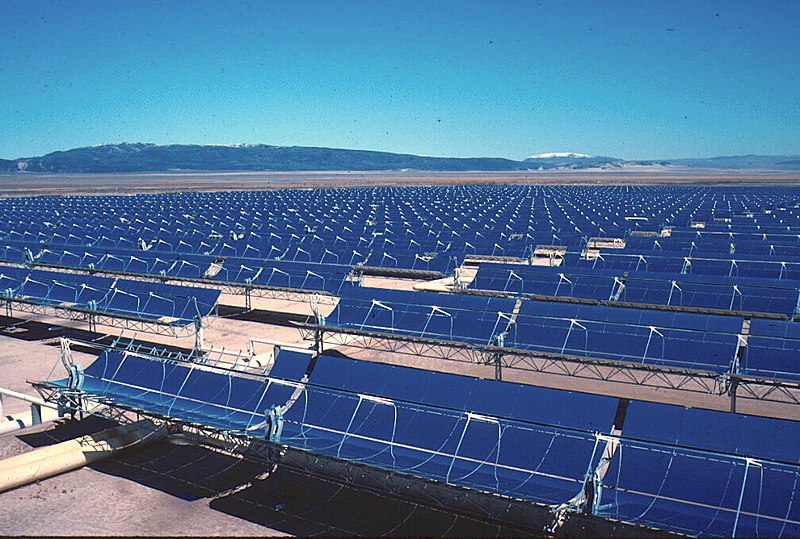
Part of the 354 MW Solar Energy Generating Systems (SEGS) parabolic trough solar complex in northern San Bernardino County, California (“Solar Power,” Wikipedia)
In their very important and well-researched book, TechNo-Fix: Why Technology Won’t Save Us or the Environment, Michael Huesemann and Joyce Huesemann make a very similar point about the dangers of human diversion of solar energy:
If humans divert a fraction of solar energy away from the environment to create ordered structures for their own purposes (e.g., houses, appliances, transportation infrastructure, communication systems), less energy is available to maintain highly ordered structures in nature.
Many people will respond to these concerns by claiming that the amount of diversions of Earth material and land itself for the creation of solar and wind power stations, at the scale necessary to replace fossil fuel power sources, would somehow be “small” or “insignificant.” That is just factually not the case, especially with the continuance of growth-demanding, over-consuming, and competition-driven societies. For example, an estimate is given in a recent report by a pro-“green energy” team of researchers, stating that with the combination of wind farms and solar panel installations necessary to replace all fossil fuel electricity production at its current scale (in the U.S.), we would only have to cover 10 % of the surface of the U.S. with such installations (The Race to Zero: can America reach net-zero emissions by 2050?, by Oliver Milman, Alvin Chang and Rashida Kamal, The Guardian, March 15, 2021) That figure does not take into account the amount of additional land surface (and habitat destruction) required for all of the necessary increase in transmission lines, which the authors of the Race to Zero… report estimate would be “enough new transmission lines to wrap around Earth 19 times.” (and that’s just for the U.S.!) To put that amount of Earth surface diversion and destruction into some familiar perspective, currently about 2% of the surface of the U.S. is covered with asphalt and concrete pavement. We all have some sense of what that much pavement (on roads, sidewalks, parking lots, freeways, etc.) looks like, mainly from flying over the country in airplanes with a window seat. Imagine then, what 10 to 70 times (when competition and consumer demand for the ever-increasing amount of electronic gadgets is figured in) that much ground covered with wind turbines, solar panels and power transmission lines would look like. All of that ground would most likely be cleared using chainsaws, tree-chomping machines, fire, and toxic herbicides, followed by bulldozers. And don’t forget the living land that would be bulldozed and paved over for new roads to accommodate construction of the new power transmission lines, access to and maintenance of the new power stations, as well as for all of the mining that will be needed to produce the various devices and products. Do you need any more material than that for new nightmares to keep you awake at night? By what measure do people declare with any certainty that the impact of such development would be “small” or “insignificant” to the life of our only habitable planet? Is going ahead with such technological and industrial development just to see if the impact really would be small worth the risk?
Here is what Bill Catton said about taking such a risk (45 years before the Race to Zero.. report) :
To put this in perspective, consider the fact that the total human use of energy is already equivalent to more than 10 percent of the total net organic production by the entire biosphere. To supply future humans with three times that much from solar devices means doing something to the largely unknown natural pattern of energy flow on a scale that is not infinitesimal after all. Homo colossus would be swinging almost as much weight as a third of the whole biosphere! The potentially disruptive effects upon the balanced processes of nature have to constitute an enormous risk. (pg. 191-192)
We must remember that Catton was writing that towards the end of the 1970s, when humanity’s total energy use was much less than what it is now. Since that time, the human population has doubled and human energy use has more than tripled, which is very close to what Catton estimated (dare we say “predicted?”—Catton was using math) in the above passage. While this tripling of human energy use over the last 50 years has remained primarily from the use of fossil fuels and solar electricity currently comprises only about 1% of the human world’s energy consumption, the figure of one third of “the net organic production by the entire biosphere” still stands. You may have heard somebody mistakenly or deceptively say that in 2023 the world got 5% of its “energy” from solar power devices. The actual fact is 5% of its electricity came from solar. Only 20% of human energy use is in the form of electricity, the other 80% being primarily in the form of combustible fossil fuels used for purposes like smelting various metals at very high temperatures, for transportation, for launching spaceships, for explosive missiles used in warfare, and for several other types of industrial uses. If we could possibly produce 100% of the electricity that the world currently uses with solar, wind and hydro power, we would still be using that same enormously disproportionate one third of our planet’s energy to maintain our species’ unsustainable ecological footprint of 1.75 Earths (or possibly 2 Earths by about 2035-40, at current rates of increase).
Whenever somebody finally does all the necessary math to come up with an accurate estimate of how much fossil fuel use will be necessary to power the enormous increase in industrial activity needed to transition to and maintain the imagined “switch to green energy,” we may find that our total energy usage would be astonishingly higher, even before we figure in the increase from continued economic growth and aggressive capitalist competition. The following chart from a 2020 scientific publication clearly confirms Catton’s figures:
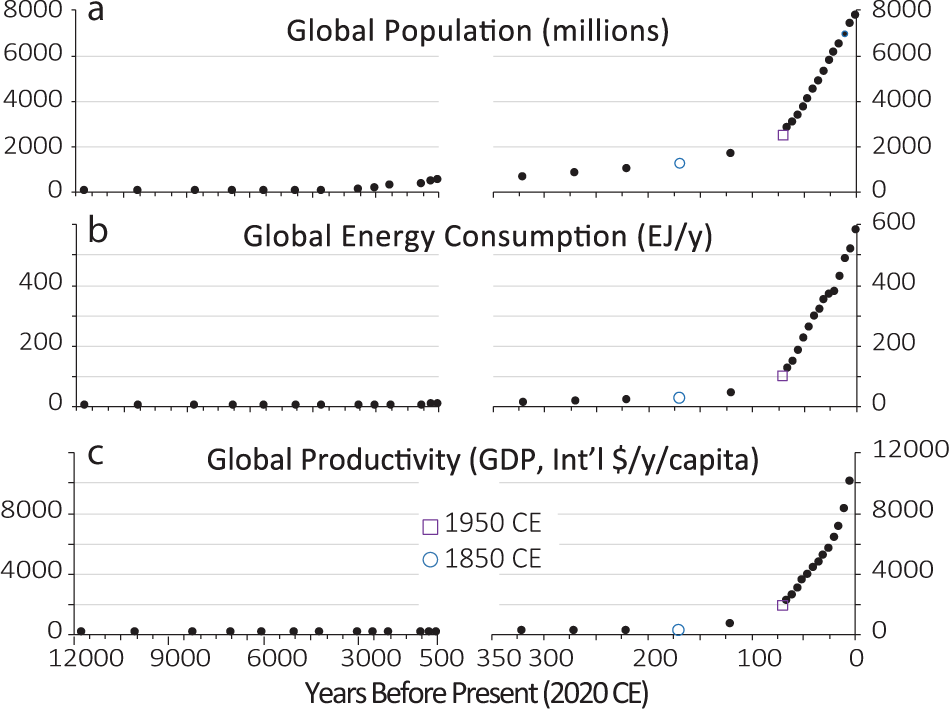
a Global human population (millions), b global energy consumption (EJ/y), and c global productivity ($/y/capita), across the Holocene and proposed Anthropocene epochs (in this paper starting in 1950 CE). All three parameters are highly correlated (Spearman’s rank coefficient = 1.00). Larger circle = 1850 CE; large square = 1950 CE. Data references are listed in Supplementary Online Material.
Source: Syvitski, J., Waters, C.N., Day, J. et al. Extraordinary human energy consumption and resultant geological impacts beginning around 1950 CE initiated the proposed Anthropocene Epoch. Commun Earth Environ 1, 32 (2020). https://doi.org/10.1038/s43247-020-00029-y
Homo colossus: too big for planet Earth
This would be a good point at which I should clarify what this “Homo colossus” entity that Catton refers to is. To put it simply, “Homo colossus” is what Homo sapiens became at the point when the Holocene epoch transitioned into the Anthropocene, c. 1950, as shown in the charts above. To be clear, not all Homo sapiens became Homo colossus at that point, since there are still some Homo sapiens among our species, today, in various locations around the world, a fact which Catton acknowledged, also. As Catton, the man who coined the term, described it, “The more potent human technology became, the more man turned into a colossus. Each human colossus required more resources and more space than each pre-colossal human.” Where does he draw the line between colossus and pre-colossus, or those humans who are still Homo sapiens? It is hard to pin that down, but Catton seems to imply that pre-industrial Indigenous people and the increasingly rare other people (mistakenly labeled as “under-developed”) who are not overshooting their local environment’s carrying capacity are still Homo sapiens. Perhaps if Catton were alive today he would mark the dividing line in correlation with the GFN’s one Earth ecological footprint model: those humans whose ecological footprint exceeds what Earth needs for us to limit ourselves to in order to carry on regeneratively are Homo colossus, and those whose footprints are at or less than what our one Earth needs for us to be are Homo sapiens.
Catton describes Homo colossus as being like giants who have acquired a peculiar genetic mutation that causes each generation of offspring to be much larger than and consume much more than the generation that gave birth to them. But, instead of genetic mutation being to blame, as in the analogy, Catton clearly describes how rapidly-developing modern technology made the gigantic impact of humans on our planet possible (including the rapidly-increasing population). While it is clear that modern technologies made our collective gigantism possible, I do not think that Catton completely explains why the technologies made the growth “required.” Beyond circumstantial or opportunistic determinism (“they do it because they can”), what Catton failed to adequately address, was the combined impact of capitalism and militarism (the roots and preservers of empire) on the ways technology is used and why it continually expands. While Catton does make some mention of the impacts of advertising and war propaganda on creating the cultural imperative for growth in consumption (and therefore in production), to meet the ever-increasing demand for new technologies and products, he avoids those two root causes. Advertising and war propaganda have played enormous roles in creating and expanding overshoot, so why not talk about their roots? As I alluded to earlier, I think that the explanation for that has something to do with Catton’s experiences at UW and Seattle itself back in the 1960s, which appear to have instilled in him an aversion toward having anything to do with the research and analysis trends within his profession (academic sociology) that he felt were completely missing the point. I realize that, lacking any complete biography or autobiography of William Catton, I cannot state this definitively, but according to his autobiographical short essay that I cited earlier, by at least 1970, Catton had decided that “the point” which sociologists needed to examine was not only racism, militarism, economic oppression, and all of the other flaws in how humans treat each other. Catton had come to perceive that the ultimate point that outweighed everything else in its gravity and potential consequence was how humans and their societal structures and practices are treating the Earth, our only physical source of life. After all, what point would there be to resolving all human interpersonal and inter-societal conflict and creating more ideal social and economic structures if we have no functional, well-endowed planet left upon which to actually live out those ideals in newly-formed ideal societies? That is not a statement of my opinion, nor is it a rhetorical question. It is an actual, legitimate question, because I understand that many people feel (at least sometimes) like life is not worth living under the perpetual burdens of economic oppression, lack of affordable healthcare, or the continuous stress from racism, homophobia, religious persecution, misogyny, or other social injustices. What I hope that people will soon come to understand is that all of these societal ills are interconnected and deeply rooted in the series of wrong turns that our species took after disregarding the need to stay harmonious with Earth’s life system.
Even though Catton was eco-centric or enviro-centric in his perspective on life’s priorities, I do not think that he considered non-ultimate things to have no importance or significance at all. I think that he had empathy and compassion for suffering humanity and for the vast majority of humans (sociologists as well as others) who did not see the dismal reality and disastrous future for life on Earth that he had come to discover. But, knowing that there are other serious issues on Earth and in human societies that people need to address, and that he probably could multi-task by occasionally engaging with those other issues, he still chose to focus his attention and his life’s work on the ultimate issue that he felt nearly everybody else was oblivious to: overshoot. Perhaps I see Catton’s perspective and commitment in that way because I closely share that perspective and we humans seem to love finding kindred spirits to whom we can relate. I could even possibly be projecting my views onto him, to some extent, as I realize that there is probably much more about William Catton and his thinking to know than what I have learned so far. It also seems to me that there are plenty of people working on the non-ultimate issues, especially human rights and social justice issues, compared to those few of us who even want to think about (much less talk about and respond to) the Earth overshoot crisis and impending systemic collapse. Besides the social justice issues, many more humans are also willing to think about, talk about, and take action on what is commonly called “the climate crisis,” which, while being an ultimate issue, is actually just one of many deadly by-products of overshoot. At this time, we are increasingly hearing use of the term, “climate justice,” which is possibly a way for climate activists to assure human rights and social justice activists that they have not abandoned those causes by working to protect our planet. I know also that some people use the term “climate justice” to express the connection between how we treat our planet to how we treat other humans, which is a valid and important point. Why are so many more people willing to tackle the climate/CO2 issue than Earth overshoot? Besides the common ignorance and obliviousness about overshoot, I think that it is because they think that the climate or carbon footprint issue can be easily resolved with more technology and commercial products, thus not disturbing the continued flow of modern industrial over-consumptive behaviors and their limited, very temporary, rewards.
The latest—and possibly the last—Cargoist fantasies
Just yesterday (4/8/2024), I saw another example of how the Cargoists do not want to know where the cargo comes from or what damage it does on its way to our consumptive delights. An astrophysicist-turned-climate scientist who works for NASA was being interviewed by Amy Goodman on Democracy Now!. He was asked to comment on Treasury Secretary Janet Yellen’s appeal to the Chinese government to slow down their world-leading industrial production of solar panels and lithium batteries to cut their more overtly capitalist competitors in the U.S. some slack and stop beating them at their own game. (Obviously, that was a paraphrase and not an exact quote, but sometimes a good paraphrase can be more accurate and clear than the quote.) My paraphrase for the scientist’s answer to that is that he basically said that it doesn’t matter where the “green energy” devices come from (China, the U.S., or elsewhere), as long as we (somehow) replace fossil fuels with enough electrical energy devices to keep the massive machinery of modern industrial civilization moving and growing. Here is the exact quote from the guy: “I don’t care where solar, where wind comes from, where any of these solutions come from. We need all hands on deck right now.” If that is what “we need,” and if those technologies really are “solutions,” I wonder how that matches up with what Earth really needs from us. Do all the human hands on this deck need to be doing everything that they can to keep the societal machine that we are captured within running smoothly, but just with somewhat less CO2 emissions? Or, do we need to use all of our hands, minds and strength to bring that life-destroying machine to a grinding halt, if that is what Earth and all interrelated species really need from us?
Present-day Cargoists are determined to believe several things that are either just not really sustainable or even physically possible. Many of the hoped-for “solutions” to the climate crisis are based on technologies that have not yet been developed, or at least not at the scale necessary to maintain current and ever-expanding industrial activities in a life-sustainable way (i.e., “carbon capture”). Nearly all proposed new “advanced technological solutions” would also require the additional extraction of natural materials in quantities way beyond what we can access without expanding mining of Earth’s surface by unfathomable magnitudes beyond current destructive practices. These types of imaginary “climate solutions” (while ignoring the actual overshoot crisis) are just as fantasy-based as flying through outer space to find a suitable, livable planet for our species to either colonize or just dig up for industrial resources to bring back to Earth. So, let’s deal with that outer space fantasy first, lay it to rest, and then move on to deal with a few of the other ones.
The Futile Pursuit of “Planet B” (Answer to question #5)
No scientist that I know of has done a better job of clearly debunking the outer space fantasy solutions than astrophysicist Thomas Murphy of UC San Diego. In his free, open access textbook, Energy and Human Ambitions on a Finite Planet (pp. 54-65), Murphy clearly illustrates the actual physical requirements and limits related to any possible fulfillment of such fantasies. As an astrophysicist with much experience in untangling students from previously-held misconceptions about the worlds beyond our planet, Murphy knows exactly where to begin this process. He begins with some mind-boggling illustrations of the distances and scale of the various astral bodies, first of our solar system, then beyond. For example, he shows how we have been greatly misled and endowed with a false perspective by the typical illustrations of our solar system found in astronomy textbooks. Even though these illustrations serve a very good purpose—showing the order in which the planets orbit around the sun and Earth’s position in relation to them all—such illustrations cannot possibly convey anything close to the actual comparisons in size and distances in real scale, using one illustration on one typical 8-inch-wide page in a book. Neither can it be done on a double-page spread, a three or four-page fold out, or even a 400-page foldout! If we were to try and make a true-to scale illustration of our solar system for a book illustration, with our planet Earth about the size of the diameter of a common pencil or a hole in a 3-ring notebook paper, and we place Earth at the far left edge of the page (or what would be about the middle of a two-page spread), our moon would be a little dot at the right hand edge of the page. “On this scale, the sun would be larger than the page and about 400 pages away. Mars would be 160 to 1,100 pages away [at its closest and furthest points in relation to Earth].” Murphy does not go on to tell us how many more pages away Pluto or Uranus would be, but I think we can all get the point without that additional information. The distances are important because without that kind of information we would not be able to calculate how much fuel it would take to get there, how much food, water and other essentials to pack for the trip, and, most significantly for a species whose average life span is a little over 70 years, how long the trip would take. Here is some astonishing perspective from Tom Murphy on the actual time spans that space journeys in pursuit of new Earth-like planets or planets with some Earth-like resources would take, using our fastest spaceships manufactured to date:
It took 12 years for Voyager 2 to get to Neptune, which is “in our backyard.” The only spacecraft to date traveling fast enough to leave the solar system are the two Voyagers, the two Pioneers, and the New Horizons probe. The farthest and fastest of this set is Voyager 1 at about 150 times the Earth–Sun distance after 43 years. The closest star is about 2,000 times farther. At its present speed of 17 km/s, it would reach the distance to the nearest star in another 75,000 years. (pg. 56)
That closest star figure is significant because it appears that we have no planet compatible for Earthling life orbiting around our Sun, other than Earth. So, we would have to begin our search for “Earth II” (a.k.a., “Planet B”) in a solar system 75,000 years (3,750 generations) away. As if it really matters, in the light of that deflating reality, there is actually another factor to consider that would make these lengthy travel times even much longer. The times that Murphy gives there are for speedy little unoccupied or “uncrewed” (I dare not say “unmanned”) space probes. A large spaceship with about 200 colonist and/or industrial laborer passengers, loaded down with all of their necessary gear and an almost incalculable amount of fuel, would be much slower, of course, if it could even have enough power to propel that amount of weight out of Earth’s gravitational pull.
Could such a large space passenger/freighter be launched out of Earth’s gravitational field and be propelled through space using solar power or any known type of electric motor? Not with anything created so far. Solar power is used currently on spacecraft and space stations for various small, basic electric-powered functions, including interior lighting and appliances, and for small-scale propulsion, once outside of gravitational pull. But to launch a spaceship out through the gravitational field of Earth is always done with the much denser power of combustible fossil fuels. Such has also been the case for leaving the moon, Mars, and probably would also be the case for trying to leave just about any other planet that has gravity. Imagine being stuck on an uninhabitable, unusable (for Earthlings, anyway) planet somewhere 75,000 years of travel away (after all of those generations of belief system perpetuation and indoctrination about the “need” to stay the course), unable to leave because you just don’t have enough juice to break out of that planet’s gravitational pull!
The other thing about powering spacecraft with solar panels is that when you get about as far away from the sun as Jupiter, solar power is no longer sufficiently capturable as an energy source (Wikipedia, “Solar panels on spacecraft”) (As a child, when standing outside under a sky full of many stars that your teacher had recently told you were all far away suns, did you ever wonder why the stars didn’t make you warm?). Do you think that we will have batteries with 75,000-year storage capacity any time soon? Or, ever? How much fossil fuel would a spaceship need to haul for a 75,000-year journey, even if the fuel was only used to break out of gravitational fields? Solar panels, at their current state of technological advancement, have to be replaced every 25 to 35 years. How long will it be until we have solar panels that last even 1,000 years? How many spare solar panels and spare batteries can a spaceship haul and still be able to get off the ground, much less out of gravitational pull?

It is very understandable how it was so easy for most of us to succumb to the delusion of “easy space travel.” For most of us, our sense of space travel distances and travel times comes from two-hour movies where we see people travel all over a galaxy to different planets in time frames that appear to be similar to travelling across Europe or the U.S. by car, without the travelers appearing to be any older as they reach their destinations.
Lastly, on this topic of space travel, we might want to briefly consider its prohibitive economic cost. As long as most humans cannot even imagine future societies without capitalism, the use of money, or dependence on international trade, space travel—from initial production all the way to “mission accomplished”—will always require humongous amounts of money. The total cost for the Apollo space program (1961-1973), that ultimately put men on the moon in 1969 and brought 842 pounds of rocks back to Earth for study, was between 176 and 288 billion dollars (adjusted for inflation)—(I think that Murphy’s higher figure includes fuel and the lower official figure does not). It is estimated that one crewed mission to Mars would now cost about $500 billion. U.S. President Richard Nixon urged the shelving of the Apollo program back in 1973 to reduce inflation and the U.S. has not had the budget to engage in a space program anywhere near the level of activity as Apollo ever since. Neither have any other nations. In the current global economic conditions, which includes rapidly-increasing expenditures for militarization, disaster relief, and mitigating the many other consequences of exceeding Earth’s ecological boundaries, more public funding for space missions seems increasingly unlikely. I suppose that increased awareness of the futilities mentioned above—among space scientists, anyway—also has something to do with it. The trend now for funding space missions is private, billionaire funding (supplemented with some raiding of the U.S. treasury) for their own space projects. I am pretty sure their ultimate purpose is to be able to flee an impending apocalypse (as seen in the recent movie, “Don’t Look Up!”), since they probably have their own personal stables of researchers keeping them well-informed about all possible and likely future scenarios, mainly to help maintain their economic competitive advantages. To them, the most colossal of us all, I say, “Good riddance and make haste.”
A reality check like this one is, understandably, very hard for many of us to accept. Dreams, fantasies, and cherished beliefs are generally very difficult for humans to give up. The ability to imagine, dream and create is a wonderful thing, especially when applied toward enhancing and preserving natural life. The human dream of flying and escaping to some more ideal location is sometimes connected to such healthy motivations, but probably just as often it is based on the desire to flee from all that is unjust, dangerous and endangered in our lives. But why seek to leave our generous, life-giving Earth, which our bodies and all of the elements that we need for life came from and belong with? We know of no other place in the universe like this one, even if we did have the means to get there. Why not just do what we need to do to end the injustices and abandon all of the wrong methods of “living” that actually endanger and destroy all of the wonderful life of Earth?
Mining and smelting
It is simultaneously amazing and depressing to me that so many self-proclaimed “environmentalists” and “nature lovers,” including some of my dear old friends, now believe that we can mine and manufacture our way out of the climate crisis. The monstrously pervasive, ever-present, industrial propaganda machine has also convinced many people that excess CO2 in the atmosphere is the only environmental issue worth focusing on and that by somehow solving that problem all other environmental issues will be solved as well. But, as noted earlier, the scientists at the Stockholm Resilience Centre have identified eight other planetary boundaries besides our climate, five already passed and three in danger of soon being passed, which all must be addressed and tended to in order to preserve the continued functioning of Earth system. There was a time, back during the 1970s and `80s, when environmentalists were deeply concerned with and acting in resistance to all of the types of Earth system destruction that they saw, both locally and globally.

Illustration from Elisabeth Robson, “Why Are We Not Talking About Ecological Overshoot?”
So, how did we come to this, the “Carbon Tunnel Vision” we see in the illustration above? I will not return now to the reasons that I have already mentioned, but, instead just expand upon one that I only alluded to briefly and provide some additional examples. That would be the tremendous profits to be made by many intertwined industries through the avowed effort to “replace fossil fuel use with green energy.” Besides the retail marketers of solar panels, wind turbines and lithium batteries—which is typically as far as most cargoists will look to see where that cargo comes from—the other intertwined industries include mining (for all of the raw materials needed to produce “green energy” cargo), the fossil fuels needed for the mining and other stages of “green” production, trucking and shipping (using diesel fuel), smelting (for the wide variety of metals used in “green energy” production, as well as for all of the glass and cement), road construction, and other activities. Those and all other commercial industries, along with all of their customers, then use the electrical energy produced by the “green” devices to continue the processes of overshoot leading to collapse. How so? Because people will use that energy (along with the fossil energy sources that they are unable to replace) to power the same systems, goals, beliefs, over-consumptive activities, and toxic, polluting, life-destroying industries previously powered by fossil fuels. As the Stockholm scientists and many other scientists have shown us—and some “old school” environmentalists still remember—excess CO2 in the atmosphere is not Earth’s only environmental crisis. (Take another look at the 9 Planetary Boundaries chart.) No matter what we power it with, we cannot make a life-destroying Machine and an unsustainable way of living compatible with Earth’s regenerative living system.
It seems evident to me that the “captains of industry,” terrified by the calls of those long ago, actual environmentalists for humans to reduce consumption and re-use, recycle and re-configure old products and discarded materials, found that idea so abhorrent that they spent much effort during the rest of the 20th century trying to find a way to make environmentalism more compatible with industrial capitalism. Putting Earth and the well-being of all natural life first, ahead of monetary profit and colossal consumption was unthinkable, for the overwhelming majority of industrial producers and consumers. The industrialists found what they were looking for with the advent of solar PV panels, colossal wind turbines, lithium batteries, and eventually some other products and processes that they could convince people were harmless and “green.” In a society of cargoists and cornucopia addicts, indoctrinated in those beliefs and lifeways for their entire lives, everywhere they went (except for a few university classes and some rare encounters with actual Earth lovers), it surely was not that difficult for the industrialists to accomplish their two primary goals: neutralize the environmental movement and preserve capitalism. They were even able to turn some former leading environmentalists into very enthusiastic “green” capitalists.
When we take a thorough look at where the “green” cargo comes from and what it is used for (along with what it cannot be used for), two closely-connected, essential industrial activities stand out prominently: mining and smelting. In societies whose primary physical infrastructure—for buildings, roads, transport vehicles, and more—is made from steel, concrete, glass and other smelted materials, mining and smelting are the essential pathways to construction, maintenance, and expansion of that infrastructure. I will cover smelting first and then mining, which is the means by which smelting and most other industrial activities are made possible. Together, they are the largest industrial contributors to CO2 emissions and the excretion of many other industrial wastes. (I also consider drilling and excavating for petroleum to be forms of mining.)

Molten pig iron from a blast furnace. (uncredited, public domain)
Steelmaking produces about 11% of the global CO2 emissions from humans, about 30% of the total CO2 emissions from all industries, and about 7% of the global total greenhouse gas emissions (GHG, which includes methane and other GHGs besides CO2. All of these stats vary slightly in the many different sources that I perused, so I averaged some and also went with the majority and most recent estimates.). There are two primary types of furnaces used for smelting steel: the blast furnace (BF) and the electric arc furnace (EAF). The blast furnace is the oldest and the industry standard, by far, accounting for a little over 70% of the steel smelting, worldwide. Electric arc furnaces have been in existence since 1888, but not applied at the larger industrial scale until the late 1960s, when improvements in EAF technology began to make the use of such furnaces more capable of operating at a larger scale and less costly than prior versions of that technology. Even so, and in spite of continued improvements in electric smelting technology, along with increased demand for a “green” method of producing steel, use of EAF furnaces by steel producers still hovers around 26 to 28%, after peaking around 35% in 2013. Why? The reasons are complex, but it mainly boils down to the fact that capitalists tend to go with whatever technologies are easiest to access, easiest to operate, and the most profitable. There are also some factors related to economic opportunities for “developing nations” to catch up with (or even surpass!) the Homo colossus nations, along with some continued technological shortcomings in the EAF processes. I will say more about all of those reasons soon, but first let’s finish with the CO2 emissions aspect. All steel smelting furnaces, including EAFs, emit some CO2 and other GHGs. The BFs, which are typically fueled by coal, emit an average of 2.33 tonnes (metric tons) of CO2 for each tonne of crude steel produced. An EAF, on average, emits “only” 1.37 tonnes of CO2 for each tonne of crude steel produced, and that figure includes EAFs that are supplied with iron from a new hydrogen-based technology called Direct Reduced Iron (DRI). The high degree of variation in CO2 emissions levels for EAFs depends largely on where the electricity to run those furnaces comes from, i.e., fossil fuel-powered electric grids or grids powered by enormous solar or wind power installations. At competitive industrial scale, EAFs can only operate compatibly with the largest types of electric grid systems, which typically, with very few exceptions, are not powered by wind and solar alone, at least not without fossil fuel or nuclear powered back-up systems. (It will be interesting to see if and how the major electric grid systems around the world will or will not be able to supply and keep up with the rapidly-increasing demand from the AI and bitcoin industries, along with electric smelters and all of the ever-increasing power demand from new electronic gadgets and products.)
In a culture where lesser evils are now defined as “good,” and not-as-polluting-as-that-other-process can be defined as “green,” it is no surprise that the new, carbon tunnel vision, “bright green” “environmentalists” were very quick to label EAF/DRI-produced steel as “green steel.” Apparently, emitting only half as much CO2 as the dirty, coal-fired BFs was deemed good enough to qualify for the highly-prized green label. And, of course, neither the environmentalists, nor the industrialists dare to mention the many other pollutants that are excreted into air, ground, and water by the steel industry besides CO2. People with something to sell—whether they be fossil fuel, steel, or mining industrialists wanting to profit from claims to be moving towards green new technologies for making their toxic, life-destroying products, industrial food producers deceptively using the labels “organic” or “GMO-free,” or “environmentalists” doing fund-raising for their particular benevolent, activist organizations—will claim or say just about anything these days. When making their claims about “green steel,” they focus on any possible or actual reductions in CO2 emissions emitted in the manufacturing process, and almost never mention the other pollutants emitted into air, ground, and water by the smelting and processing of steel and other metals, such as: cobalt, selenium, sulfur dioxide (source of acid rain), carbonyl sulfide, mercury, copper, silver, iron, hydrogen fluoride, polycyclic compounds, lead, nickel, manganese, polychlorinated biphenyls, arsenic, beryllium, cadmium, chromium, antimony, and various lead compounds. Is any of that material really “green enough” for us to breathe or drink at any measurable levels? Is it “green enough” if the people downwind and downstream from those mining sites and manufacturing plants are mostly “people of color?” Is it “green enough” for the beings of other species who have as much right to continue living in Earth’s free life-giving system as the humans do?
Recent trends in the steel industry have provided us with another excellent illustration of the delusion of “phantom carrying capacity” and “ghost acreage” that Bill Catton illuminated for us, so long ago. In order to make this illustration clear, I must first describe one significant limitation of the EAF. The EAF cannot carry out the first step in the steel making process, which is referred to both as “metallising” and “reducing” the iron ore before it can be turned into steel. BFs, however, can reduce iron ore before smelting it into steel, and the metallised iron that they produce (“pig iron” being the most common type) can then be fed into EAFs to continue the rest of the process. EAFs typically smelt pig iron, recycled scrap steel, or a combination of the two (along with various chemical additives and metal alloys) into, workable, marketable steel. In order to make EAFs less dependent upon dirty BFs and a little “greener” the DRI (direct reduced iron) process was invented to supply EAFs with non-BF-produced metallised iron. The DRI process uses hydrogen (which is processed using 95% methane, a.k.a., “natural gas,” a fossil fuel) and some other chemicals to reduce the iron ore, and it is not a 100% green or even CO2-free process, by any honest measure. Those who claim that the DRI/EAF process is “green” like to talk about how the primary waste product of the DRI production is water, which can be re-used in the hydrogen-making process, and the fact that the EAFs mostly use recycled steel scrap to “charge” the furnaces. But, as in all recycling processes, entropy and the unavoidable introduction of impurities into the source material requires that some of the original, or “virgin,” material (pig iron, in the case of steel) be mixed into the batch, in some proportion. In the case of EAF/DRI steel production that virgin material is referred to as “ore-based metallics” (OBMs), which is often necessary, as a supplement to the DRI, depending on the quality of the scrap steel and scrap iron being fed into the EAF, to reduce impurities and strengthen the end product. The wide variation in quantity of OBMs (including pig iron) necessary per batch runs roughly between 5-80%. All right, that is as far as I can go with this “metallurgy class” for today. Now we can move on to the illustration of phantom carrying capacity.
The “bright green environmentalists” are very excited about the fact that in the United States and Mexico, the use of EAFs has increased to overtake the use of BFs in the steel industry. A 2019 survey showed that in the U.S. the figure had risen to 68% EAFs over BFs and even higher in Mexico, at 77%. (Canada lags behind at 46%.) How exciting is that!!?? What a great reason for hope…or should we call such hope “hopium?” How do such figures square with the fact that, worldwide, 70 to 75% (by some estimates) of steel production is still done with BFs and that, globally, “only 28% of new steel manufacturing capacity under construction is for electric furnaces?” There are a few conveniently overlooked items that we need to consider for the big picture to become clearer. Where does the cargo come from that makes the great increase in American use of EAFs possible? “Currently, imported pig iron makes up nearly all the merchant supply available to North American mills…pig iron import levels have ranged between 4-6 Mt (megatons) annually in the USA and 0.2-0.6 Mt in Mexico, with most material originating from Brazil, Russia, and Ukraine.” (Hmmm, could seeking an upper hand in the pig iron market have anything to do with U.S. interest in that war between Russia and Ukraine?) Other major exporters of pig iron and iron ore include Australia and China, and as the EAFs increase in America and some parts of Europe, so does the importation of pig iron, in spite of the concurrent (but insufficient) increase in DRI. China is the most prominent producer of steel in the entire world, by far, producing about 50% of the world’s total, annually, and about 90% of their production is done with BFs. With China’s influence and participation, five of the top six steel producing nations are Asian, as follows (in order of quantity): China (50.4%, when including Taiwan, or 49.1%, excluding Taiwan), Japan (6.2%), India (6%), United States (the exception, 4.8%), Russia (geographically much more Asian than European, 4.2%), and South Korea (4.2%).
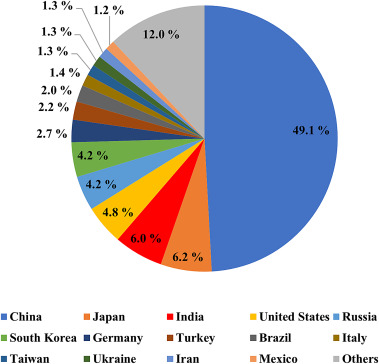
All of those nations, with the exception of the U.S., primarily use BFs. But the U.S. imports its BF products (mainly pig iron) from other nations while thereby exporting (at least in the minds and papers of some people) its duly-earned credit for large portions of the CO2 and other wastes generated by those foreign BFs, along with credit for its share of the ecological footprint associated with the whole filthy business. Can any nations on Earth (or any so-called “green cities” on Earth) rightfully declare, “our hands are so clean and our footprints are ever-so-green” just because they have the money to pay industrialists of other, foreign or “phantom” acreages to soil their lands, water and air while producing products for use by businesses and consumers in their own locations? I don’t think so. As with a murder committed by a paid hitman, the purchaser of that contract is a guilty accomplice. Another very cogent reality that is overlooked by these false claims of “green innocence” is that there is only one interconnected atmosphere on Earth and emissions of CO2, other GHGs, and toxic particulates anywhere are thereby emitted everywhere. Just because we cannot see or do not want to know where the cargo comes from or where our wastes go, that does not eliminate the consequences of those things, or make them actual “phantoms.” There is also only one continuous and interconnected ocean (in spite of human-made boundary lines and labels), which is now also being mined for so-called “green” technologies.
Cement, the binding agent for all of the diverse materials that go into the manufacture of concrete, the modern world’s favorite building material, is also smelted in fossil fuel-fed furnaces and “accounts for around 7% of all greenhouse gas emissions worldwide,” or about the same volume of GHG emissions as steel. I did not find the carbon footprint for global glass manufacturing, but I know that the mining and handling of the various materials throughout that process exposes people to many toxic fine particulates that go into their lungs. I will leave it to others to look up the CO2 emissions and other toxic excretions of glass manufacturing, because I am currently out of time for doing that. (After all, this double book review can’t also be “the whole story of everything!”)
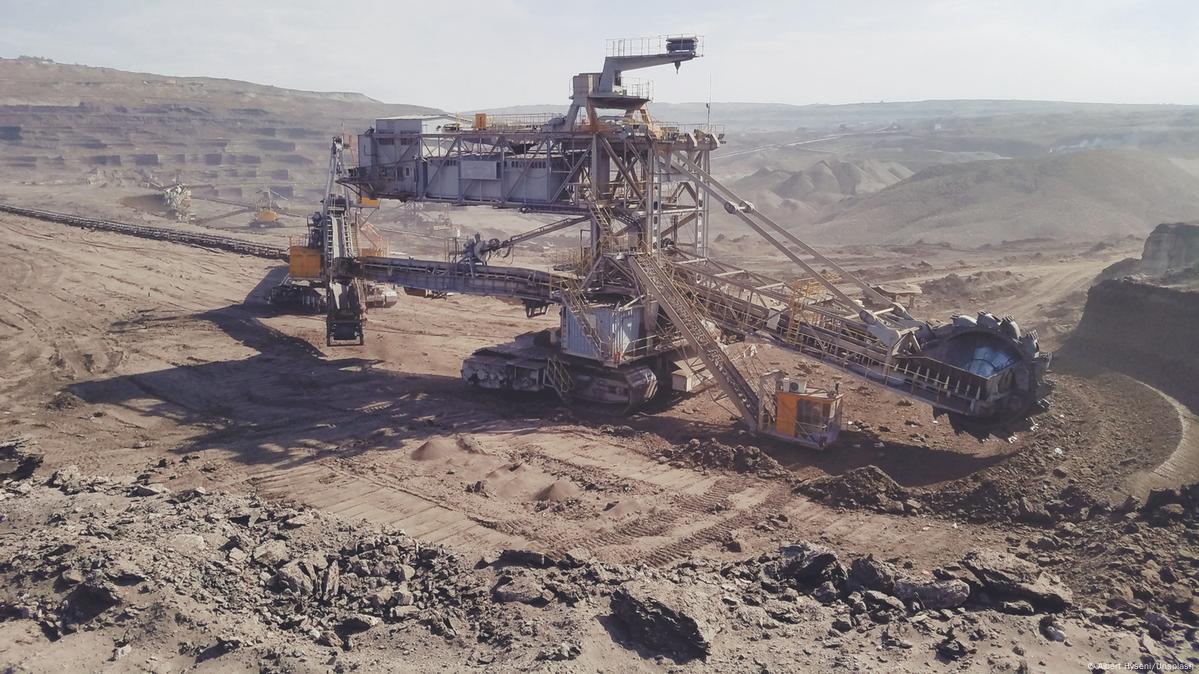
The mining of critical raw materials leaves rubble dumps in its wake. Image: Albert Hyseni/Unsplash
All of the mining and manufacturing in the industrial world is toxic and habitat-destroying, to varying degrees, but, as Bill Catton taught us, rather than focus on particular individual culprits, it is more important for us to understand the collective impact of the whole thing. Much more research needs to be done and is being done now to thoroughly measure such impacts. I mentioned earlier the recent unveiling of the extremely disproportionate consumption of Earth’s substance by humans, compared to all that is used by other species. That disproportionate consumption by humans continues to expand, for many reasons, and two of the most significant reasons are natural entropy and unrestrained capitalism. Both of those factors are also deeply connected to the continual increase in mining and other forms of extraction. Natural material entropy is one big reason why we cannot have 100% recycling of material goods. Depending upon the type and condition of the materials being recycled, the amount of newly-extracted or “virgin” material that must be added to each batch (for marketable quality-related reasons) ranges between about 5 and 90%. In addition to that, the dissipation of materials that have been mined voraciously over the last two centuries (fossil fuels, metal ores (including rare metals), various minerals and chemicals, etc.) requires that proportionately more and more rock and soil be dug up, dynamited, drilled and sifted through to acquire proportionately less and less of the desired, commodified materials. All of those materials are finite, but the economic and cultural social Machine still mechanically, robotically moves on as if everything is infinite—until, of course, that Machine has nothing left to eat or nobody left to feed it.
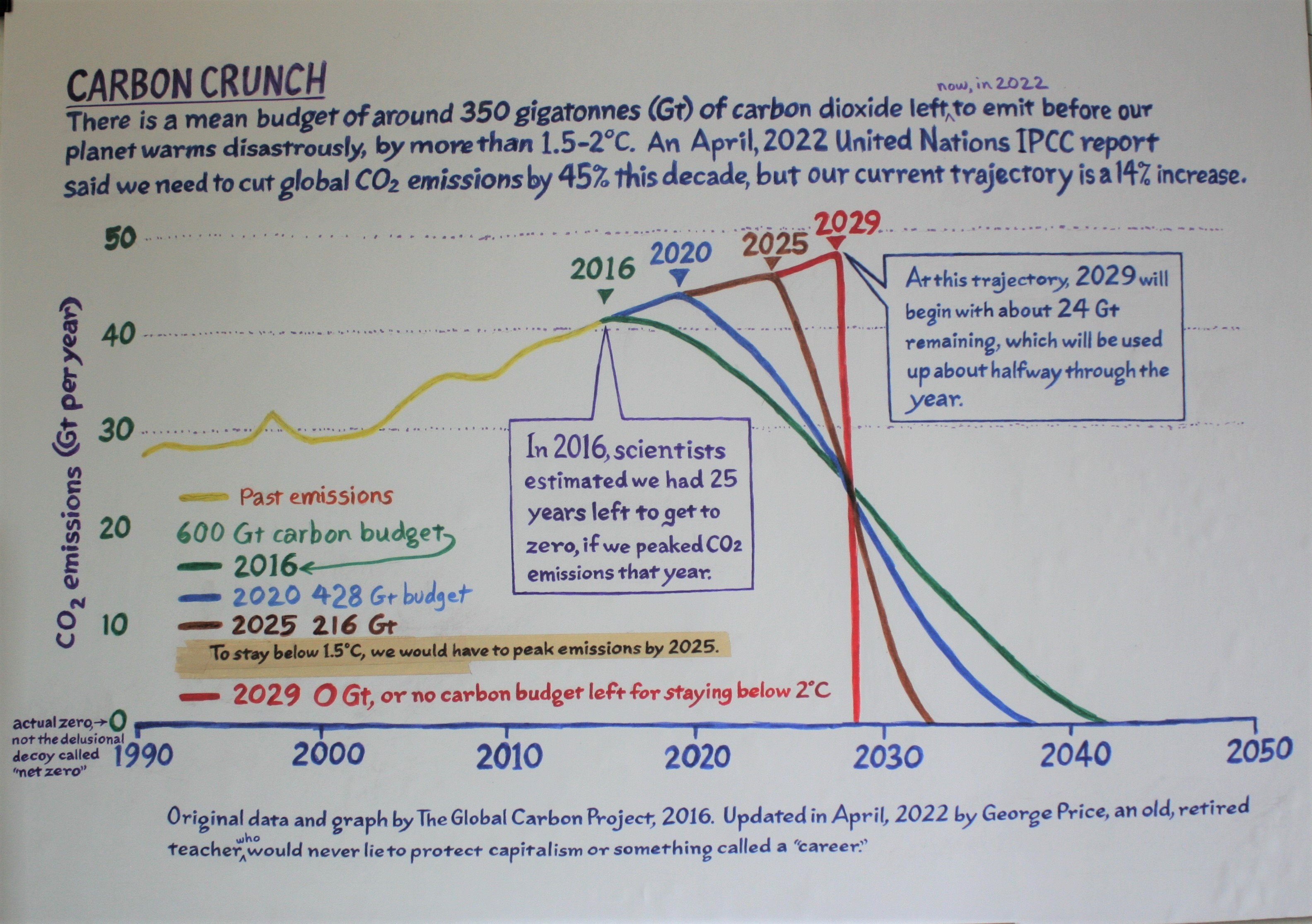
Old-school, pre-PowerPoint style, handwritten and hand-drawn poster by the author of this essay.
Since the amount of CO2 in Earth’s atmosphere continues to rise, in spite of so many “best efforts,” the latest trend in measuring “success in the fight against climate change” used by many bright green cargoists is to measure reductions in the rate of increase in CO2 emissions and in average global temperatures and then celebrate those examples of slower increase as if they were actual (net) decreases! A skilled presenter from a bright green “climate action” organization can really inspire and stir up a lot of techno “hopium” in a crowd of people who are desperately seeking ways to fight climate change while simultaneously keeping the status quo systems and their way of life intact. A couple of examples of that deceptive tactic that I have recently encountered are the En-ROADS software program created by Climate Interactive and MIT Management, and Project Drawdown’s “Table of Solutions.” These were recently presented to an Indigenous climate action group I belong to as part of our annual Earth Day activities. The En-ROADS software calculates how much various “green” technologies and human actions can reduce the global average temperature increase by the year 2100, including some imaginary technologies that they admit do not yet exist. The “Table of Solutions” does basically the same thing, measuring the rate of increase in CO2 emissions, instead. The best and most honest climate scientists (even among the relatively moderate United Nations’ IPCC) have been telling the whole world for years that Earth needs for us to immediately reverse the CO2 emissions trajectory to a radical decrease, not just a slower increase, as shown in the chart above. Imagine a person with extreme obesity whose doctor has told them, “You really have to start losing weight immediately, because your heart just will not be able to take any more increase in weight.” So the person decides to just only give up bacon and soda pop and their weight continues to increase, but at a slower rate. Soon after making that little, incremental, but very insufficient change, the person dies of a heart attack.
That is all I will say about cargoist fantasies for now. I was going to go over electric cars and electric semi-trucks, but there are plenty of other expose’s on that topic out there. I refer you to Bright Green Lies, TechNofix, and Ozzie Zehner’s work for more on those. I need to move on now to a couple of other points, so I can wrap this up soon.
The pointless search for culprits, by those who are missing the point (?)
During the time that William Catton taught at the University of Washington and the time that he wrote Overshoot, the profession of sociology and the growing spirit of resistance to social injustice was leading many people to vigilantly seek out and expose culprits of all sorts—individuals, economic systems, deeply-entrenched cultural or religious practices that seemed to no longer make much sense, and deep corruption in the legal and political realms. While Catton was certainly not oblivious to all of that, he perceived that the vast majority of seekers for justice and social progress were missing the point. Yes, there are some very corrupt and degenerate individual humans all over the world doing horrific, unjustifiable things and causing much suffering and harm for other humans, as well as to other species. Yes, there are also some very fundamentally unsound, unjust, unequal, ruthless and predatory economic and social systems and political institutions all over the world that systematically create pain and suffering for all species, through the normal, day to day operations of those systems—not just as occasional glitches, or aberrant “bad apples.” But all of these destructive human systems and individuals, along with their particular circumstances and social contexts, as seen from Catton’s ecological worldview, were not the root causes or points of origin for our present global calamities. They were all set into motion thousands of years ago, through a long series of wrong turns, miscalculations, collective misguidance and consequential circumstances, rooted in alienation from Earth’s symbiotic systems and natural laws (such as, the laws of physics). The resulting destructive ways of living and perceiving were then normalized and inherited by their posterity.
Children cannot rightly be blamed for the type of world and personal circumstances that they were born into and trained into. Children need to be raised and nurtured in families and communities that teach them (by words, but more importantly by life examples and the modeling that their elders show them) how to live in appreciation, love, and gratitude for the gifts of life from the natural world. Being denied that knowledge and experience is a form of child abuse. But parents, families, caregivers, and whole communities or societies that were neglected and abused in that same way cannot be blamed for failing to exemplify for their children something that they have never known or experienced themselves. A society of humans who have mostly been taught that the natural world is a dangerous place that we have to protect ourselves against, but maybe has some beautiful “scenery” we can enjoy looking at, or briefly visit, occasionally, is a society of abused and tragically deprived people who do not know what life really is. As we are experiencing at this potent moment in human history, such societies are not capable of sustaining themselves indefinitely, or aiding (as a total net benefit) in the wonderful systemic processes for regenerating Earth Life.
I began researching and writing this essay about three years ago. It is now the middle of February in the year 2025, and some of the most wretched culprits that our species has ever produced are currently wreaking havoc throughout the world—and some of the worst of the worst have taken over the country in which I have always lived and many of my ancestors lived within for thousands of years. While there have been many individual humans through the ages who have attempted to take over or “rule the world,” there probably have not been more than a handful of deranged maniacs, if any, who intentionally sought to destroy all life on Earth. As the destruction of life on Earth by human activities, ways of living, and ways of thinking is now occurring, at “breakneck speed,” it is normal for us to wonder which ones of us are the most at fault for causing this tragic, complex crisis. William Catton suggested that a better question than who is to blame is what is to blame:
In a world that will not accommodate four billion of us if we all become colossal, it is both futile and dangerous to indulge in resentment, as we shall be sorely tempted to do, blaming some person or group whom we suppose must have intended whatever is happening to happen. If we find ourselves beset with circumstances we wish were vastly different, we need to keep in mind that to a very large extent they have come about because of things that were hopefully and innocently done in the past by almost everyone in general, and not just by anyone in particular. If we single out supposed perpetrators of our predicament, resort to anger, and attempt to retaliate, the unforeseen outcomes of our indignant acts will compound fate. (pg. 177)
Catton probably also felt uncomfortable with the then-increasing sense that an identity group that included himself—Euro-descended or “white” men in positions of authority—were society’s chief culprits, both historically and in the present, especially those with the most wealth and power. I really do not know how he felt about that, or if it bothered him at all. I would just add to the above statements, both his and mine, that there may indeed be systemic and individual culprits (among all identity groups), upon whom we might justifiably place some blame for certain particular examples of destructiveness, and even label them as “despicable.” But how much greatly-needed human positive creative energy might be wasted on despising? In a state of global dystopian or post-apocalyptic crises, would it not be much better, and extremely urgent, for those who survive to use our energy and creative abilities to go forward as best as we can in an entirely different and ecologically-led direction? No matter how wrong or misguided we have all become, Earth will always be right, and ready to guide us onto the good path of real life.
In order to answer question #1 of this essay, “What is the biggest real threat to all life on Earth that we currently find ourselves needing to face and respond to,” we need to distinguish between root causes and subsequent effects. Natural responses to our biological circumstances and needs, combined with unnatural and even anti-natural systems of thought and belief, environmentally unsustainable cultural practices, alienation from the natural world, etc., are root causes. Individual humans whom we might call “culprits,” “bad” people, better or worse persons, “evil” or “lesser evil” ones, fall into the category of subsequent effects—which is a realm in which we all find ourselves encumbered and complicit, to varying degrees. Present-day human pathologies and harmful behaviors (the “whats,” not the “whos”) are rooted in a very long sequence of root causes and their subsequent effects. To only act against the subsequent effects is like trying to fight diseases by only attacking the symptoms and muting or suppressing those symptoms using drugs. Real healing comes from identifying root causes and changing behaviors. Not only do we have to stop doing harm and start doing what is best for our individual bodies, but we need to also stop harming and start doing what is best for the natural ecosystems that provide nutrients and protection for our bodies and the bodies of all other species, as well. In order to understand our current and very near-future predicaments, we need to look at life on Earth from an eco-centric, rather than anthropocentric perspective. Once we have identified the root causes of Earth’s predicament (which goes back much further than the advent of fossil fuels), those who survive industrial civilization’s collapse and have a unique opportunity to start totally new societies, must then act, to the best of their abilities, to prevent those root causes from ever developing again.
How did we arrive at our current predicament? I will not repeat my earlier descriptions of some of humanity’s historic wrong turns. I thought about trying to make a chronological list of the “great wrong turns of humanity,” but there are just too many and also too many unknowns. Maybe the first wrong turn (which I did not mention before), or root of all roots, was the over-development of human ego: the imagination that we have individual life needs that are disconnected from, or irrelevant to, the well-being we receive from our natural symbiotic relations with all of the rest of Earth Life. I can see how both anthropocentrism and the commodification of nature could possibly be rooted in that. Another one that I did not mention previously, which might also possibly be the first root, is lack of gratitude or thankfulness for all of the gifts of natural life and our gift of being a part of the whole of Life. Robin Wall Kimmerer has written beautifully about the significance of gratitude to all life, including how giving thanks is a vital and often central element in most tribal ceremonies. I also only made a brief mention of misogyny in a short list earlier, but the devaluation and disrespect towards women, especially of older women, well beyond their child-bearing years, was an enormous wrong turn as well. For most of human history, it was not that way. Elder women in traditional tribal societies were the primary keepers of medicine knowledge and had important leadership and advisory roles, as well. I am sure that there are many vital discussions that we can have about all of that. What is important to note at this point, though, is that we simply inherited this mess. It was handed down to us. We know that it is human-caused, but not so much by particular human individuals. Instead of looking to various individuals (and those who are most alike, or closely aligned with those individuals) to place the blame, we need to look at a broad, intersecting collection of particular human beliefs, social systems and cultural practices. These beliefs, systems, and practices are the results of the wrong turns taken by humans, beginning about ten to twelve thousand years ago, at various locations around the planet.
Like travelers who, when they first sense that they are lost, feel no need to consult a map or a talking robot (GPS), or ask anybody for directions, most of our species just continued to wander further and further off the desired path—the path of harmonious, symbiotic, inter-related, reciprocal natural life, which many Indigenous peoples refer to as “the Original Instructions.” As Catton makes clear, that long series of wrong turns also led to an even longer series of unforeseen consequences that further complicated the mess, thus decreasing our ability to correct ourselves, or respond in ways that would be beneficial to the well-being of all life on Earth. Over many generations of further wayward wanderings, deeper into the tangled maze of being lost, all of the errant ways of living and perceiving acquired from being so profoundly lost gradually became normalized, unquestioned, inherited and repeated. It is now normal for most humans around the world to believe things like “nature must be controlled by humans,” “humans are superior to all other species,” “more possessions is better than less,” “easier is always better than difficult,” “we cannot live without electricity,” “using motorized machines is better than using our muscles,” and “we cannot live without money” (even though we did very well living without money for 97% of our time of existence as a species).
Humans generally want to believe that the ways that they were taught to live and the values and beliefs that were instilled in them, from childhood on, are basically correct, even when things go very wrong or calamities occur. That is very understandable, especially for people who experience what seems to them to be a general, over-all benefit from the status quo system, in spite of the systemic flaws that they recognize and that may have even caused themselves some personal pain. Human bonding—be it with parents, relatives, friends, or society itself—requires some acceptance of pain and nonsense, and human societies are very effective at teaching their members what to accept and what must never be openly questioned. Since it is very difficult and painful to accept the realization, or even the possibility, that we are all deeply lost and that the calamitous predicaments that we now find ourselves mired within are the result of some deeply-entrenched major flaws in our society’s cultural imperatives and systemic physical infrastructure, we usually respond to that possibility with minimizing and denial. We want to believe that the flaws are smaller than they really are (or seem to be) and that their consequences will always be temporary.
Desperate for simple, easy answers that can bring speedy resolution, rather than face up to the actual, enormous, complex problems in which we are caught up and involuntarily complicit, we often seek and find other humans to blame as the culprits and cause of our distress. That way, the answer becomes simply to somehow disempower the identified culprits from being able to repeat the harm that they are accused of causing. That, in part, is why human cultures have always had stories about heroes overcoming villains. It is tempting, then, to imagine that doing something like voting for one “lesser evil” politician over another one would make some kind of significant change away from our long-meandering and currently self-destructive, life-destructive course. But changing the players—through elections, or even through locking some of them away in prisons or murdering them—does not change or end the game that is being played. When one mob boss is thrown into prison, another one is ready to take his place. Vote out or impeach one corrupt politician and another one pops up needing to be dealt with, like an endless game of whack-a-mole. I am not saying that there is no point to catching and prosecuting culprits and preventing them from doing further harm. Protecting all life from harm is a very important, natural part of being. But to bring the whole absurd game to an end, we actually have to stop playing it and find something else to do. Hopefully, that will be something much different and truly conducive to a healthier, better, harmonious and joyful way of life, like Homo sapiens lived about 12,000 years ago. To go back 250 years—before the fossil fuel-powered Industrial Revolution—or 550 years, before colonialism hit the western hemisphere, would not be far back enough, because the vast majority of our species had already become too alienated from Earth’s ways long before then. The state of being born lost, unfathomably far-removed from our former ways of symbiotic eco-harmony is the real culprit and the root cause of all of the lesser, subsequent, distractional or decoy culprits. Now is the time to find the path back to Earth’s life-regenerating ways, but most modern humans will probably not be willing to even think about going there until it becomes completely and obviously impossible to go anywhere else. It looks like that will be the case very soon.
Two important points raised in Bottleneck
William Catton’s final book, Bottleneck: Humanity’s Impending Impasse, was self-published in 2009, twenty-nine years after the publication of Overshoot and six years before his death. Catton used most of the book to revisit, expand upon and clarify some of what he wrote in Overshoot, so it would be somewhat redundant to go over that part of the book here, except maybe for a few additional insights that came to him in his later years. Instead, I will focus on just two points, or topics, from Bottleneck, one that he did not go into at all in the first book, but he deals with at considerable length and depth here, and another that he mentioned briefly in Overshoot, but has much more to say about in this final book. Those topics are: 1. Narrowly-focused occupational and/or professional specialization; 2. Commercial advertising’s significant contribution to the amplification of ecological overshoot. Of those two, the first topic is the one which he elaborates upon at much greater length. Interestingly, both of those topics could have easily served as segues into deeper discussions of how capitalism escalates overshoot and climate heating, but, for reasons I can only speculate upon, Catton just wouldn’t let himself go all the way there. I will go there, gladly, in this section, below.
Point One: Narrowly-focused occupational or professional specialization prevents or obstructs big picture thinking. This particular point connects deeply with my previous discourse about why we minimize, deny, and avoid even considering the real depth to which our society’s prevailing structures, paradigms and goals are fundamentally flawed and now even obsolete, for dealing with our current global crises. I have to admit that when I first read Catton’s section on the “division of labor” and narrow occupational specialization (pp. 39-74) it seemed to me to be a 35-page tangential rant about some obscure insider debate in academic sociology during the early 20th century. Well, that may be what it superficially was about, at first glance, but after digesting and rereading much of it, I eventually realized how that piece made a vital connection to the point of the entire book, and, ultimately, to our ability to understand why the overwhelming majority of our species cannot see or recognize what is actually happening to our planet.
As Catton addresses this sociological argument over the pros and cons of occupational specialization versus occupational diversity (having multiple skill sets, or being what is often referred to dismissively in modern society as a “Jack of all trades”), he begins with analysis and commentary on what specialization has done to human interpersonal and social relations:
…one of the effects of modern division of labor, I believe, has been to alienate us more and more from one another. If that is so, then what has made complex societies possible may have also made them self-destructive. Do we actually identify ourselves as all one species (which we still are, biologically), or do we behave as if we regard ourselves as so unlike other human beings that they are almost equivalent to being something other than human? Does modern life make it easier or harder to adhere to the religious precept of universal human brotherhood?
In the modern world, in addition to ethnic, racial, nationality, political, religious, social class and gender components of identity that distinguish us from one another, our additional concepts of “who am I?” depend to a remarkable extent upon our occupations. The different jobs of different people become a major aspect of their identities, of who (and what) they take themselves to be.
Most people do not understand either the obligations or the perquisites of most of those other occupations of the many people we encounter. Both the fact that each of us derives identity from our job and the fact that we have little understanding of most other jobs are characteristic of modern societies.
Before Catton goes on to connect this social phenomenon to its implications and actual impacts on life for all species in the natural world, and on our current global crises, he dwells for a while on the human societal impacts of occupationally-specialized societies. Specialization of labor in human societies goes back over ten thousand years, to the times of the early wrong turns, including: the advent of agriculture, the commodification of the natural world, dependence on trade with other distant societies, the advent of money, and the maintenance of professional militaries to protect and secure the artificial “wealth” acquired from those forms of alienation from Natural Life. The development of modern industrialism and the use of fossil fuels was not the beginning of occupational specialization, or even of our current ecological mega-crisis, but it greatly-accelerated all of those long-standing human social practices and dependencies, along with their impacts.
Generally, and to varying degrees, individuals within Indigenous and pre-industrial societies have possessed and practiced much more diverse life skill sets than individuals in modern industrial societies. From infancy on, the educational experience of children in traditional Indigenous societies involved following around those who were older than them, closely observing the various types of work that was done, mimicking the work, then being allowed to assist with and participate in the work, thus developing a wide array of practical skills and knowledge for each individual. During my career as a historian and lecturer in Native American Studies, students would sometimes ask me how some tribal communities or nations survived and rebuilt themselves after horrific losses of as much as 80 to 90% of their tribal or local band populations, from warfare and epidemic diseases. The answer to that question is found (mostly) within that cultural system of diversification of individual knowledge and life skills. Such survival and regeneration, of not just individual lives and communities, but also entire sets of cultural practices, plant and medicine knowledge, relations with particular homeland ecosystems, knowledge of behavior patterns of other animals, other types of knowledge, and all of the necessary life skills, would not have been possible for highly-specialized societies after suffering similar loss. That would be the case whether in large cities, or in small, one-main-industry towns. Societies with high degrees of specialization for individual laborers, managers of labor, and elite professionals depend on having some form of interactive arrangement in which all of their manufactured necessary goods are made available to the whole society by its specialized parts. If any of those goods become unavailable, whether through the loss of individuals with the skills necessary to produce the goods, or through large-scale loss of persons, infrastructure, and raw materials through warfare or natural disasters, those societies then must seek to replace those lost products and skills from sources outside of their local domains. Most modern industrial societies (including so-called “green cities”) are also largely dependent on imports and the transportation supply chain for much of their necessary consumption of products. It would be very difficult to find any modern industrial town or city that is completely self-sufficient, with enough locally-produced necessary goods for all, economic equality or sharing, and no individual hoarding. If there is such a place in actual existence on planet Earth, made by and for modern, industrial homo sapiens, I would sure like to know about it!
Catton goes on to describe and illuminate the constraints, disabilities, and destructive forces that highly-specialized societies place upon themselves and upon the natural world, on which we all depend. Workers in the same factory, producing the same product are “so differentiated in the kinds of tasks they performed that no one produced the whole marketable product, much less the entire array of goods or services involved in a society’s way of life.” I can provide an example of that from my early adult years, when I worked in a wooden chair factory. Some workers there spent the entire workday putting together the backs of the chairs; others spent the day putting together the cushioned seats; others sprayed varnish on the wooden parts; some put the backs on the top part of the seats and others fit the legs on to the seat bottoms, etc. A worker could spend decades working in the chair factory and not have learned all the skills necessary to make a complete wooden chair—and nobody would find anything wrong with that! That is normal under highly specialized division of labor. There are also examples of factories where the workers actually do have the necessary set of skills to produce the entire finished products but are forced to narrowly specialize on one aspect of the product, nevertheless. I worked in such a factory right out of high school that produced furniture artworks (or wall space coverings) for department stores and business office décor, in which the employees were actually artists and did know how to individually produce the finished product—a painting—but were nevertheless forced to spend all day on an assembly line producing the same small parts of the paintings, over and over again, collectively producing, in sum, the actual finished paintings (which were legally marketed as “hand-painted original artworks,” with each one bearing the signature of the owner of that “art” factory). Catton describes how the societal impacts of specialization worsen with the so-called “advancement” of technology:
Elaboration of the division of labor and advancement of technological culture go hand in hand—technological inventions breed new occupational specialties, and vice versa. An unwanted (and too often unanticipated, and insufficiently recognized) side effect of this technological-occupational “progress” is the escalating societal vulnerability….With new ways in which societies are vulnerable, many human activities deemed “normal” within a given culture can inadvertently trigger societal traumas, small or large.
The types of societal traumas that Catton gives as examples vary, from the occasional sudden failures of widely depended upon technologies, such as power grid blackouts and machinery breakdowns, to the failings in human character caused by job insecurity combined with aggressive interpersonal competition. Every time a new technology is invented, another small group within a society develops a new set of skills that the vast majority of other people know nothing about. Initially, knowing those new skills gives such people, who live in an economically competitive capitalist system, much more than just a rosy sense of accomplishment or high level achievement. It also gives them a sense that society now values them more, will reward them more abundantly, and will want to keep them employed in using those special skills for the profit of the owners of the new technology. But, once the new technology and its associated skill set ages a little, becomes better known, and more widely-adopted, including many more people now in possession of the new skill set, that sense of job security becomes shaky, precarious, and constantly under threat. After a short time, a skill that was once in high demand becomes devalued and eventually a source of profound personal insecurity for those who counted upon possession of that skill as their key to economic security and consumptive bliss. As the rate of the advent of new technologies and gadgets speeds up, while industries simultaneously become increasingly unregulated and laborers less protected, that sense of insecurity spreads. In such a state of insecurity, many employees become compelled to do nearly anything to return to their former optimistic, happy condition. Here is some of how Catton describes human responses to such traumatic circumstances:
Being “on a treadmill” means, beyond implications of drudgery or tedium, that each member of an industrial society has an abiding interest in never letting his particular job be finished. The system’s need for his special function must never be allowed to become satiated. The custom of making annual “model changes” in automobiles and major appliances—so familiar to denizens of modern societies that few think to question its naturalness or inevitability—seems to exemplify this treadmill compulsion to ensure perpetual “need” for the latest somewhat altered version. Especially when it can be touted as “all new!” The need to keep on selling is almost undeniably a major factor generating “style changes” in any fashion industry—clothing, housing, whatever. Sellers of any product or service have an incentive to encourage public belief that new equals improved…(pg. 94)
Point Two: The insidious harm being done to our world by the pervasive practice of advertising
It is on this page of Bottleneck that Catton begins his segue from discussing occupational specialization to critiquing the business of advertising. In the above quote, it is difficult to see where the segue begins because it is hard to tell if and where Catton actually switches from describing the human need to sell one’s self and one’s particular skill set in the marketplace to the selling of material products. Is he talking about both, simultaneously? It is also at this point of the book that we find Catton’s only two mentions of capitalism by name, although so much of what Catton elaborates upon throughout the book can be easily applied to a critique of capitalist industrial society. It is also here, on this page of the book, that Catton reveals why he is not directly engaging in a critique of the capitalist system—at least not exclusively. From Bill Catton’s ecological or eco-centric perspective, capitalism, communism, socialism, or any hybrid or reformed economic system in the modern industrial world that promotes economic and technological growth, expansion of natural resource extraction for increased production and consumption of unnecessary products, are all equally guilty of propelling overshoot, collapse, natural and unnatural disasters, and mass extinctions. According to Catton, the “treadmill of production” is a “fundamental attribute of industrialism; it is by no means exclusively capitalistic.” Catton explains further,
The problem goes much deeper than the qualities of capitalism versus communism, etc. It is the same problem whether a regime’s sacred scripture was authored by Adam Smith or by Karl Marx. Division of labor impairs self-sufficiency, necessitates exchange among specialties, and thus causes people to treat one another as “resources” and/or “customers.” We are dehumanized. (pg. 94)
Understandably, Catton’s dismissal of the widely-presumed significance of all modern economic ideologies was not what most sociologists and ideologues of the 1970s and `80s wanted to hear. Very few of them had ever thought about human economic behavior and economic ideas from an ecological perspective. Capitalist, communist, socialist, fascist, or other modern industrial societies are all in competition with each other, economically and militarily, for a decreasing pool of industrial resource materials, due to overshoot (whether they deny that for fear of alarming their people, or not). While the leaders of all of the industrialized nations seek to maximize their own national technological skill sets, collectively, they simultaneously maintain control over their worker populations by limiting the workers to one specialized skill set each, or one occupation or profession at a time, with few exceptions (one increasingly common major exception nowadays is that more and more people need to work more than one job, just to get by). Workers in such societies are forced to compete with each other for economic security, perks, promotions, hiring, awards, honors, basic respect, or acknowledgement that they possess any personal intrinsic value at all. In societies where any human can become redundant or disposable if they do not contribute sufficiently to the goals or wishes of those who own or control their labor, there is always a sense of potential impending disaster or personal ruin.
When the well-being of individual citizens is dependent upon their employer’s continued economic, productive, and consumptive growth, the citizens are constantly compelled to sell themselves and prove their worth to those who are in positions of power over them, both before and after being hired by them. Without highly diversified individual skill and knowledge sets, especially those skills and knowledge that would allow them to live directly from relationship to the natural world, outside of the system and without the need for money, citizens have no other way to stay alive than to submit themselves to the system. In that way, citizens are also compelled to perpetuate the activities that contribute to overshoot and ecosystem collapse, often unwillingly or unknowingly, and also not knowing that they are ultimately contributing to the eventual collapse and extinction of the societies or civilizations that they think that they can never leave or live without. This experience of inescapable entrapment is probably the largest root cause of most modern human trauma.
Is the sense of entrapment, the pressure to compete aggressively for positions of employment, the fear of offending or disappointing employers or supervisors, the fear of unemployment, etc., indisputably greater in capitalist societies than socialist or communist ones? Based only on their professed ideologies, especially the socialist claims to be cooperative, egalitarian societies, committed to “the common good and well-being of all citizens,” most people who are slightly familiar with both systems would assume that the answer to that question is yes. But that answer would most likely come from people who have never actually lived in a communist or socialist society (especially the non-democratic versions of such societies). Upon closer examination, after taking into account the actual experiences of people living in such societies—including the social mechanisms for limiting dissent and encouraging conformity and political loyalty, the many examples of fear and insecurity rooted in various forms of economic deprivation (usually as a punishment), unjust distribution of material rewards, undeserved occupational promotions and honors, and unjust prosecutions and imprisonments—an abundance of traumatic fear, sense of entrapment, and other stress-producing elements can be found in such societies, as well.
Regardless of the economic system, humans in modern industrial societies are still in possession of certain natural instincts, including the need to belong to and be valued by a larger group, the need for safety and mutual protection, the need for deeper love and bonding, the assurance that our basic biological needs will be met, etc. In times and circumstances in which those instinctual needs are under threat of deprivation, or deprived in actuality, humans are often compelled to risk or directly impair the well-being of others because they imagine that doing so would somehow contribute to an improvement in their own condition of insecurity. While some humans and some human societies have more of a sense that their security is connected to the “common good” (at least the common good of their society, but not necessarily the common good of their whole ecosystem), their actual experiences with corrupt holders of power and other flaws in their political systems—especially injustice in the distribution of social rewards and punishments—tend to hinder or dampen that sense and put them on guard against negative outcomes.
It appears to be evident that all modern industrial societies, and even some of the more remote pre-industrial or Indigenous societies, are tainted by many of the same flawed or damaged human characteristics and behaviors. Living in modern (especially urban) societies has imbued most of our species with an unconscious sense that our lives are so unnatural that nature must not really matter or be relevant to life. With very few exceptions, we all lost the original eco-harmonious ways of being hundreds or thousands of years ago. Many Indigenous American cultures have apocalyptic stories—stories about the endings and beginnings of previous worlds—that occurred in “time immemorial” (or the infinite past), long before the arrival of European colonialists to the western hemisphere. A common element to these types of stories is the people (both humans and/or other-than-human species) either forgetting or rebelling against “the original instructions.” In addition to all of that, many tribal nations in America/ “Turtle Island” have stories about a dangerous spirit being named “Wetiko,” “Wendigo,” or other pronunciations in different Indigenous languages and dialects. The commonly-described character traits of Wetiko include that he is constantly consuming and that he is insatiable. After first contact with colonialists from Europe, many Indigenous people sensed that many of those new immigrants were under the destructive, misdirecting influence of Wetiko, just like some of their own people had been, as told in some of their stories.
I understand the power of feeling entrapped or caught up and compelled by something that seems to be inescapable, especially when one has not seen any actual models for the possibility of a completely different way of living, in Earth-harmonious human societies. Can humans accomplish something that they have never visualized or even imagined can exist? Even when some humans become aware of minor reforms or corrections that can make life better for themselves and their children, such as improving their diets, getting more healthy physical exercise, or greatly reducing time spent on electronic screen devices, they often fail to make those changes, due, in part, to insecurities regarding the loss of basic social needs, such as belonging and acceptance to peer groups. Nobody wants to be rejected or isolated for “thinking that they are better than us.” The cultural indoctrination, the pressures to submit and conform, and the tremendous amount of personal effort and investment that people spend on economic security and climbing the career ladder all create an unquestioning and almost unstoppable momentum that is very difficult or “too risky” to resist or risk losing. We now have career politicians and political staff in both dominant American political parties who are so caught up and focused in on receiving their desired return on their exhausting personal investment in those careers that they are willing to risk allowing the U.S. to be taken over by theocratic fascists and tech billionaires just so they can be sure to cash in!
To drop out of the entrapment of “normal society” and live in a utopian eco-village is understandably off the radar, unthinkable, and even unimaginable to the vast majority of modern industrial humans. That particular disability is greatly enhanced and fortified by the constant barrage of commercial advertising, which eats away at us 24/7, even while we are sleeping! William Catton understood that destructive force very well:
…an advertising industry is an enterprise devoted to inducing unbalanced human relations—making consumers more dependent and sellers more powerful. Ads are devised to foster acquisitiveness, to persuade people to be dissatisfied with whatever items they currently possess, with experiences they have already had, and even with who or what their present self-conception says they are—so they will buy the new product or the new service. (pg. 161)
Most significantly, to ecological concerns, advertising accelerates the trajectory of modern industrial over-extraction, over-production, over-consumption, excessive waste production, and pollution. The passage in the above quote about how advertising is used “to foster acquisitiveness…,” reflects one of the few passages in Overshoot in which Catton speaks, perhaps even more radically than he does here, about the environmental dangers of excessive use of advertising (The context for this statement is a list of questions near the end of the book about what we would need to do to divert our course away from overshoot and into a new, eco-sustainable paradigm, and whether or not modern humans could actually do those things):
Is there any chance that we can learn to practice such mandatory austerity unless we can first be spared the widespread, deliberate badgering of people into wanting more, more, more? With the new paradigm we should begin to recognize the increasingly anti-social ramifications of advertising. We need to discredit and wind down this want-multiplying industry, perhaps even legally suppress it. (Overshoot, page 235)
Catton’s critique of the advertising business, in both of his books, points out both the sociological and the ecological harms that it creates and how those are intertwined. In Bottleneck, although Catton reiterates the point about the ecological damage done by advertising, he focuses more on how advertising contributes greatly to “dehumanization,” and to social relations in which other people are viewed as either “resources or customers.” In another part of this section on advertising and the division of labor, Catton also says that the dehumanization causes everyone to be “viewed as either revenue sources or as costs of doing business.” In addition to that, Catton points out the dehumanizing impact of the anonymity and isolation found in large urban populations, which he also attributes to widespread occupational specialization. “The need of diverse specialties to interact with one another gives rise, in whatever country, to urban concentrations of population.” Urbanization, especially the large-scale examples of that, has been long-recognized as a producer of both human alienation from nature and the acceleration of overshoot.
While I can concur with much of Catton’s analysis, I think that diverse occupational specialization is less of a root cause and more of a symptom, or peripheral root, spawned from a much greater human error. The problem can be traced back to the various distant points in time when different human population groups moved away from small, local, ecosystem-guided communities in which individual members of those communities all possessed a diverse set of practical life skills and essential knowledge. Going from that ideal (though not “perfect”) way of living to the commodification of the natural world, anthropocentrism, local overpopulation, the need to find ways to expand carrying capacity, and the consequential unnatural dependencies on long-distance trade and the new invention called “money,” are the root causes which led to the problems which Catton associates with widespread narrow occupational specialization. Along with what I learned from Catton’s discourse on the pointless search for individual culprits, this is why I am now able to comprehend how humans who commit horrible crimes of all kinds, causing great damage to other humans, other species, and even to the very Source of life itself, are also victims of a tremendous force set into motion so long ago that most humans have no idea of what it was and what has happened to us all.
The insidious persuasive power of advertising on a society whose members have been continuously bombarded with it throughout their entire lives is also the reason that political election campaigns in the U.S. (and elsewhere?) are now dependent upon raising tremendous amounts of money, in some cases hundreds of millions of dollars per candidate. Aspiring politicians who are not well-known and have no means for raising an amount of money that is even sort of close to their opponent’s means, generally do not even try. For that, and many other reasons, it has become increasingly futile to try to transform the established power machinery by political means, yet it seems that people will keep trying to do so, mainly because they feel a need to believe that the governing institutions of modern mega-societies, empires, or oligarchies can somehow work for the benefit of the majority or even the whole society. That belief derives, in part, from the experience of being raised by reasonably decent parents or caregivers, which helps to create the comforting sense that our “wiser and more adept” members of society will take care of every problem, or at least keep us safe enough, so that we can focus on our own needs, personal responsibilities, and desires. That sense is also created by the “advertising” for the status quo authority structures that is done through the public school systems.
From an ecological or eco-centric viewpoint, the greatest harm that advertising does is to turn many Homo sapiens into Homo colossus, and to impress upon many more Homo sapiens throughout the world the aspiration to become a Homo colossus, even if their particular society’s economic barriers do not allow them to actually make the transformation. A glaring example of this has been observed in American television advertising over the last decade, or two. The majority of those ads appear to target the descendants of people who were historically marginalized, oppressed, and discriminated against and thereby prevented from obtaining equal access to the “cargo” that the historic oppressors and their descendants seem to enjoy in disproportionately great abundance. As natural as it may be for humans to want to have equal access to the privileges, rewards and “cool stuff” that seem to be commonly enjoyed by many others, I wonder how much that desire is greatly amplified by the advertisers. Is the goal of advertising to persuade the customers to become not only colossal consumers, but also insatiable—persuaded that they can never become colossal enough, as long as there are some other people around who are more colossal than themselves? Is equality or equal opportunity for full participation in a corrupt, misdirected, life-destroying society a misplaced or ill-advised life goal? Equally what? Equality in access to basic needs and to the opportunities to pursue “personal advancement” is essential for the pursuit of economic justice and other aspects of social justice. “Upward mobility” for members of society who have been denied such access and opportunities is a necessity for creating a just society. But, in light of our current ecological crisis, in societies like the U.S., where the average ecological footprint requires 5 Earths for each individual person, “downward mobility” for every individual whose footprint exceeds one Earth, would be much more urgent and appropriate in pursuit of social equality. Ideally, for Earth Life’s sake, all humans should have an ecological footprint of one Earth or slightly less. Earth does not need any more of the consequential damage brought on by colossal ways of living. But, under what possible circumstances can that type of social justice ever actually happen?
Conclusions: first Catton’s and then mine
What can or should we do with all of this information about overshoot and human violations of Earth’s carrying capacity? Did William Catton have any suggestions or actual plans for dealing effectively with and possibly resolving this predicament? What were Catton’s thoughts about that in 2009, when he wrote Bottleneck compared with his perceptions and analysis on the same basic predicament when he wrote Overshoot, back in 1980? Had the events which transpired, the changes in Earth’s circumstances, and any increased ecological awareness among humans during the three decades between the publication of those two books given Catton more or less hope for any resolution? In both of those books, Catton describes what he felt were the necessary changes that humans must make to stand any chance of survival for our species, while simultaneously expressing his doubts about whether humans, in sufficient numbers, would or even could do what really needs to be done.
I will start with Overshoot, written during a decade when the environmental movement was rapidly rising, bringing tremendous influence on public awareness and government policies, and probably instilling more reasons for hope among people who care about the future of Earth’s biosphere than in any decade since then. Catton’s assessment at that time for the future prospects of life on Earth can be found in the last two chapters: Chapter 14, “Turning Around,” and Chapter 15, “Facing the Future Wisely.” In “Turning Around,” Catton lays out what changes he thinks must occur among our species, both perceptually and behaviorally, with an emphasis on the perceptual change of a paradigm shift to an eco-centric, rather than anthropocentric view of all life. “Misperception is the problem to be overcome by a paradigm shift, and only a paradigm shift can overcome it.” (pg. 244). In order to truly grasp Catton’s conclusions on the prospect of humans turning back or halting overshoot, we have to clearly understand what Catton means by an “environmental paradigm.” Understanding that will aid immensely with answering any questions about why we cannot resolve the crisis with just behavioral, technological, or physical actions alone (question #4 at the beginning of this essay). Catton’s basic, undergirding point was that we will not take the appropriate actions and make the necessary radical changes by approaching the predicament with the same kind of thinking, worldview, and foundational paradigms that created it in the first place. (The importance of that fact is also very clearly relayed by Daniel Wildcat, an Indigenous ecological writer and academic, in his recent book, On Indigenuity: Learning the Lessons of Mother Earth.) For Catton’s thorough description of the ecological paradigm that we must shift to, see pages 238-241 of Overshoot. Here is a key selection from that:
Human beings are just one species among many species that are interdependently involved in biotic communities.
Human social life is shaped by intricate linkages of cause and effect (and feedback) in the web of nature, and because of these, purposive human actions have many unintended consequences.
The world we live in is finite, so there are potent physical and biological limits constraining economic growth, social progress, and other aspects of human living.
However much the inventiveness of Homo sapiens or the power of Homo colossus may seem for a while to transcend carrying capacity limits, nature has the last word.
On pages 231-236, Catton discusses some necessary “adjustments” that “may keep us from making our future more gruesome than it has to be.” He then goes on to elaborate on five “excruciatingly tough questions” that we must ask ourselves to determine what “needs to be done.” Catton does not present the questions (or, “challenges,” as he also calls them) in a summary list, but, even though he numbers them like a list, instead expounds on each one at length. I will attempt to summarize them in a list below, using both quotes and paraphrases:
-
“Can we begin to phase out our use of `fossil fuels’ as combustible sources of energy?” He then goes on to explain why, in his own, unique way, providing the science on CO2 emissions that is familiar to most of us today, but relatively few people knew about or understood in the 1970s.
- Catton phrased this one more as a declarative statement than a direct question. “We urgently need to realize, as did the forester, Aldo Leopold (who grasped the new paradigm as long ago as 1933), that if a civilization is to endure, it must be a system of `mutual and interdependent cooperation between human animals, other animals, plants, and soils.” He goes on in this point to describe again the need for a paradigm shift from anthropocentrism to what he calls the “ecological paradigm.”
-
“If we come anywhere near measuring up to these first two challenges, we must then ask whether we can candidly acknowledge that general affluence simply cannot last in the face of a carrying capacity deficit.” (“Excruciatingly tough,” indeed.)
-
“Depletion of ghost acreage is not only forcing us to take stringent efficiency measures, but it will also irresistibly compel return to a simpler life. Will we accept it with any grace? Or will we kick and scream our way into it, imagining we could always have everything we want if only those government people weren’t forbidding it?” Remember the decade when Catton was writing this: at that time we actually did have a Congress and a President (Jimmy Carter) that passed legislation and made recommendations to protect “the environment,” including reducing consumption. Carter gave a special address to the nation on national TV, asking everybody to turn their heaters down a little bit and put on sweaters to reduce energy consumption! He also recommended reducing automobile speed to a maximum of 55 mph, even on the freeways. We also had a Supreme Court in 1978 that ruled 6 to 3 against construction of a dam, in order to protect an endangered fish species, arguing that it was clearly the intent of Congress, when it passed the Endangered Species Act, a few years before, “to halt and reverse the trend towards species extinction, whatever the cost.” (!!! Pg. 261) Clearly, we are living in a much different kind of decade now. Now, it is the people in government who are determined that they and their billionaire corporate puppet masters “must always have everything that [they] want,” and apparently the majority of the American electorate agree with them on that. Catton goes on in that section to describe how even the hippie communes (for the most part) could not successfully live up to their pursuit of the simple life, “so it seems hardly probable that mankind on any large scale will adapt gracefully to `de-development’ [or “de-growth,” as we say today].”
-
The last of the five questions, or “challenges,” is the one about reducing or suppressing advertising, which I already quoted above. (“Is there any chance that we can learn to practice such mandatory austerity unless we can first be spared”…etc.)
In the next chapter, Chapter 15, “Facing the Future Wisely,” Catton deals with the likelihood of any human success at resolving these issues to the degree needed to avoid overshoot and crash. In summary, his prognosis is that the best we can do is to stop ourselves from making our usual mistakes, based on our old “obsolete,” anthropocentric, cargoist paradigm, and thereby not make a miserable predicament even worse. I will close this section with two of his most potent final, or conclusive quotes in that last chapter of Overshoot, before taking a brief look at his final statements in Bottleneck:
…humanity may be best served by an environment we try to avoid changing. Human self-restraint may serve human purposes better than human dominance of the biosphere can. Mankind derives benefits from ecosystems not dominated by man, benefits that may be unavailable from ecosystems man does dominate. (page 264)
Our best bet is to act as if we believed we have already overshot, and do our best to ensure that the inevitable crash consists as little as possible of outright die-off of Homo sapiens. Instead it should consist as far as possible of the chosen abandonment of those seductive values characteristic of Homo colossus. Indeed, renunciation of such values may be the main alternative to renewed indulgence in cruel genocide. If crash should prove to be avoidable after all, a global strategy of trying to moderate expected crash is the strategy most likely to avert it. (page 266)
If Catton was not certain that we had already reached overshoot, at the time that he wrote Overshoot, he clearly had no doubt that we were deep into it by the time he wrote Bottleneck, thirty years later. The state of the world at the time Catton was writing Bottleneck, in 2008-09, included: attempts to recover from a severe economic recession by doubling down on and artificially propping up an unsustainable economic system and over-consumptive “way of life”; increasing warfare and aggression as nations scrambled to acquire increasing shares of decreasing “natural resources” (especially oil); and a still-increasing global population (just two years before we hit 7 billion). From Catton’s observations and study over the previous four decades, regarding Earth system functional limits and overshoot, things were looking rather bleak for the future. Not only had the CO2 in the atmosphere continued to rise dramatically, along with all the other symptoms of overshoot, but just as significantly (or even more significantly), Homo colossus seemed to have been multiplying at a faster rate than Homo sapiens. (Or, maybe Homo colossus had just been getting more and more colossal in size, rather than by ratio of numbers, as the wealth disparity expanded so rapidly.) Even with the public rise in interest in ecology and in non-Western lifeways and worldviews, mostly among college-educated humans, the overwhelming majority were still anthropocentric cargoists and not interested at all in switching their unquestioned assumptions about life to something called an “ecological paradigm.” In the last chapter of the book, he provides the following conclusive statement about the likelihood of avoiding a global crash, due to carrying capacity overshoot:
All the previous chapters have been aimed at enabling the reader to see why, with great reluctance and regret, I am compelled to doubt that we can confidently hope to avoid a serious “crash” as the focal human experience of the 21st century—envisioned also as our species having to pass through an ecological “bottleneck.” (pg. 206)
Although the entire book, as Catton says there, is full of reasons why he came to that grim and regretful conclusion, the last two chapters contain some of the most clearly and eloquently-stated reasons. Rather than summarize all of his reasons myself, I will just provide a few of the most pertinent quotes below and let you read the rest of it for yourselves:
Much of humanity has become Homo colossus, and the notion that all people should aspire to becoming Homo colossus has spread to the rest of the world. If in fact Earth’s human carrying capacity has already been overshot, the relentlessly increasing carrying capacity deficit (the ultimate breeder of redundancy anxiety) will inflict, sooner or later, a catastrophic load reduction. At this twenty-first century’s close, Earth’s human population will be not more, but considerably less than at the century’s beginning. This is the bottleneck century. (pg. 200, emphases in the original)
For there to be any hope of solving the most serious problems confronting the world today, even after we have begun to perceive their connection to the abusive dominance of the biosphere by Homo colossus, unprecedented society-wide and world-wide cooperation is urgently needed. Tragically, the insidious identity-denigration tendency so intrinsic to modern societies is a serious impediment to cooperative efforts beyond the local neighborhood or community. (pg. 212)
When thinking about global climate change, its human causation, and its ultimate impact on human societies, various well-informed people have come to believe that in this industrial era we have already overshot sustainable human carrying capacity. My own studies, my travel experiences, and my observations of nature have convinced me that this diagnosis is valid and so is the implied prognosis. Human civilization appears therefore in a situation analogous to that airliner attempting to take off from a runway too short for it to accelerate sufficiently to get airborne before the pavement’s end. Carrying capacity deficit is serious, and tantamount to insufficient runway length. (pg. 204)
That last quote reminds me of our earlier discourse in this essay regarding the limits of space travel. Whether it’s a rocket ship, a jet airplane, or a misguided human society, the heavier the load, the less likely it is to take off—much less reach its chosen destination. Spaceships need tremendous amounts of fuel to break out of a planet’s (or a sun’s) gravitational pull. The more loaded down an airplane is, with passengers, baggage, and fuel, the longer a runway it needs to be able to take off. It is relatively easy for humans to understand how the weight loads and circumstantial capacities for those two endeavors are irrefutably finite. (The ability for an old man, like myself, with degenerating knee and hip joints to get up off the couch is also finitely limited by the amount of weight I may carry in my belly! 🙂 ) Why then is it so difficult for citizens of misguided, or generally too colossal, societies to realize that they have taken too much from and excreted too much waste upon our limited and finite planet?
In both of his books, Catton describes that particular disability as a product of human evolution, but more so as a matter of cultural evolution than the biological kind. Biological evolution developed us into Homo sapiens. Cultural evolution transformed many of us into Homo colossus. In addition to that, Catton discusses how biological evolution equipped all species to adapt more to present or existing circumstances rather than to potential future scenarios. It is generally agreed upon in science that humans have a more “highly-developed” or “complex” ability to imagine possible futures than other species have. But when squirrels store nuts in a cache to help them get through the seasons before the next harvest of nuts is available, are they demonstrating more or less prescience than humans who make plans for the future based on non-factual conspiracy theories or on cargoist and cornucopian beliefs about limitless future abundance? Perhaps “complex” or “highly-developed” is not necessarily superior to simple and ecologically sustainable.
The “identity-denigration tendency so intrinsic to modern societies,” mentioned in the second of the three quotes above, is a reference to the harm caused by the pervasive and deeply painful alienation and lack of personal valuation experienced by large segments of the population in modern, industrial, exploitative and anonymous urban societies. (This is experienced by some people living rurally, as well, but Catton focuses more on the more numerous urban dwellers.) He also refers to this phenomenon as “significance deprivation,” and says that it causes marginalized, oppressed, and otherwise neglected citizens to fear that society might consider them to be redundant or disposable, which gives them “an overwhelming urge to declare to the world, `We exist and we matter.’” While some people respond to such alienation by forming or joining support groups, activist organizations, and labor unions, etc., others respond in desperate acts of violence—either against their selves or others, and sometimes both. Catton’s point here, in connection to the difficulty for modern humans to cooperate on large-scale common problem-solving, especially internationally, is that the alienation and focus on self-interest generated by the “specialized division of labor” (beyond plain old capitalist insatiable greed) makes sufficient international collaboration on behalf of Earth system highly unlikely.
Bottleneck ends with an epilogue statement in which William Catton struggles to generate a small ray of hope, focusing on a possibility that his two little great-grandsons might be among the possible survivors of the crash and they all would learn enough from the experience to start over without making the same mistakes. That passage in the book was very emotionally moving for this parent and grandparent, as I am sure that it would be for most others.
My conclusion: learn Earth’s ways now, as much as that is still possible
After reading those two books by William Catton and evaluating the points made therein in the light of all of the related information that I could find from various other sources—scientific, sociological, historical, journalistic, and experiential—I have come to some daunting, but not necessarily immobilizing, conclusions. We, as a wayward, dysfunctional species, have just become too big of a problem for our only planet, and the consequences of that now include a real mess of a predicament that appears to have too much structural momentum for us—that small portion of our species who care enough to take any possible necessary action—to stop or resolve on our own. At least not in the all-too-brief and rapidly-narrowing window of time that we have left to work with. Even if we could possibly electrify all of industrial civilization’s various engines and motors without the use of any fossil fuels (which is impossible, currently and even in the near future), we could not do that at the ever-increasing scale that modern civilization demands. Any attempt to keep modern industrial technological society going and growing, using any existing or imaginary power sources, will soon hit several very real physical, material, and ecological limits (as described earlier), thus crashing both the ecological (to some unknown extent) and the human-made systems (probably and hopefully, the human-made systems first). At this moment (February, 2025), the human systems appear to be set to implode soon from the burden of their own corruption, besides the aforementioned unsustainability.
Perhaps Earth herself, working in harmony with father Sun, in response to the imbalance and disorder caused by human industrial and economic activities, is now attempting to restore natural balance and order and defend life on Earth through these increasing forceful actions that humans call “natural disasters.” Most humans do not realize that such forceful calamities might ultimately be what brings an end to the enormous human-made disasters that we are all actually experiencing. Those self-defensive forces of Earth Life may, ultimately, be the only force which can put the brakes on this runaway train of human misdirection. Whether it ends up being the natural disasters or the other predictable results of human societies’ very unnatural and even anti-natural ways of living, or both, some type of natural consequences may actually be the only force capable of bringing this predicament to a halt and thereby possibly allow some small portion of us to start over in a new, eco-centric, Earth-harmonious way. Since most of us are not prepared for such a radical halt and change of directions, what we need to do is to start learning how to live that way now and prepare for all possible and most likely endings and beginnings.
I understand deeply how most people will view this conclusion as completely repulsive and unacceptable. Even many of my fellow Earth protector activists might view my words as some form of “giving up the struggle,” or betrayal (if “the struggle” means the attempt to get the political and economic powers to stop the destruction that they are causing and begin to do the actions necessary to preserve life on Earth, they might be correct. I do not believe that the keepers of modern civilization’s political and economic systems will do what Earth wants). I, too would have thought so, until about eleven years ago, as I began to become more aware of the actual magnitude of what human civilizations (not just fossil fuel usage) have done and are still doing to our planet. Who can even stop to consider the possibility that most of our way of life, the systems that we are so deeply invested in and committed to, or feel inescapably entrapped within, most of the tools that we commonly use and depend upon, many of our familiar points of reference and much of what we believe in, are all the results of a long series of “big mistakes?” It is nearly unthinkable. How can we ever admit that what threatens life on Earth now is not just some kind of aberration or glitch in otherwise functional systems, or not just “a few bad apples,” but actually the result of systems, structural institutions, and misguided paradigms that are rotten at their foundations? Just the process of questioning the value of all (or most) of our investments of time, energy, pain and money in building our careers and accumulating a little bit of property or wealth—as well as all our efforts and investments in altruistic quests for societal reform, humanitarian causes, and even environmental protection—is unallowable, both culturally and psychologically, for most modern humans. I get it. I was there for most of my life (with a few periods that could possibly be called exceptions), until just a few years before I retired. I understand why most modern humans—even many who consider themselves to be “environmentalists”—would prioritize protecting careers, property, social status, personal comfort and what they think is “wealth” over protecting Earth’s living system—which is the only thing that we really cannot live without.
I am also deeply aware of why a speaker from a leading climate activist organization would tell an audience at a climate conference, “We cannot live without electricity. We need to electrify everything.” But I also have come to understand why that is neither an accurate diagnosis nor a real medicine for our global systemic illness. In order to end our self-destructive course and defeat the monstrous, Wetiko machine, we actually have to stop feeding the monster! As the old saying goes, we cannot rationally expect to keep engaging in the same actions, with the same type of thinking, and thereby fix the problems that those actions and that thinking actually caused. Regrettably, I am also convinced that the vast majority of humans will not stop feeding the monster, or upholding and continuing with the only way of life that they know, until it is actually no longer physically possible to do so. Even so, there are some among us who are doing everything that we can to stop our own participation in feeding the monster, disengage ourselves from the machine, and create new Earth-harmonious societies now and for as long as we still can. I realize also that this process of intentional stopping (or, “chosen abandonment,” as Catton called it) cannot be “cold turkey,” or sudden, immediate, and total, for people who are not prepared for it. Therefore, much effort must be made, “ASAP,” for people to come together, pool their resources to acquire some land, learn the useful, eco-harmonious skills and ways of being, then prepare and create viable, eco-centric communities. That process of transformation will be difficult, but ultimately extremely rewarding for all Life, beyond anything that we can now imagine. But an unintentional stopping (involuntary abandonment), for people who encounter the collapse unprepared, will probably be untenable and chaotic, with much suffering and many deaths.
Since there is so much that we humans do not know and are unable to predict, this is really a matter of acceptable risk and likely consequences. What would we risk losing by phasing out the use of all unsustainable, life-destroying modern technologies and learning to live with only technologies that are actually green—technologies that help us live while allowing for the regeneration of Earth’s living system and the preservation of all remaining species of life? One enormous fear that many of us have is that if we went to truly green ways of living we would lose the “benefits” of “advanced” modern medical technologies—the pharmaceuticals, the life-saving and death-delaying machines, etc,. A question about all of that which we need to examine and evaluate is, are those benefits really net benefits to all life on Earth, when we consider the associated costs to life from the total production and implementation process (including waste production) of modern medicine? That would include things such as mining, smelting, manufacturing, all of the plastic packaging, transport, and toxic waste pollution. (Such a calculation of the net cost of the technologies does not include the costs connected to the sporadic operational failures of modern medicine in their attempts to correctly diagnose and heal our diseases and afflictions.) Some large number of people would probably die or have the quality of their lives greatly diminished without those technologies, but an even larger number of people will experience those things if we stay on our current course towards collapse and mass extinctions. We do not know how many humans could possibly survive collapse, if any, or how long the survivors would be able to continue living. Although the entire planet and its systems would suffer enormous impacts, those impacts would probably not be uniform and would vary somewhat from place to place. As in past major global climate altering events, such as the last Ice Age, not all locations on our ecologically diverse planet are impacted in the same manner and to the same degree. Now that there are so many raving lunatics in control of several of the world’s largest nations (especially the U.S., Israel, North Korea, and Russia), the possibility of nuclear war and a nuclear winter is more likely than ever, and if that happens the number of small pockets of biologically survivable locations could be reduced to zero. Are there researchers out there doing the math on all of these potential outcomes, including the degrees of likelihood for each one? There should be and probably are. It is not just the numbers to consider, of course, but also the amount of resulting pain and suffering. We need to do the research, avoid censorship of the results, and seriously consider all possible outcomes.
Would we risk losing much more by staying the course of industrial technological use (including more electrical power devices), development and growth? What would we risk losing by preparing ourselves now to live directly from Earth’s system, in particular, local ecosystems, without the use of or need for money (at least after getting land and building the green living infrastructures)? There are many questions that we need to ask and discuss. The answers to those questions will depend on whom we ask (including both human and other-than-human bearers of wisdom—see Robin Wall Kimmerer’s essay, “Hearing the Language of Trees,” excerpt from The Mind of Plants: Narratives of Vegetal Intelligence, edited by John C. Ryan, Patricia Viera, and Monica Galiano, published by Synergetic Press (2021), re-printed in Yes!, October 29, 2021 ), and on our ability to listen and to hear (to truly comprehend). The illuminating process of relational, symbiotic communion with many of the other species of living beings of Earth (finding and learning to think with “Earth’s Mind”) will be essential to recover for not repeating the old series of basic, big mistakes. Why do we only turn to or consult with members of the only species that is actually destroying our planet? We must also eradicate patriarchy and misogyny in order to recover the traditional valuation of the social contributions of elder women that we lost during the old wrong turns, especially the healing knowledge of medicine keepers and other types of traditional wisdom.
What we are willing to risk and the consequences that we are willing to accept—which also include the positive consequences to be derived from symbiotic, truly green, truly free, joyful and harmonious living—will depend upon our various priorities in life and how flexible we and our various life circumstances might allow ourselves to be about those priorities. We must decide very soon whether preserving life on Earth is more important than preserving a “way of life” that is actually destroying the natural life systems upon which we still biologically depend. Can we have a living, regenerating planet and a life-destroying culture at the same time, in perpetuity? Are the present political and economic systems, along with the technologies and cultural paradigms which support them, worth saving, or worth the Herculean and probably futile effort to try to “fix” them? In order to make rational, fact-based, reality-based decisions about that, we must honestly face the facts about what can be fixed and what cannot be fixed regarding those systems. If we cannot arrive at definitive answers to all of those questions, then we will have to act upon what is evidently “most likely,” which is just what humans with limited foresight always have to do, anyway.
Where can we go from here? Could there possibly be an eco-compatible “restart button” for human life on Earth that we can push? After the likely, and apparently impending, collapse of the world’s remaining empires, beginning with the largest one (it is now February 2025, as I do this final edit), there will be a subsequent collapse of the other remaining status quo governing and economic systems, due to their dependency on the larger international trade system. The climate change tipping points already set into motion will continue to rise, due to the shelf life of CO2 already emitted into the atmosphere (50+ years), and the still increasing CO2 emissions, the still-rising methane emissions, ice cap melt, sea level rise and the multitude of weather anomaly disasters. There might eventually be many various attempts, carried out by small remnant groups of survivors in various locations around the world, to either restart human civilization or to try something completely new (and simultaneously ancient). They would all, of course, face many obstacles and difficulties, in some places more extreme and daunting than others. Attempts to rebuild industrial civilization, founded on the same, misguided world views and paradigms, can only end in the same tragic results, if such attempts could even get anywhere at all. Attempts to start living in Earth’s ways must be accompanied by the abandonment of anthropocentrism and by learning to see the world as true “Earthlings,” as that is gradually defined for us by time spent living within the laws and limits of our specific, local, home ecosystems. (Earthlings, including beings of all species, are meant to live very locally, even though we have relations and connections all over the planet). The green living physical skills and tools, alone, will not be enough, without new conceptual paradigms and resultant attitudes that include appreciation and thankfulness for all life, which will naturally grow within us from joyful experience living symbiotically within Earth system. The exhilarating, fulfilling experiences therein, combined with our collective memory of all that was wrong before, will also naturally move us to protect the living ecosystems. That is why I am urging people to begin learning about and creating alternative, eco-centric, Earth-harmonious, non-monetary communities (or small societies) now, while we are still able to do so in relative comfort and ease, rather than trying to do so in the midst of chaos, material deprivation, and without much knowledge or preparation. A community united together with a common vision would also have a better chance of surviving and fending off gangs of predatory raiders than a nuclear family or a “rugged individual” would.
In 2022, I published another open source, absolutely-free-access essay on my blog, Learning Earthways, titled, Paths Forward: In Defense of “Utopian” Creativity. Maybe this double book review/essay is, in part, an attempt to persuade people to read and consider what I wrote in Paths Forward…., and another older essay, The End of Money: The Need for Alternative, Sustainable, Non-monetary Local Economies. In that one I discuss how to disable the Wetiko economic system through non-participation (a permanent, total boycott), while building Earth-based, non-monetary societies, instead. There are also many other people—scientists and non-scientists alike—who are increasingly coming to the same or similar conclusions about our future prospects and the likely future prospects for all life on Earth. The number of people (both scientists and non-scientists) publishing and re-posting research data, and writing their assessments, opinions or conclusions on these matters is rapidly increasing and there is much to consider and sort through. Some, for whatever reasons, have come to the conclusion that collapse can only lead to total extinction for humans and other vertebrates, with no survivors or possibility for long-term survival. All that I have learned to date, regarding how many variable and unknown elements may be at play, circumstantially and throughout our very ecologically diverse entire planet, has not led me to such a certain and inflexible conclusion. I have mentioned and supplied links to several of the writers whom I feel have done and are doing very important work, throughout this essay. More can be found in a list on my blog (which I need to update very soon). Other good collections of links to more information on these and related topics can be found here, and here, and here. It is very important to keep in mind, though, that the best path to learning Earthways is through actually developing symbiotic and reciprocal relations with all of the species of living beings in the specific local ecosystem in which you live, not just by reading articles and books. All of us err at times and can be wrong about certain points of analysis. Understandably, there is something within me that hopes that at least some of my conclusions are wrong and that we will not have to lose so many lives and so much of the way of life that we have been accustomed to. But, if we must err, due mainly to our limited knowledge about the future, I choose to err on the side of caution—guided by the best scientific evidence available and by Earth’s wise, essential teachings—and on the side of what would likely be best for the continuance of Earth’s Life.
I am actually excited by the prospect that a small portion of our species might soon have both opportunity and motivation to return to Earth’s ways for being social and biological humans, even though I grieve deeply for the likely vast majority of our species who will not be able or willing to engage with that experience. Since my life focus is now on learning more of Earth’s sustainable, regenerative lifeways, while assisting and collaborating with others who are going in that same direction, this might be my last long essay that seeks to explain why we are doing that. Whatever I post or write on my blog for the near or foreseeable future will be more practical, “how-to” sorts of information about how we and others are actually trying to live, including the actually green technologies that we use, on our small farm and in other, similar, ecologically-centered places. Withdrawing from and no longer participating in the monstrous, life destroying machine—especially no longer using money and, instead, considering the well-being of our ecosystems to be the true source of all real “wealth”—might actually become the most effective act of resistance or civil disobedience ever, and could possibly hasten the end of the anti-life systems, if enough people go in this direction soon enough. If that does not happen, and what we are doing is “just” a path towards a possible, post-collapse, Earth-harmonious “re-boot” for Homo sapiens, or maybe just the best way for us to live in the here and now, it is still the most reasonable and appealing way forward that I can see and actually do, at this time.



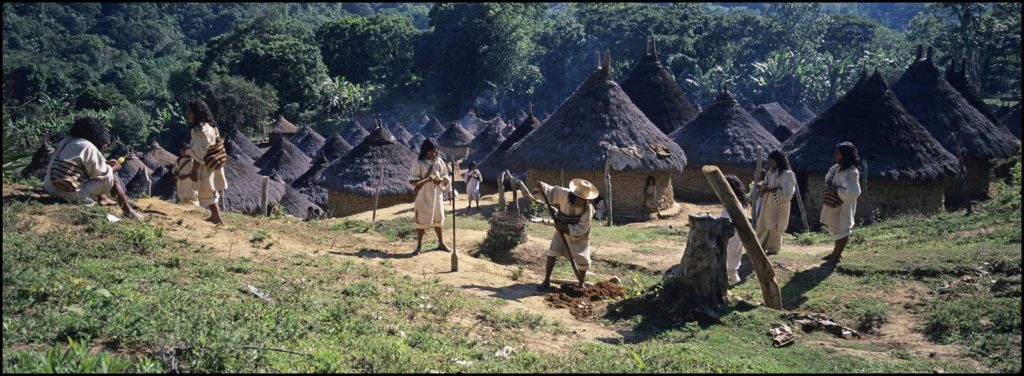

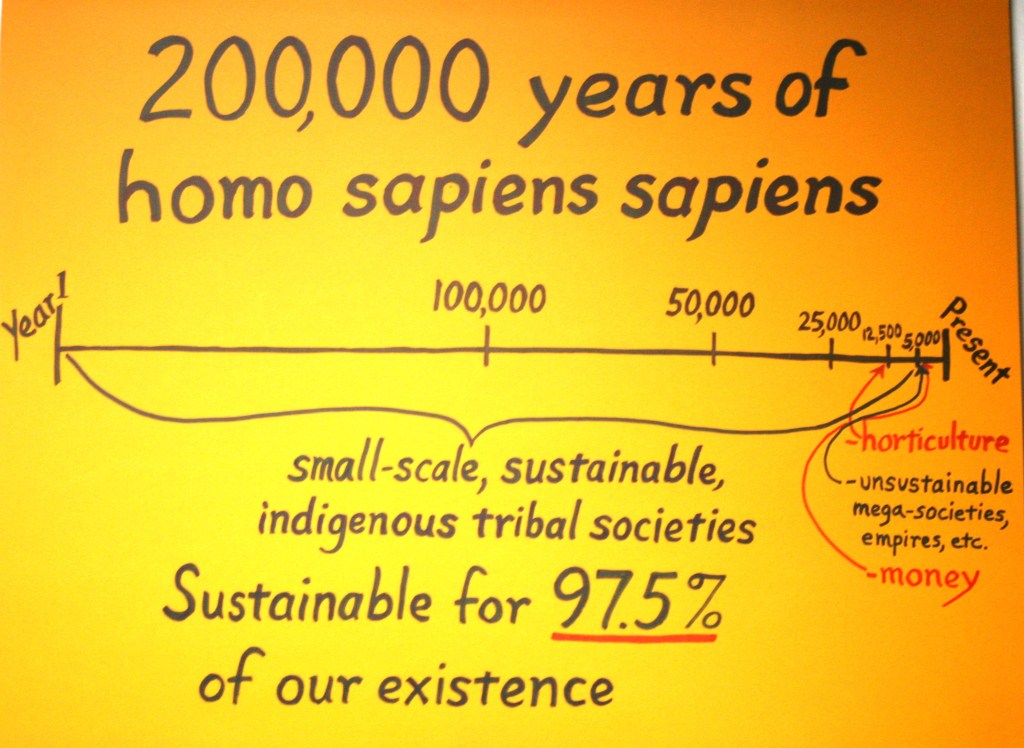


 Learning Earthways
