
This is a “spin-off” from my long, “book-length” essay, Natural Consequences: Reflections on William R. Catton, Jr.’s “Overshoot” and “Bottleneck.” It was also inspired by my webinar presentation for System Change Not Climate Change, which can be found on their YouTube page at https://www.youtube.com/watch?v=7yqPsI2cO08&t=4859s Some people requested that I put these observations into an outline or list format and elaborate upon it further.
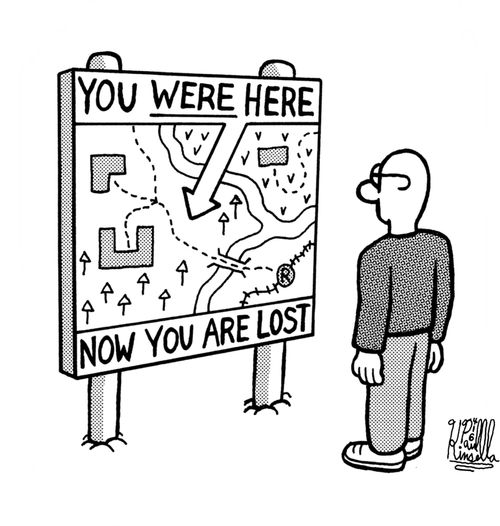
Cartoon illustration by Paul Kinsella. For more about how profoundly lost our species has become due to such a long sequence of wrong turns, see the “Natural Consequences…” essay. There are suggestions for possibly viable, life-regenerative paths forward in the essay, too.
Where, when and how did our species go wrong? Specifically, how did our species become the only species on Earth (out of 10 million) whose customary, normal, daily “way of life” directly contributes to the disabling and destruction of Earth’s life-sustaining, life-regenerating natural system? What were we thinking and doing that led to the long sequence of debilitating activities that have brought us to our current predicament that we apparently cannot stop, even though we know it is bringing many species, including our own, to extinction? Since we, as a species, have not always been living like this, and we used to live in harmony with natural life for about 97% of human history, why did we change? “Radical” means “of the root,” or, “pertaining to the roots.” My radical perspective on human history drives me toward seeking the roots of everything that has transpired and brought us to how we are now, in hope of correction and healing.
Here is a brief outlined summary of the likely sequence of significant wrong turns, although the chronology is probably impossible to confirm and therefore should inspire serious question and debate. Surely, this played out differently within different cultures, at different times and locations. There were probably also some wrong turns that closely overlapped or occurred simultaneously. That is one reason that I did not number this outline and used bullets instead.
- Over-development of the human ego– The first wrong turn was not a physical activity at all. It was an internal, psychological, perhaps spiritual, or mental change. I think that it was a type of over-development of the human ego that creates a sense of disconnection or individual separation from the whole of Life. It was at first a small fracture, leading, over long time and further misdirection, to a severe breaking away from our natural, symbiotic, inter-connected relationship with all parts of Earth’s living system. Although there is a legitimate place and function for self-awareness, and self-significance, that was never meant to overtake or destroy our awareness of connectedness, inter-dependence and reciprocity with all other living beings.
- Loss of gratitude and loss of humility– Are these two wrong turns or one? I think that these might be one example of internal wrong turns that usually happened simultaneously, in the wake of the initial experience of disconnection from Earth’s life system. The oldest teachings, or “Original Instructions,” of Indigenous peoples include many lessons on the importance of gratitude: heartfelt and manifested in the giving of thanks, both as an individual attitude or state of being, and collectively through various group ceremonies. That state of being (being truly thankful), also provides us another protection against distorted ego and disconnection from the Whole: humility. The most significant consequence of those first three internal wrong turns, before any of the major wrong actions taken by humans, was how they led to the internal loss of connection between self and others (of all species). Once that disconnection happens within a person, it is not that far of a leap to go from knowing that you belong to all of life to believing that all that you desire in life should belong to you. At that point of negative transformation, humans began to act out the long sequence of wrong turns, misdirections, bad habits, increasing misconceptions, and unforeseen consequences that brought us to where we are today: the collapse of an unsustainable way of life, built on an unnatural, disconnected foundation.
- Anthropocentrism– the belief that humans are superior in quality and/or value to other species of life and that human needs are more important than the needs of any other species. Anthropocentrism is a direct offspring of self-disconnection and self-centeredness, expanded to include others who are more like one’s self, and it originates in that previously-mentioned state of over-developed ego. The perception that we, as individuals, are not deeply interconnected with and interdependent upon all other living beings acts to devalue the lives of all other beings within our minds, particularly those species that seem to be the most unlike our own species. Anthropocentrism can lead to ethnocentrism and other forms of centering that increase our disconnection to all other living beings. The antidote to anthropocentrism is biocentrism or being Earth system-centered. For more on this topic, I recommend the following two books: “The Myth of Human Supremacy,” by Derrick Jensen, and “Symbiotic Planet: A New Look at Evolution,” by Lynn Margulis.
- The commodification of the gifts of nature. Once a human has “othered” and devalued all other species of life, through disconnection, then all other life becomes mentally categorized as “things,” rather than persons. The so-called “things” of this world are assigned value or “worthiness” by humans based on their usefulness to self or to other humans. If things are determined by humans to be not useful, then such things are considered to be irrelevant or disposable. In a market economy, the gifts of Nature that are considered to be usable or marketable things are called “commodities.” The commodification of Nature combines with anthropocentrism to create the concept of humans “owning” the natural world (or, at least parts of it) and therefore having a “right” to dominate all natural beings and do with them as they please. That presumed right has also extended to ownership and dominance over other humans, by some humans, throughout our history. When humans have made laws against the commodification of other humans, then those who wish to break such laws have created doctrines and beliefs that significantly “other” and dehumanize the humans whom they seek to dominate and exploit.
- Agriculture. It has become popular in recent decades, among the very small minority of humans who even give this topic much thought, to hastily blame something called “agriculture” as the first major wrong turn of humanity. But they typically do not bother to examine or distinguish between what agriculture means today—the large-scale commercial growing of crops for money—and the small-scale, habitat-harmonious cultivation of plants as a regenerative supplement to (not a replacement for) conscientious, Earth-system-regulated, regenerative foraging. Many social theorists, anthropologists and historians have mistakenly assumed that Indigenous peoples completely abandoned hunting and gathering as soon as they discovered their ability to cultivate food from seeds, which was never the case. Even to this present day, the Indigenous peoples who engage in the cultivation and tending of food plants also continue to practice some of their traditional hunting and gathering, to the extent that it is still possible. It seems to me that at some point during the development of the commodity relationship of humans to the gifts of nature, the originally sustainable, supplemental cultivation of seeds into food plants began to exceed the carrying capacity of some local ecosystems and transformed into agriculture. That was another major wrong turn. The commodification of seeds and plants contributed to more anthropocentric license for control over nature, thus greatly increasing the disconnection from interdependence with natural systems. It also contributed greatly to the development of more densely-populated human societies and inequality in wealth and power, especially after agricultural products were monetized for trade markets.
- Dependency on trade. As I have mentioned elsewhere, traditional Indigenous inter-group trade practices, before the commodification of nature and the invention of money, were more of a social bonding and peace-keeping mechanism, rather than a quest for economic advantage over others. The original ways of life, based in maintaining a community’s homeland ecosystem in a sustainable, regenerative manner, provided for the people’s economic needs. Within those settings, trade was not a necessity or means for survival, but, instead a pleasant enhancement of life. “Useful commodities” take on an additional artificial value, and additional alienation from the living Earth system, with dependency on long-distance trade, and even more so, when societies begin to use money. The dependency on trade also creates the delusion of what William Catton called “phantom carrying capacity,” or “ghost acreage.”
- The invention of money and the assigning of artificial value to all life based on monetary values, such as market values and the monetary cost of extracting or otherwise procuring natural materials for the manufacture of marketable products. The cost to non-human nature, or to dehumanized “others” is rarely even considered under monetary economics. Monetary economics creates the potential for extremely disproportionate acquisition of “wealth” and “power” to be wrested into the hands of those who hold the most money, regardless of how they acquired that money. Even when such people are convicted and imprisoned for illegally acquiring money and power, they can avoid serving out their sentences through the intervention of other millionaires, billionaires, or trillionaires who have the political power to set them free. That systemic flaw, which has also spawned many cultural flaws, has created most of the extreme injustice and destruction of natural life that we are dealing with in the world today. But even worse than that is how the human belief in money as the source of life and the key to having all that we need or want has alienated us further and further from the true source of life and well-being (or “wealth”): Mother Earth, Father Sun and their regenerative, perfectly balanced, abundantly-providing life system. People will consistently protect, honor, and cling to whatever they think is the source of their well-being in life. If they recognize that Earth’s life-giving system is the source, then that is what they will protect, honor, and hold dear. If they think that money is the source, then they will enthusiastically, and often aggressively, pursue and cling to that. I wrote at length and in more depth on this topic in the essay on my blog, titled, “The End of Money: The Need for Alternative, Sustainable, Non-monetary Local Economies.”
- The “takeover method” (as William Catton called it) of expanding carrying capacity, which is the origin of another major wrong turn: colonialism, also known as “theft of homelands.” Colonialism also further legitimizes and normalizes the idea of owning land, because colonialists believe that they can unapologetically “own” whatever they can take.
- Militarism as a means for enabling the takeover method and protecting the ill-gotten gains of colonialism. That also coincided with another major wrong turn: slavery and human trafficking (commodification of other humans). The increased dependency on military force (both offensively and defensively) leads to a disproportionate increase in the value of warriors. Since warriors were usually males, the value of women and their diverse social roles coincidentally began to decrease, which is the root of another major wrong turn: misogyny and patriarchy. Coinciding with that, we see the gradual replacement of Earth-based spirituality with male-dominated, state-endorsed patriarchal religions.
- The creation of unsustainable mega-societies—city states, nation states and empires. That wrong turn contributed to denser local populations, which put greater stress on local ecosystems and created more cases of local overshoot, while increasing dependency on trade and agriculture even further. The political structures spawned by these over-populated mega-societies were also a major boost to patriarchy, as the previously traditional democratic councils of both male and female tribal elders became replaced by male autocratic rulers, who were often promoted from the military into political power.
- Economic inequality, rooted in ownership and acquisition of lands and the material gifts of nature by force and by the accumulation of disproportionate amounts of money. That also led to the expansion of hereditary monarchies, as a way of keeping the wealth and power within the families who have acquired it. That caused the old tribal ways of economic sharing and reciprocating to further diminish, throughout the planet.
- Capitalism, a market-centered economic system that legitimizes greed, compels and ultimately demands economic growth, promotes ruthless competition and over-consumption, discourages empathy, and alienates people further from connection to Earth system. Economic inequality, in various locations and contexts, preceded capitalism, but capitalism provided mechanisms to put economic inequality “on steroids.” Privilege and competitive advantage acquired through monetary wealth perpetuates the continual increase in advantage and inequality (“Them that gots shall get…”). The material rewards, and social status generated by the system often do not differentiate between earned rewards and stolen wealth. One exception in the differentiation in social status granted to thieves is the higher status generally granted to thieves who conduct their thievery by deceit, subtlety and sophistry and the lower status granted to thieves who rely more upon simple brute force.
- The Industrial Revolution– The ruthless pursuit of competitive advantage, accelerated by colonialism, was/is a primary motivation for the so-called “technological advancements” that have occurred since the beginning of the Industrial Revolution (about the time of the invention of the steam engine in the early 18th century). Ruthless, predatory competition and over-consumption creates insatiable appetites and destroys gratitude and contentment. The Industrial Revolution also led to the worship or glorification of new inventions or what is often called “human ingenuity.”
- The discovery of fossil fuels, beginning with coal and followed by petroleum, put the Industrial Revolution “on steroids” and accelerated all industrial and economic activity, including all of the other more recent history of human wrong turns that most people are somewhat more familiar with. What is now referred to as “The Great Acceleration” is marked on many “hockey stick” graphs as beginning around 1950, which also marks the approximate year of the turning from the Holocene era to the current Anthropocene era of Earth history.
- The use of electricity. Here is one that is almost impossible for present-day humans to accept as a “wrong turn.” As is the case with fossil fuel power, electrically powered devices have also greatly accelerated extraction of Earth’s material substances, along with production, consumption and waste, leading to the transition from the Holocene era to the Anthropocene, around mid-20th century. The digital era of computers, internet, cell phones and AI, has further transformed human societies and the biosphere itself even more rapidly than all of the previous technologies. Scientific researchers recently discovered that the total weight of all of the materials made and currently used by humans (1.15 trillion tonnes) recently surpassed the total weight of all biological life on Earth (1.12 trillion tonnes)! Humans make up just 0.1% of Earth’s biological life, or “biomass,” and we are just one of between eight and ten million different species of animals. What right do we have to extract and reconfigure so much of Earth’s material substance?
- Social conditioning and pressure to not question the status quo. This one might take us back, “full circle,” to the first wrong turns, since it seems to have been a constant presence in most or maybe all human societies throughout history. It could also have a lot to do with why many students of evolutionary science declare that our species is just not wired for making major changes to our customary patterns of thought, behavior, and “way of life.” The concept of “dangerous” and forbidden questions and the restriction of free speech, combined with the human need to belong to some other humans, has a lot to do with how the unacceptable becomes acceptable, normalized and often nearly inescapable. “Resistance is futile,” they tell us, while resistance to all of the social structures produced by the wrong turns of humanity is the only path forward to real, eco-harmonious life.
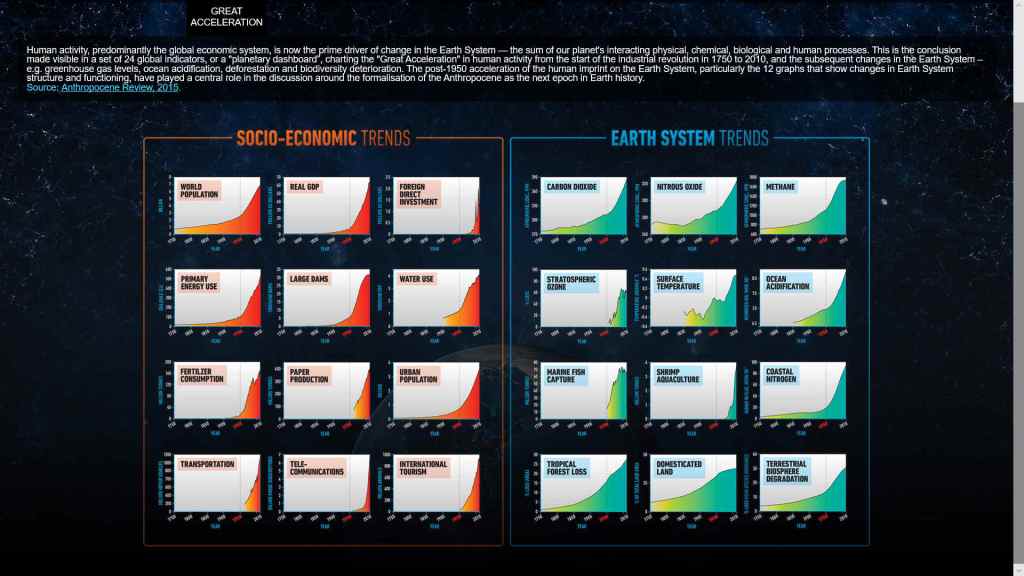
To view an enlarged version of the above image, its description, and source information, right click on the image and select “open image in new tab.”

