Natural Consequences: Reflections on William R. Catton, Jr.’s “Overshoot” and “Bottleneck”


(A little bit of prologue: I began researching for and writing this double book review essay about three years ago. I did not know then that I would not finally complete it and have it ready to post until February of 2025, nor did I know that the collapse of the U.S., the nation I was born and raised in, would occur in that same year. This essay provides a little bit of explanation for that collapse, but mainly tells a much bigger story about the roots of all of the national and biological collapses that are unfolding now, at this climactic moment in human and Earth history.)

(Last edited: July 5, 2025. I just added a brief summary description of each of the “Nine Planetary Boundaries” and corrected a few typos.)

“Wow! This looks like a lot of writing. Where might this ‘rabbit hole’ take me, if I decide to dive in and read it?” This double book review will discuss, explain, and provide some answers to the following questions:

  1. What is the biggest real threat to all life on Earth that we currently find ourselves needing to face and respond to?
  2. How did we arrive at our current predicament?
  3. Why can’t we continue with a growth-dependent, competitive economic system and simultaneously reverse the life-destructive, self-destructive course that we currently find ourselves propelled upon?
  4. Why can’t our available and developing technologies save our customary ways of living and simultaneously preserve Earth’s living system?
  5. Will we ever find a “Planet B” and is it worth sacrificing the only beautiful, generously life-giving planet that we actually still have in a futile attempt to try to find and actually travel to such a place?
  6. What is Mother Earth asking us to consider and to do now? (the most important question of all)

Preface: a statement of purpose and intent

Why am I writing this? Do I think that the facts, analysis and arguments that I present here will change anybody’s (or some significant number of persons’) mind, priorities or actions? Considering the widespread increase in misinformation, combined with the growing cultural tendency (in many human cultures, but especially in the U.S.) to value beliefs over facts and to even ascribe social honor to people who “stand steadfast” in whatever beliefs they hold, regardless of facts, I do not expect whatever I end up writing here to provoke much change. For many reasons, I do not expect that this piece of writing can help much to propel the necessary massive change in human behavior and status quo institutions quickly enough to avoid the severe, life-extinguishing consequences of human ecological overshoot already set into motion and already occurring increasingly all over the planet. Even so, I still feel compelled to make the effort. One reason for that is, based on the experiences of myself and many others whom I know surrounding sudden, tragic loss of the lives of dear ones, I anticipate that the increasing disastrous occurrences that the world is now facing will cause more and more people to ask these three very difficult questions: 1) Why is this happening to us? 2) What could we have done differently to prevent it? 3) What can we do now to move forward, into a better, healthier way of life? I hope that I can provide some degree of comfort or consolation to people by providing some legitimate, fact-based answers to those questions.

Once those first three questions are addressed, another question naturally arises: If people already knew about these things that are happening to our world now and their potential consequences fifty or more years ago, why didn’t they tell everybody and why didn’t governments do more about it back then, when it might have made a more significant difference? Well, many people actually did speak up, explaining the situation and proposing possibly appropriate actions or responses—including, William R. Catton, Jr., the author of the two books discussed in this book review/essay—and many people heard it and began taking some appropriate actions right then, but apparently not nearly enough.

Do I think that answering the “why” questions, even if that could help a large majority of humans come to understand the actual predicament in which we now find all life on Earth, will actually be enough to provoke the actions necessary to significantly slow down or reverse the currently accelerating trajectory of destruction? Probably not, for many reasons that I will elaborate on in the following pages. Nevertheless, I continue to communicate and try to help people around the world prepare for any possibly viable, sustainable paths forward in the face of the collapse of familiar societal structures and regional ecosystems, throughout planet Earth. I do this not because I think that I have any particular powers of persuasion or even any adept abilities with the written word. On the contrary, most of what I have written in the past on these topics seems to mostly inspire doubt, dismissal, and possibly disgust. That might be an overly negative conclusion, but I can only guess at that because very, very few people ever comment upon or engage with me in discussion of my writings at all. Maybe it is just the topic itself that is too repulsive or overwhelming for most people to engage with. Ironically, it is that very phenomenon of all that is unknown—what I do not know about the effectiveness of my attempts at communication and what I actually do not know about future possibilities for life on Earth—that also compels me to continue with my efforts, “just in case.”

Another reason that I keep hacking away at this endeavor is that I just cannot sit back and do nothing while I witness so much suffering (for all species, especially the innocent victims who have not contributed much at all to creating our dire circumstances), or when I consider the possibility that some may be spared some of the pain due to something that I might possibly be able to do or say for them. Beyond the act of writing or the use of words, another thing that I have found I can do that might be helpful is to show people how my family and I have been living and learning with the natural world for most of the last 53 years, especially in the last 20 years. We can teach ways and practices that could be useful and beneficial to humans and simultaneously beneficial to the other living beings whose ecosystems we share, both now and post-collapse. Maybe I am just writing this for some potential benefit for the future survivors.

Diving In: William R. Catton, Jr. and the circumstantial context in which he wrote, Overshoot: The Ecological Basis of Revolutionary Change (first edition published in 1980)

The environmental sociologist, William R. Catton, Jr. (1926-2015), was by no means the only person in the 1970s, researching, analyzing and writing about the actual predicament of life on Earth, but many people writing and thinking on that topic today cite Catton’s Overshoot as the first or most important book that they ever read explaining the real causes and actual severity of our current global ecological crisis. I will cite some of the other writers and thinkers of that era who worked on the same subject in my links, but for now I will just say that the list includes the co-authors (Donella H. Meadows, Dennis l. Meadows, Jorgen Randers, William W. Behrens III) of the groundbreaking 1972 report, The Limits to Growth, and the several works of that decade by Paul R. and Anne H. Ehrlich (post 1968’s controversial, The Population Bomb). As monumental as those works were, many leading ecological writers of the last thirty or so years cite Overshoot as the pivotal or most influential book to help clarify their understanding of our complex, multi-faceted ecological and societal crises. Even so, the vast majority of humans, even those of Catton’s own country (the U.S.), and probably most of those who call themselves “environmentalists,” have never heard of William Catton, his book, Overshoot, or even the concept of overshoot itself! Why is that so? We will discuss some reasons for that in what follows below.


Overshoot was published in 1980 and Bottleneck was published in 2009. I will begin with Overshoot and follow that with a brief discussion of Bottleneck that will include some comparative referrals back to the earlier book. I read the books in that order and found such comparisons to be both fascinating and informative. William Catton was a man of my father’s generation, born in 1926 (one year before my father). Catton was 83 when he self-published Bottleneck and had been retired from academia for 20 years at that time. There were several things that I noticed while reading Bottleneck which probably would never have occurred to me had I not had some experiences similar to Catton’s, within academia, after retirement, in the liberating experience of self-publishing, and in the experience of aging. I will describe and elaborate on some of those experiences and thoughts within that section of this double book review, along with a little more biographical information about William Catton.

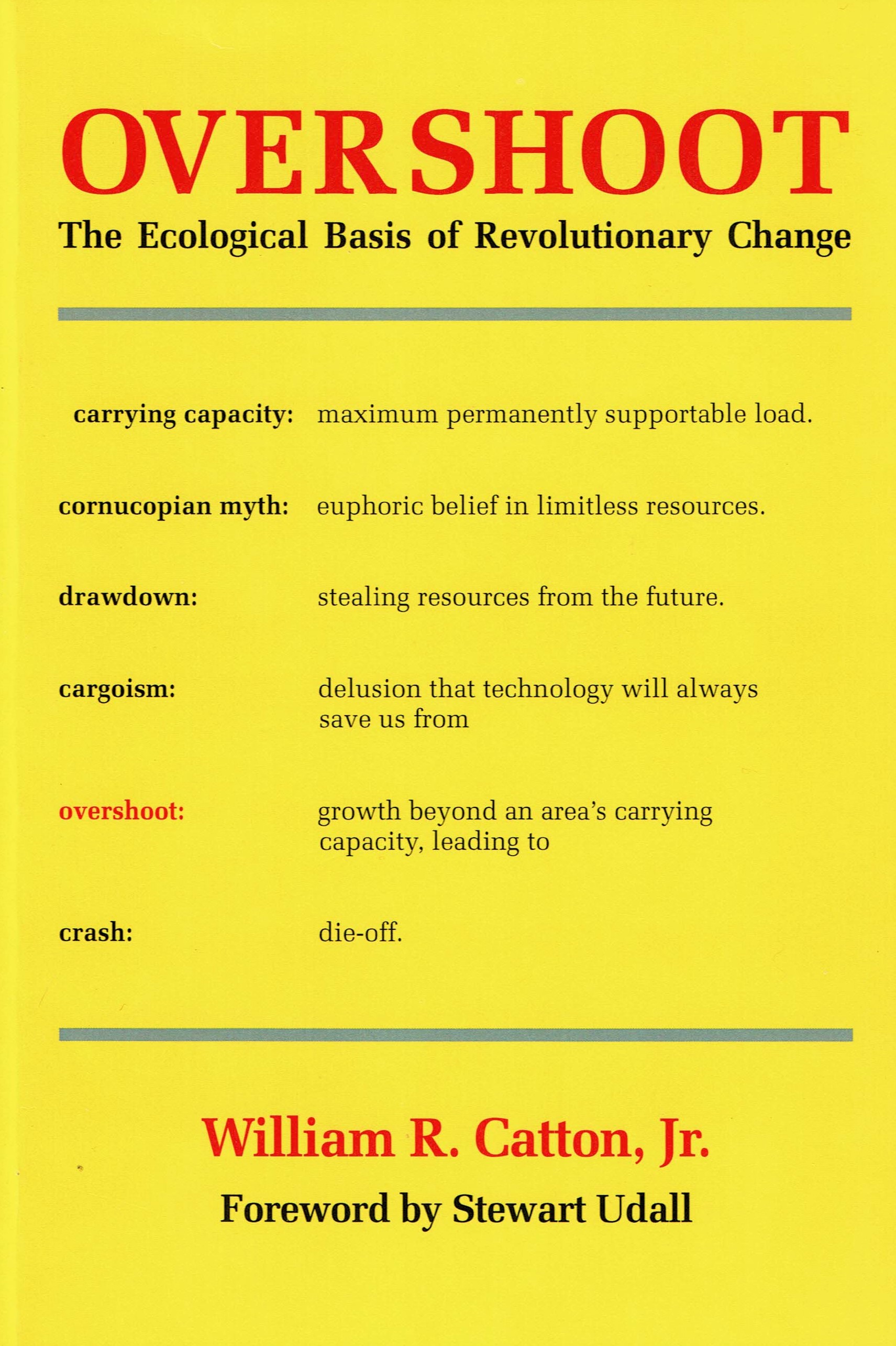
As can be seen in the cover image of the book, Overshoot, it is the only book I know of which begins its text on the cover instead of on its pages within. There, on the cover, we find six extremely important terms, along with their definitions, which are all elaborated upon further in the pages within, and are essential to understanding the author’s main points. While reading this book, long before I had finished it, it became very clear to me that unless a person understands the relevance of those six terms to our current global ecological predicament, they have completely missed the point and do not understand our actual predicament at all! More on that as I go through my analysis of the book and its message.

We also see on the cover the book’s subtitle, “The Ecological Basis of Revolutionary Change.” Sometime after I finished reading the book, while I was contemplating further why Catton had not seen any need to spend much time at all directly critiquing capitalism within its pages (more on this later), I received a possible revelation about that subtitle. I had wondered why Catton had not used the word “for” instead of “of” before the phrase “Revolutionary Change.” After all, he was writing the book during the 1970s, when there was still a good number of people going around proclaiming the need for and justifications for revolutionary change, or for revolution itself. Having been personally acquainted with that movement at that time, I just naturally wondered why Catton had not used that word. Eventually, it became clear to me that Catton was not talking about any type of human-devised revolution. Although humans have contributed greatly to creating the conditions for the “revolutionary” changes which Catton perceived to be coming upon our whole world, he also saw that this revolution was not intended by or consciously devised by humans. The revolutionary changes which Catton foresaw and wrote about in Overshoot are the natural consequences of human excess and misdirection—the violation of natural laws and the exceeding of the carrying capacities of our local and global ecosystems. In a sense, this current global crisis (overshoot and crash) could be described as Earth herself “revolting” against the ability of humans to carry on with their life-destructive ways any further. But it could be more accurate to describe it as Catton did: that finite Earth’s long-ago-established interactive laws, limits and the natural consequences of breaking those laws are the ecological basis of the revolutionary changes to Earth’s life systems that we are now observing with accelerating frequency, intensity and damage, not only to living species and ecosystems, but also to the infrastructures of human societies. The overheating of Earth’s atmosphere, the increasingly intense weather events, the droughts, fires, floods, hurricanes, tornadoes, rising sea levels, ocean acidification, dramatic reductions in biodiversity, and losses of habitat, are all revolutionary changes that have an ecological basis that existed prior to human or anthropogenic violations of natural law. The consequences for those violations were already built into Earth’s system. The early human societies, and many Indigenous peoples to this day, had/have many stories that refer to the “Original Instructions,” or natural laws, including our symbiotic, mutually beneficial relationships with all Earth Life, and warnings about the consequences of violating those laws and breaking those relational connections (more on this later). William Catton perceived that this natural revolution will, ultimately, supersede or overrule any human attempts at either revolution or reforms, or at preserving the societal status quo, and will ultimately determine the limits, possibilities, successes or futility for all human plans and ambitions.


So much for the book cover, the title, and the table of contents. Now we can go on to discuss the rest of the book. 🙂  Don’t worry. Of course this book review will not attempt to cover every page or even every chapter of the book. I only intend to cover some parts of the book which expound upon the six terms on the book’s cover in ways that will address the six vital questions that I raised at the beginning of this book review essay. Along the way, I will bring in material from the works of more recent writers and researchers which have confirmed and expanded upon the findings and ideas that William Catton brought forward so long ago. Citations for those works can be found in the hyperlinks, to help facilitate your own research and further understanding. I think that I should mention here that Overshoot has an index but, unfortunately, Bottleneck does not, probably because it was self-published (I learned from my own self-publishing experience that indexing is a very difficult process and expensive to hire somebody else to do it).

William Catton did not invent the concept of overshoot, nor was he the first to “discover” it. If he were here today, I think that he would agree with me that it is much more urgent for people to understand Earth overshoot than to become familiar with Catton’s biography. Therefore, I will dive right into the topic of overshoot now, and interweave a little more of the relevant biographical information on Catton wherever it seems appropriate within the context of this essay. Probably, the most relevant biographical material would revolve around how he came to see that sociologists should pay more attention to a society’s relationship to the planet upon which we live and depend on for our biological needs, and our interactions with the particular ecosystems where we are located.

Carrying Capacity and Overshoot

Humans can easily understand that a drinking glass has a limit to how much liquid can be poured into it, or the limited number of dinner guests that can be adequately served by the meal that the chef already prepared. But it seems to require exceptional, sometimes strenuous, effort for most humans in this modern, alienated-from-nature world to grasp that a living system as large as Earth can also have maximum limits or capacities. In the first chapter of the book, Catton provides us with a more detailed definition of carrying capacity than the brief one on the book’s cover:

An environment’s carrying capacity for a given kind of creature (living a given way of life) is the maximum persistently feasible load—just short of the load that would damage that environment’s ability to support life of that kind. Carrying capacity can be expressed quantitatively as the number of us, living in a given manner, which a given environment can support indefinitely.

What is not clearly stated in that definition, but is mentioned by Catton elsewhere, is that local ecosystems on Earth (what he calls “environments” here) never contain only one species of life. But, for the purpose of illustration, it is sometimes easier to explain carrying capacity using one species, with certain specific types of behaviors, and then add in other species and behaviors to illustrate the more complex aspects of carrying capacities within actual, bio-diverse ecosystems. Another thing that complicates determining the carrying capacity of a particular place or ecosystem for accommodating human residents is the widely varying behaviors of humans when they are present in an ecosystem. Unlike more compliant-with-nature or behaviorally predictable species, such as deer, for example, whom we can confidently predict will confine their behavior to activities such as grazing, browsing, drinking water, sleeping, protecting their young, etc., and never destroy forests or build parking lots, humans are very different. Some humans might behave very recklessly, selfishly, and destructively in their approach to life and relationships with other life forms in their ecosystem, while other humans can behave nearly as harmlessly as a deer, with a broad spectrum of attitudes and behaviors in between those extremes. Consequently, when attempting to assess or quantify the carrying capacity for humans in a given place, it is essentially important to clarify what types of humans, with which types of behaviors, would be living in that place.

There is one type of behavior that both humans and non-humans can and do sometimes engage in which can very significantly impact the carrying capacity of their homeland: excessive reproduction, to the point of overpopulation. Even if all of the other behaviors of the inhabitants of an ecosystem are compatible with the living system of a particular place, overpopulation by itself can lead to overshoot. When a species has overshot the carrying capacity of their homeland for their particular species, they will eventually run out of food and experience “die-off” or “crash” (extreme population reduction, or local extinction). Some members of the overpopulating species might migrate to another location before crash can occur. Both of those paths (die-off or migration) are ways that Nature brings an overload of a particular species back to a level that is sustainable for local carrying capacity. Most of the disastrous human-caused errors that significantly affected the history of our species, are rooted in humans living in ways that try to mitigate overshoot and avoid death or migration using practices and devices that oppose natural laws and systems. Catton’s books and my comments in this essay will show in some detail examples of how that has occurred. It is also important to realize that the impacts of overshoot caused by one species are never limited to that one species, alone, since all life in any place is interconnected and interdependent to some degree.

What Catton meant in the above definition of carrying capacity, when speaking about an “environment’s ability to support” certain forms of life and their associated behaviors “indefinitely,” is referred to by most people who speak on the topic these days as an ecosystem’s ability to “regenerate” itself, perpetually. That is what ecosystems do naturally, unless one or more of the species residing within the system reaches overshoot, through over-population, over-consumption, excessive production of waste, or some combination of all of those. That brings us to another, or just re-worded, definition of overshoot, found in the glossary at the end of the book:

OVERSHOOT:  (v.) to increase in numbers so much that the habitat’s carrying capacity is exceeded by the ecological load, which must in time decrease accordingly; (n.) the condition of having exceeded for the time being the permanent carrying capacity of the habitat.

At the time that Catton was writing Overshoot, the “increase in numbers,” or human over-population, was at the forefront of the minds of most of the relatively few researchers who were giving overshoot any serious consideration at all. The global human population reached 4 billion in 1974, which was double what it was in 1925 and quadruple the world population in 1805. Although the population doubled again in 2023, hitting 8 billion, the annual global rate of growth (currently, 0.8%) and the global fertility rate (GFR) have both declined significantly over the last several decades and many scientists project that GFR will fall below replacement level (2.1 births per woman—we are currently at 2.3, were at 3.0 in 1992 and 5.3 in 1963) within the next ten to twenty years. As global birth rates have fallen and death rates risen, some demographers estimate that human global population will peak sometime between 2040 and 2080. During the same time that those population dynamics have come into play, human material extraction, consumption, and waste production have continued to rise at very high rates. For example, during the last five decades, in which the population doubled from 4 billion to 8 billion, the rate of energy usage tripled. I will expound on those human industrial and consumptive behavior issues more later, but for now what is important to realize is that overshoot, both locally and globally, can, in some cases, be more a result of human behaviors (what type of humans live in a given location) than just human numbers.

Some scientific methods for looking at and precisely measuring carrying capacity and overshoot have been developed over the last thirty years by the Global Footprint Network, based on work done in the early 1990s by William Rees and Mathis Wackernagel. I do not know those two men personally, but I have heard that their work was inspired in part by William Catton’s Overshoot. Rather than just focus upon CO2, climate change and the “carbon footprint,” GFN collects, analyzes, and publishes data on all human activities that impact the entire regenerative biocapacity of Earth system, in pursuit of answers to the prime question, “How much do people take compared to what the Earth can renew?” Here, from the GFN website, is a brief summary description of the vital work that their organization does:

Global Footprint Network’s key strategy has been to make available robust Ecological Footprint data. The Ecological Footprint continues to be the only metric that comprehensively compares human demand on nature against nature’s capacity to regenerate. It is based on simple, straightforward accounting – not on arbitrary scoring. Since its inception, Global Footprint Network has calculated Footprints of countries for each year that UN data has been available. Since 2019, these national calculations are produced by York University under the governance of the Footprint Data Foundation (FoDaFo). Currently the accounts cover 1961 to 2022. Together with partners, we, and now FoDaFo, have made every annual edition more transparent and more accurate. This has included rigorous reviews by government institutes and advisory committees, including the Science Advisory Council of FoDaFo.

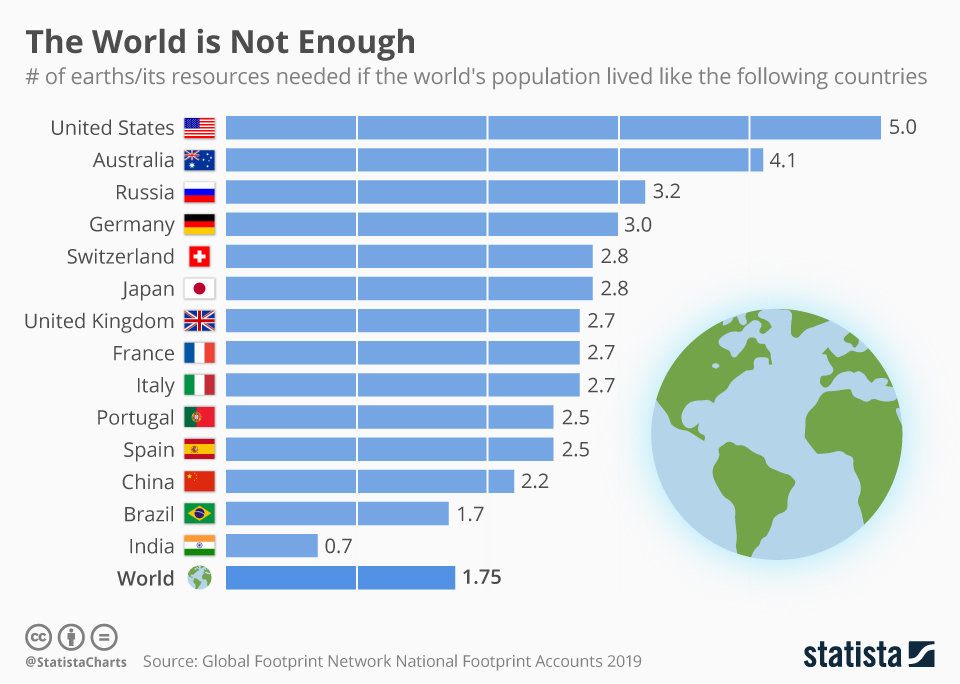
What I find most useful about the work of the Global Footprint Network, for clearly communicating to people the depth of Earth’s current crisis, is their calculations regarding how many additional planet Earth’s we (all of humanity) would need to maintain our current human behaviors, or “ways of life,” and simultaneously allow our biosphere to regenerate its life systems (if that was even possible). Currently, from their 2023 report, the most recent number that the GFN has computed for that is 1.75 planet Earths, for all of humanity combined. What does that mean? When we overshoot Earth’s ability to regenerate at the pace that we are extracting and consuming from her and to process and absorb the many megatons of waste, of all kinds, that we are excreting upon her lands, waters, and atmosphere, biological life on Earth is gradually destroyed. If Earth’s ecosystems are not allowed to regenerate, they then begin to degenerate. Natural life does not remain static. It keeps moving along, fulfilling its particular symbiotic purposes, or it decays and dies (which fulfills another symbiotic purpose, unless deaths become excessive). In light of that biological reality, a vital question that the GFN and other ecological researchers are probing is how much overshoot can our planet and our species take? How long can Earth accommodate our species with an eco-footprint of 1.75, 2.0 or 2.5 Earths?

The GFN also has provided us with figures for the ecological footprints of over 200 individual nations, which vary greatly, and the number of Earths needed for the whole world to live in the average manner of the people of each particular nation. Notably, the number of additional Earths needed will always increase, as long as our species continues to live in ways that require additional growth in consumption, production, waste, and population. GFN has compiled and made freely available detailed data on that and many other factors contributing to overshoot, sorted by country, individuals, cities, corporations, and other categories. Here (below) is a chart with summaries of the footprint data from 14 of the over 200 countries studied. The complete list and detailed breakdowns of the data can be found on their website.
The following GFN chart is a timeline showing at what point our species reached and then exceeded planetary overshoot (about 1969-70), with the types of human over-consumption and excess waste compiled into six, color-coded categories:
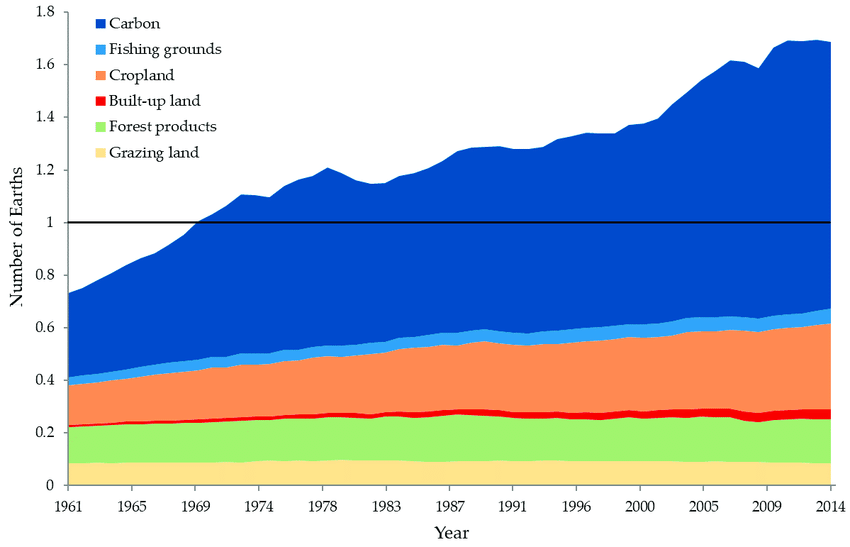
While the data accumulated and reported by the GFN is much more extensive and detailed than what appears in that chart, the chart clearly suggests that CO2 emissions are the largest single contributor to Earth overshoot. Industrial petro-chemical agriculture (labeled here as “cropland”) plays the next largest role and the trajectories for both of those contributors continue to rise now, in 2025. Another category of human activity that continues to expand and increasingly contribute to overshoot is the item on the chart labeled “built-up land” (the red section on the chart). It seems that there must be some better label for that, but what “built-up land” refers to is all of the land that is transformed by humans from natural or wild habitat into infrastructure for human social habitat, such as new buildings, paved roads, parking lots, waste treatment facilities, factories, etc. Maybe the phrase should be “additional human infrastructure projects,” or the “de-naturalization of land.”

Seeing on the GFN timeline chart how large a role “Carbon” (the blue area) plays in overshoot, a not-fully-informed, “green” technology optimist might speedily conclude that all we need to do is switch from fossil fuel burning energy use to electric energy devices, in order to live regeneratively, in synch with our one Earth. What is generally overlooked or intentionally ignored by such simplistic, wishful thinking is how much fossil fuel-powered industrial equipment is currently necessary and preferred by industrial capitalists (mainly for competitive reasons) in order to mine the materials, conduct the manufacturing, transport, install, and maintain the enormous “green” energy infrastructure that would be necessary to continue with our unsustainable, over-consumptive, and ever-growing “needs.” Nearly all of the factors contributing to overshoot have been made possible by the enormous industrial, economic and technological infrastructure that has been powered increasingly by fossil fuels over the last 250 years, as William Catton details in his books and we shall discuss further, below. There is a considerable amount of human impact on Earth’s life-giving systems that is not mentioned or accounted for in this chart, like impacts from mining, pollution of surface water sources, and the drawdown of underground aquifers, just to name a few. If those and many other anthropogenic (human-caused) impacts were included in the chart, the blue “Carbon” area would make up a much smaller proportion of the whole, and thereby provide us with a more accurate picture of the causes of ecological overshoot.

The GFN openly acknowledges the gaps and shortcomings in their data collection process, and they say that most of that is due to their long ago decision to rely completely upon United Nations scientific data, in order to avoid suggestions of bias or “cherry picking” data that supports pre-conceived notions. Consequently, another limit that proceeds from that decision is that the UN data only covers impacts from human use demands upon the “biosphere’s (or any region’s) regenerative capacity.” Human demands and impacts upon Earth’s non-renewable or non-regenerative resources found in the geosphere, such as fossil fuels and rare metals, along with many other chemical and mineral entities, are not included in that data set. Neither are the needs of and uses by non-human beings who share the same ecosystems and regions with the humans. The GFN therefore encourages people to look to other research data sources to fill such gaps and they welcome criticism and communication on how they might improve their work. (Ecological Footprint Accounting: Limitations and Criticism, Global Footprint Network research team, 1 August 2020 – Version 1.0) The GFN recently formed a collaborative partnership with York University in Canada which they expect will greatly improve their ability to do more robust research on overshoot and the Ecological footprint and continuously fill more of the data gaps. Regarding the limited data that they have had to work with up until this recent change, the GFN made this potent realization: “…the real biocapacity is even smaller than our estimates. On the Footprint side, not all demands are included because not all are documented in UN accounts. Hence the real footprint is larger.”

Before I return to directly examining William Catton’s books, I will briefly describe another university-affiliated research center with an even larger number of researchers probing into anthropogenic impacts on Earth system that are contributing to overshoot. I am referring to the Stockholm Resilience Centre at Stockholm University in Sweden. There are many new “climate studies” programs springing up at universities around the world, but the GFA program at York and the SRC at Stockholm are the only two programs that I know of which are focused on Earth system overshoot, instead of just climate. I hope that there are actually many more than just those two, or that there will be soon. Some urgent questions that researchers need to explore and publish data for, ASAP, include:

  • How much fossil fuel will likely be burned (globally) in the attempt to mine, manufacture and install so-called “green energy” infrastructure replacements for fossil fuels?
  • What is the extent of damage to Earth’s life system, to date and annually, being perpetrated by the mining industry and how much might that increase through a global “green energy” transition?
  • What is the extent of damage to Earth’s life system, to date and annually, being perpetrated by the smelting of steel, copper, cement, and glass?
  • At current rates of increase in industrial activity, globally, by what near-future year (or decade) will we have made certain that the “Sixth Great Mass Extinction” will occur? (Have we already reached that point?)

The SRC has identified nine categories or types of ecological processes that “are critical for maintaining the stability and resilience of Earth system as a whole.” Those nine categories, commonly referred to as the “nine planetary boundaries,” are identified in the chart below and defined in detail in their reports. As of August, 2023, SRC research and analysis has found that human activities impacting Earth system have now exceeded what they call “the safe operating space for humanity” in six out of the nine categories. As stated in their 2023 report:

The planetary boundaries framework delineates the biophysical and biochemical systems and processes known to regulate the state of the planet within ranges that are historically known and scientifically likely to maintain Earth system stability and life-support systems conducive to the human welfare and societal development experienced during the Holocene. Human activities have now brought Earth outside of the Holocene’s window of environmental variability, giving rise to the proposed Anthropocene epoch.

Earth system is a dynamic, life-sustaining, regenerative interaction between the geosphere, the biosphere (which includes what we could call the “aquasphere?”), and the atmosphere, along with the vital contributions from the sun and our moon. Before about 1950, humans were simply part of the biosphere, but around that point in time human impact upon Earth system had become so significant that it was (and is now) a powerful force in determining Earth system’s continued functional well-being. Some people (both scientists and non-scientists) now refer to this phenomenal magnitude of impact as the “anthroposphere.” Unlike the other spheres of Earth system, the anthroposphere is much more destructive to life than sustaining or regenerative in its impact. To only assess the well-being of Earth system by measuring the CO2 content of Earth’s atmosphere (as many now seem content to do) ignores and obfuscates the extensive damage being done by humanity to Earth system as a whole. The following recent chart by the Stockholm Resilience Centre illustrates the nine planetary boundaries and does a much better job than the GFN chart above of showing which aspects of overshoot are causing the most harm to life on Earth, and what greater dangers and losses lie ahead:
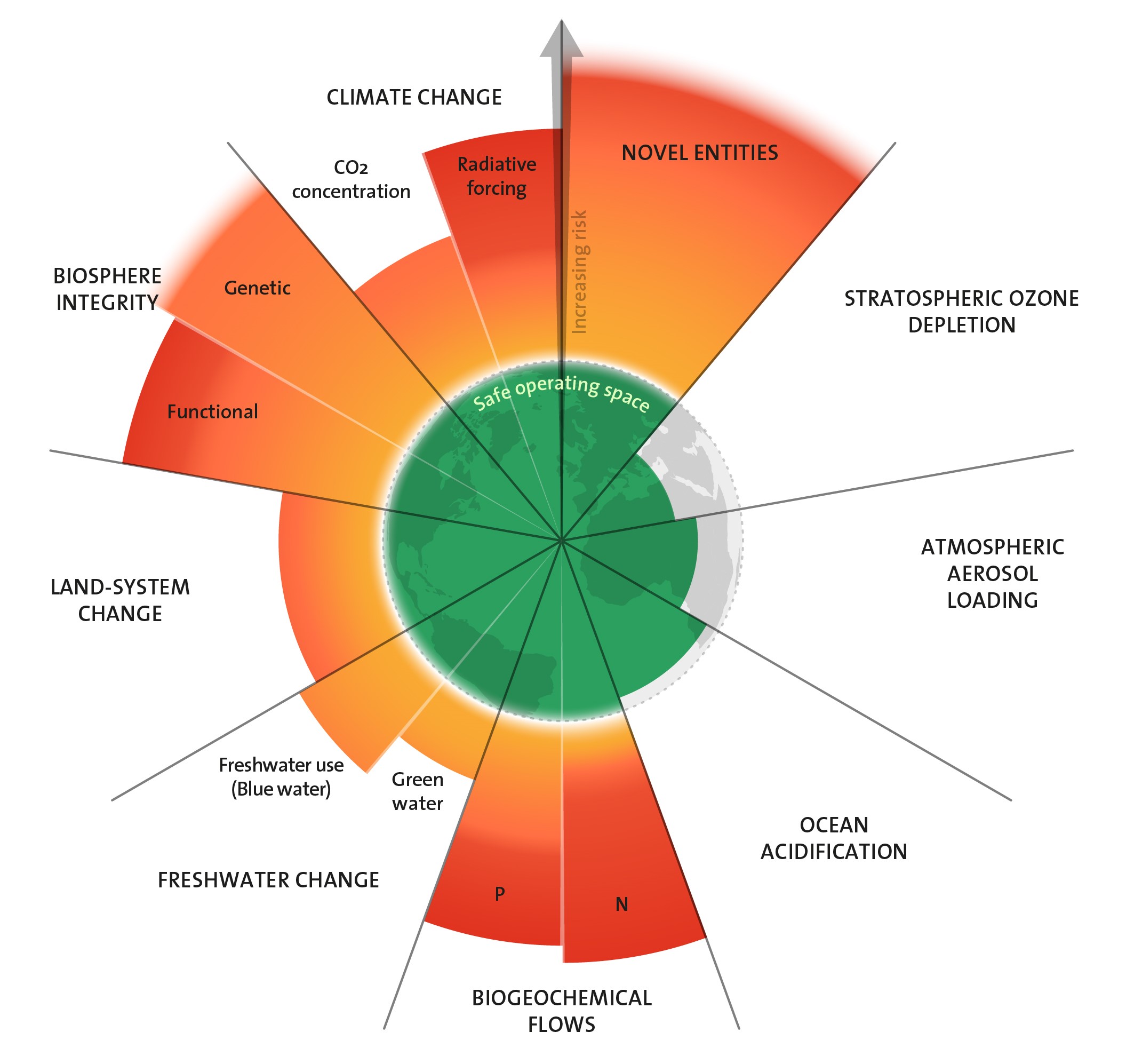
Credit: “Azote for Stockholm Resilience Centre, based on analysis in Richardson et al 2023

Here is a brief summary of the 9 planetary boundaries and how far we have exceeded or are close to exceeding each one:
Biosphere Integrity, Climate Change, Novel Entities, Stratospheric Ozone Depletion*, Freshwater Change, Atmospheric Aerosol Loading*, Ocean Acidification*, Land System Change, Biogeochemical Flows
*= the three boundaries that have not yet been transgressed

1. Biosphere Integrity-

This boundary is perhaps the most significant and also happens to be the one that humans have exceeded to the furthest extent. According to the scientists who authored the planetary boundaries report: “The planetary functioning of the biosphere ultimately rests on its genetic diversity, inherited from natural selection not only during its dynamic history of coevolution with the geosphere but also on its functional role in regulating the state of Earth system. Genetic diversity and planetary function, each measured through suitable proxies, are therefore the two dimensions that form the basis of a planetary boundary for biosphere integrity.” The most obvious indicators of violation of this particular planetary boundary are the rising extinction rate and the loss of biodiversity throughout our planet. According to the authors, “Of an estimated 8 million plant and animal species [other scientists estimate between 9 and 10 million species], around 1 million are threatened with extinction, and over 10% of genetic diversity of plants and animals may have been lost over the past 150 years.” Those facts do not mean much to most modern humans, who are not aware of the symbiotic connections, interrelatedness, and interdependency of all life. Prevailing human cultures tend to believe that life consists of unrelated individuals (among all species) who live in a state of ruthless, predatory competition with each other. The concepts of “survival of the fittest,” unregulated capitalism, anthropocentrism, and racial supremacy are all compatible with that belief paradigm of separateness and disconnection. Scientific researchers recently discovered that the total weight of all of the materials made and currently used by humans (1.15 trillion tonnes) recently surpassed the total weight of all biological life on Earth (1.12 trillion tonnes)! Humans make up just 0.1% of Earth’s biological life, or “biomass,” and we are just one of between nine and ten million different species of animals. What right do we have to extract and reconfigure so much of Earth’s material substance? To return to a way of life that is conducive to biosphere integrity, humans need to find out what would actually be our sustainable, regenerative share of Earth’s material substance and return to a one Earth footprint manner of living.

2. Climate Change-

This planetary boundary is currently the most popular, or well-known. For most present-era humans it is the only one of the 9 boundaries that people are aware of or concerned with (with the possible exception of some types of toxic pollution, such as water, air and plastics, which are covered in a few of the other planetary boundaries, such as “Novel Entities” and “Freshwater Change,” as we shall soon discuss). Why are people more comfortable dealing with Climate Change than the other planetary boundaries? Could it be because the capitalists have convinced them that it is solvable through buying more manufactured technological products (solar panels, lithium batteries, windmills, etc.) that would thereby allow them to keep their over-consumptive, addictive way of life?

The evidence that we have blown way past this boundary is abundant: 430 ppm CO2 in the atmosphere, and rising, when the safe zone max is 350 ppm; we have surpassed 1.5 degrees C warmer than pre-industrial era avg. temps; breaking more and more temperature records every year; ocean warming; coral ecosystems dying; increasing weather catastrophes and anomalies; loss of habitat forcing migrations and extinctions; permafrost and glaciers melting; sea levels rising; acceleration of symptoms; tipping points, etc.

3. “Novel entities”-

What this boundary refers to is “truly novel anthropogenic introductions to Earth system. These include synthetic chemicals and substances (e.g., microplastics, endocrine disruptors, and organic pollutants); anthropogenically mobilized radioactive materials, including nuclear waste and nuclear weapons; and human modification of evolution, genetically modified organisms and other direct human interventions in evolutionary processes. Novel entities serve as geological markers of the Anthropocene However, their impacts on Earth system as a whole remain largely unstudied. The planetary boundaries framework is only concerned with the stability and resilience of Earth system, i.e., not human or [individual, particular, local] ecosystem health. Thus, it remains a scientific challenge to assess how much loading of novel entities Earth system tolerates before irreversibly shifting into a potentially less habitable state.”

Humans will never be able to create or form something out of nothing, but (unfortunately?) we can extract or gather materials from Earth and transform them into something that does not exist in that form naturally, or without human intervention. Such things are what these scientists call “novel entities.” The creation of novel entities is more impactful than the combining of particular materials commonly used as food in new ways, or inventing recipes. Novel entities are wholly original anthropogenic substances that have been introduced by humans into Earth system that have the potential to alter or interfere with the proper, life-sustaining functions of Earth system and its component ecosystems. Anthropogenic materials that are non-biodegradable are prime examples of that, as are the hundreds of thousands of synthetic chemicals that are routinely produced by human industry and released into the environment. Recent scientific research has revealed to us what might be the most pervasive and highly destructive type of “novel entity” on our planet: PFAS, which stands for Polyfluoroalkyl substances, a combination of carbon and fluorine, the strongest bond in chemistry. PFAS were invented in the early 1940s for the purpose of safely containing uranium in nuclear bombs. They are the most unbreakable, non-biodegradable materials created by humans yet, and so widely-used in manufacturing all types of products, that they have dispersed into air, water, and the bodies of all living organisms. These poisons are also found in our blood, giving us cancers and a host of other diseases. Just like pharmaceutical companies putting new drugs on the market that have not been adequately tested for safety, diverse other industries have long been digging up all kinds of things from under Earth’s surface, combining them, smelting them, and otherwise transforming them into all sorts of unnatural forms, without much regard for potential harm or any respectful consideration of what Earth would rather have us do with those things—like just leave them in the ground where they have always belonged, playing their own particular necessary roles in the functions of Earth system. The belief that there are “things” within or upon Earth’s surface that are “doing nothing,” or are worthless until humans devise some use for them is one of the most significant conceptual errors in the whole history of our species. Along with the conjoined belief that humans can just do whatever they want to non-human “others,” tremendous harm has been done.

I cannot think of any novel entities that are confirmed to be ecologically benign. As the scientists said, “…their impacts on Earth system as a whole remain largely unstudied.” So, it is difficult to assess how far this planetary boundary has been exceeded, but the scientists suspect that the violation has been very substantial, just based on what little we do know about the damage that has been done to life on Earth by these entities, especially PFAS, plastics, nuclear radiation, and genetically modified organisms. 

The recommendation of the report’s authors is, “…for novel entities, then, the only truly safe operating space that can ensure maintained Holocene-like conditions is one where these entities are absent unless their potential impacts with respect to Earth system have been thoroughly evaluated.” In other words, don’t mess around with Earth’s gifts without permission from Earth, especially if you have no idea what the heck you are doing, or the harm that the consequences of your actions might cause!

4. Stratospheric ozone depletion-
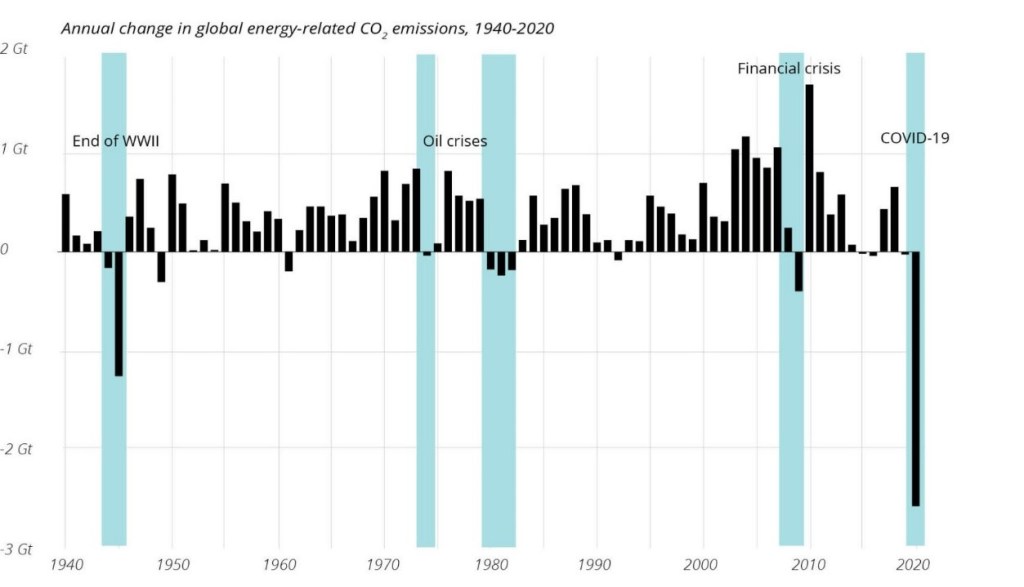
This particular planetary boundary is the only one that was previously exceeded (about 40 years ago) and has since been corrected to a level slightly below the boundary. According to the authors, “Stratospheric ozone depletion is a special case related to the anthropogenic release of novel entities where gaseous halocarbon compounds from industry and other human activities released into the atmosphere lead to long-lasting depletion of Earth’s ozone layer.” Unlike some other attempts to mitigate exceeding of planetary boundaries, such as using solar panels and wind turbines, the threat to Earth’s stratospheric ozone later was successfully reduced to a safe level without resorting to the use of assumed technological “fixes.” Instead, due to an international cooperative agreement made in 1987, the emissions of gaseous halocarbon compounds was reduced by actual reduction in the use of materials that produce those compounds. The mitigation was accomplished by actually ceasing to continue with the human behavior that created the problem in the first place! What a novel, brilliant idea! Why don’t we try that type of mitigation on the climate problem? The trajectory of release of CO2 into the atmosphere has only moved downward twice in this 21st century: during 2008, when the global economic crisis greatly reduced industrial economic activity, and for a few months in 2020 during the economic activity reduction due to the Covid 19 pandemic. Shutting down and ceasing to continue with toxic industrial activity is the only solution that has proven to work toward reversing (not just slowing down) the rise in atmospheric carbon!

5. Freshwater change-
The planetary boundary called “freshwater change” is concerned with anthropogenic modifications of Earth system functions of freshwater, in particular with deviations from pre-industrial, Holocene era normal extent of variability. The scientist who study and assess this boundary consider changes across the entire water cycle over land. They have divided freshwater into two categories: “blue water” (surface and groundwater) and green water (plant available water found in root-zone soil moisture). “The green water component directly accounts for hydrological regulation of terrestrial ecosystems, climate, and biogeochemical processes, whereas the blue water component accounts for river regulation and aquatic ecosystem integrity. Both components, due to anthropogenic interference, transgressed their planetary boundary safe zones, early in the 20th century. In the United States, before the Clean Water Act was passed in 1972, it was customary for all kinds of industrial manufacturers to dump their waste materials into nearby rivers, lakes, or the ocean.

6. Atmospheric aerosol loading
Atmospheric aerosols are fine particles of various types in the atmosphere, which, in certain quantities, can impact Earth system. Aerosols occur in the atmosphere naturally, from sources such as dust storms, smoke and soot from forest fires, and ash from volcanic eruptions. Anthropogenic aerosols are the particulate matter cast into the atmosphere by human industrial, domestic, and recreational activities, which includes items like smoke, exhaust, evaporated liquid waste products, dust, and airborne “novel entities.”
One common impact on Earth system caused, at least in part, by an overload of aerosols in a region of the atmosphere is disruptions and reductions in annual monsoon rains. Between 14,000 and 5,000 years ago, the Sahara Desert was a well-vegetated region with forests, wetlands, and many lakes. It is now the largest source of atmospheric dust on our planet, and the least conducive region for supporting biotic life. What happened there? Desertification has both natural and human (or anthropogenic) causes, which can create a reinforcing cycle of feedbacks. The natural ways that can occur include severe drought that causes vegetation die-off, leading to an increased chance of wildfires, which put the aerosols smoke, ash, and soot into the atmosphere. Lack of vegetation (which becomes exacerbated by animals over-grazing the reduced supply) and extreme drying of the soil creates more dust, another aerosol blown into the atmosphere by wind. To complete the cycle, the heavily-increased amount of aerosols in the atmosphere disturbs, reduces, or even cancels the annual monsoon season, leading to more drought, etc. That, along with a little bit of anthropogenic activity, like the use of fire, is probably how the Sahara became a desert.

Since the beginning of the industrial era, a whole slew of additional anthropogenic contributions to aerosols in the atmosphere has led to the desertification of many regional areas around the world. Global heating, as a result of increased CO2, has also played a major role in desertification. Ironically, the increase in aerosol particles in the atmosphere has also had a slight muting effect on the increase in global warming. The planetary boundaries scientists have tentatively concluded that we are still in the “safe operating zone” for atmospheric aerosol loading, while cautioning us that there is much more that needs to be discovered and applied for this topic (such as anthropogenic impacts on the natural production of aerosols). The scientists make many such statements about the uncertainties due to so many unknowns about the interactive functions of Earth system in their discussions of each of the nine planetary boundaries. Earth system science is still a relatively new academic field of study. That makes me wonder if the human species is about to exit the realm of life on Earth just when we are on the verge of learning so much more about how Earth system actually operates. But can knowing, alone, change our ways of being?

7. Ocean Acidification
Ocean acidification is one of the three boundaries that the scientists estimate have not yet been surpassed. Of those three, ocean acidification appears to be the closest to being transgressed next. To measure anthropogenic contribution to ocean acidification, the control variable that the scientists use is the carbonate ion concentration in surface seawater. They tell us that, “anthropogenic ocean acidification currently lies at the margin of the safe operating space, and the trend is worsening as anthropogenic CO2 emission continues to rise.” It was just reported today that atmospheric CO2 just reached 430 ppm. 350 ppm is the safe limit for that, and the trajectory under the machine of industrial technological civilization is continued acceleration.

8. Land System Change
This is the one about the importance of the trees. According to the authors of the report: “This boundary focuses on the three major forest biomes that globally play the largest role in driving biogeophysical processes, i.e. tropical, temperate, and boreal. The control variable remains the same: forest cover remaining compared to the potential area of forest in the Holocene.” Deforestation is the key indicator in measuring that this boundary has been clearly transgressed. One of the best examples is that the Amazon forest recently (2023?) moved from being one of Earth’s largest carbon sinks to now being a source for CO2 emissions. According to these scientists, deforestation has been ongoing in most forested regions on Earth since 2015. With the help of satellite images, which are used to make land cover classification maps, this planetary process is rather easy to observe and analyze. Land use conversion, for industrial and agricultural access to Earth “resources,” and for creation of more human urban habitat, are the primary causes of deforestation, besides the increase in wildfires.

9. Biogeochemical Flows
I will begin this one by quoting directly from the report: “Biogeochemical flows reflect anthropogenic perturbation of global element cycles. Currently, the framework considers nitrogen (N) and phosphorus (P) as these two elements constitute fundamental building blocks of life, and their global cycles have been markedly altered through agriculture and industry. Anthropogenic impacts on global carbon cycling are equally fundamental but are addressed in the climate and biosphere integrity boundaries. Other elements could come into focus under this boundary as an understanding of human perturbation of element cycles advances. For both N and P, the anthropogenic release of reactive forms to land and oceans is of interest, as altered nutrient flows and element ratios have profound effects on ecosystem composition and long-term Earth system effects. Some of today’s changes will only be seen on evolutionary time scales, while others are already affecting climate and biosphere integrity.”

The greatest harm done by these anthropogenic releases or flows of phosphorus and nitrogen is the eutrophication of freshwater ecosystems. Eutrophication occurs when excessive buildup of nitrogen and phosphorus in freshwater systems generates excessive reproduction of algae and aquatic plants to the point where oxygen is greatly reduced in the water, causing die-off of fish, aquatic insects, shellfish, and many plants. This process has been long in play throughout the world, caused mostly by runoff from chemicals used in agriculture, but also from industrial pollution. Scientists estimate that this planetary boundary has been exceeded globally and in many locales since about 1988 and it is now the second most transgressed of the planetary boundaries, after biosphere integrity. Novel entities is in third place, followed by climate change (fourth), land system change (fifth), and fresh water change (sixth). Of the three planetary boundaries that are still in the safe operating zone, it appears that ocean acidification will most likely become the seventh planetary boundary to be crossed, since it is now just barely in the safe zone. Considering how long it takes for scientific data to be analyzed and results to be verified, along with how rapidly human-caused biosphere degeneration is accelerating, the ocean acidification boundary might already have been transgressed.

Regarding the possibility for mitigation or healing of a transgressed planetary boundary, there is one very important point that we need to be deeply aware of. Due to the interdependent relationship of all nine aspects, or “boundaries,” within Earth’s symbiotic living system, it will never be enough to only mitigate one, four, or even five of the six planetary boundaries that have already been breached. Because of their interconnectedness, and the fact that, as these scientists say, all 9 aspects or processes of Earth system “are critical for maintaining the stability and resilience of Earth system as a whole,” we need to live ways of life that will maintain the safe operating functions of all nine. If our species continues to live in ways that keep us on, or recklessly accelerate, our path of destruction of our only viable planet home, and we eventually violate all nine planetary boundaries, we will not be able to return to Holocene era, pre-industrial safe operating conditions if we only mitigate eight of the boundaries. If we do not mitigate or restore all nine, all of the other boundaries would be affected and eventually atrophy back into their previously transgressed state.

In many scholarly and journalistic articles over the last three or four years, I have observed a steadily increasing awareness about overshoot and the need to greatly reduce and/or abandon much of our production, consumption, and waste, rather than try to maintain current levels or continue to increase them while somehow “switching” to the use of electronically powered technological devices. No matter what we power it with, human overshoot of Earth’s carrying capacities will ultimately lead to crash and mass extinctions, if we do not cease from the behaviors and technologies that generate overshoot. We also have not yet even invented (much less actually produced) the types of electronic technological devices or machines that can “successfully” replace, compete with, or surpass the power density levels that are available to industrial extraction, manufacture, and transport through burning fossil fuels. In an economic system and culture that demands aggressive competition in nearly every human endeavor, and prioritizes competitive economic success over the survival of natural life systems, humans bound to such systems and cultures will continue to use fossil fuels until they simply are no longer available, or their way of life has completely crashed, whichever occurs first. As the crisis of overshoot becomes more acute and undeniable, we shall likely soon see data on our actual predicament published everywhere, along with the predictable, desperate attempts to refute, misinterpret, censor or suppress the information. Unfortunately, human beings who favor beliefs and personal comfort over factual, scientifically-proven reality have an incredible ability to deny just about anything.

William Catton’s transformation into an environmental sociologist

Now, back to Catton and his books (more directly, that is—I actually never really left that). As can be seen in the 2014 GFN chart, it is estimated that we reached Earth overshoot, or what one planet Earth can handle from our unsustainable human behaviors, around 1969. The first “Earth Day” in the U.S. took place shortly thereafter, on April 22, 1970, more as a response to recent horrific incidents of industrial pollution (including the massive oil spill on the coast of Santa Barbara, California in January 1969, and the polluted Cuyahoga River near Cleveland, Ohio catching on fire during the summer of that same year) than any significant public awareness of overshoot. This brings us to some observations about the social, professional and experiential context in which William Catton began researching and writing Overshoot, around that same time. Since no book-length or complete biography of Catton’s life exists, my ability to interpret Catton’s response to that context is limited mainly to what we can find in his own writings and in a few interviews. The most revealing account of Catton’s transition from “mainstream” sociologist to eco-sociologist during the early 1970s was written by himself and published in 2008, in an academic journal called, Organization & Environment. The title of the article is, “A Retrospective View of My Development as an Environmental Sociologist.”

William Catton was a professor of sociology at the University of Washington, from 1957 through 1969, a time of enormous change in U.S. social culture (as it also was in other similar societies), mostly in the area of reassessing and attempting to correct deeply-rooted, long-standing societal injustices. The academic field of sociology was understandably focused on those types of issues, both then and long since then. As awareness and concern for environmental issues rose in the late 1960s and early 1970s, progressive social activists and sociologists who were engaged with the two most vital issues that preceded the environmental movement—anti-racism and anti-war—sometimes suspected that environmental concerns were a distraction from those issues, which seemed so much more important to them at that time. Some people thought environmentalism might even be an intentional decoy devised by their opponents. Besides paranoia, perhaps the primary reason for that was Americans and most citizens of modern western societies during the 1970s, whether on the political left or the political right, were anthropocentric in their world view, as the vast majority still are today. Anthropocentric people see human need issues as being of higher priority than issues concerning the well-being of the vast multitude of other species in the natural world, and they generally fail to understand that the basic, essential biological needs of all living beings who share this planet are symbiotically intertwined. Besides being anthropocentric, being urbanized and alienated from nature leads some people to prioritize human justice and relational issues over seemingly abstract concerns regarding a nebulous something called “nature” or “the environment.” When such people are concerned about environmental issues, they generally lean towards “environmental justice” issues, such as impacts from industrial toxic waste deliberately occurring disproportionately in communities of color. In light of that piece of socio-cultural context, I wondered if Bill Catton had ever been criticized or verbally attacked during those times for his attempts to move the field of sociology in a more environmentally-focused, or at least “environmentally aware,” direction. If such conflict did indeed occur, nothing in Catton’s “Retrospective View” article mentions it, even though he does elaborate upon several reasons why he was compelled to resign from his position at UW in 1970 and move himself and his large family all the way to New Zealand to take up a sociology teaching position there, at the University of Canterbury.

What Catton does make clear in his “Retrospective View” article, is that the late 1960s and early `70s was a time of major change for him, professionally and personally, and that he began writing Overshoot during the three years (1970-1973) that he lived and taught in New Zealand. As Catton described it,

Early in 1970, discouraged by effects of the overgrowth of the University of Washington, where enrollment had doubled since I first came to that institution, and disheartened by adverse social effects of population increase in the Puget Sound region, I resigned from the UW sociology faculty and moved my family to Christchurch, New Zealand, an environment significantly resembling an earlier (less populous) version of western Washington.

While it may be interesting to learn more about those “adverse social effects of population increase in the Puget Sound region” and what specifically bothered Catton most about that, I think that it is more relevant to this book review to probe more deeply into what influenced Catton towards a more eco-centric world view. Bill Catton had long been a “nature-lover” and somewhat of a hobby biologist. During his time in Seattle, he and his family frequently visited and camped in the national parks and forests of that region, especially Mount Rainier National Park, which seems to have been his favorite place (cite interview). As the park became more frequently used by weekend visitors during the mid-1960s, Catton got his work schedule changed so that he could engage in some of his scholarly duties on the weekends and get two or three days off at the beginning of the week to take his family camping at Mt. Rainier when the place was much less crowded. He really enjoyed seeing the carloads of people leaving the park on Sunday, while his family entered and then had the park nearly to themselves. During the last six years of the 1960s, Catton wrote several sociological articles on how people use the national parks and wilderness areas, some of which were co-written with professional foresters and professors of forestry. Besides plunging him into a vast realm of new knowledge and information, those collaborative experiences and explorations assisted Catton in making his transition toward a more ecological worldview.

William Catton’s transition to environmental sociologist completed itself during those three years in New Zealand. In the “Retrospective View” article, Catton describes what he calls his “aha! experience.” It happened in a visitor center in a New Zealand national park. As the Catton family often did in the U.S., soon after arriving in NZ, they began exploring that country’s national parks and always spent plenty of time checking out the educational exhibits in the visitor centers. At Westland National Park, Catton found an exhibit on the topic of succession. Succession is a biological process within ecosystems in which one species in an ecosystem declines in numbers or completely disappears, due to the ways in which the habitat has been altered by the uses and practices of the diminishing species and/or other species, as well. The diminishing species is eventually succeeded by another species, which has found the ecosystem to have become more beneficial for its own use due to the ways in which it was altered by the preceding species. Catton provides his own definitions for succession in the glossaries of both books, but I think that this definition from the glossary in Bottleneck is clearer and more useful than the one in Overshoot:

SUCCESSION: an orderly and directional process of change in the composition of a biotic community, resulting from effects of its life processes upon its environment. As former member species dwindle and die out they are replaced by other species (with access to that locality but not previously living there) which happen to be better suited to the changed conditions.

A natural question for a modern industrial/technological, alienated-from-nature and well-socialized human to ask at this point might be, “what do biotic communities have to do with sociology, which is the study of human societies?” After years of exploring human societies’ impacts on natural places, especially regarding over-population and overuse, Catton was beginning to explore questions about nature’s pressures and limits upon human societies. Bill Catton’s “aha! moment” at the Westland National Park visitor center convinced him that sociologists need to become more cognizant of the fact that human societies are still subject to Earth’s natural laws and limits, in spite of modern humanity’s so-called “technological advances” and displays of alleged “mastery over nature.” In resistance to the conventional thinking of not just a particular academic discipline, but an entire society that evidently believed that humans had transcended nearly all subjection to natural laws and ecological limits and are therefore exempt from any consequences for violating such laws, Catton applied the principle factors leading to succession of non-human species in biotic communities to human societies and their interactions with local ecosystems. Re-examining human social interactions and human history from an ecological perspective can enlarge and improve sociology and bring many vital, big picture connections to any academic field of study.

Sociologists of the 1970s, when examining the reasons for the displacement or extinguishment of many human societies, throughout history—from small villages to vast empires—typically considered the causes to be most commonly related to interference or invasion by another human society. Sometimes, usually in the case of fallen empires, internal corruption among the ruling class was considered to be a prime culprit. Catton considered such analyses to be short-sighted, limited by an unfortunate blind spot within his profession which led to the subject of human community succession being “too long misrepresented in sociological literature as an invader-driven process.” According to Catton, the prevailing understanding among sociologists, that “invaders were imagined to be succession’s driving force, pushing out prior occupants who supposedly might otherwise have thrived forever on a given site” made them “oblivious to the important fact that occupants of a site may make it unsuitable for themselves after a time by the use they have made of it.” Catton summed up his point on succession in Overshoot with the following cogent words: “industrial man’s impact upon his habitat might make it unsuitable for industrial man.” In summarizing his “aha! moment” at the visitor center, Catton said, “It was clear to me now that if a national park could be damaged by overuse, so could a continent—or even a whole planet.” Speaking of the new perspective on sociology that he came to during his three years in New Zealand, Catton describes a “growing conviction that sociology needed to pay more attention to some of the biogeochemical processes and other factors traditionally deemed nonsocial and `irrelevant’ to sociology.” What could be more relevant to sociology than to examine the common social processes by which a society can actually destroy their natural source of life?

It has become increasingly evident over the last twenty or more years, especially in about the last ten years, that Mother Earth will soon have the final say regarding the ultimate destiny of modern industrial technological human societies. Having spent the largest segment of my career teaching the survey course in Native American Studies and living in an Indigenous community for the past 39 years, I came to that conclusion as much through my learnings on traditional indigenous world views as I did through my relatively recent (but enthusiastic!) study of ecological science. I agree with Bill Catton’s view that not only sociologists, but everybody else of all professions should look at the world from an ecological, rather than anthropocentric, perspective (more on this when we get into Catton’s critique of narrow professional specialization in Bottleneck). I put the well-being of Earth’s life-giving system above all else, and I would like to see other humans come to the same view. That is why I need to briefly explain now why I have a little problem, not with Catton’s view on the natural reasons for succession of human communities, but with how insensitively he presents that view to those among his readers who are descendants of human communities that were succeeded by unnatural forces not of their own making, such as colonialism or genocide. Rather than ignore, omit, or deny this problem, I am dealing with it now because I anticipate that many people (especially some of my former students and my grandchildren) might also have a problem about the way that Catton says some things, along with some important things that he omits saying (which young “woke” people would expect and almost require him to mention), and I do not want that to keep them from reading his books.

It seems to me that, while “swinging the pendulum” in this other direction, away from the usual emphases within sociology on succession of human communities being the result of brutal or unjust treatment of the prior inhabitants of a place by a succeeding community, toward a more ecological explanation, Catton made a very common human error. He did not acknowledge any points at which the views of those whom he was correcting were also correct. For example, often in the course of history the succession of a human territory or homeland by another group of humans was indeed due to the processes of brutal, violent invasion, colonialism, and other forms of injustice. Acknowledging some points at which opponents in a debate are correct usually helps to build a stronger and more persuasive argument, and I think that William Catton likely knew that. So, I wonder why he did not acknowledge that particular, rather obvious point in his book. Did he not realize that by doing so he could possibly make it more likely that other sociologists, many faculty in other fields of study, many students and many non-academics who held similar views of history (critical of prevailing power structures and practices) would listen to his own views? I wonder if Catton was even concerned at all with changing anybody’s mind or winning anybody over to his way of thinking, or did that seem pointless to him in the face of what he may have perceived to be an inevitably doomed society? These questions and issues arise again during his historical discourse regarding what he calls the “cornucopian myth” and also in the section on “cargoism.” Other than those matters, I really have no problem with Catton’s books, except for what I perceive to be his failure to adequately address capitalism’s role in creating the present global ecological crisis (more on this later, as well). I expect my young friends might also have a little problem with Catton’s repeated use of male pronouns, such as “mankind” or “man” to refer to all humanity as a species. Maybe they can find it excusable as merely a product of the culture and era in which Catton was raised, realizing that most other writers from that era, including some with whom they may agree or admire, also used the same linguistic practice?

The “Cornucopian Myth”

Through the concept of the “Cornucopian Myth,” William Catton provides some social and ecological history of the roots of overshoot, or how we arrived at our present global predicament (some possible answers to question number 2 at the beginning of this book review essay, “How did we arrive at our current predicament?”).

Old Mother Hubbard
Went to the cupboard
To give her poor dog a bone.
But when she got there
The cupboard was bare
And so the poor dog had none.

Many (probably most) people in the affluent societies of this modern industrial, technological, over-consuming world have never experienced a completely bare food cupboard or a totally empty refrigerator, except as newly-purchased furniture. Whenever the supplies become low, even just low on a few essential items, these people have ways to go out and purchase or acquire not only the items in short supply, but usually a few other desired non-essential items, on impulse. Such repeated experience of endless supply, combined with a lack of experience of destitution, helps to create and sustain a grand delusion within modern human minds of infinite supply on an actually finite planet. But, beyond individual personal experiences, the grand delusion of this “cornucopian myth” is also something that we members of modern affluent societies inherited from thousands of years of societal “wrong turns,” and misguided thinking that created ruptures and complete breaks from previously harmonious, or at least sustainable, relations with various ecological homelands. Catton also elaborates on how the cornucopian delusion was helped along by the use of some artificial, temporary and unsustainable extensions of local carrying capacities, such as: taking over other people’s homelands, dependence on trade and imports, and monoculture agriculture.

I will say more about the thousands of years of delusion later, but in Overshoot, William Catton is more focused on just the last 500 or so years of delusion-building. One notable exception to that is found in chapter 2, “The Tragic Story of Human Success,” in which Catton points out that the greatest expansion of human population occurred between 10,000 and 6,000 years ago, after humans discovered the ability to cultivate plants from seeds and eventually turned that discovery from permaculture and subsistence horticulture into agriculture. During that period of time, the human population multiplied by a factor of ten, from approximately 8,000,000 to nearly eighty million. Although the development of agriculture was an extremely significant step towards promoting human hubris and anthropocentrism regarding our place and our powers within Earth system, it was not humanity’s first experiment with “managing a portion of the biotic community,” as Catton claimed. Long before the advent of agriculture, human “hunter/gatherers” (a.k.a., “foragers”), in all ecosystems of the world that they inhabited, had already developed some considerable methods of habitat and species “management,” which they combined with their practices of symbiotic co-usage with the other species. Examples of pre-agricultural biotic management include: groups of hunters pushing herds of prey animals into traps for selective culling of those herds; controlled burns in both grasslands and forests, which (after the rains) created fertile grazing lands of fresh, high-protein grasses, preferred by many prey ungulates, and thus simultaneously creating more likely areas for easier hunting; maintaining regeneration and availability of many “wild” (not planted by humans) plant foods and medicines through various selective, careful, and respectful gathering practices; along with many other small eco-footprint habitat “management,” or, “engagement” practices. I do not blame Catton for not knowing all of that, since he was not an anthropologist and even most anthropologists of his era had very little accurate information at all (and even less understanding) about Indigenous and early human cultures, beliefs and practices.

Another important point that needs clarification is that when humans first took up the practice of subsistence horticulture, at the various times and locations, they continued with hunting and gathering while just supplementing those traditional practices with small-scale, subsistence cultivation of crops. While the proportion of subsistence gained through cultivating plants increased more rapidly in some places than in others, early humans, generally, did not make a sudden switch from foraging to exclusive or predominant use of agriculture (contrary to what Catton suggests and many others still assume). Such combined methods of subsistence continue among many Indigenous peoples to this present day.

So, when and how did the cultivation of food plants become a problem? At various points along the way, over these last 10,000 years, some human communities exceeded the amount of cultivation that was sustainable or regenerative to their home ecosystems, at which point horticulture, or something like “permaculture,” morphed into agriculture. Those points in time roughly coincided with three other major wrong turns for humanity: loss of appreciation for our symbiotic interdependence with other species on Earth’s system; dependence on long-distance trade; and the advent of money. All three of those wrong turns, combined, spawned the commodification of the natural world. Humans tend to protect and preserve whatever they depend upon economically. When a human society is economically dependent on maintaining a generously life-supporting, symbiotic, regenerative relationship with their local ecosystem (homeland), then that is what those people will care about most and seek to preserve and protect. Human societies that depend on artificial, unnatural, monetary and trade-based economies will care most about and seek to preserve that.

As new technologies made the artificial, unnatural and anti-natural ways of living easier (including agriculture, but not just that), humans became more dependent upon and more likely to protect the new status quo activities made possible by each new technology. The new ways of thinking and living generated by those early wrong turns created wealth and power imbalances, including the creation of nation states, empires, colonialism and capitalism, which also forced many traditional, ecosystem-based early peoples into submission to the new human systems. When fossil fuels came into common usage, especially within agriculture in the 20th century, the ecological problems resulting from commercial agriculture increased rapidly. A notable example is how the increased application of plowing massive tracts of land, enabled by the new fossil fuel-powered tractors during the 1920s, contributed to the “Dust Bowl” disaster in the 1930s American Midwest “farm belt.” It must also not be forgotten that, about 40 years prior to the advent of the gas engine tractor plow, those lands of the Great Plains had already been severely degraded by the genocide and removal of the American Bison, who had played a major biological role in the natural regeneration of those lands for many thousands of years.


   

Catton begins his genesis of the cornucopian myth with the “discovery of a second hemisphere” of planet Earth by Europeans crossing the Atlantic in the late 15th century. Without naming names or dealing much with their motives, ideologies or beliefs, Catton dives directly into the consequential cause and effect relations and impacts of colonialist physical behaviors and practices upon the natural lives of humans and non-humans in colonized places. On the surface, it looks like Catton’s only concern about colonialist ideologies is the development of the belief in infinite harvest on a finite planet, which is the essence of what he calls the “cornucopian delusion.” His primary concern here is with the impact of the colonialist activities on the colonialists themselves (cornucopian delusion-building and “cargoism”), and therefore he says very little about colonialism’s impact on the other human victims of colonialism—the Indigenous first peoples of the lands taken by colonialists, and the Indigenous people from central western Africa who were captured and forcibly removed from their homelands to be used in the western hemisphere as enslaved laborers. Catton’s ultimate concern in his eco-centric telling of world history is to assist people with understanding how we eventually came to our present global ecological predicament. Rather than contribute further to the prevailing sociological and historiographic practice of focusing on the numerous examples of victimization of particular human groups and individuals, along with assigning culprit status to the various particular forces of social injustice or predatory exploitation of humans by other humans, Catton sought to expose and describe what he observed to be usually overlooked and neglected: the biological, experiential, and conceptual root causes of global calamity (past and present) affecting all living species, besides and including humans. The resulting omissions in his story may be somewhat disturbing for those of us who are used to focusing on the human victims and multigenerational damage incurred from colonialism, until we begin to see why his focus was so different. Catton was looking, from an eco-centric, rather than anthropocentric perspective, at a much bigger picture of human history than is commonly perceived by most highly-specialized and narrowly-focused academic historians and sociologists.

The cornucopian delusion conceives of Earth as an endless supply of both necessary and unnecessary (or extravagant) material “resources,” “there for the taking,” whether by just or unjust means. Acting upon that delusion leads to the same biological result, regardless of human intentions and whatever methods, laws, and limits human societies impose upon themselves without first observing nature’s laws and limits: overshoot, collapse, and succession of species (including ours) by other species. Under Catton’s ecological analysis of the roots of our predicament, the various individual examples and particulars of human activity are not nearly as important as the consequentially disastrous biophysical outcomes of human actions and large-scale misdirection themselves. Large-scale human cultural assumptions, then, developed and perpetuated over hundreds or thousands of years, and how they either conformed to or conflicted with biophysical ecosystems, weigh more in determining root causes than the particular identities, methods and offenses of individuals, nations, corporations, economic systems, or other human entities. For example, a socialist nation can be just as guilty of over-consumption and pollution of Earth’s living systems as a capitalist or fascist nation can, and can bring forth the same disastrous results. Both the former Soviet Union and present-day China have provided us with a multitude of examples for that point. By making some effort to let this particular perspective “sink in,” one might then be better able to understand how, while insightfully explaining the cornucopian myth, Catton could simultaneously make statements that might seem very insensitive (or “unwoke”) to people from another, perhaps more anthropocentric, perspective, such as the following:

We have come to a time when old assumptions that compel us to misunderstand what is happening to us have to be abandoned. We and our immediate ancestors lived through an age of exuberant growth, overshooting permanent carrying capacity without knowing what we were doing. The past four centuries of magnificent progress were made possible by two non-repeatable achievements: (a) discovery of a second hemisphere, and (b) development of ways to exploit the planet’s energy savings deposits, the fossil fuels. The resulting opportunities for economic and demographic exuberance convinced people that it was natural for the future to be better than the past. For a while that belief was a workable premise for our lives and institutions. But when the New World became more populated than the Old World had been, and when resource depletion became significant, the future had to be seen through different lenses. Assumptions that were once viable but have become obsolete must be replaced with a new perspective, one that enables us to see more effectively and to understand more accurately.

I spent decades telling students not to use such long block quotes unless absolutely necessary and that such cases should be extremely rare. This is one such rare case, because the context for the few understandably offensive phrases within that long quote is so important. To the point: nobody needs to tell me that there is a Eurocentric tone and an apparent obliviousness toward the ravages and horrors of colonialism within Catton’s statement. I taught, lectured and wrote about Eurocentrism, white supremacy, the privilege that allows for obliviousness towards the sufferings of others, Manifest Destiny, institutional racism, genocide, slavery, resistance, class privilege, and all the rest for 33 years. Yes, I really did cringe with anxiety and nausea when I first read that passage (which appears early in the book, on pages five and six). Thoughts like, “magnificent progress for who?”, “a workable premise for whose lives and institutions?”, and, “did he really just use the `discovery of a new world’ trope uncritically?” raced through my head. But, instead of just putting the book down (or throwing it across the room, as one of my dear former colleagues used to do when encountering passages like that) or dismissing it altogether, I read on and tried to understand how a man (even a sociologist!) who was so clearly “woke” about our Earth’s actual predicament could make such apparently “un-woke” statements as those. As I continued to read and think about the book, my patience, openness and persistence soon more than “paid off.”

Besides his insights into the cornucopian myth, William Catton had much else to say in answer to question number 2 at the beginning of this essay (“How did we arrive at our current predicament?”). In order to believe in infinite harvest on an actually finite planet, humans first had to believe that Earth is either not finite within its bounds (carrying capacity) or that humans and the other species we share this planet with could never become so numerous and voracious as to exceed Earth’s amazing bounty (or, “cornucopia”). Just by looking at the many “hockey stick” timeline charts that science has made available to us in the last few decades, which show the rapid increases in human population and pollution (excess CO2 being just one of the many pollutants), along with the increases in consumption of all sorts of “natural resources” (Earth’s gifts of life) over the last 200+ years, compared to the steady state in those numbers for thousands of years prior to that sudden rise, it becomes clear that for most of human existence we had little reason to fear or even ponder global exhaustion of Earth’s supply for life’s essentials. Living in small societies, with very localized experiences and perspectives, most humans understood temporary shortfalls, due to things such as droughts, natural disasters, or limited access caused by warfare or human oppression of other humans, but they also understood that they could always migrate to somewhere else, or import resources from somewhere else, if their local worlds became unlivable. Catton describes several other historical circumstances and human practices that contributed to human obliviousness about Earth’s limits, including what he calls the “takeover” method (colonialism, or taking over other peoples’ homelands and resources); “drawdown” or “stealing from the future”; “cargoism,” meaning dependence upon technology to always come to our rescue; and the very powerful (and very finite, non-renewable and temporary) use of fossil fuels. All of those practices have the common thread of enabling the cornucopian delusion by creating what Catton calls “phantom carrying capacity.”

Phantom Carrying Capacity and Ghost Acreage

Here is Catton’s definition of “phantom carrying capacity” found in the glossary of Overshoot (pg. 278):

illusory or extremely precarious capacity of an environment to support a life form [species?] or a way of life; that portion of a population that cannot be permanently supported when temporarily available resources become unavailable.

In other words, a phantom carrying capacity is not a real carrying capacity (as defined earlier) for a specific “environment,” ecosystem, or homeland because it requires the people living there to acquire resources from outside of their home environment. A true carrying capacity is renewable and regenerative in its place, if its inhabitants live within its means and care for that place according to Nature’s laws and limits. Regenerative ecosystems are also, typically, very biodiverse, which allows the inhabitants of such places to have many dietary choices available, even if there arises a temporary shortfall in one or two of their customary foods. That regenerative biodiversity also allows the inhabitants of such a place to not have to depend upon imports or long-distance trade. As further illustration, Catton refers to the concept of “ghost acreage,” that he found in a book titled, The Hungry Planet, by food scientist Georg Borgstrom. Ghost acreage is land or waters outside of the homeland that a society, community, or nation depends upon for its subsistence. Having such invisible, or out-of-sight, acreage available for access (through colonialism, trade, long-distance foraging, or any other means) allows human communities to imagine that they can extend their actual local carrying capacity to basically anywhere on the planet, without having to see their consequential impact upon not only those source places, but also, ultimately, to themselves and/or their posterity, through the impacts upon the whole planet caused by the diminished carrying capacities created around the world by their actions.

Another potent illustration of the delusion of “ghost acreage” is found in Derrick Jensen, Lierre Keith, and Max Wilbert’s enormously revealing book, Bright Green Lies: How the Environmental Movement Lost Its Way and What We Can Do About It. In their chapter called, “The Green City Lie,” these authors provide us with some very vital statistics on the gigantic ecological footprints that cities have upon Earth, even the allegedly environmentally “woke” or “green” cities, like Seattle, Portland (OR), or Amsterdam. However small their local footprint within so-called “city limits” may be, the impact of their imported resources from ghost acreages of land and sea all over the planet far outweighs any local environmental progress they have made. For example,

..when we account for imported products and services, cities are responsible for 60 percent higher carbon emissions than previously thought. Wealthy consumer cities that no longer have large industrial sectors have significantly reduced their local emissions. However, when the emissions associated with their consumption of [imported] goods and services are included, these cities’ emissions have grown substantially…

The increasing practice by wealthy nations of outsourcing industrial extraction, manufacture and labor to countries in Asia, Africa, South America and elsewhere does not actually reduce anybody’s ecological footprint, but instead actually increases their footprint greatly through transportation, especially shipping. Jensen, Keith, and Wilbert tell us that just “the 16 largest ships [in the world] create more pollution than all the cars in the world. Globally, shipping causes about 25 percent of all of the nitrogen oxide pollution and just under 10 percent of the sulfur oxide pollution.” So, when we add to that all of the additional impact of industrial transport using trains, trucks, airplanes and their supporting infrastructures, it becomes even clearer that phantom carrying capacity is a very significant and consequential delusion. A positive alternative to it also becomes clear: that consuming only locally-grown and locally-made or gathered foods and other products is one of the greenest and most rational things we can do for the benefit of life on Earth.

Drawdown: stealing from the future (including from our own grandchildren)

Bill Catton began the first chapter of his book, Overshoot, by telling a story that is an illuminating illustration of what drawdown is, and also how critically dangerous it can be. In short, it is a story about a village community experiencing famine and thinking long-term, or “big picture,” even while going through the agony of starvation. A soldier had been ordered to guard a small communal stock of sacks of grain. Upon noticing the soldier guarding the grain, a journalist who had been sent to cover the story of the famine asked one of the community leaders why the starving community members did not overpower the guard and take some of the grain to possibly save their lives. The leader explained to the journalist that those last sacks of grain were the ones that the people had saved as seed for next season’s planting. In closing his explanation, the leader said, “We do not steal from the future.”

As Catton explains in his commentary on that story, drawdown, or taking and consuming without regard for the future or even for present limits, as if Earth’s life supply actually is a limitless cornucopia, will consequently lead to overshoot:

Today mankind is locked into stealing ravenously from the future. That is what this book is about. It is not just a book about famine or hunger. Famine in the modern world must be read as one of several symptoms reflecting a deeper malady in the human condition—namely diachronic competition, a relationship whereby contemporary well-being is achieved at the expense of our descendants. …we have made satisfaction of today’s human aspirations dependent upon massive deprivation for posterity.

In a competition between present humanity and future humanity for Earth’s gifts (a.k.a. “resources”), the present bunch is always at an advantage, especially at the current and increasing rates of resource depletion (our species is now consuming three times what it was consuming in the 1970s, though “only” at twice the population). But does there really have to be this kind of competition? We could live cooperatively with the world of future generations by living cooperatively and symbiotically with the natural world today. What we imagine to be something called “human nature,” along with our understanding of human evolution, has been largely shaped by a combination of the need for academic scientists to appease the large capitalist/imperialist power structures that fund their work and a need to justify certain behavioral tendencies among us that we might not feel right about or proud of, among other contributing factors. Scientific observation of the behaviors of humans and other animal species does indeed provide us with many examples of competitive behavior, but we can also observe many examples of symbiotic relations, love, cooperation and generosity, both within a species and between different species. We have often seen birds sitting on the backs of large mammals (such as hippos, rhinos, and buffalo), eating flies and other insects for both their own nutritional needs and for the relief of those mammals from the biting insects. All species freely provide essential nutrients to the soil, through excrement and through the decomposing of their expired bodies. The berry bushes, fruit trees and nut trees freely give their fruits to all who need the nourishment (when they are not claimed, fenced off, and guarded as “property”), as well as to those who take more than they need.

As for the alleged “competitive nature” among humans, competition has always existed in some forms, but so has cooperation. In many early and Indigenous human cultures, competition was reserved for things like sports, games, courtship, and demonstrations of various skills, while economic activities, such as hunting, gathering and small-scale cultivation of crops were engaged in cooperatively. That was back in the time before the invention of money, but we can still find some continuance of such cooperation among some human communities in various locations around the world today. Even in trade relations between many indigenous tribes—which is often assumed by modern humans to be a strictly economic activity—typically, the only forms of competition between people of different tribes was to show who was the most generous in sharing what they brought to give, or whose craft work was the finest in quality. While demonstrations of generosity can be viewed as a type of spiritual competition, they are actually better understood as ways of bringing honor to one’s family and tribe. In addition to that, the social benefit of intertribal trade gatherings included preserving peaceful and respectful relationships between neighboring tribal societies. Those annual and semi-annual gatherings also often led to intertribal marriages, which also worked toward making intertribal warfare less likely. “Governing,” or community decision-making in such cultures was (and still is, in some cases) another example of cooperation, carried out democratically or by representative councils, while considering the potential impact of their proposals on future generations, as well as upon ecosystems and other species.

Did William Catton view the natural world as more competitive than symbiotic or cooperative, as did most western academics of his era, even in the ecological science fields? I do not know, but from much of what he wrote, especially regarding succession and dominant species, it seems to me that he probably did. But he also deeply understood the interconnected, interdependent relations between all species of life, as he expressed in this quote from Overshoot: “Human beings are just one species among many species that are interdependently involved in biotic communities.” (pg 238) Several other passages among his writings also express that awareness.

In acquiescence to the will of the ruling class, many scientists have been compelled to promote the notion that greed, theft, oppression and ruthless exploitation are “natural” human traits, and even natural to other species, as well. But we have seen many demonstrations by all species, including humans, of being satisfied with a sense of enough consumption—and even a sense of gratitude—rather than a constant quest to fill voracious, unquenchable appetites. Lions who have recently filled themselves with meat after a communal hunt and feast, for example, have been seen to allow gazelles to safely pass nearby them, rather than leave their state of rest and satisfaction to immediately return to predation. I will not digress now into a discussion of “free will,” since all choice-making is moved to some degree by various pressures, beliefs and influences. I will just simply say that the very broad spectrum of variations between being generous or greedy, or between being focused on immediate self-gratification or on the long-term good of all, is evidence of some sort of choice-making, rather than absolute bio-determinism, at work in the world.

Catton’s statement above, that, “Famine in the modern world must be read as one of several symptoms reflecting a deeper malady in the human condition” is another example of his perspective that the various particulars of our common distress (i.e., famine, war, poverty, various injustices, etc.) are not as potent or significant as their root cause. Symptoms never are. Bringing us to understand the root causes of our current predicament is the overriding, motivating purpose of his books. The continuing, accelerating process of drawdown is one of the biggest root causes, and so is the selfish, short-sighted mindset that accompanies it, making people oblivious to the best interests of even their own grandchildren.

“Cargoism”: the delusion-building hubris that human technological innovation will always come to the rescue

This one might be the hardest one for people who never lived in the world before the time that everybody had to have a flat, rectangular, hand-sized metal and plastic device with a visual screen on it (that they must carry with them at all times and pay heed to continuously) to accept as delusional. It will also be very difficult to accept for those people who have put their hopes in hauling resources to Earth from other planets in space ships, and for those who want to believe that solar panels, wind turbines, and electronic vehicles will save Earth’s atmosphere and simultaneously preserve their cornucopian “way of life.”

Here is the origin and meaning of Catton’s descriptive phrase, “cargoism.” It is based in his observations regarding stories he heard from anthropologists about the Indigenous people of some of the Melanesian islands, during the time of their earliest contact with European colonialists and explorers. As they first encountered and gradually became familiar with European products and technologies, some (not all) of those things had a somewhat magical allure and attraction, eventually followed by a perceived “need” to possess such items for their own use. There soon developed a longing and even some anxious anticipation among the Melanesians for the arrival of the next ship from Europe bearing the precious cargo. They made prayers that more of the useful and perceived-as-necessary items would arrive sooner, and sometimes they built storage houses in anticipation of the need to store that bounty, that flowed from some unknown, mysterious, cornucopian place. Sometimes they would also build new docks for the ships that brought the cargo. To say that such was the response of all Melanesians to the advent of European technologies and products would be an over-simplified, Eurocentric assumption. So, just to be clear before going any further with Catton’s analogy on “cargoism,” many Indigenous people around the world, including Melanesia, while somewhat amused or entertained by these new arrivals, commonly had more of an indifferent, “take it or leave it” attitude about those items, or, in some cases, outright rejected them. For example, at first contact with alcoholic beverages, most Indigenous peoples thought they were being poisoned by the Europeans. As in most of our own first experiences with alcohol, people generally need to be taught that we are supposed to like it, or we will become social outcasts, before a taste for it or an addiction to it eventually takes hold. The types of European cargo that Melanesians and other Indigenous people tended to like or favor were cooking utensils, some other tools, cloth, and ornamental objects that could be made into jewelry (including coins, which had no other use value for people who had never acquired a need for money).

Having never seen the factories where the cargo came from, and never seeing the sailors or other colonialists make any of that cargo themselves, the technology behind the appearance of the amazing cargo was a total mystery to the Melanesians, except for the very large boats that carried the stuff to them. But how much do most users of today’s technologies and products know about how these things are made, what they are made out of, how they actually work, or where they really come from? What do we know about all of the harm done to our planet and to our species by taking materials found deep inside the ground, using powerful, CO2-spewing machinery, and the energy-intensive processes used to turn those materials into these modern products that we use? What do we even know about what those products do to our bodily health? Do we not need to know anything more than the fact that the products provide us with some forms of pleasure and convenience and that our possession of those products helps facilitate social bonding with other similarly-encultured humans? William Catton clearly understood that there is no essential difference between the infatuation with the products of mysterious technologies experienced by 19th-century Melanesians and the like infatuation experienced by modern humans today:

The essential parallel is this: the Melanesians were able to believe they would receive cargo because they had no accurate knowledge of how European goods came into existence, or why they came to the islands. The modern Cargoist who expects to be bailed out of this year’s ecological predicament by next year’s technological breakthrough holds similar beliefs because of his inadequate knowledge of ecology and of technology’s role in it. Both Cargoist faiths rest upon the quicksand of fundamental ignorance lubricated by superficial knowledge.

I find it somewhat amazing that Catton had the insight to express that back in the late 1970s, long before most people were aware that there even is something called an “ecological predicament.” I would just add to what Catton says there that there actually is one very significant difference between those “Melanesians” and most humans today. Unlike the vast majority of modern humans, the 19th century Melanesians still knew very well how to live without all of the new technologies and products that were brought to their homelands. Most modern humans do not even know how to adequately feed themselves without the modern cargo ships we call, “the supply chain,” without the modern cargo storage buildings we call, “the grocery stores” and, of course, without that symbolic object of artificial “wealth” called “money,” or “currency.”

The “Cargoist faith,” as Catton calls it, is indeed a belief system. It is a faith endowed with just as many mighty powers to direct, misdirect, and compel human decision-making as any religious belief in existence among humans today, and it probably has many more adherents than those other belief systems. The essential beliefs of Cargoism are: the cargo supply chain must and will always be there for us; human “ingenuity,” manifested through technological innovation will see to that; any problems or damage caused by human technologies will always be solved by newer, better  technologies; and anybody who questions those beliefs is “backwards” or not very smart (or, a “Luddite”). While new technologies have impressed humans throughout our long history as a species on Earth, the explosion of multitudes of new technologies that began with the discovery of fossil fuels (first coal and then oil) and the Industrial Revolution (beginning approximately 250 years ago) were the major contributors to this modern, greatly-amplified version of Cargoism. Ultra-competitive, ruthlessly predatory capitalism and the increasing pervasiveness of advertising have also played a very large role. One additional major factor in the perpetuation of Cargoism, that Catton did not overlook, is that for so long human technological innovation and “advancement” really seemed to work very well for many of us (especially for those who prospered the most from it, financially). It seemed to increase Earth’s carrying capacity, allowed for more and more people to pack themselves into urban spaces, and produced the materials necessary to provide (though unequally) for all of those rapidly-growing population centers. Very few people in modern, “western” societies during the early-to-mid industrial era thought about Earth’s finite limits, especially any possible end to Earth’s fossil fuel deposits. Even though humans had seen coal mines become tapped out and oil wells run dry, at various particular locations, they persisted in their belief that there will always be more fuel deposits to exploit somewhere else on our finite planet. Catton described and explained that faith as:

…the uncritical supposition that past technological advances could be taken as representative samples of an inherently unending series of comparable achievements. Such a faith overlooked the fact that man’s ostensible “enlargement” of the world’s productivity in the past had mainly consisted of successive diversions of the world’s life-supporting processes from use by other species to use by man. It failed to see that “progress”…must stop when all divertable resources have been diverted. Man obviously can’t take over more than everything.

Unfortunately, what might seem obvious now to scientists and non-scientists alike who take the time and effort to study Earth’s biotic, life-sustaining systems and the phenomenon of overshoot, is still oblivious to most humans, especially to determined believers in Cargoism and the technologies that support it. They don’t care where the cargo comes from, how it gets here, how it is made, or the damage that its use leaves in its wake, just as long as it keeps arriving and the familiar game continues to play. In our present time, as many people have come to realize that fossil fuel use is no longer sustainable, the faith is turning to what are believed to be “green energy” technologies. This brings us to a partial answer to question number 4 at the beginning of this book review essay: “Why can’t our available and developing technologies save our customary ways of living and simultaneously preserve Earth’s living system?”

The sun and the natural energy that freely radiates from him to us and to all life on Earth is truly “green” and can only harm us if we, or the habitat in which we live, takes too much of it in a given time frame. Wind is also “green” and harmless, unless too much of it flows in a concentrated form (i.e., tornadoes, hurricanes) into structures and spaces that cannot withstand its force. But what about the physical devices that humans create to harness solar and wind energy and use it to power their over-consumptive, wasteful, destructive societies? Are those devices truly green in their creation, use, and disposal? People seem to forget that those devices have to physically come from somewhere. Does it not matter where and how the raw materials are excavated out of the ground to be fabricated into “green energy” devices, and what impact those processes have on many species of life and entire ecosystems? How about the things that we do with this allegedly “green” energy once we have acquired it? Does it not matter that the energy produced by these devices is used to perpetuate activities and systems of entire human societies that function to degrade and eventually destroy our source of natural life?

At the time when Catton wrote Overshoot, the technology for generating electricity with solar PV panels and enormous wind turbines was still in its early stages of development and not yet in widespread use. Catton only mentions the proposed solar technologies a few brief times and he does not mention wind power devices at all. When Catton does mention technologies that harness the sun, he applies his own unique ecological perspective and asks vital questions that many people to this day have not thought to ask:

If only 1/10th of 1 percent of the solar energy that reached the earth’s surface was captured by plants and fixed in organic molecules, this did not mean the other 99.9 percent was a “vast untapped reservoir” awaiting man’s exploitation. It could be exceedingly dangerous for mankind to try using even an additional 0.1 percent; the difference between an untapped 99.9 percent and an untapped 99.8 percent might seem trivial, but it would be an imposition upon the energy system of the ecosphere comparable to that already being made by the entire standing crop of organisms of all kinds. (pg 191)

These “vast untapped reservoirs” of not only solar energy, but just about any material entity in existence, that humans so often claim to see in profuse abundance, are only as abundant as humans imagine them to be because they fail to see that those things might be here for the use of somebody else besides just us humans. Who knows?—a couple of eagles flying over a lake that you have always thought of as full of plenty of fish might be saying to each other, “It used to be so much easier to swoop down there and grab fish near the surface before the humans started making the water warmer and driving the fish into the deeper places where the cooler water is.” But, if humans, with all their “advanced” fishing technologies, can catch fish in the deep waters as easily as they can catch fish near the surface, what does that matter to them? To the humans, there are still plenty of fish. As Catton said previously, most anthropocentric humans do not even realize that they are diverting resources away from use by other species, and when they do realize that, they turn to belief in human supremacy over other species in order to justify it. Scientific researchers recently discovered that the total weight of all of the materials made and currently used by humans (1.15 trillion tonnes) recently surpassed the total weight of all biological life on Earth (1.12 trillion tonnes)! Humans make up just 0.1% of Earth’s biological life, or “biomass, and we are just one of between nine and ten million different species of animals. What right do we have to extract and reconfigure so much of Earth’s material substance?

Catton also points out the fact that if we divert the sun’s rays away from the ground by covering it with vast expanses of thousands of PV panels to create solar power stations, we also divert the sun’s energy away from the natural functions that are beneficial to humans and other species alike, such as photosynthesis and evaporation of water to make clouds and rain. Do we need electricity more than we need plants, trees, oxygen, and rainwater? Does Earth need our electricity? Would life on Earth be better off without it?
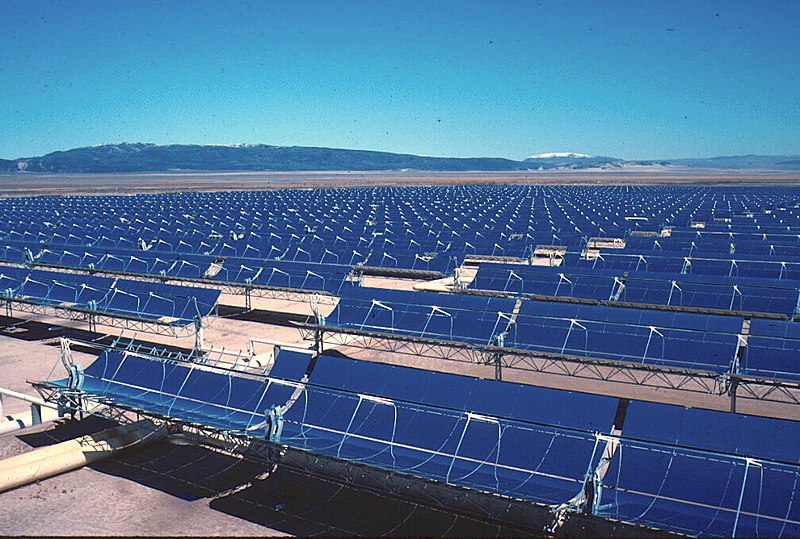
                       

Part of the 354 MW Solar Energy Generating Systems (SEGS) parabolic trough solar complex in northern San Bernardino County, California (“Solar Power,” Wikipedia)

In their very important and well-researched book, TechNo-Fix: Why Technology Won’t Save Us or the Environment, Michael Huesemann and Joyce Huesemann make a very similar point about the dangers of human diversion of solar energy:

If humans divert a fraction of solar energy away from the environment to create ordered structures for their own purposes (e.g., houses, appliances, transportation infrastructure, communication systems), less energy is available to maintain highly ordered structures in nature.

Many people will respond to these concerns by claiming that the amount of diversions of Earth material and land itself for the creation of solar and wind power stations, at the scale necessary to replace fossil fuel power sources, would somehow be “small” or “insignificant.” That is just factually not the case, especially with the continuance of growth-demanding, over-consuming, and competition-driven societies. For example, an estimate is given in a recent report by a pro-“green energy” team of researchers, stating that with the combination of wind farms and solar panel installations necessary to replace all fossil fuel electricity production at its current scale (in the U.S.), we would only have to cover 10 % of the surface of the U.S. with such installations (The Race to Zero: can America reach net-zero emissions by 2050?, by Oliver Milman, Alvin Chang and Rashida Kamal, The Guardian, March 15, 2021) That figure does not take into account the amount of additional land surface (and habitat destruction) required for all of the necessary increase in transmission lines, which the authors of the Race to Zero… report estimate would be “enough new transmission lines to wrap around Earth 19 times.” (and that’s just for the U.S.!) To put that amount of Earth surface diversion and destruction into some familiar perspective, currently about 2% of the surface of the U.S. is covered with asphalt and concrete pavement. We all have some sense of what that much pavement (on roads, sidewalks, parking lots, freeways, etc.) looks like, mainly from flying over the country in airplanes with a window seat. Imagine then, what 10 to 70 times (when competition and consumer demand for the ever-increasing amount of electronic gadgets is figured in) that much ground covered with wind turbines, solar panels and power transmission lines would look like. All of that ground would most likely be cleared using chainsaws, tree-chomping machines, fire, and toxic herbicides, followed by bulldozers. And don’t forget the living land that would be bulldozed and paved over for new roads to accommodate construction of the new power transmission lines, access to and maintenance of the new power stations, as well as for all of the mining that will be needed to produce the various devices and products. Do you need any more material than that for new nightmares to keep you awake at night? By what measure do people declare with any certainty that the impact of such development would be “small” or “insignificant” to the life of our only habitable planet? Is going ahead with such technological and industrial development just to see if the impact really would be small worth the risk?

Here is what Bill Catton said about taking such a risk (45 years before the Race to Zero.. report) :

To put this in perspective, consider the fact that the total human use of energy is already equivalent to more than 10 percent of the total net organic production by the entire biosphere. To supply future humans with three times that much from solar devices means doing something to the largely unknown natural pattern of energy flow on a scale that is not infinitesimal after all. Homo colossus would be swinging almost as much weight as a third of the whole biosphere! The potentially disruptive effects upon the balanced processes of nature have to constitute an enormous risk. (pg. 191-192)

We must remember that Catton was writing that towards the end of the 1970s, when humanity’s total energy use was much less than what it is now. Since that time, the human population has doubled and human energy use has more than tripled, which is very close to what Catton estimated (dare we say “predicted?”—Catton was using math) in the above passage. While this tripling of human energy use over the last 50 years has remained primarily from the use of fossil fuels and solar electricity currently comprises only about 1% of the human world’s energy consumption, the figure of one third of “the net organic production by the entire biosphere” still stands. You may have heard somebody mistakenly or deceptively say that in 2023 the world got 5% of its “energy” from solar power devices. The actual fact is 5% of its electricity came from solar. Only 20% of human energy use is in the form of electricity, the other 80% being primarily in the form of combustible fossil fuels used for purposes like smelting various metals at very high temperatures, for transportation, for launching spaceships, for explosive missiles used in warfare, and for several other types of industrial uses. If we could possibly produce 100% of the electricity that the world currently uses with solar, wind and hydro power, we would still be using that same enormously disproportionate one third of our planet’s energy to maintain our species’ unsustainable ecological footprint of 1.75 Earths (or possibly 2 Earths by about 2035-40, at current rates of increase).

Whenever somebody finally does all the necessary math to come up with an accurate estimate of how much fossil fuel use will be necessary to power the enormous increase in industrial activity needed to transition to and maintain the imagined “switch to green energy,” we may find that our total energy usage would be astonishingly higher, even before we figure in the increase from continued economic growth and aggressive capitalist competition. The following chart from a 2020 scientific publication clearly confirms Catton’s figures:
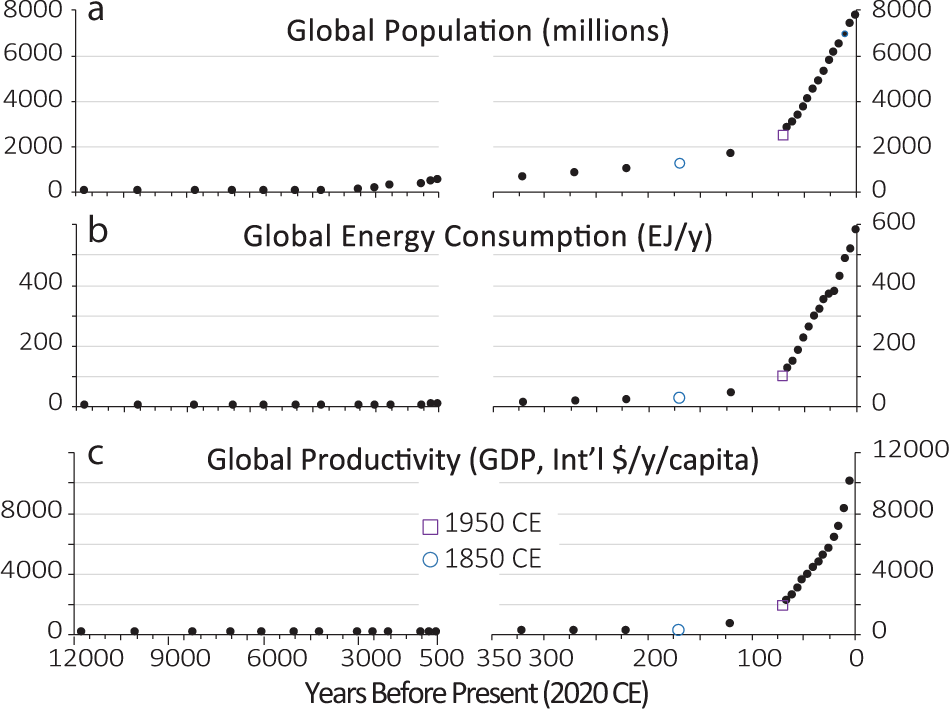
a Global human population (millions), b global energy consumption (EJ/y), and c global productivity ($/y/capita), across the Holocene and proposed Anthropocene epochs (in this paper starting in 1950 CE). All three parameters are highly correlated (Spearman’s rank coefficient = 1.00). Larger circle = 1850 CE; large square = 1950 CE. Data references are listed in Supplementary Online Material.

Source: Syvitski, J., Waters, C.N., Day, J. et al. Extraordinary human energy consumption and resultant geological impacts beginning around 1950 CE initiated the proposed Anthropocene Epoch. Commun Earth Environ 1, 32 (2020). https://doi.org/10.1038/s43247-020-00029-y

Homo colossus: too big for planet Earth

This would be a good point at which I should clarify what this “Homo colossus” entity that Catton refers to is. To put it simply, “Homo colossus is what Homo sapiens became at the point when the Holocene epoch transitioned into the Anthropocene, c. 1950, as shown in the charts above. To be clear, not all Homo sapiens became Homo colossus at that point, since there are still some Homo sapiens among our species, today, in various locations around the world, a fact which Catton acknowledged, also. As Catton, the man who coined the term, described it, “The more potent human technology became, the more man turned into a colossus. Each human colossus required more resources and more space than each pre-colossal human.” Where does he draw the line between colossus and pre-colossus, or those humans who are still Homo sapiens? It is hard to pin that down, but Catton seems to imply that pre-industrial Indigenous people and the increasingly rare other people (mistakenly labeled as “under-developed”) who are not overshooting their local environment’s carrying capacity are still Homo sapiens. Perhaps if Catton were alive today he would mark the dividing line in correlation with the GFN’s one Earth ecological footprint model: those humans whose ecological footprint exceeds what Earth needs for us to limit ourselves to in order to carry on regeneratively are Homo colossus, and those whose footprints are at or less than what our one Earth needs for us to be are Homo sapiens.

Catton describes Homo colossus as being like giants who have acquired a peculiar genetic mutation that causes each generation of offspring to be much larger than and consume much more than the generation that gave birth to them. But, instead of genetic mutation being to blame, as in the analogy, Catton clearly describes how rapidly-developing modern technology made the gigantic impact of humans on our planet possible (including the rapidly-increasing population). While it is clear that modern technologies made our collective gigantism possible, I do not think that Catton completely explains why the technologies made the growth “required.” Beyond circumstantial or opportunistic determinism (“they do it because they can”), what Catton failed to adequately address, was the combined impact of capitalism and militarism (the roots and preservers of empire) on the ways technology is used and why it continually expands. While Catton does make some mention of the impacts of advertising and war propaganda on creating the cultural imperative for growth in consumption (and therefore in production), to meet the ever-increasing demand for new technologies and products, he avoids those two root causes. Advertising and war propaganda have played enormous roles in creating and expanding overshoot, so why not talk about their roots? As I alluded to earlier, I think that the explanation for that has something to do with Catton’s experiences at UW and Seattle itself back in the 1960s, which appear to have instilled in him an aversion toward having anything to do with the research and analysis trends within his profession (academic sociology) that he felt were completely missing the point. I realize that, lacking any complete biography or autobiography of William Catton, I cannot state this definitively, but according to his autobiographical short essay that I cited earlier, by at least 1970, Catton had decided that “the point” which sociologists needed to examine was not only racism, militarism, economic oppression, and all of the other flaws in how humans treat each other. Catton had come to perceive that the ultimate point that outweighed everything else in its gravity and potential consequence was how humans and their societal structures and practices are treating the Earth, our only physical source of life. After all, what point would there be to resolving all human interpersonal and inter-societal conflict and creating more ideal social and economic structures if we have no functional, well-endowed planet left upon which to actually live out those ideals in newly-formed ideal societies? That is not a statement of my opinion, nor is it a rhetorical question. It is an actual, legitimate question, because I understand that many people feel (at least sometimes) like life is not worth living under the perpetual burdens of economic oppression, lack of affordable healthcare, or the continuous stress from racism, homophobia, religious persecution, misogyny, or other social injustices. What I hope that people will soon come to understand is that all of these societal ills are interconnected and deeply rooted in the series of wrong turns that our species took after disregarding the need to stay harmonious with Earth’s life system.

Even though Catton was eco-centric or enviro-centric in his perspective on life’s priorities, I do not think that he considered non-ultimate things to have no importance or significance at all. I think that he had empathy and compassion for suffering humanity and for the vast majority of humans (sociologists as well as others) who did not see the dismal reality and disastrous future for life on Earth that he had come to discover. But, knowing that there are other serious issues on Earth and in human societies that people need to address, and that he probably could multi-task by occasionally engaging with those other issues, he still chose to focus his attention and his life’s work on the ultimate issue that he felt nearly everybody else was oblivious to: overshoot. Perhaps I see Catton’s perspective and commitment in that way because I closely share that perspective and we humans seem to love finding kindred spirits to whom we can relate. I could even possibly be projecting my views onto him, to some extent, as I realize that there is probably much more about William Catton and his thinking to know than what I have learned so far. It also seems to me that there are plenty of people working on the non-ultimate issues, especially human rights and social justice issues, compared to those few of us who even want to think about (much less talk about and respond to) the Earth overshoot crisis and impending systemic collapse. Besides the social justice issues, many more humans are also willing to think about, talk about, and take action on what is commonly called “the climate crisis,” which, while being an ultimate issue, is actually just one of many deadly by-products of overshoot. At this time, we are increasingly hearing use of the term, “climate justice,” which is possibly a way for climate activists to assure human rights and social justice activists that they have not abandoned those causes by working to protect our planet. I know also that some people use the term “climate justice” to express the connection between how we treat our planet to how we treat other humans, which is a valid and important point. Why are so many more people willing to tackle the climate/CO2 issue than Earth overshoot? Besides the common ignorance and obliviousness about overshoot, I think that it is because they think that the climate or carbon footprint issue can be easily resolved with more technology and commercial products, thus not disturbing the continued flow of modern industrial over-consumptive behaviors and their limited, very temporary, rewards.

The latest—and possibly the last—Cargoist fantasies

Just yesterday (4/8/2024), I saw another example of how the Cargoists do not want to know where the cargo comes from or what damage it does on its way to our consumptive delights. An astrophysicist-turned-climate scientist who works for NASA was being interviewed by Amy Goodman on Democracy Now!. He was asked to comment on Treasury Secretary Janet Yellen’s appeal to the Chinese government to slow down their world-leading industrial production of solar panels and lithium batteries to cut their more overtly capitalist competitors in the U.S. some slack and stop beating them at their own game. (Obviously, that was a paraphrase and not an exact quote, but sometimes a good paraphrase can be more accurate and clear than the quote.) My paraphrase for the scientist’s answer to that is that he basically said that it doesn’t matter where the “green energy” devices come from (China, the U.S., or elsewhere), as long as we (somehow) replace fossil fuels with enough electrical energy devices to keep the massive machinery of modern industrial civilization moving and growing. Here is the exact quote from the guy: “I don’t care where solar, where wind comes from, where any of these solutions come from. We need all hands on deck right now.” If that is what “we need,” and if those technologies really are “solutions,” I wonder how that matches up with what Earth really needs from us. Do all the human hands on this deck need to be doing everything that they can to keep the societal machine that we are captured within running smoothly, but just with somewhat less CO2 emissions? Or, do we need to use all of our hands, minds and strength to bring that life-destroying machine to a grinding halt, if that is what Earth and all interrelated species really need from us?

Present-day Cargoists are determined to believe several things that are either just not really sustainable or even physically possible. Many of the hoped-for “solutions to the climate crisis are based on technologies that have not yet been developed, or at least not at the scale necessary to maintain current and ever-expanding industrial activities in a life-sustainable way (i.e., “carbon capture”). Nearly all proposed new “advanced technological solutions” would also require the additional extraction of natural materials in quantities way beyond what we can access without expanding mining of Earth’s surface by unfathomable magnitudes beyond current destructive practices. These types of imaginary “climate solutions” (while ignoring the actual overshoot crisis) are just as fantasy-based as flying through outer space to find a suitable, livable planet for our species to either colonize or just dig up for industrial resources to bring back to Earth. So, let’s deal with that outer space fantasy first, lay it to rest, and then move on to deal with a few of the other ones.

The Futile Pursuit of “Planet B” (Answer to question #5)

No scientist that I know of has done a better job of clearly debunking the outer space fantasy solutions than astrophysicist Thomas Murphy of UC San Diego. In his free, open access textbook, Energy and Human Ambitions on a Finite Planet (pp. 54-65), Murphy clearly illustrates the actual physical requirements and limits related to any possible fulfillment of such fantasies. As an astrophysicist with much experience in untangling students from previously-held misconceptions about the worlds beyond our planet, Murphy knows exactly where to begin this process. He begins with some mind-boggling illustrations of the distances and scale of the various astral bodies, first of our solar system, then beyond. For example, he shows how we have been greatly misled and endowed with a false perspective by the typical illustrations of our solar system found in astronomy textbooks. Even though these illustrations serve a very good purpose—showing the order in which the planets orbit around the sun and Earth’s position in relation to them all—such illustrations cannot possibly convey anything close to the actual comparisons in size and distances in real scale, using one illustration on one typical 8-inch-wide page in a book. Neither can it be done on a double-page spread, a three or four-page fold out, or even a 400-page foldout! If we were to try and make a true-to scale illustration of our solar system for a book illustration, with our planet Earth about the size of the diameter of a common pencil or a hole in a 3-ring notebook paper, and we place Earth at the far left edge of the page (or what would be about the middle of a two-page spread), our moon would be a little dot at the right hand edge of the page. “On this scale, the sun would be larger than the page and about 400 pages away. Mars would be 160 to 1,100 pages away [at its closest and furthest points in relation to Earth].” Murphy does not go on to tell us how many more pages away Pluto or Uranus would be, but I think we can all get the point without that additional information. The distances are important because without that kind of information we would not be able to calculate how much fuel it would take to get there, how much food, water and other essentials to pack for the trip, and, most significantly for a species whose average life span is a little over 70 years, how long the trip would take. Here is some astonishing perspective from Tom Murphy on the actual time spans that space journeys in pursuit of new Earth-like planets or planets with some Earth-like resources would take, using our fastest spaceships manufactured to date:

It took 12 years for Voyager 2 to get to Neptune, which is “in our backyard.” The only spacecraft to date traveling fast enough to leave the solar system are the two Voyagers, the two Pioneers, and the New Horizons probe. The farthest and fastest of this set is Voyager 1 at about 150 times the Earth–Sun distance after 43 years. The closest star is about 2,000 times farther. At its present speed of 17 km/s, it would reach the distance to the nearest star in another 75,000 years. (pg. 56)

That closest star figure is significant because it appears that we have no planet compatible for Earthling life orbiting around our Sun, other than Earth. So, we would have to begin our search for “Earth II” (a.k.a., “Planet B”) in a solar system 75,000 years (3,750 generations) away. As if it really matters, in the light of that deflating reality, there is actually another factor to consider that would make these lengthy travel times even much longer. The times that Murphy gives there are for speedy little unoccupied or “uncrewed” (I dare not say “unmanned”) space probes. A large spaceship with about 200 colonist and/or industrial laborer passengers, loaded down with all of their necessary gear and an almost incalculable amount of fuel, would be much slower, of course, if it could even have enough power to propel that amount of weight out of Earth’s gravitational pull.

Could such a large space passenger/freighter be launched out of Earth’s gravitational field and be propelled through space using solar power or any known type of electric motor? Not with anything created so far. Solar power is used currently on spacecraft and space stations for various small, basic electric-powered functions, including interior lighting and appliances, and for small-scale propulsion, once outside of gravitational pull. But to launch a spaceship out through the gravitational field of Earth is always done with the much denser power of combustible fossil fuels. Such has also been the case for leaving the moon, Mars, and probably would also be the case for trying to leave just about any other planet that has gravity. Imagine being stuck on an uninhabitable, unusable (for Earthlings, anyway) planet somewhere 75,000 years of travel away (after all of those generations of belief system perpetuation and indoctrination about the “need” to stay the course), unable to leave because you just don’t have enough juice to break out of that planet’s gravitational pull!

The other thing about powering spacecraft with solar panels is that when you get about as far away from the sun as Jupiter, solar power is no longer sufficiently capturable as an energy source (Wikipedia, “Solar panels on spacecraft”) (As a child, when standing outside under a sky full of many stars that your teacher had recently told you were all far away suns, did you ever wonder why the stars didn’t make you warm?). Do you think that we will have batteries with 75,000-year storage capacity any time soon? Or, ever? How much fossil fuel would a spaceship need to haul for a 75,000-year journey, even if the fuel was only used to break out of gravitational fields? Solar panels, at their current state of technological advancement, have to be replaced every 25 to 35 years. How long will it be until we have solar panels that last even 1,000 years? How many spare solar panels and spare batteries can a spaceship haul and still be able to get off the ground, much less out of gravitational pull?

It is very understandable how it was so easy for most of us to succumb to the delusion of “easy space travel.” For most of us, our sense of space travel distances and travel times comes from two-hour movies where we see people travel all over a galaxy to different planets in time frames that appear to be similar to travelling across Europe or the U.S. by car, without the travelers appearing to be any older as they reach their destinations.

Lastly, on this topic of space travel, we might want to briefly consider its prohibitive economic cost. As long as most humans cannot even imagine future societies without capitalism, the use of money, or dependence on international trade, space travel—from initial production all the way to “mission accomplished”—will always require humongous amounts of money. The total cost for the Apollo space program (1961-1973), that ultimately put men on the moon in 1969 and brought 842 pounds of rocks back to Earth for study, was between 176 and 288 billion dollars (adjusted for inflation)—(I think that Murphy’s higher figure includes fuel and the lower official figure does not). It is estimated that one crewed mission to Mars would now cost about $500 billion. U.S. President Richard Nixon urged the shelving of the Apollo program back in 1973 to reduce inflation and the U.S. has not had the budget to engage in a space program anywhere near the level of activity as Apollo ever since. Neither have any other nations. In the current global economic conditions, which includes rapidly-increasing expenditures for militarization, disaster relief, and mitigating the many other consequences of exceeding Earth’s ecological boundaries, more public funding for space missions seems increasingly unlikely. I suppose that increased awareness of the futilities mentioned above—among space scientists, anyway—also has something to do with it. The trend now for funding space missions is private, billionaire funding (supplemented with some raiding of the U.S. treasury) for their own space projects. I am pretty sure their ultimate purpose is to be able to flee an impending apocalypse (as seen in the recent movie, Don’t Look Up!), since they probably have their own personal stables of researchers keeping them well-informed about all possible and likely future scenarios, mainly to help maintain their economic competitive advantages. To them, the most colossal of us all, I say, “Good riddance and make haste.”

A reality check like this one is, understandably, very hard for many of us to accept. Dreams, fantasies, and cherished beliefs are generally very difficult for humans to give up. The ability to imagine, dream and create is a wonderful thing, especially when applied toward enhancing and preserving natural life. The human dream of flying and escaping to some more ideal location is sometimes connected to such healthy motivations, but probably just as often it is based on the desire to flee from all that is unjust, dangerous and endangered in our lives. But why seek to leave our generous, life-giving Earth, which our bodies and all of the elements that we need for life came from and belong with? We know of no other place in the universe like this one, even if we did have the means to get there. Why not just do what we need to do to end the injustices and abandon all of the wrong methods of “living” that actually endanger and destroy all of the wonderful life of Earth?

Mining and smelting

It is simultaneously amazing and depressing to me that so many self-proclaimed “environmentalists” and “nature lovers,” including some of my dear old friends, now believe that we can mine and manufacture our way out of the climate crisis. The monstrously pervasive, ever-present, industrial propaganda machine has also convinced many people that excess CO2 in the atmosphere is the only environmental issue worth focusing on and that by somehow solving that problem all other environmental issues will be solved as well. But, as noted earlier, the scientists at the Stockholm Resilience Centre have identified eight other planetary boundaries besides our climate, five already passed and three in danger of soon being passed, which all must be addressed and tended to in order to preserve the continued functioning of Earth system. There was a time, back during the 1970s and `80s, when environmentalists were deeply concerned with and acting in resistance to all of the types of Earth system destruction that they saw, both locally and globally. 

Illustration from Elisabeth Robson, “Why Are We Not Talking About Ecological Overshoot?


So, how did we come to this, the “Carbon Tunnel Vision” we see in the illustration above? I will not return now to the reasons that I have already mentioned, but, instead just expand upon one that I only alluded to briefly and provide some additional examples. That would be the tremendous profits to be made by many intertwined industries through the avowed effort to “replace fossil fuel use with green energy.” Besides the retail marketers of solar panels, wind turbines and lithium batteries—which is typically as far as most cargoists will look to see where that cargo comes from—the other intertwined industries include mining (for all of the raw materials needed to produce “green energy” cargo), the fossil fuels needed for the mining and other stages of “green” production, trucking and shipping (using diesel fuel), smelting (for the wide variety of metals used in “green energy” production, as well as for all of the glass and cement), road construction, and other activities. Those and all other commercial industries, along with all of their customers, then use the electrical energy produced by the “green” devices to continue the processes of overshoot leading to collapse. How so? Because people will use that energy (along with the fossil energy sources that they are unable to replace) to power the same systems, goals, beliefs, over-consumptive activities, and toxic, polluting, life-destroying industries previously powered by fossil fuels. As the Stockholm scientists and many other scientists have shown us—and some “old school” environmentalists still remember—excess CO2 in the atmosphere is not Earth’s only environmental crisis. (Take another look at the 9 Planetary Boundaries chart.) No matter what we power it with, we cannot make a life-destroying Machine and an unsustainable way of living compatible with Earth’s regenerative living system.

It seems evident to me that the “captains of industry,” terrified by the calls of those long ago, actual environmentalists for humans to reduce consumption and re-use, recycle and re-configure old products and discarded materials, found that idea so abhorrent that they spent much effort during the rest of the 20th century trying to find a way to make environmentalism more compatible with industrial capitalism. Putting Earth and the well-being of all natural life first, ahead of monetary profit and colossal consumption was unthinkable, for the overwhelming majority of industrial producers and consumers. The industrialists found what they were looking for with the advent of solar PV panels, colossal wind turbines, lithium batteries, and eventually some other products and processes that they could convince people were harmless and “green.” In a society of cargoists and cornucopia addicts, indoctrinated in those beliefs and lifeways for their entire lives, everywhere they went (except for a few university classes and some rare encounters with actual Earth lovers), it surely was not that difficult for the industrialists to accomplish their two primary goals: neutralize the environmental movement and preserve capitalism. They were even able to turn some former leading environmentalists into very enthusiastic green” capitalists.

When we take a thorough look at where the “green” cargo comes from and what it is used for (along with what it cannot be used for), two closely-connected, essential industrial activities stand out prominently: mining and smelting. In societies whose primary physical infrastructure—for buildings, roads, transport vehicles, and more—is made from steel, concrete, glass and other smelted materials, mining and smelting are the essential pathways to construction, maintenance, and expansion of that infrastructure. I will cover smelting first and then mining, which is the means by which smelting and most other industrial activities are made possible. Together, they are the largest industrial contributors to CO2 emissions and the excretion of many other industrial wastes. (I also consider drilling and excavating for petroleum to be forms of mining.)

Molten pig iron from a blast furnace.     (uncredited, public domain)

Steelmaking produces about 11% of the global CO2 emissions from humans, about 30% of the total CO2 emissions from all industries, and about 7% of the global total greenhouse gas emissions (GHG, which includes methane and other GHGs besides CO2. All of these stats vary slightly in the many different sources that I perused, so I averaged some and also went with the majority and most recent estimates.). There are two primary types of furnaces used for smelting steel: the blast furnace (BF) and the electric arc furnace (EAF). The blast furnace is the oldest and the industry standard, by far, accounting for a little over 70% of the steel smelting, worldwide. Electric arc furnaces have been in existence since 1888, but not applied at the larger industrial scale until the late 1960s, when improvements in EAF technology began to make the use of such furnaces more capable of operating at a larger scale and less costly than prior versions of that technology. Even so, and in spite of continued improvements in electric smelting technology, along with increased demand for a “green” method of producing steel, use of EAF furnaces by steel producers still hovers around 26 to 28%, after peaking around 35% in 2013. Why? The reasons are complex, but it mainly boils down to the fact that capitalists tend to go with whatever technologies are easiest to access, easiest to operate, and the most profitable. There are also some factors related to economic opportunities for “developing nations” to catch up with (or even surpass!) the Homo colossus nations, along with some continued technological shortcomings in the EAF processes. I will say more about all of those reasons soon, but first let’s finish with the CO2 emissions aspect. All steel smelting furnaces, including EAFs, emit some CO2 and other GHGs. The BFs, which are typically fueled by coal, emit an average of 2.33 tonnes (metric tons) of CO2 for each tonne of crude steel produced. An EAF, on average, emits “only” 1.37 tonnes of CO2 for each tonne of crude steel produced, and that figure includes EAFs that are supplied with iron from a new hydrogen-based technology called Direct Reduced Iron (DRI). The high degree of variation in CO2 emissions levels for EAFs depends largely on where the electricity to run those furnaces comes from, i.e., fossil fuel-powered electric grids or grids powered by enormous solar or wind power installations. At competitive industrial scale, EAFs can only operate compatibly with the largest types of electric grid systems, which typically, with very few exceptions, are not powered by wind and solar alone, at least not without fossil fuel or nuclear powered back-up systems. (It will be interesting to see if and how the major electric grid systems around the world will or will not be able to supply and keep up with the rapidly-increasing demand from the AI and bitcoin industries, along with electric smelters and all of the ever-increasing power demand from new electronic gadgets and products.)

In a culture where lesser evils are now defined as “good,” and not-as-polluting-as-that-other-process can be defined as “green,” it is no surprise that the new, carbon tunnel vision, “bright green” “environmentalists” were very quick to label EAF/DRI-produced steel as “green steel.” Apparently, emitting only half as much CO2 as the dirty, coal-fired BFs was deemed good enough to qualify for the highly-prized green label. And, of course, neither the environmentalists, nor the industrialists dare to mention the many other pollutants that are excreted into air, ground, and water by the steel industry besides CO2. People with something to sell—whether they be fossil fuel, steel, or mining industrialists wanting to profit from claims to be moving towards green new technologies for making their toxic, life-destroying products, industrial food producers deceptively using the labels “organic” or “GMO-free,” or “environmentalists” doing fund-raising for their particular benevolent, activist organizations—will claim or say just about anything these days. When making their claims about “green steel,” they focus on any possible or actual reductions in CO2 emissions emitted in the manufacturing process, and almost never mention the other pollutants emitted into air, ground, and water by the smelting and processing of steel and other metals, such as: cobalt, selenium, sulfur dioxide (source of acid rain), carbonyl sulfide, mercury, copper, silver, iron, hydrogen fluoride, polycyclic compounds, lead, nickel, manganese, polychlorinated biphenyls, arsenic, beryllium, cadmium, chromium, antimony, and various lead compounds. Is any of that material really “green enough” for us to breathe or drink at any measurable levels? Is it “green enough” if the people downwind and downstream from those mining sites and manufacturing plants are mostly “people of color?” Is it “green enough” for the beings of other species who have as much right to continue living in Earth’s free life-giving system as the humans do?

Recent trends in the steel industry have provided us with another excellent illustration of the delusion of “phantom carrying capacity” and “ghost acreage” that Bill Catton illuminated for us, so long ago. In order to make this illustration clear, I must first describe one significant limitation of the EAF. The EAF cannot carry out the first step in the steel making process, which is referred to both as metallising” and “reducing” the iron ore before it can be turned into steel. BFs, however, can reduce iron ore before smelting it into steel, and the metallised iron that they produce (“pig iron” being the most common type) can then be fed into EAFs to continue the rest of the process. EAFs typically smelt pig iron, recycled scrap steel, or a combination of the two (along with various chemical additives and metal alloys) into, workable, marketable steel. In order to make EAFs less dependent upon dirty BFs and a little “greener” the DRI (direct reduced iron) process was invented to supply EAFs with non-BF-produced metallised iron. The DRI process uses hydrogen (which is processed using 95% methane, a.k.a., “natural gas,” a fossil fuel) and some other chemicals to reduce the iron ore, and it is not a 100% green or even CO2-free process, by any honest measure. Those who claim that the DRI/EAF process is “green” like to talk about how the primary waste product of the DRI production is water, which can be re-used in the hydrogen-making process, and the fact that the EAFs mostly use recycled steel scrap to “charge” the furnaces. But, as in all recycling processes, entropy and the unavoidable introduction of impurities into the source material requires that some of the original, or “virgin,” material (pig iron, in the case of steel) be mixed into the batch, in some proportion. In the case of EAF/DRI steel production that virgin material is referred to as “ore-based metallics” (OBMs), which is often necessary, as a supplement to the DRI, depending on the quality of the scrap steel and scrap iron being fed into the EAF, to reduce impurities and strengthen the end product. The wide variation in quantity of OBMs (including pig iron) necessary per batch runs roughly between 5-80%. All right, that is as far as I can go with this “metallurgy class” for today. Now we can move on to the illustration of phantom carrying capacity.

The “bright green environmentalists” are very excited about the fact that in the United States and Mexico, the use of EAFs has increased to overtake the use of BFs in the steel industry. A 2019 survey showed that in the U.S. the figure had risen to 68% EAFs over BFs and even higher in Mexico, at 77%. (Canada lags behind at 46%.) How exciting is that!!?? What a great reason for hope…or should we call such hope “hopium?” How do such figures square with the fact that, worldwide, 70 to 75% (by some estimates) of steel production is still done with BFs and that, globally, “only 28% of new steel manufacturing capacity under construction is for electric furnaces?” There are a few conveniently overlooked items that we need to consider for the big picture to become clearer. Where does the cargo come from that makes the great increase in American use of EAFs possible? “Currently, imported pig iron makes up nearly all the merchant supply available to North American mills…pig iron import levels have ranged between 4-6 Mt (megatons) annually in the USA and 0.2-0.6 Mt in Mexico, with most material originating from Brazil, Russia, and Ukraine.” (Hmmm, could seeking an upper hand in the pig iron market have anything to do with U.S. interest in that war between Russia and Ukraine?) Other major exporters of pig iron and iron ore include Australia and China, and as the EAFs increase in America and some parts of Europe, so does the importation of pig iron, in spite of the concurrent (but insufficient) increase in DRI. China is the most prominent producer of steel in the entire world, by far, producing about 50% of the world’s total, annually, and about 90% of their production is done with BFs. With China’s influence and participation, five of the top six steel producing nations are Asian, as follows (in order of quantity): China (50.4%, when including Taiwan, or 49.1%, excluding Taiwan), Japan (6.2%), India (6%), United States (the exception, 4.8%), Russia (geographically much more Asian than European, 4.2%), and South Korea (4.2%).
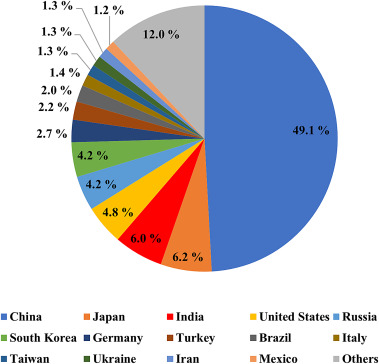
All of those nations, with the exception of the U.S., primarily use BFs. But the U.S. imports its BF products (mainly pig iron) from other nations while thereby exporting (at least in the minds and papers of some people) its duly-earned credit for large portions of the CO2 and other wastes generated by those foreign BFs, along with credit for its share of the ecological footprint associated with the whole filthy business. Can any nations on Earth (or any so-called “green cities” on Earth) rightfully declare, “our hands are so clean and our footprints are ever-so-green” just because they have the money to pay industrialists of other, foreign or “phantom” acreages to soil their lands, water and air while producing products for use by businesses and consumers in their own locations? I don’t think so. As with a murder committed by a paid hitman, the purchaser of that contract is a guilty accomplice. Another very cogent reality that is overlooked by these false claims of “green innocence” is that there is only one interconnected atmosphere on Earth and emissions of CO2, other GHGs, and toxic particulates anywhere are thereby emitted everywhere. Just because we cannot see or do not want to know where the cargo comes from or where our wastes go, that does not eliminate the consequences of those things, or make them actual “phantoms.” There is also only one continuous and interconnected ocean (in spite of human-made boundary lines and labels), which is now also being mined for so-called “green” technologies.

Cement, the binding agent for all of the diverse materials that go into the manufacture of concrete, the modern world’s favorite building material, is also smelted in fossil fuel-fed furnaces and “accounts for around 7% of all greenhouse gas emissions worldwide,” or about the same volume of GHG emissions as steel. I did not find the carbon footprint for global glass manufacturing, but I know that the mining and handling of the various materials throughout that process exposes people to many toxic fine particulates that go into their lungs. I will leave it to others to look up the CO2 emissions and other toxic excretions of glass manufacturing, because I am currently out of time for doing that. (After all, this double book review can’t also be “the whole story of everything!”)
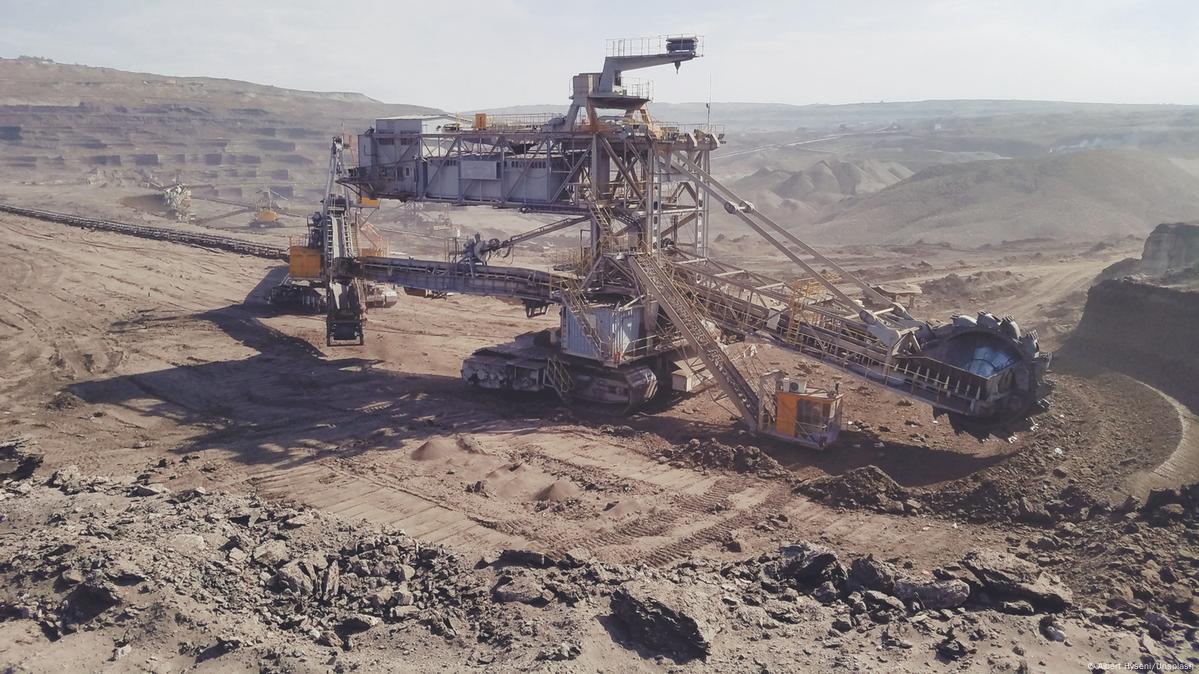
The mining of critical raw materials leaves rubble dumps in its wake.     Image: Albert Hyseni/Unsplash

All of the mining and manufacturing in the industrial world is toxic and habitat-destroying, to varying degrees, but, as Bill Catton taught us, rather than focus on particular individual culprits, it is more important for us to understand the collective impact of the whole thing. Much more research needs to be done and is being done now to thoroughly measure such impacts. I mentioned earlier the recent unveiling of the extremely disproportionate consumption of Earth’s substance by humans, compared to all that is used by other species. That disproportionate consumption by humans continues to expand, for many reasons, and two of the most significant reasons are natural entropy and unrestrained capitalism. Both of those factors are also deeply connected to the continual increase in mining and other forms of extraction. Natural material entropy is one big reason why we cannot have 100% recycling of material goods. Depending upon the type and condition of the materials being recycled, the amount of newly-extracted or “virgin” material that must be added to each batch (for marketable quality-related reasons) ranges between about 5 and 90%. In addition to that, the dissipation of materials that have been mined voraciously over the last two centuries (fossil fuels, metal ores (including rare metals), various minerals and chemicals, etc.) requires that proportionately more and more rock and soil be dug up, dynamited, drilled and sifted through to acquire proportionately less and less of the desired, commodified materials. All of those materials are finite, but the economic and cultural social Machine still mechanically, robotically moves on as if everything is infinite—until, of course, that Machine has nothing left to eat or nobody left to feed it.
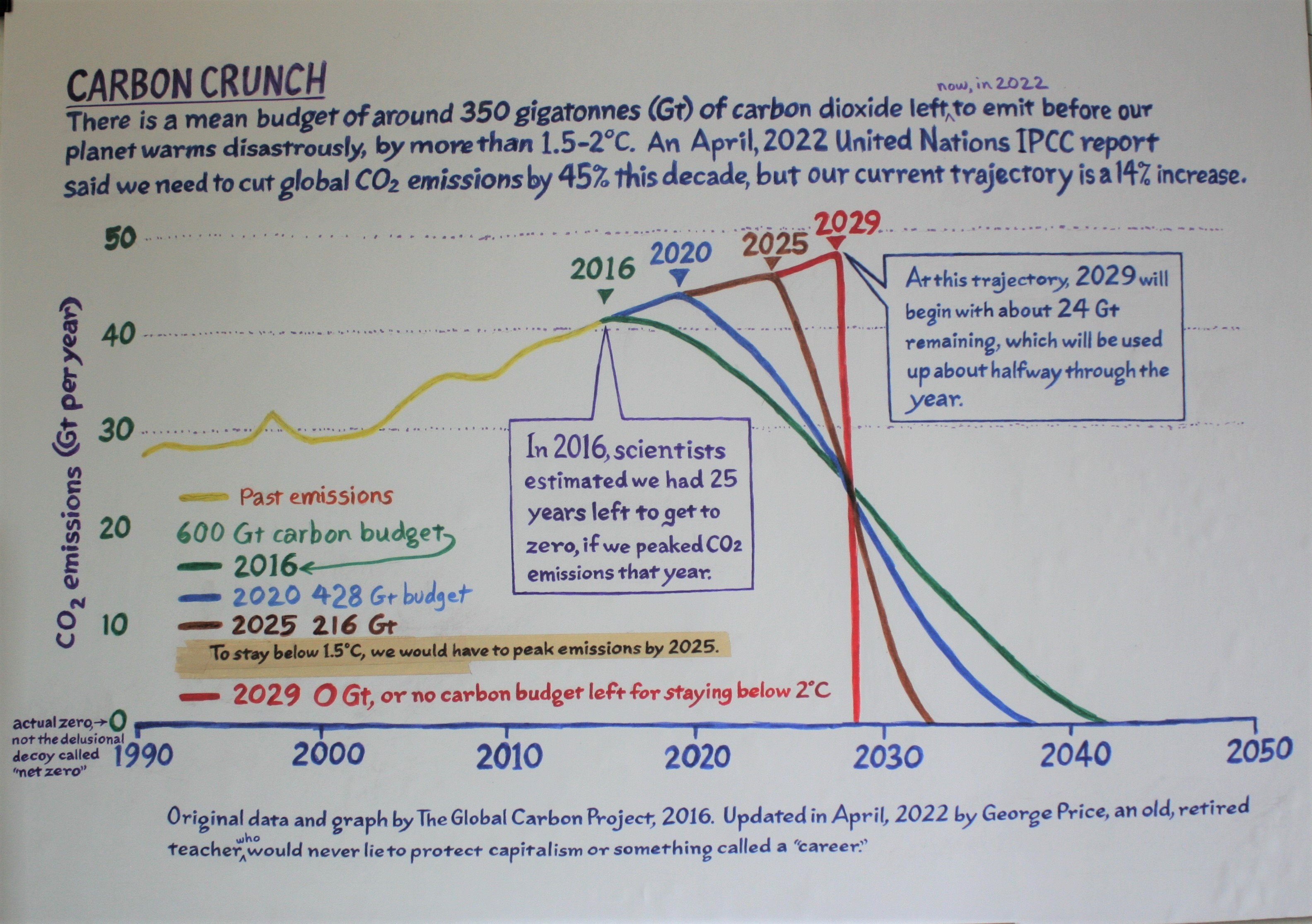
Old-school, pre-PowerPoint style, handwritten and hand-drawn poster by the author of this essay.

Since the amount of CO2 in Earth’s atmosphere continues to rise, in spite of so many “best efforts,” the latest trend in measuring “success in the fight against climate change” used by many bright green cargoists is to measure reductions in the rate of increase in CO2 emissions and in average global temperatures and then celebrate those examples of slower increase as if they were actual (net) decreases! A skilled presenter from a bright green “climate action” organization can really inspire and stir up a lot of techno “hopium” in a crowd of people who are desperately seeking ways to fight climate change while simultaneously keeping the status quo systems and their way of life intact. A couple of examples of that deceptive tactic that I have recently encountered are the En-ROADS software program created by Climate Interactive and MIT Management, and Project Drawdown’s “Table of Solutions.” These were recently presented to an Indigenous climate action group I belong to as part of our annual Earth Day activities. The En-ROADS software calculates how much various “green” technologies and human actions can reduce the global average temperature increase by the year 2100, including some imaginary technologies that they admit do not yet exist. The “Table of Solutions” does basically the same thing, measuring the rate of increase in CO2 emissions, instead. The best and most honest climate scientists (even among the relatively moderate United Nations’ IPCC) have been telling the whole world for years that Earth needs for us to immediately reverse the CO2 emissions trajectory to a radical decrease, not just a slower increase, as shown in the chart above. Imagine a person with extreme obesity whose doctor has told them, “You really have to start losing weight immediately, because your heart just will not be able to take any more increase in weight.” So the person decides to just only give up bacon and soda pop and their weight continues to increase, but at a slower rate. Soon after making that little, incremental, but very insufficient change, the person dies of a heart attack.

That is all I will say about cargoist fantasies for now. I was going to go over electric cars and electric semi-trucks, but there are plenty of other expose’s on that topic out there. I refer you to Bright Green Lies, TechNofix, and Ozzie Zehner’s work for more on those. I need to move on now to a couple of other points, so I can wrap this up soon.

The pointless search for culprits, by those who are missing the point (?)

During the time that William Catton taught at the University of Washington and the time that he wrote Overshoot, the profession of sociology and the growing spirit of resistance to social injustice was leading many people to vigilantly seek out and expose culprits of all sorts—individuals, economic systems, deeply-entrenched cultural or religious practices that seemed to no longer make much sense, and deep corruption in the legal and political realms. While Catton was certainly not oblivious to all of that, he perceived that the vast majority of seekers for justice and social progress were missing the point. Yes, there are some very corrupt and degenerate individual humans all over the world doing horrific, unjustifiable things and causing much suffering and harm for other humans, as well as to other species. Yes, there are also some very fundamentally unsound, unjust, unequal, ruthless and predatory economic and social systems and political institutions all over the world that systematically create pain and suffering for all species, through the normal, day to day operations of those systems—not just as occasional glitches, or aberrant “bad apples.” But all of these destructive human systems and individuals, along with their particular circumstances and social contexts, as seen from Catton’s ecological worldview, were not the root causes or points of origin for our present global calamities. They were all set into motion thousands of years ago, through a long series of wrong turns, miscalculations, collective misguidance and consequential circumstances, rooted in alienation from Earth’s symbiotic systems and natural laws (such as, the laws of physics). The resulting destructive ways of living and perceiving were then normalized and inherited by their posterity.

Children cannot rightly be blamed for the type of world and personal circumstances that they were born into and trained into. Children need to be raised and nurtured in families and communities that teach them (by words, but more importantly by life examples and the modeling that their elders show them) how to live in appreciation, love, and gratitude for the gifts of life from the natural world. Being denied that knowledge and experience is a form of child abuse. But parents, families, caregivers, and whole communities or societies that were neglected and abused in that same way cannot be blamed for failing to exemplify for their children something that they have never known or experienced themselves. A society of humans who have mostly been taught that the natural world is a dangerous place that we have to protect ourselves against, but maybe has some beautiful “scenery” we can enjoy looking at, or briefly visit, occasionally, is a society of abused and tragically deprived people who do not know what life really is. As we are experiencing at this potent moment in human history, such societies are not capable of sustaining themselves indefinitely, or aiding (as a total net benefit) in the wonderful systemic processes for regenerating Earth Life.

I began researching and writing this essay about three years ago. It is now the middle of February in the year 2025, and some of the most wretched culprits that our species has ever produced are currently wreaking havoc throughout the world—and some of the worst of the worst have taken over the country in which I have always lived and many of my ancestors lived within for thousands of years. While there have been many individual humans through the ages who have attempted to take over or “rule the world,” there probably have not been more than a handful of deranged maniacs, if any, who intentionally sought to destroy all life on Earth. As the destruction of life on Earth by human activities, ways of living, and ways of thinking is now occurring, at “breakneck speed,” it is normal for us to wonder which ones of us are the most at fault for causing  this tragic, complex crisis. William Catton suggested that a better question than who is to blame is what is to blame:

In a world that will not accommodate four billion of us if we all become colossal, it is both futile and dangerous to indulge in resentment, as we shall be sorely tempted to do, blaming some person or group whom we suppose must have intended whatever is happening to happen. If we find ourselves beset with circumstances we wish were vastly different, we need to keep in mind that to a very large extent they have come about because of things that were hopefully and innocently done in the past by almost everyone in general, and not just by anyone in particular. If we single out supposed perpetrators of our predicament, resort to anger, and attempt to retaliate, the unforeseen outcomes of our indignant acts will compound fate. (pg. 177)

Catton probably also felt uncomfortable with the then-increasing sense that an identity group that included himself—Euro-descended or “white” men in positions of authority—were society’s chief culprits, both historically and in the present, especially those with the most wealth and power. I really do not know how he felt about that, or if it bothered him at all. I would just add to the above statements, both his and mine, that there may indeed be systemic and individual culprits (among all identity groups), upon whom we might justifiably place some blame for certain particular examples of destructiveness, and even label them as “despicable.” But how much greatly-needed human positive creative energy might be wasted on despising? In a state of global dystopian or post-apocalyptic crises, would it not be much better, and extremely urgent, for those who survive to use our energy and creative abilities to go forward as best as we can in an entirely different and ecologically-led direction? No matter how wrong or misguided we have all become, Earth will always be right, and ready to guide us onto the good path of real life.

In order to answer question #1 of this essay, “What is the biggest real threat to all life on Earth that we currently find ourselves needing to face and respond to,” we need to distinguish between root causes and subsequent effects. Natural responses to our biological circumstances and needs, combined with unnatural and even anti-natural systems of thought and belief, environmentally unsustainable cultural practices, alienation from the natural world, etc., are root causes. Individual humans whom we might call “culprits,” “bad” people, better or worse persons, “evil” or “lesser evil” ones, fall into the category of subsequent effects—which is a realm in which we all find ourselves encumbered and complicit, to varying degrees. Present-day human pathologies and harmful behaviors (the “whats,” not the “whos”) are rooted in a very long sequence of root causes and their subsequent effects. To only act against the subsequent effects is like trying to fight diseases by only attacking the symptoms and muting or suppressing those symptoms using drugs. Real healing comes from identifying root causes and changing behaviors. Not only do we have to stop doing harm and start doing what is best for our individual bodies, but we need to also stop harming and start doing what is best for the natural ecosystems that provide nutrients and protection for our bodies and the bodies of all other species, as well. In order to understand our current and very near-future predicaments, we need to look at life on Earth from an eco-centric, rather than anthropocentric perspective. Once we have identified the root causes of Earth’s predicament (which goes back much further than the advent of fossil fuels), those who survive industrial civilization’s collapse and have a unique opportunity to start totally new societies, must then act, to the best of their abilities, to prevent those root causes from ever developing again.

How did we arrive at our current predicament? I will not repeat my earlier descriptions of some of humanity’s historic wrong turns. I thought about trying to make a chronological list of the “great wrong turns of humanity,” but there are just too many and also too many unknowns. Maybe the first wrong turn (which I did not mention before), or root of all roots, was the over-development of human ego: the imagination that we have individual life needs that are disconnected from, or irrelevant to, the well-being we receive from our natural symbiotic relations with all of the rest of Earth Life. I can see how both anthropocentrism and the commodification of nature could possibly be rooted in that. Another one that I did not mention previously, which might also possibly be the first root, is lack of gratitude or thankfulness for all of the gifts of natural life and our gift of being a part of the whole of Life. Robin Wall Kimmerer has written beautifully about the significance of gratitude to all life, including how giving thanks is a vital and often central element in most tribal ceremonies. I also only made a brief mention of misogyny in a short list earlier, but the devaluation and disrespect towards women, especially of older women, well beyond their child-bearing years, was an enormous wrong turn as well.  For most of human history, it was not that way. Elder women in traditional tribal societies were the primary keepers of medicine knowledge and had important leadership and advisory roles, as well. I am sure that there are many vital discussions that we can have about all of that. What is important to note at this point, though, is that we simply inherited this mess. It was handed down to us. We know that it is human-caused, but not so much by particular human individuals. Instead of looking to various individuals (and those who are most alike, or closely aligned with those individuals) to place the blame, we need to look at a broad, intersecting collection of particular human beliefs, social systems and cultural practices. These beliefs, systems, and practices are the results of the wrong turns taken by humans, beginning about ten to twelve thousand years ago, at various locations around the planet.

Like travelers who, when they first sense that they are lost, feel no need to consult a map or a talking robot (GPS), or ask anybody for directions, most of our species just continued to wander further and further off the desired path—the path of harmonious, symbiotic, inter-related, reciprocal natural life, which many Indigenous peoples refer to as “the Original Instructions.” As Catton makes clear, that long series of wrong turns also led to an even longer series of unforeseen consequences that further complicated the mess, thus decreasing our ability to correct ourselves, or respond in ways that would be beneficial to the well-being of all life on Earth. Over many generations of further wayward wanderings, deeper into the tangled maze of being lost, all of the errant ways of living and perceiving acquired from being so profoundly lost gradually became normalized, unquestioned, inherited and repeated. It is now normal for most humans around the world to believe things like “nature must be controlled by humans,” “humans are superior to all other species,” “more possessions is better than less,” “easier is always better than difficult,” “we cannot live without electricity,” “using motorized machines is better than using our muscles,” and “we cannot live without money” (even though we did very well living without money for 97% of our time of existence as a species).
  

Humans generally want to believe that the ways that they were taught to live and the values and beliefs that were instilled in them, from childhood on, are basically correct, even when things go very wrong or calamities occur. That is very understandable, especially for people who experience what seems to them to be a general, over-all benefit from the status quo system, in spite of the systemic flaws that they recognize and that may have even caused themselves some personal pain. Human bonding—be it with parents, relatives, friends, or society itself—requires some acceptance of pain and nonsense, and human societies are very effective at teaching their members what to accept and what must never be openly questioned. Since it is very difficult and painful to accept the realization, or even the possibility, that we are all deeply lost and that the calamitous predicaments that we now find ourselves mired within are the result of some deeply-entrenched major flaws in our society’s cultural imperatives and systemic physical infrastructure, we usually respond to that possibility with minimizing and denial. We want to believe that the flaws are smaller than they really are (or seem to be) and that their consequences will always be temporary.

Desperate for simple, easy answers that can bring speedy resolution, rather than face up to the actual, enormous, complex problems in which we are caught up and involuntarily complicit, we often seek and find other humans to blame as the culprits and cause of our distress. That way, the answer becomes simply to somehow disempower the identified culprits from being able to repeat the harm that they are accused of causing. That, in part, is why human cultures have always had stories about heroes overcoming villains. It is tempting, then, to imagine that doing something like voting for one “lesser evil” politician over another one would make some kind of significant change away from our long-meandering and currently self-destructive, life-destructive course. But changing the players—through elections, or even through locking some of them away in prisons or murdering them—does not change or end the game that is being played. When one mob boss is thrown into prison, another one is ready to take his place. Vote out or impeach one corrupt politician and another one pops up needing to be dealt with, like an endless game of whack-a-mole. I am not saying that there is no point to catching and prosecuting culprits and preventing them from doing further harm. Protecting all life from harm is a very important, natural part of being. But to bring the whole absurd game to an end, we actually have to stop playing it and find something else to do. Hopefully, that will be something much different and truly conducive to a healthier, better, harmonious and joyful way of life, like Homo sapiens lived about 12,000 years ago. To go back 250 years—before the fossil fuel-powered Industrial Revolution—or 550 years, before colonialism hit the western hemisphere, would not be far back enough, because the vast majority of our species had already become too alienated from Earth’s ways long before then. The state of being born lost, unfathomably far-removed from our former ways of symbiotic eco-harmony is the real culprit and the root cause of all of the lesser, subsequent, distractional or decoy culprits. Now is the time to find the path back to Earth’s life-regenerating ways, but most modern humans will probably not be willing to even think about going there until it becomes completely and obviously impossible to go anywhere else. It looks like that will be the case very soon.

Two important points raised in Bottleneck

William Catton’s final book, Bottleneck: Humanity’s Impending Impasse, was self-published in 2009, twenty-nine years after the publication of Overshoot and six years before his death. Catton used most of the book to revisit, expand upon and clarify some of what he wrote in Overshoot, so it would be somewhat redundant to go over that part of the book here, except maybe for a few additional insights that came to him in his later years. Instead, I will focus on just two points, or topics, from Bottleneck, one that he did not go into at all in the first book, but he deals with at considerable length and depth here, and another that he mentioned briefly in Overshoot, but has much more to say about in this final book. Those topics are: 1. Narrowly-focused occupational and/or professional specialization; 2. Commercial advertising’s significant contribution to the amplification of ecological overshoot. Of those two, the first topic is the one which he elaborates upon at much greater length. Interestingly, both of those topics could have easily served as segues into deeper discussions of how capitalism escalates overshoot and climate heating, but, for reasons I can only speculate upon, Catton just wouldn’t let himself go all the way there. I will go there, gladly, in this section, below.

Point One: Narrowly-focused occupational or professional specialization prevents or obstructs big picture thinking. This particular point connects deeply with my previous discourse about why we minimize, deny, and avoid even considering the real depth to which our society’s prevailing structures, paradigms and goals are fundamentally flawed and now even obsolete, for dealing with our current global crises. I have to admit that when I first read Catton’s section on the “division of labor” and narrow occupational specialization (pp. 39-74) it seemed to me to be a 35-page tangential rant about some obscure insider debate in academic sociology during the early 20th century. Well, that may be what it superficially was about, at first glance, but after digesting and rereading much of it, I eventually realized how that piece made a vital connection to the point of the entire book, and, ultimately, to our ability to understand why the overwhelming majority of our species cannot see or recognize what is actually happening to our planet.

As Catton addresses this sociological argument over the pros and cons of occupational specialization versus occupational diversity (having multiple skill sets, or being what is often referred to dismissively in modern society as a “Jack of all trades”), he begins with analysis and commentary on what specialization has done to human interpersonal and social relations:

…one of the effects of modern division of labor, I believe, has been to alienate us more and more from one another. If that is so, then what has made complex societies possible may have also made them self-destructive. Do we actually identify ourselves as all one species (which we still are, biologically), or do we behave as if we regard ourselves as so unlike other human beings that they are almost equivalent to being something other than human? Does modern life make it easier or harder to adhere to the religious precept of universal human brotherhood?

In the modern world, in addition to ethnic, racial, nationality, political, religious, social class and gender components of identity that distinguish us from one another, our additional concepts of “who am I?” depend to a remarkable extent upon our occupations. The different jobs of different people become a major aspect of their identities, of who (and what) they take themselves to be.

Most people do not understand either the obligations or the perquisites of most of those other occupations of the many people we encounter. Both the fact that each of us derives identity from our job and the fact that we have little understanding of most other jobs are characteristic of modern societies.

Before Catton goes on to connect this social phenomenon to its implications and actual impacts on life for all species in the natural world, and on our current global crises, he dwells for a while on the human societal impacts of occupationally-specialized societies. Specialization of labor in human societies goes back over ten thousand years, to the times of the early wrong turns, including: the advent of agriculture, the commodification of the natural world, dependence on trade with other distant societies, the advent of money, and the maintenance of professional militaries to protect and secure the artificial “wealth” acquired from those forms of alienation from Natural Life. The development of modern industrialism and the use of fossil fuels was not the beginning of occupational specialization, or even of our current ecological mega-crisis, but it greatly-accelerated all of those long-standing human social practices and dependencies, along with their impacts.

Generally, and to varying degrees, individuals within Indigenous and pre-industrial societies have possessed and practiced much more diverse life skill sets than individuals in modern industrial societies. From infancy on, the educational experience of children in traditional Indigenous  societies involved following around those who were older than them, closely observing the various types of work that was done, mimicking the work, then being allowed to assist with and participate in the work, thus developing a wide array of practical skills and knowledge for each individual. During my career as a historian and lecturer in Native American Studies, students would sometimes ask me how some tribal communities or nations survived and rebuilt themselves after horrific losses of as much as 80 to 90% of their tribal or local band populations, from warfare and epidemic diseases. The answer to that question is found (mostly) within that cultural system of diversification of individual knowledge and life skills. Such survival and regeneration, of not just individual lives and communities, but also entire sets of cultural practices, plant and medicine knowledge, relations with particular homeland ecosystems, knowledge of behavior patterns of other animals, other types of knowledge, and all of the necessary life skills, would not have been possible for highly-specialized societies after suffering similar loss. That would be the case whether in large cities, or in small, one-main-industry towns. Societies with high degrees of specialization for individual laborers, managers of labor, and elite professionals depend on having some form of interactive arrangement in which all of their manufactured necessary goods are made available to the whole society by its specialized parts. If any of those goods become unavailable, whether through the loss of individuals with the skills necessary to produce the goods, or through large-scale loss of persons, infrastructure, and raw materials through warfare or natural disasters, those societies then must seek to replace those lost products and skills from sources outside of their local domains. Most modern industrial societies (including so-called “green cities”) are also largely dependent on imports and the transportation supply chain for much of their necessary consumption of products. It would be very difficult to find any modern industrial town or city that is completely self-sufficient, with enough locally-produced necessary goods for all, economic equality or sharing, and no individual hoarding. If there is such a place in actual existence on planet Earth, made by and for modern, industrial homo sapiens, I would sure like to know about it!

Catton goes on to describe and illuminate the constraints, disabilities, and destructive forces that highly-specialized societies place upon themselves and upon the natural world, on which we all depend. Workers in the same factory, producing the same product are “so differentiated in the kinds of tasks they performed that no one produced the whole marketable product, much less the entire array of goods or services involved in a society’s way of life.” I can provide an example of that from my early adult years, when I worked in a wooden chair factory. Some workers there spent the entire workday putting together the backs of the chairs; others spent the day putting together the cushioned seats; others sprayed varnish on the wooden parts; some put the backs on the top part of the seats and others fit the legs on to the seat bottoms, etc. A worker could spend decades working in the chair factory and not have learned all the skills necessary to make a complete wooden chair—and nobody would find anything wrong with that! That is normal under highly specialized division of labor. There are also examples of factories where the workers actually do have the necessary set of skills to produce the entire finished products but are forced to narrowly specialize on one aspect of the product, nevertheless. I worked in such a factory right out of high school that produced furniture artworks (or wall space coverings) for department stores and business office décor, in which the employees were actually artists and did know how to individually produce the finished product—a painting—but were nevertheless forced to spend all day on an assembly line producing the same small parts of the paintings, over and over again, collectively producing, in sum, the actual finished paintings (which were legally marketed as “hand-painted original artworks,” with each one bearing the signature of the owner of that “art” factory). Catton describes how the societal impacts of specialization worsen with the so-called “advancement” of technology:

Elaboration of the division of labor and advancement of technological culture go hand in hand—technological inventions breed new occupational specialties, and vice versa. An unwanted (and too often unanticipated, and insufficiently recognized) side effect of this technological-occupational “progress” is the escalating societal vulnerability….With new ways in which societies are vulnerable, many human activities deemed “normal” within a given culture can inadvertently trigger societal traumas, small or large.

The types of societal traumas that Catton gives as examples vary, from the occasional sudden failures of widely depended upon technologies, such as power grid blackouts and machinery breakdowns, to the failings in human character caused by job insecurity combined with aggressive interpersonal competition. Every time a new technology is invented, another small group within a society develops a new set of skills that the vast majority of other people know nothing about. Initially, knowing those new skills gives such people, who live in an economically competitive capitalist system, much more than just a rosy sense of accomplishment or high level achievement. It also gives them a sense that society now values them more, will reward them more abundantly, and will want to keep them employed in using those special skills for the profit of the owners of the new technology. But, once the new technology and its associated skill set ages a little, becomes better known, and more widely-adopted, including many more people now in possession of the new skill set, that sense of job security becomes shaky, precarious, and constantly under threat. After a short time, a skill that was once in high demand becomes devalued and eventually a source of profound personal insecurity for those who counted upon possession of that skill as their key to economic security and consumptive bliss. As the rate of the advent of new technologies and gadgets speeds up, while industries simultaneously become increasingly unregulated and laborers less protected, that sense of insecurity spreads. In such a state of insecurity, many employees become compelled to do nearly anything to return to their former optimistic, happy condition. Here is some of how Catton describes human responses to such traumatic circumstances:

Being “on a treadmill” means, beyond implications of drudgery or tedium, that each member of an industrial society has an abiding interest in never letting his particular job be finished. The system’s need for his special function must never be allowed to become satiated. The custom of making annual “model changes” in automobiles and major appliances—so familiar to denizens of modern societies that few think to question its naturalness or inevitability—seems to exemplify this treadmill compulsion to ensure perpetual “need” for the latest somewhat altered version. Especially when it can be touted as “all new!” The need to keep on selling is almost undeniably a major factor generating “style changes” in any fashion industry—clothing, housing, whatever. Sellers of any product or service have an incentive to encourage public belief that new equals improved…(pg. 94)

Point Two: The insidious harm being done to our world by the pervasive practice of advertising

It is on this page of Bottleneck that Catton begins his segue from discussing occupational specialization to critiquing the business of advertising. In the above quote, it is difficult to see where the segue begins because it is hard to tell if and where Catton actually switches from describing the human need to sell one’s self and one’s particular skill set in the marketplace to the selling of material products. Is he talking about both, simultaneously? It is also at this point of the book that we find Catton’s only two mentions of capitalism by name, although so much of what Catton elaborates upon throughout the book can be easily applied to a critique of capitalist industrial society. It is also here, on this page of the book, that Catton reveals why he is not directly engaging in a critique of the capitalist system—at least not exclusively. From Bill Catton’s ecological or eco-centric perspective, capitalism, communism, socialism, or any hybrid or reformed economic system in the modern industrial world that promotes economic and technological growth, expansion of natural resource extraction for increased production and consumption of unnecessary products, are all equally guilty of propelling overshoot, collapse, natural and unnatural disasters, and mass extinctions. According to Catton, the “treadmill of production” is a “fundamental attribute of industrialism; it is by no means exclusively capitalistic.” Catton explains further,

The problem goes much deeper than the qualities of capitalism versus communism, etc. It is the same problem whether a regime’s sacred scripture was authored by Adam Smith or by Karl Marx. Division of labor impairs self-sufficiency, necessitates exchange among specialties, and thus causes people to treat one another as “resources” and/or “customers.” We are dehumanized. (pg. 94)

Understandably, Catton’s dismissal of the widely-presumed significance of all modern economic ideologies was not what most sociologists and ideologues of the 1970s and `80s wanted to hear. Very few of them had ever thought about human economic behavior and economic ideas from an ecological perspective. Capitalist, communist, socialist, fascist, or other modern industrial societies are all in competition with each other, economically and militarily, for a decreasing pool of industrial resource materials, due to overshoot (whether they deny that for fear of alarming their people, or not). While the leaders of all of the industrialized nations seek to maximize their own national technological skill sets, collectively, they simultaneously maintain control over their worker populations by limiting the workers to one specialized skill set each, or one occupation or profession at a time, with few exceptions (one increasingly common major exception nowadays is that more and more people need to work more than one job, just to get by). Workers in such societies are forced to compete with each other for economic security, perks, promotions, hiring, awards, honors, basic respect, or acknowledgement that they possess any personal intrinsic value at all. In societies where any human can become redundant or disposable if they do not contribute sufficiently to the goals or wishes of those who own or control their labor, there is always a sense of potential impending disaster or personal ruin.

When the well-being of individual citizens is dependent upon their employer’s continued economic, productive, and consumptive growth, the citizens are constantly compelled to sell themselves and prove their worth to those who are in positions of power over them, both before and after being hired by them. Without highly diversified individual skill and knowledge sets, especially those skills and knowledge that would allow them to live directly from relationship to the natural world, outside of the system and without the need for money, citizens have no other way to stay alive than to submit themselves to the system. In that way, citizens are also compelled to perpetuate the activities that contribute to overshoot and ecosystem collapse, often unwillingly or unknowingly, and also not knowing that they are ultimately contributing to the eventual collapse and extinction of the societies or civilizations that they think that they can never leave or live without. This experience of inescapable entrapment is probably the largest root cause of most modern human trauma.

Is the sense of entrapment, the pressure to compete aggressively for positions of employment, the fear of offending or disappointing employers or supervisors, the fear of unemployment, etc., indisputably greater in capitalist societies than socialist or communist ones? Based only on their professed ideologies, especially the socialist claims to be cooperative, egalitarian societies, committed to “the common good and well-being of all citizens,” most people who are slightly familiar with both systems would assume that the answer to that question is yes. But that answer would most likely come from people who have never actually lived in a communist or socialist society (especially the non-democratic versions of such societies). Upon closer examination, after taking into account the actual experiences of people living in such societies—including the social mechanisms for limiting dissent and encouraging conformity and political loyalty, the many examples of fear and insecurity rooted in various forms of economic deprivation (usually as a punishment), unjust distribution of material rewards, undeserved occupational promotions and honors, and unjust prosecutions and imprisonments—an abundance of  traumatic fear, sense of entrapment, and other stress-producing elements can be found in such societies, as well.

Regardless of the economic system, humans in modern industrial societies are still in possession of certain natural instincts, including the need to belong to and be valued by a larger group, the need for safety and mutual protection, the need for deeper love and bonding, the assurance that our basic biological needs will be met, etc. In times and circumstances in which those instinctual needs are under threat of deprivation, or deprived in actuality, humans are often compelled to risk or directly impair the well-being of others because they imagine that doing so would somehow contribute to an improvement in their own condition of insecurity. While some humans and some human societies have more of a sense that their security is connected to the “common good” (at least the common good of their society, but not necessarily the common good of their whole ecosystem), their actual experiences with corrupt holders of power and other flaws in their political systems—especially injustice in the distribution of social rewards and punishments—tend to hinder or dampen that sense and put them on guard against negative outcomes.

It appears to be evident that all modern industrial societies, and even some of the more remote pre-industrial or Indigenous societies, are tainted by many of the same flawed or damaged human characteristics and behaviors. Living in modern (especially urban) societies has imbued most of our species with an unconscious sense that our lives are so unnatural that nature must not really matter or be relevant to life. With very few exceptions, we all lost the original eco-harmonious ways of being hundreds or thousands of years ago. Many Indigenous American cultures have apocalyptic stories—stories about the endings and beginnings of previous worlds—that occurred in “time immemorial” (or the infinite past), long before the arrival of European colonialists to the western hemisphere. A common element to these types of stories is the people (both humans and/or other-than-human species) either forgetting or rebelling against “the original instructions.” In addition to all of that, many tribal nations in America/ “Turtle Island” have stories about a dangerous spirit being named “Wetiko,” “Wendigo,” or other pronunciations in different Indigenous languages and dialects. The commonly-described character traits of Wetiko include that he is constantly consuming and that he is insatiable. After first contact with colonialists from Europe, many Indigenous people sensed that many of those new immigrants were under the destructive, misdirecting influence of Wetiko, just like some of their own people had been, as told in some of their stories.

I understand the power of feeling entrapped or caught up and compelled by something that seems to be inescapable, especially when one has not seen any actual models for the possibility of a completely different way of living, in Earth-harmonious human societies. Can humans accomplish something that they have never visualized or even imagined can exist? Even when some humans become aware of minor reforms or corrections that can make life better for themselves and their children, such as improving their diets, getting more healthy physical exercise, or greatly reducing time spent on electronic screen devices, they often fail to make those changes, due, in part, to insecurities regarding the loss of basic social needs, such as belonging and acceptance to peer groups. Nobody wants to be rejected or isolated for “thinking that they are better than us.” The cultural indoctrination, the pressures to submit and conform, and the tremendous amount of personal effort and investment that people spend on economic security and climbing the career ladder all create an unquestioning and almost unstoppable momentum that is very difficult or “too risky” to resist or risk losing. We now have career politicians and political staff in both dominant American political parties who are so caught up and focused in on receiving their desired return on their exhausting personal investment in those careers that they are willing to risk allowing the U.S. to be taken over by theocratic fascists and tech billionaires just so they can be sure to cash in!

To drop out of the entrapment of “normal society” and live in a utopian eco-village is understandably off the radar, unthinkable, and even unimaginable to the vast majority of modern industrial humans. That particular disability is greatly enhanced and fortified by the constant barrage of commercial advertising, which eats away at us 24/7, even while we are sleeping! William Catton understood that destructive force very well:

…an advertising industry is an enterprise devoted to inducing unbalanced human relations—making consumers more dependent and sellers more powerful. Ads are devised to foster acquisitiveness, to persuade people to be dissatisfied with whatever items they currently possess, with experiences they have already had, and even with who or what their present self-conception says they are—so they will buy the new product or the new service. (pg. 161)

Most significantly, to ecological concerns, advertising accelerates the trajectory of modern industrial over-extraction, over-production, over-consumption, excessive waste production, and pollution. The passage in the above quote about how advertising is used “to foster acquisitiveness…,” reflects one of the few passages in Overshoot in which Catton speaks, perhaps even more radically than he does here, about the environmental dangers of excessive use of advertising (The context for this statement is a list of questions near the end of the book about what we would need to do to divert our course away from overshoot and into a new, eco-sustainable paradigm, and whether or not modern humans could actually do those things):

Is there any chance that we can learn to practice such mandatory austerity unless we can first be spared the widespread, deliberate badgering of people into wanting more, more, more? With the new paradigm we should begin to recognize the increasingly anti-social ramifications of advertising. We need to discredit and wind down this want-multiplying industry, perhaps even legally suppress it. (Overshoot, page 235)

Catton’s critique of the advertising business, in both of his books, points out both the sociological and the ecological harms that it creates and how those are intertwined. In Bottleneck, although Catton reiterates the point about the ecological damage done by advertising, he focuses more on how advertising contributes greatly to “dehumanization,” and to social relations in which other people are viewed as either “resources or customers.” In another part of this section on advertising and the division of labor, Catton also says that the dehumanization causes everyone to be “viewed as either revenue sources or as costs of doing business.” In addition to that, Catton points out the dehumanizing impact of the anonymity and isolation found in large urban populations, which he also attributes to widespread occupational specialization. “The need of diverse specialties to interact with one another gives rise, in whatever country, to urban concentrations of population.” Urbanization, especially the large-scale examples of that, has been long-recognized as a producer of both human alienation from nature and the acceleration of overshoot.

While I can concur with much of Catton’s analysis, I think that diverse occupational specialization is less of a root cause and more of a symptom, or peripheral root, spawned from a much greater human error. The problem can be traced back to the various distant points in time when different human population groups moved away from small, local, ecosystem-guided communities in which individual members of those communities all possessed a diverse set of practical life skills and essential knowledge. Going from that ideal (though not “perfect”) way of living to the commodification of the natural world, anthropocentrism, local overpopulation, the need to find ways to expand carrying capacity, and the consequential unnatural dependencies on long-distance trade and the new invention called “money,” are the root causes which led to the problems which Catton associates with widespread narrow occupational specialization. Along with what I learned from Catton’s discourse on the pointless search for individual culprits, this is why I am now able to comprehend how humans who commit horrible crimes of all kinds, causing great damage to other humans, other species, and even to the very Source of life itself, are also victims of a tremendous force set into motion so long ago that most humans have no idea of what it was and what has happened to us all.

The insidious persuasive power of advertising on a society whose members have been continuously bombarded with it throughout their entire lives is also the reason that political election campaigns in the U.S. (and elsewhere?) are now dependent upon raising tremendous amounts of money, in some cases hundreds of millions of dollars per candidate. Aspiring politicians who are not well-known and have no means for raising an amount of money that is even sort of close to their opponent’s means, generally do not even try. For that, and many other reasons, it has become increasingly futile to try to transform the established power machinery by political means, yet it seems that people will keep trying to do so, mainly because they feel a need to believe that the governing institutions of modern mega-societies, empires, or oligarchies can somehow work for the benefit of the majority or even the whole society. That belief derives, in part, from the experience of being raised by reasonably decent parents or caregivers, which helps to create the comforting sense that our “wiser and more adept” members of society will take care of every problem, or at least keep us safe enough, so that we can focus on our own needs, personal responsibilities, and desires. That sense is also created by the “advertising” for the status quo authority structures that is done through the public school systems.

From an ecological or eco-centric viewpoint, the greatest harm that advertising does is to turn many Homo sapiens into Homo colossus, and to impress upon many more Homo sapiens throughout the world the aspiration to become a Homo colossus, even if their particular society’s economic barriers do not allow them to actually make the transformation. A glaring example of this has been observed in American television advertising over the last decade, or two. The majority of those ads appear to target the descendants of people who were historically marginalized, oppressed, and discriminated against and thereby prevented from obtaining equal access to the “cargo” that the historic oppressors and their descendants seem to enjoy in disproportionately great abundance. As natural as it may be for humans to want to have equal access to the privileges, rewards and “cool stuff” that seem to be commonly enjoyed by many others, I wonder how much that desire is greatly amplified by the advertisers. Is the goal of advertising to persuade the customers to become not only colossal consumers, but also insatiable—persuaded that they can never become colossal enough, as long as there are some other people around who are more colossal than themselves? Is equality or equal opportunity for full participation in a corrupt, misdirected, life-destroying society a misplaced or ill-advised life goal? Equally what? Equality in access to basic needs and to the opportunities to pursue “personal advancement” is essential for the pursuit of economic justice and other aspects of social justice. “Upward mobility” for members of society who have been denied such access and opportunities is a necessity for creating a just society. But, in light of our current ecological crisis, in societies like the U.S., where the average ecological footprint requires 5 Earths for each individual person, “downward mobility” for every individual whose footprint exceeds one Earth, would be much more urgent and appropriate in pursuit of social equality. Ideally, for Earth Life’s sake, all humans should have an ecological footprint of one Earth or slightly less. Earth does not need any more of the consequential damage brought on by colossal ways of living. But, under what possible circumstances can that type of social justice ever actually happen?

Conclusions: first Catton’s and then mine

What can or should we do with all of this information about overshoot and human violations of Earth’s carrying capacity? Did William Catton have any suggestions or actual plans for dealing effectively with and possibly resolving this predicament? What were Catton’s thoughts about that in 2009, when he wrote Bottleneck compared with his perceptions and analysis on the same basic predicament when he wrote Overshoot, back in 1980? Had the events which transpired, the changes in Earth’s circumstances, and any increased ecological awareness among humans during the three decades between the publication of those two books given Catton more or less hope for any resolution? In both of those books, Catton describes what he felt were the necessary changes that humans must make to stand any chance of survival for our species, while simultaneously expressing his doubts about whether humans, in sufficient numbers, would or even could do what really needs to be done.

I will start with Overshoot, written during a decade when the environmental movement was rapidly rising, bringing tremendous influence on public awareness and government policies, and probably instilling more reasons for hope among people who care about the future of Earth’s biosphere than in any decade since then. Catton’s assessment at that time for the future prospects of life on Earth can be found in the last two chapters: Chapter 14, “Turning Around,” and Chapter 15, “Facing the Future Wisely.” In “Turning Around,” Catton lays out what changes he thinks must occur among our species, both perceptually and behaviorally, with an emphasis on the perceptual change of a paradigm shift to an eco-centric, rather than anthropocentric view of all life. “Misperception is the problem to be overcome by a paradigm shift, and only a paradigm shift can overcome it.” (pg. 244). In order to truly grasp Catton’s conclusions on the prospect of humans turning back or halting overshoot, we have to clearly understand what Catton means by an “environmental paradigm.” Understanding that will aid immensely with answering any questions about why we cannot resolve the crisis with just behavioral, technological, or physical actions alone (question #4 at the beginning of this essay). Catton’s basic, undergirding point was that we will not take the appropriate actions and make the necessary radical changes by approaching the predicament with the same kind of thinking, worldview, and foundational paradigms that created it in the first place. (The importance of that fact is also very clearly relayed by Daniel Wildcat, an Indigenous ecological writer and academic, in his recent book, On Indigenuity: Learning the Lessons of Mother Earth.) For Catton’s thorough description of the ecological paradigm that we must shift to, see pages 238-241 of Overshoot. Here is a key selection from that:

Human beings are just one species among many species that are interdependently involved in biotic communities.

Human social life is shaped by intricate linkages of cause and effect (and feedback) in the web of nature, and because of these, purposive human actions have many unintended consequences.

The world we live in is finite, so there are potent physical and biological limits constraining economic growth, social progress, and other aspects of human living.

However much the inventiveness of Homo sapiens or the power of Homo colossus may seem for a while to transcend carrying capacity limits, nature has the last word.

On pages 231-236, Catton discusses some necessary “adjustments” that “may keep us from making our future more gruesome than it has to be.” He then goes on to elaborate on five “excruciatingly tough questions” that we must ask ourselves to determine what “needs to be done.” Catton does not present the questions (or, “challenges,” as he also calls them) in a summary list, but, even though he numbers them like a list, instead expounds on each one at length. I will attempt to summarize them in a list below, using both quotes and paraphrases:

  1. “Can we begin to phase out our use of `fossil fuels’ as combustible sources of energy?” He then goes on to explain why, in his own, unique way, providing the science on CO2 emissions that is familiar to most of us today, but relatively few people knew about or understood in the 1970s.

  1. Catton phrased this one more as a declarative statement than a direct question. “We urgently need to realize, as did the forester, Aldo Leopold (who grasped the new paradigm as long ago as 1933), that if a civilization is to endure, it must be a system of `mutual and interdependent cooperation between human animals, other animals, plants, and soils.” He goes on in this point to describe again the need for a paradigm shift from anthropocentrism to what he calls the “ecological paradigm.”
  1. “If we come anywhere near measuring up to these first two challenges, we must then ask whether we can candidly acknowledge that general affluence simply cannot last in the face of a carrying capacity deficit.” (“Excruciatingly tough,” indeed.)

  1. “Depletion of ghost acreage is not only forcing us to take stringent efficiency measures, but it will also irresistibly compel return to a simpler life. Will we accept it with any grace? Or will we kick and scream our way into it, imagining we could always have everything we want if only those government people weren’t forbidding it?” Remember the decade when Catton was writing this: at that time we actually did have a Congress and a President (Jimmy Carter) that passed legislation and made recommendations to protect “the environment,” including reducing consumption. Carter gave a special address to the nation on national TV, asking everybody to turn their heaters down a little bit and put on sweaters to reduce energy consumption! He also recommended reducing automobile speed to a maximum of 55 mph, even on the freeways. We also had a Supreme Court in 1978 that ruled 6 to 3 against construction of a dam, in order to protect an endangered fish species, arguing that it was clearly the intent of Congress, when it passed the Endangered Species Act, a few years before, “to halt and reverse the trend towards species extinction, whatever the cost.” (!!! Pg. 261) Clearly, we are living in a much different kind of decade now. Now, it is the people in government who are determined that they and their billionaire corporate puppet masters “must always have everything that [they] want,” and apparently the majority of the American electorate agree with them on that. Catton goes on in that section to describe how even the hippie communes (for the most part) could not successfully live up to their pursuit of the simple life, “so it seems hardly probable that mankind on any large scale will adapt gracefully to `de-development’ [or “de-growth,” as we say today].”

  1. The last of the five questions, or “challenges,” is the one about reducing or suppressing advertising, which I already quoted above. (“Is there any chance that we can learn to practice such mandatory austerity unless we can first be spared”…etc.)

In the next chapter, Chapter 15, “Facing the Future Wisely,” Catton deals with the likelihood of any human success at resolving these issues to the degree needed to avoid overshoot and crash. In summary, his prognosis is that the best we can do is to stop ourselves from making our usual mistakes, based on our old “obsolete,” anthropocentric, cargoist paradigm, and thereby not make a miserable predicament even worse. I will close this section with two of his most potent final, or conclusive quotes in that last chapter of Overshoot, before taking a brief look at his final statements in Bottleneck:

…humanity may be best served by an environment we try to avoid changing. Human self-restraint may serve human purposes better than human dominance of the biosphere can. Mankind derives benefits from ecosystems not dominated by man, benefits that may be unavailable from ecosystems man does dominate. (page 264)

Our best bet is to act as if we believed we have already overshot, and do our best to ensure that the inevitable crash consists as little as possible of outright die-off of Homo sapiens. Instead it should consist as far as possible of the chosen abandonment of those seductive values characteristic of Homo colossus. Indeed, renunciation of such values may be the main alternative to renewed indulgence in cruel genocide. If crash should prove to be avoidable after all, a global strategy of trying to moderate expected crash is the strategy most likely to avert it. (page 266)

If Catton was not certain that we had already reached overshoot, at the time that he wrote Overshoot, he clearly had no doubt that we were deep into it by the time he wrote Bottleneck, thirty years later. The state of the world at the time Catton was writing Bottleneck, in 2008-09, included: attempts to recover from a severe economic recession by doubling down on and artificially propping up an unsustainable economic system and over-consumptive “way of life”; increasing warfare and aggression as nations scrambled to acquire increasing shares of decreasing “natural resources” (especially oil); and a still-increasing global population (just two years before we hit 7 billion). From Catton’s observations and study over the previous four decades, regarding Earth system functional limits and overshoot, things were looking rather bleak for the future. Not only had the CO2 in the atmosphere continued to rise dramatically, along with all the other symptoms of overshoot, but just as significantly (or even more significantly), Homo colossus seemed to have been multiplying at a faster rate than Homo sapiens. (Or, maybe Homo colossus had just been getting more and more colossal in size, rather than by ratio of numbers, as the wealth disparity expanded so rapidly.) Even with the public rise in interest in ecology and in non-Western lifeways and worldviews, mostly among college-educated humans, the overwhelming majority were still anthropocentric cargoists and not interested at all in switching their unquestioned assumptions about life to something called an “ecological paradigm.” In the last chapter of the book, he provides the following conclusive statement about the likelihood of avoiding a global crash, due to carrying capacity overshoot:

All the previous chapters have been aimed at enabling the reader to see why, with great reluctance and regret, I am compelled to doubt that we can confidently hope to avoid a serious “crash” as the focal human experience of the 21st century—envisioned also as our species having to pass through an ecological “bottleneck.” (pg. 206)

Although the entire book, as Catton says there, is full of reasons why he came to that grim and regretful conclusion, the last two chapters contain some of the most clearly and eloquently-stated reasons. Rather than summarize all of his reasons myself, I will just provide a few of the most pertinent quotes below and let you read the rest of it for yourselves:

Much of humanity has become Homo colossus, and the notion that all people should aspire to becoming Homo colossus has spread to the rest of the world. If in fact Earth’s human carrying capacity has already been overshot, the relentlessly increasing carrying capacity deficit (the ultimate breeder of redundancy anxiety) will inflict, sooner or later, a catastrophic load reduction. At this twenty-first century’s close, Earth’s human population will be not more, but considerably less than at the century’s beginning. This is the bottleneck century. (pg. 200, emphases in the original)

For there to be any hope of solving the most serious problems confronting the world today, even after we have begun to perceive their connection to the abusive dominance of the biosphere by Homo colossus, unprecedented society-wide and world-wide cooperation is urgently needed. Tragically, the insidious identity-denigration tendency so intrinsic to modern societies is a serious impediment to cooperative efforts beyond the local neighborhood or community. (pg. 212)

When thinking about global climate change, its human causation, and its ultimate impact on human societies, various well-informed people have come to believe that in this industrial era we have already overshot sustainable human carrying capacity. My own studies, my travel experiences, and my observations of nature have convinced me that this diagnosis is valid and so is the implied prognosis. Human civilization appears therefore in a situation analogous to that airliner attempting to take off from a runway too short for it to accelerate sufficiently to get airborne before the pavement’s end. Carrying capacity deficit is serious, and tantamount to insufficient runway length. (pg. 204)

That last quote reminds me of our earlier discourse in this essay regarding the limits of space travel. Whether it’s a rocket ship, a jet airplane, or a misguided human society, the heavier the load, the less likely it is to take off—much less reach its chosen destination. Spaceships need tremendous amounts of fuel to break out of a planet’s (or a sun’s) gravitational pull. The more loaded down an airplane is, with passengers, baggage, and fuel, the longer a runway it needs to be able to take off. It is relatively easy for humans to understand how the weight loads and circumstantial capacities for those two endeavors are irrefutably finite. (The ability for an old man, like myself, with degenerating knee and hip joints to get up off the couch is also finitely limited by the amount of weight I may carry in my belly! 🙂 ) Why then is it so difficult for citizens of misguided, or generally too colossal, societies to realize that they have taken too much from and excreted too much waste upon our limited and finite planet?

In both of his books, Catton describes that particular disability as a product of human evolution, but more so as a matter of cultural evolution than the biological kind. Biological evolution developed us into Homo sapiens. Cultural evolution transformed many of us into Homo colossus. In addition to that, Catton discusses how biological evolution equipped all species to adapt more to present or existing circumstances rather than to potential future scenarios. It is generally agreed upon in science that humans have a more “highly-developed” or “complex” ability to imagine possible futures than other species have. But when squirrels store nuts in a cache to help them get through the seasons before the next harvest of nuts is available, are they demonstrating more or less prescience than humans who make plans for the future based on non-factual conspiracy theories or on cargoist and cornucopian beliefs about limitless future abundance? Perhaps “complex” or “highly-developed” is not necessarily superior to simple and ecologically sustainable.

The “identity-denigration tendency so intrinsic to modern societies,” mentioned in the second of the three quotes above, is a reference to the harm caused by the pervasive and deeply painful alienation and lack of personal valuation experienced by large segments of the population in modern, industrial, exploitative and anonymous urban societies. (This is experienced by some people living rurally, as well, but Catton focuses more on the more numerous urban dwellers.) He also refers to this phenomenon as “significance deprivation,” and says that it causes marginalized, oppressed, and otherwise neglected citizens to fear that society might consider them to be redundant or disposable, which gives them “an overwhelming urge to declare to the world, `We exist and we matter.’” While some people respond to such alienation by forming or joining support groups, activist organizations, and labor unions, etc., others respond in desperate acts of violence—either against their selves or others, and sometimes both. Catton’s point here, in connection to the difficulty for modern humans to cooperate on large-scale common problem-solving, especially internationally, is that the alienation and focus on self-interest generated by the “specialized division of labor” (beyond plain old capitalist insatiable greed) makes sufficient international collaboration on behalf of Earth system highly unlikely.

Bottleneck ends with an epilogue statement in which William Catton struggles to generate a small ray of hope, focusing on a possibility that his two little great-grandsons might be among the possible survivors of the crash and they all would learn enough from the experience to start over without making the same mistakes. That passage in the book was very emotionally moving for this parent and grandparent, as I am sure that it would be for most others.

My conclusion: learn Earth’s ways now, as much as that is still possible

After reading those two books by William Catton and evaluating the points made therein in the light of all of the related information that I could find from various other sources—scientific, sociological, historical, journalistic, and experiential—I have come to some daunting, but not necessarily immobilizing, conclusions. We, as a wayward, dysfunctional species, have just become too big of a problem for our only planet, and the consequences of that now include a real mess of a predicament that appears to have too much structural momentum for us—that small portion of our species who care enough to take any possible necessary action—to stop or resolve on our own. At least not in the all-too-brief and rapidly-narrowing window of time that we have left to work with. Even if we could possibly electrify all of industrial civilization’s various engines and motors without the use of any fossil fuels (which is impossible, currently and even in the near future), we could not do that at the ever-increasing scale that modern civilization demands. Any attempt to keep modern industrial technological society going and growing, using any existing or imaginary power sources, will soon hit several very real physical, material, and ecological limits (as described earlier), thus crashing both the ecological (to some unknown extent) and the human-made systems (probably and hopefully, the human-made systems first). At this moment (February, 2025), the human systems appear to be set to implode soon from the burden of their own corruption, besides the aforementioned unsustainability.

Perhaps Earth herself, working in harmony with father Sun, in response to the imbalance and disorder caused by human industrial and economic activities, is now attempting to restore natural balance and order and defend life on Earth through these increasing forceful actions that humans call “natural disasters.” Most humans do not realize that such forceful calamities might ultimately be what brings an end to the enormous human-made disasters that we are all actually experiencing. Those self-defensive forces of Earth Life may, ultimately, be the only force which can put the brakes on this runaway train of human misdirection. Whether it ends up being the natural disasters or the other predictable results of human societies’ very unnatural and even anti-natural ways of living, or both, some type of natural consequences may actually be the only force capable of bringing this predicament to a halt and thereby possibly allow some small portion of us to start over in a new, eco-centric, Earth-harmonious way. Since most of us are not prepared for such a radical halt and change of directions, what we need to do is to start learning how to live that way now and prepare for all possible and most likely endings and beginnings.

I understand deeply how most people will view this conclusion as completely repulsive and unacceptable. Even many of my fellow Earth protector activists might view my words as some form of “giving up the struggle,” or betrayal (if “the struggle” means the attempt to get the political and economic powers to stop the destruction that they are causing and begin to do the actions necessary to preserve life on Earth, they might be correct. I do not believe that the keepers of modern civilization’s political and economic systems will do what Earth wants). I, too would have thought so, until about eleven years ago, as I began to become more aware of the actual magnitude of what human civilizations (not just fossil fuel usage) have done and are still doing to our planet. Who can even stop to consider the possibility that most of our way of life, the systems that we are so deeply invested in and committed to, or feel inescapably entrapped within, most of the tools that we commonly use and depend upon, many of our familiar points of reference and much of what we believe in, are all the results of a long series of “big mistakes?” It is nearly unthinkable. How can we ever admit that what threatens life on Earth now is not just some kind of aberration or glitch in otherwise functional systems, or not just “a few bad apples,” but actually the result of systems, structural institutions, and misguided paradigms that are rotten at their foundations? Just the process of questioning the value of all (or most) of our investments of time, energy, pain and money in building our careers and accumulating a little bit of property or wealth—as well as all our efforts and investments in altruistic quests for societal reform, humanitarian causes, and even environmental protection—is unallowable, both culturally and psychologically, for most modern humans. I get it. I was there for most of my life (with a few periods that could possibly be called exceptions), until just a few years before I retired. I understand why most modern humans—even many who consider themselves to be “environmentalists”—would prioritize protecting careers, property, social status, personal comfort and what they think is “wealth” over protecting Earth’s living system—which is the only thing that we really cannot live without.

I am also deeply aware of why a speaker from a leading climate activist organization would tell an audience at a climate conference, “We cannot live without electricity. We need to electrify everything.” But I also have come to understand why that is neither an accurate diagnosis nor a real medicine for our global systemic illness. In order to end our self-destructive course and defeat the monstrous, Wetiko machine, we actually have to stop feeding the monster! As the old saying goes, we cannot rationally expect to keep engaging in the same actions, with the same type of thinking, and thereby fix the problems that those actions and that thinking actually caused. Regrettably, I am also convinced that the vast majority of humans will not stop feeding the monster, or upholding and continuing with the only way of life that they know, until it is actually no longer physically possible to do so. Even so, there are some among us who are doing everything that we can to stop our own participation in feeding the monster, disengage ourselves from the machine, and create new Earth-harmonious societies now and for as long as we still can. I realize also that this process of intentional stopping (or, “chosen abandonment,” as Catton called it) cannot be “cold turkey,” or sudden, immediate, and total, for people who are not prepared for it. Therefore, much effort must be made, “ASAP,” for people to come together, pool their resources to acquire some land, learn the useful, eco-harmonious skills and ways of being, then prepare and create viable, eco-centric communities. That process of transformation will be difficult, but ultimately extremely rewarding for all Life, beyond anything that we can now imagine. But an unintentional stopping (involuntary abandonment), for people who encounter the collapse unprepared, will probably be untenable and chaotic, with much suffering and many deaths.

Since there is so much that we humans do not know and are unable to predict, this is really a matter of acceptable risk and likely consequences. What would we risk losing by phasing out the use of all unsustainable, life-destroying modern technologies and learning to live with only technologies that are actually green—technologies that help us live while allowing for the regeneration of Earth’s living system and the preservation of all remaining species of life? One enormous fear that many of us have is that if we went to truly green ways of living we would lose the “benefits” of “advanced” modern medical technologies—the pharmaceuticals, the life-saving and death-delaying machines, etc,. A question about all of that which we need to examine and evaluate is, are those benefits really net benefits to all life on Earth, when we consider the associated costs to life from the total production and implementation process (including waste production) of modern medicine? That would include things such as mining, smelting, manufacturing, all of the plastic packaging, transport, and toxic waste pollution. (Such a calculation of the net cost of the technologies does not include the costs connected to the sporadic operational failures of modern medicine in their attempts to correctly diagnose and heal our diseases and afflictions.) Some large number of people would probably die or have the quality of their lives greatly diminished without those technologies, but an even larger number of people will experience those things if we stay on our current course towards collapse and mass extinctions. We do not know how many humans could possibly survive collapse, if any, or how long the survivors would be able to continue living. Although the entire planet and its systems would suffer enormous impacts, those impacts would probably not be uniform and would vary somewhat from place to place. As in past major global climate altering events, such as the last Ice Age, not all locations on our ecologically diverse planet are impacted in the same manner and to the same degree. Now that there are so many raving lunatics in control of several of the world’s largest nations (especially the U.S., Israel, North Korea, and Russia), the possibility of nuclear war and a nuclear winter is more likely than ever, and if that happens the number of small pockets of biologically survivable locations could be reduced to zero. Are there researchers out there doing the math on all of these potential outcomes, including the degrees of likelihood for each one? There should be and probably are. It is not just the numbers to consider, of course, but also the amount of resulting pain and suffering. We need to do the research, avoid censorship of the results, and seriously consider all possible outcomes.

Would we risk losing much more by staying the course of industrial technological use (including more electrical power devices), development and growth? What would we risk losing by preparing ourselves now to live directly from Earth’s system, in particular, local ecosystems, without the use of or need for money (at least after getting land and building the green living infrastructures)? There are many questions that we need to ask and discuss. The answers to those questions will depend on whom we ask (including both human and other-than-human bearers of wisdom—see Robin Wall Kimmerer’s essay, “Hearing the Language of Trees,” excerpt from The Mind of Plants: Narratives of Vegetal Intelligence, edited by John C. Ryan, Patricia Viera, and Monica Galiano, published by Synergetic Press (2021), re-printed in Yes!, October 29, 2021 ), and on our ability to listen and to hear (to truly comprehend). The illuminating process of relational, symbiotic communion with many of the other species of living beings of Earth (finding and learning to think with “Earth’s Mind”) will be essential to recover for not repeating the old series of basic, big mistakes. Why do we only turn to or consult with members of the only species that is actually destroying our planet? We must also eradicate patriarchy and misogyny in order to recover the traditional valuation of the social contributions of elder women that we lost during the old wrong turns, especially the healing knowledge of medicine keepers and other types of traditional wisdom.

What we are willing to risk and the consequences that we are willing to accept—which also include the positive consequences to be derived from symbiotic, truly green, truly free, joyful and harmonious living—will depend upon our various priorities in life and how flexible we and our various life circumstances might allow ourselves to be about those priorities. We must decide very soon whether preserving life on Earth is more important than preserving a “way of life” that is actually destroying the natural life systems upon which we still biologically depend. Can we have a living, regenerating planet and a life-destroying culture at the same time, in perpetuity? Are the present political and economic systems, along with the technologies and cultural paradigms which support them, worth saving, or worth the Herculean and probably futile effort to try to “fix” them? In order to make rational, fact-based, reality-based decisions about that, we must honestly face the facts about what can be fixed and what cannot be fixed regarding those systems. If we cannot arrive at definitive answers to all of those questions, then we will have to act upon what is evidently “most likely,” which is just what humans with limited foresight always have to do, anyway.

Where can we go from here? Could there possibly be an eco-compatible “restart button” for human life on Earth that we can push? After the likely, and apparently impending, collapse of the world’s remaining empires, beginning with the largest one (it is now February 2025, as I do this final edit), there will be a subsequent collapse of the other remaining status quo governing and economic systems, due to their dependency on the larger international trade system. The climate change tipping points already set into motion will continue to rise, due to the shelf life of CO2 already emitted into the atmosphere (50+ years), and the still increasing CO2 emissions, the still-rising methane emissions, ice cap melt, sea level rise and the multitude of weather anomaly disasters. There might eventually be many various attempts, carried out by small remnant groups of survivors in various locations around the world, to either restart human civilization or to try something completely new (and simultaneously ancient). They would all, of course, face many obstacles and difficulties, in some places more extreme and daunting than others. Attempts to rebuild industrial civilization, founded on the same, misguided world views and paradigms, can only end in the same tragic results, if such attempts could even get anywhere at all. Attempts to start living in Earth’s ways must be accompanied by the abandonment of anthropocentrism and by learning to see the world as true “Earthlings,” as that is gradually defined for us by time spent living within the laws and limits of our specific, local, home ecosystems. (Earthlings, including beings of all species, are meant to live very locally, even though we have relations and connections all over the planet). The green living physical skills and tools, alone, will not be enough, without new conceptual paradigms and resultant attitudes that include appreciation and thankfulness for all life, which will naturally grow within us from joyful experience living symbiotically within Earth system. The exhilarating, fulfilling experiences therein, combined with our collective memory of all that was wrong before, will also naturally move us to protect the living ecosystems. That is why I am urging people to begin learning about and creating alternative, eco-centric, Earth-harmonious, non-monetary communities (or small societies) now, while we are still able to do so in relative comfort and ease, rather than trying to do so in the midst of chaos, material deprivation, and without much knowledge or preparation. A community united together with a common vision would also have a better chance of surviving and fending off gangs of predatory raiders than a nuclear family or a “rugged individual” would.

In 2022, I published another open source, absolutely-free-access essay on my blog, Learning Earthways, titled, Paths Forward: In Defense of “Utopian” Creativity. Maybe this double book review/essay is, in part, an attempt to persuade people to read and consider what I wrote in Paths Forward…., and another older essay, The End of Money: The Need for Alternative, Sustainable, Non-monetary Local Economies. In that one I discuss how to disable the Wetiko economic system through non-participation (a permanent, total boycott), while building Earth-based, non-monetary societies, instead. There are also many other people—scientists and non-scientists alike—who are increasingly coming to the same or similar conclusions about our future prospects and the likely future prospects for all life on Earth. The number of people (both scientists and non-scientists) publishing and re-posting research data, and writing their assessments, opinions or conclusions on these matters is rapidly increasing and there is much to consider and sort through. Some, for whatever reasons, have come to the conclusion that collapse can only lead to total extinction for humans and other vertebrates, with no survivors or possibility for long-term survival. All that I have learned to date, regarding how many variable and unknown elements may be at play, circumstantially and throughout our very ecologically diverse entire planet, has not led me to such a certain and inflexible conclusion. I have mentioned and supplied links to several of the writers whom I feel have done and are doing very important work, throughout this essay. More can be found in a list on my blog (which I need to update very soon). Other good collections of links to more information on these and related topics can be found here, and here, and here. It is very important to keep in mind, though, that the best path to learning Earthways is through actually developing symbiotic and reciprocal relations with all of the species of living beings in the specific local ecosystem in which you live, not just by reading articles and books. All of us err at times and can be wrong about certain points of analysis. Understandably, there is something within me that hopes that at least some of my conclusions are wrong and that we will not have to lose so many lives and so much of the way of life that we have been accustomed to. But, if we must err, due mainly to our limited knowledge about the future, I choose to err on the side of caution—guided by the best scientific evidence available and by Earth’s wise, essential teachings—and on the side of what would likely be best for the continuance of Earth’s Life.

I am actually excited by the prospect that a small portion of our species might soon have both opportunity and motivation to return to Earth’s ways for being social and biological humans, even though I grieve deeply for the likely vast majority of our species who will not be able or willing to engage with that experience. Since my life focus is now on learning more of Earth’s sustainable, regenerative lifeways, while assisting and collaborating with others who are going in that same direction, this might be my last long essay that seeks to explain why we are doing that. Whatever I post or write on my blog for the near or foreseeable future will be more practical, “how-to” sorts of information about how we and others are actually trying to live, including the actually green technologies that we use, on our small farm and in other, similar, ecologically-centered places. Withdrawing from and no longer participating in the monstrous, life destroying machine—especially no longer using money and, instead, considering the well-being of our ecosystems to be the true source of all real “wealth”—might actually become the most effective act of resistance or civil disobedience ever, and could possibly hasten the end of the anti-life systems, if enough people go in this direction soon enough. If that does not happen, and what we are doing is “just” a path towards a possible, post-collapse, Earth-harmonious “re-boot” for Homo sapiens, or maybe just the best way for us to live in the here and now, it is still the most reasonable and appealing way forward that I can see and actually do, at this time.

I Made a Hat!

I Made a Hat!

Almost three years ago, the last time I flew on an airplane, I saw a man in the airport on the island of Hawaii wearing an amazing, beautiful hat made out of leaves. The leaves kind of reminded me of the cattail leaves at my home in Montana, so I began to wonder if I could make a hat like that. Early this spring, after I noticed that my sombrero had really become tattered and worn out, I decided that I would follow that Hawaiian vision and actually make the hat of my dreams and wonderings. Now it is done and I share with you this video of my experience in the creative process. Not only was it a fun and rewarding experience, but it also provides us with another example of how we can break free from the deadly societal systems and, with Earth’s help, in cooperative interaction, learn the many low-tech, eco-friendly skills that we will soon need to provide for ourselves and others.

Paths Forward: In Defense of “Utopian” Creativity

The Kogi village and tribal community of Tairona, in northern Colombia.

Paths Forward: In Defense of “Utopian” Creativity (last edited and updated, 03-18-2023)

(A helpful note for the reader: To read an endnote click on the number one time. To get back to the place in the text, click on the number again. Hyperlinks can be clicked on and then opened in a new tab.)

The oral traditions and origin stories of many Indigenous peoples, worldwide, include some stories of the endings of previous worlds. In such stories, the end of one world usually coincides with the beginning of a new world. Typically, the end of one world is the end of a grave error, the end of a world gone wrong. The life-endangering wrong way had to end for life to continue anew.[1] To have a fresh start, venturing into many unknowns, might be somewhat scary, but it is really a wonderful gift.

In the early winter months of 2014, in Missoula, Montana, I was part of a coalition of climate activists and Indigenous Earth and water protectors who were trying to stop, or at least discourage, the transport of enormous pieces of mining equipment to the tar sands in Alberta, Canada, where it would be used in the largest and dirtiest oil extraction project on our planet. The equipment was so large that the companies that owned those things could only move them through cities in the middle of the night, at the time of least traffic use (around 2:00 a.m.). They could not transport these monstrosities on the freeways because they were too tall—even lying down on trucks—to go under the overpasses. We called them the “megaloads.” On four cold winter nights, in January through March, we walked out onto the largest street in Missoula as soon as we saw a megaload and its entourage of pilot cars and police vehicles approaching. We sang and round-danced in the middle of the street, carrying signs, and sometimes our crowd was big enough to make a circle that fit from curb to curb across the whole street. The police allowed us to continue for a short while (the longest time was 22 minutes), then they cleared us off the road. A handful of our people intentionally got arrested, but most did not.

Sometime after the fourth megaload blockade, the oil and equipment transport companies decided to refabricate the equipment for transport on the freeways. We had caused them a minor inconvenience and a little negative publicity regarding the tar sands industry and its impacts on the Canadian boreal forests, rivers, the health of humans and other species, and global warming. So they began transporting their destructive devices in smaller pieces, to be reassembled upon arrival in Alberta. That change in operations cost three companies (Exxon Mobil, Imperial Oil, and transport company, Mammoet) about two billion dollars altogether, or about one quarter’s profits (at that time, just before oil prices dropped and tar sands extracting became a little less profitable). When taking government subsidies and tax breaks given to oil corporations into account, they probably hardly even felt a pinch from our annoying actions and were actually able to expand their tar sands operations and increase their profits for a few years after the blockades. Our blockade coalition held together for a few months longer, waiting for the next megaload to come through Missoula, which never came.

During those weeks and months after the last megaload blockade, I spent a good amount of time analyzing and reassessing the value and effectiveness of street blockades and similar actions on the big picture. The big question on my mind, and in the minds of some of my friends, was, “What did we accomplish and what good did we do for protecting the Earth through our actions in the street?” We also wondered who even noticed what we did (most citizens of Missoula are asleep at 2:00 a.m. and we didn’t get much media coverage) and, for those that noticed, did anybody who wasn’t already in agreement with our views on protecting the natural world change their minds and decide to take action on behalf of natural life? How about the megaload transport workers, security guards and police, whom we forced to stop their work and sit there watching us for 15 or 20 minutes, reading our signs, and listening to our round dance songs and our vocal pleas for the end of fossil fuel use? Did any of them change their thinking or quit their jobs? Well, we never heard back from any of them on that, as far as I know, seven years later.

One thing that seemed pretty certain to me then, and I’m even more sure about now, is that humans who live in monetary-based economies (capitalist or socialist) will very rarely choose to cease engaging in activities that assure them that they will be rewarded with that most essential material tool: money. That includes fossil fuel workers, the corporate bosses who own their labor, and just about everybody else who lives within the constraints of modern industrial societies. Most people would not knowingly engage in toxic, life-destroying activities if they were not getting paid for it or benefitting from it in some other way, or if they did not feel that they had no choice other than to make money doing such things. As long as people are rewarded for destroying life on Earth, they will continue to destroy life on Earth. Just about a week before the first megaload blockade, in January, I had written an essay about how money and beliefs about money are at the root of all of the activities, systems, and structural devices that are destroying natural life on Earth, titled, “The Problem with Money.” In the months after the last blockade, I revised that essay into a new one, titled, The End of Money: The Need for Alternative, Sustainable, Non-monetary Local Economies , and began to bring the ideas therein into many public forums, mostly attended by other self-professed “environmental activists.” That essay is a combination of critique of the status quo and suggestions for alternative, EarthLife-centered, local economies and societal structures. At that point in time, I had come to the conclusion that it was futile to continue attempting to change the prevailing large-scale societies (nation states and corporate-controlled empires), working through the usual channels, and settling for the small increments and ineffective gestures toward change allowed by the systemic authorities.[2] As I was learning more about the science regarding Earth’s bio-system tipping points and feedback cycles, I could see that we most likely do not have the time to move at such a snail’s pace, “barking up the wrong trees,” and make the types of major changes in human activities and social systems necessary for stopping the destruction of our interconnected Life on Earth and preventing more mass extinctions and ecosystem collapses. It had become clear to me then, and it is even clearer now, that the actual function of our political and economic systems is to perpetuate and protect the productive and consumptive mechanisms and so-called “way of life” that is destroying life on Earth, regardless of any official statements of purpose or intent to the contrary. As a professional historian and long-time social activist, I see two primary purposes for most human political governments throughout history: 1) to protect the property, wealth and power of the ruling elites, 2) to keep everybody else compliant with the prevailing social system (whether through threats to their safety and well-being, or by small gestures of appeasement that generate pacifying and delusional hopes and beliefs in the system).The response that I received from most people to all of that was disappointing, but also enlightening. For a variety of understandable reasons, many people feel an immediate need to dismiss and block out not only the essay, but my entire perspective on necessary responses to our current crisis as “utopian dreaming,” or some similarly dismissive label.

When people read that essay or hear me say things like the economic and political structure of modern industrial societies is fundamentally wrong and that these societies must end most of their ways of being before they destroy most life on Earth, there are two responses that I hear most frequently, from the very few people who bother to talk with me about these ideas at all. Here are those responses:

“You are throwing out the baby with the bath water!”

“You are making the perfect the enemy of the good.”

My succinct reply to that first dismissive accusation can be found in the very short essay on this blog titled, “Who is the Baby?” That reply basically goes along the lines of asking people which baby they want to save, industrial civilization and their modern conveniences, or natural biological life on Earth, because we cannot save both. That is all I will say about that one now, as the point has also been made in my book review of Bright Green Lies, even better in the Bright Green Lies book itself, and by many others, including more and more climate-related scientists. (I will elaborate on this further, below). In this present essay, I would like to focus on that second dismissive accusation, which was actually the primary impetus for me to write this essay in the first place, along with my love for natural life.

There are many important questions to probe about the assumedly “perfect” and the allegedly “good.” Why do most people believe that utopian thinking is a quest for “perfection?” How did that claim originate? Whose interest does the claim that all utopian thinkers are unrealistic, irrational perfectionists serve? What is the difference between an imaginary, unattainable, “perfect” society and an ideal society? Are the societies that we (residents of all modern industrial nation states) live in now something that we can justifiably call “good?” When we call societies like these “good,” do we really mean that they are “lesser evils?” Very often, when people are told that their society is not good, or is unjust and harmful to life, they respond by comparing it to some other countries that they consider to be much worse. Is “good” and “lesser evil” truly the same thing? What should be the essential, required elements for a truly good or ideal society, especially in light of the current and near-future global crises? I would like to productively address all of the above questions in this essay and, by doing so, hopefully open up some possibilities for future interaction and deeper engagement with these core issues. Ultimately, I would like to persuade people that utopian thinking and actual creativity really is a useful, vital and even absolutely necessary exercise for us to engage in now, in order to be able to proactively and successfully deal with the challenges presented to us by the current and future, multi-pronged crises facing both Earth’s biosphere and the prevailing human societal frameworks.

Obviously, answering these questions will require some clarification of the definitions of several terms, especially “utopian.” So, in the interest of getting right to the point, let’s begin with that word. The word, “utopia,” was invented by Thomas More (Sir or Saint Thomas More, if you think that we should use one of those two titles that were bestowed upon him by the recognized authorities, when speaking of him), for his 1516 novel, “A little, true book, not less beneficial than enjoyable, about how things should be in a state and about the new island Utopia.” That was the original, long title (but in English, instead of the original Latin). There are six slightly different shorter titles used in some of the various English translations of the book, as follows:        

  • On the Best State of a Republic and on the New Island of Utopia
  • Concerning the Highest State of the Republic and the New Island Utopia
  • On the Best State of a Commonwealth and on the New Island of Utopia
  • Concerning the Best Condition of the Commonwealth and the New Island of Utopia
  • On the Best Kind of a Republic and About the New Island of Utopia
  • About the Best State of a Commonwealth and the New Island of Utopia

Why was it important for me to show you More’s actual original title of the book and the six commonly-used titles? Because none of the titles describe the fictional island nation called Utopia as “perfect” and the book is not a discussion of perfect societies at all, but rather of best or most optimal societies. More uses the word “perfect” six times in the book, but never as a descriptive term for Utopia. [3] Rather than calling Utopia perfect or flawless, More preferred words like “best” or “good.” In his original title, More suggests that Utopia is an example of “how things should be in a state,” or, in other words, an ideal—but not perfect—state. The word “best,” in the 16th century as well as now, is a relative term, defined as “better than all other examples of a certain type or class of thing.” Under that general definition, the thing referred to as best is also understood to be the best so far, or best that we know of, until something better of its type is either found, accomplished, or created. In no way is the best considered to be permanently best, flawless, without room for improvement, or perfect.

The meaning of the word “best” in the various English titles of the book, as outlined above, becomes even clearer when we consider the structure and style of this frame narrative novel. The book is divided into two parts, the first part being a discussion between More and a couple of fictional characters about both the flaws and the best aspects of European societies, including England, and the second part is a descriptive narrative by one of More’s fictional friends about a fictional island somewhere off the coast of South America called “Utopia.” [4] Much of the social structure, politics, economics (i.e., no private property in Utopia), beliefs and customs of Utopia are compared to those in Europe and found by More’s friend to be ideal, or at least better than those in Europe.  But, not only does no character in the story assert that Utopia is perfect, More himself, as a character in his own novel, states in conclusion at the end of the book that, when listening to his friend describe Utopia, “many things occurred to me, both concerning the manners and laws of that people [the Utopians], that seemed very absurd,” and, after listing some of those disagreeable aspects of Utopian society, he says in his final sentence, “however, there are many things in the Commonwealth of Utopia that I rather wish, than hope, to see followed in our governments.”[5] The literary device that More uses here, in which he places himself in conversation with the fictional characters that he created (his “imaginary friends?”), allows him to express ideas that might have been dangerous for him to propose directly, in his own voice, while representing himself as somewhat oppositional to the radical social ideas advocated for by the character who describes Utopia, Raphael Hythlodaye. This technique also allowed More to be somewhat mysterious, or publicly ambivalent, regarding his actual views about ideal societies (“plausible deniability”?), as he was considering finding employment in the court of King Henry VIII at the time when he was writing “Utopia.”[6]

For the record, and to be absolutely clear, as I see it, and I think most of my readers would agree, Thomas More’s Utopia is no utopia or ideal society.

For the record, and to be absolutely clear, as I see it, and I think most of my readers would agree, Thomas More’s Utopia is no utopia or ideal society. Even though the Utopians have an economic system that is somewhat ideal and closely resembles the non-monetary, use value (rather than market or commodity value), need-based distribution, gift economy type of economic system that I and others have long advocated for,[7] much of the rest of Utopia’s social order is abominable. For example, it is a patriarchal society with all of the political leaders being males, and the Utopians allow for and excuse colonialism and slavery (not race-based, but for convicts and prisoners of war). While they seem to keep their population within the carrying capacity of their island most of the time, when their population gets a little too large for that, they form temporary colonies on the neighboring mainland, with or without the permission of the people already living there, on lands that they call “waste land,” because the land is uncultivated or “undeveloped” by humans (a familiar excuse used frequently by European colonialists of the western hemisphere, in More’s time and long after). That perspective and practice also illustrates the crucial missing element of the Utopian economic system, which (if it actually existed) would doom it to unsustainability and failure: it is anthropocentric, or centered on human needs and desires only, and not on the needs and sustainable, regenerative order of their local ecosystems, including all species of Life. That has been the most significant flaw of most utopian communal experiments in western, Euro-based societies for centuries (a point that I will elaborate upon further, below).

            One reason for the common claim that the Utopia in More’s book, or any proposed utopian society, is intended to be perfect and therefore can never actually exist, can be found in the debate over More’s intended meaning of the name. Thomas More invented the name, Utopia, based on one of two possible Greek prefixes. (The suffix is “topos,” which means “place,” and there is no debate regarding that.) The debatable possible prefixes are “ou” (pronounced “oo,” as in “boo” or “goo”), which means “no,” or “none,” and “eu” (pronounced like “you”), which means “good.” Depending upon which Greek prefix one thinks More incorporated for the name of his fictional society, Utopia can either mean “No place,” if the prefix came from ou, or “good place,” if it came from eu. The U in the word Utopia has long been pronounced like the Greek eu, which suggests that More possibly used that prefix to form the name, but, since we have no audio recordings of how utopia was pronounced by More and other early 16th century English speakers, we don’t know with any certainty that they pronounced it in the same way that we do now. The text of Utopia itself, was originally written in Latin by More (who left it to later, posthumous publishers to produce English translations), not Greek, so there is no assurance there as to which Greek prefix he meant. “Utopia” is the Latin spelling of the name. For some reason, possibly related to his personal career ambitions and even his personal safety (in a society in which people often unexpectedly or capriciously “lost their heads”), More left the question about the meaning of “Utopia”—no place or a good place—open to debate. There is a contextual clue on page 171 of the second English translation, but it does not definitively resolve the question. [8]

            So, now we can leave that question of the origin and meaning of the word behind us and get to the more important question of why most people believe that utopian thinking is a futile, foolish quest for “perfection.” The short, most direct, and most likely answer is because that is what they have always been told. But, if that is not how the inventor of the word defined it, who decided to give us this other story, and why? Follow the interest and the benefit (not just the money). The powerful and wealthy, the rulers of the vast majority of human societies, find it in their interest to discourage their subject people from imagining or creating alternative societies that are no longer subject to their domain and no longer contribute toward generating enormous, disproportionate amounts of material wealth for themselves. Ever since human beings began to depart from living in local, indigenous, eco-centered, life-regenerating communities and started creating unsustainable mega-societies like nation states and empires, about 7,000 years ago, the rulers have worked hard (or hired and forced others to work hard) at producing and perpetuating many lies for the purpose of deluding or frightening their subjects into remaining submissive to their systemic power, wealth and control. Over this long span of time, the rulers became very adept at persuading people what to think and what not to think, and with the electronic technologies invented over the last hundred or so years,[9] the subjected general public has been constantly bombarded with such messages. Commercial advertising, mandatory public schooling, peer pressure, parental love, fear of poverty, and the quest for equality, along with many other things, have all been used successfully by the ruling class as mechanisms for keeping people submissive and keeping wealth and power in the hands of a select social minority.

One of the saddest things that I have ever seen is children being taught to censor themselves from asking legitimate, important, and even vital questions, especially the big questions about the often illogical, counterintuitive and clearly unjust societal structure and traditions.

Not only are we told what to think, but also which topics to never think about seriously and which questions are too dangerous to ever ask. One of the saddest things that I have ever seen is children being taught to censor themselves from asking legitimate, important, and even vital questions, especially the big questions about the often illogical, counterintuitive and clearly unjust societal structure and traditions. The topics that the rulers would like to see eliminated from our thoughts and plans the most are those that threaten to end their power, wealth and social control. Thoughts, plans, and especially actions, for creating ideal, utopian societies must therefore be suppressed and eliminated, and the most effective mechanism used for that purpose, so far, has been to convince people that utopian societies can never exist because utopia means “perfect” and we all know that humans are not, have never been, and will never be, perfect. It would be much harder for the rulers to convince us that we can’t become something much better than we are now, not just individually, but collectively, as a society, and therefore they cannot allow “utopian” to be defined as “better” or “best possible,” as the title and discourse in Thomas More’s book seems to suggest.

The more that subject people are rewarded, praised, honored, and awarded for their submission and service to the rulers and the system, the more difficult it becomes for them to question and resist the status quo. When the status quo systems are completely accepted as at least inevitable (“the only game in town”), if not unquestionable, and people are convinced that any apparent flaws in the system will eventually be corrected by the system, utopian creativity becomes unnecessary, dismissed, and considered a foolish waste of time and energy. Thoughts about reform—improving the system through the allegedly self-correcting mechanisms available within the system—are about as far as people are encouraged to reach in pursuit of social change. But the system, which is really a conjoined political, cultural and economic system, is primarily designed to self-preserve, not self-correct. What the system preserves most is the power of the wealthiest persons in the society, who control or strongly influence the politicians by use of lobbyists, bribery and threats to the politicians’ continued luxurious lifestyles or their actual safety. This happens at all levels of government, but is most structurally effective and most firmly established at the federal level. In the United States (and in other nations, as well to somewhat lesser degrees), the “revolving door” phenomenon, in which congresspersons who leave Congress are then hired by corporations to serve as lobbyists to their former colleagues in government, and sometimes later return to politics in higher public offices (such as presidential cabinet positions), is a prime example of this type of political corruption. A 2005 report by the non-profit consumer rights advocacy organization, Public Citizen, found that between 1998 and 2004, 43% of the congresspersons who left their government positions registered to work as lobbyists. Other reports show that another approximately 25% work as lobbyists without officially registering by becoming corporate “consultants” or lawyers.[10] Besides the lobbying aspect of the system—If you need more evidence of the depth of the systems’ corruption and why it will most likely continue to self-preserve for the perpetuation of the mechanisms causing Earth’s biosphere collapse instead of self-correcting to the substantial degree now necessary to prevent such collapse—do some research and analysis on the U.S. Supreme Court’s 2010 “Citizens United v. Federal Election Commission” decision and on the “pay to play” system which all U.S. congressperson’s (of both political parties) must go through in order to get significant positions on law-writing committees or gain financial support from their party for their next re-election campaign. I could go on and on about the system’s corruption and its likely trajectory, but this is an essay about ideal paths forward and new possible systems, not so much about dystopia. I will only describe enough here about the current dystopian society and its contribution to the global crises to illuminate the need to abandon it and turn towards “utopian” creativity.

While much has been researched and written about the political and economic elements of the conjoined system, not as much has been dealt with regarding the cultural element, which is as much at the heart of the problem as the other two. One study that deals well with that cultural and ethical element, “The Ethics of Lobbying: Organized Interests, Political Power, and the Common Good”, by the Woodstock Theological Center (Georgetown University Press 2002), provides us with a very telling short quote from a corporate lobbyist they interviewed, who chose to speak anonymously: “I know what my client wants; no one knows what the common good is.” For utopian and alternative society thinkers and creators, it is this issue of the common good (which I expand further, below, to include the common well-being of all Life in Earth, not just humans), which the modern industrial political systems seem to have lost sight of, that matters most. If there is still some concern for the common good in modern western societies, the sense of “common good” that seems to prevail is that it is in everybody’s best interest to preserve the established systemic order, keep the money flowing, and continue shopping and consuming way beyond our actual needs. A culture in which personal, individual self-interest, most often manifested in personal material accumulation and consumption as the greatest concern for the vast majority of people, will consequently produce the types of political systems that we are subject to today. If one is familiar with and understands that type of culture, combined with the fact that getting elected to a political office now requires amounts of money that are inaccessible to the vast majority of aspirants to political office, then it should come as no surprise that the vast majority of politicians are more concerned with securing the financial assistance needed to keep their political power than they are with whatever may be the common good.[11]

While it is true that utopian thinking has taken on all sorts of forms over the centuries—from moderately restructured or reformed societies that closely resemble the societies that their creators criticize or reject, to societies that are only different due to the invention and application of phenomenal new technologies or wonders of human innovation, to those societies which are completely, radically different from the status quo systems and culture that their creators have come to reject and refuse to perpetuate—when I think of the type of utopian societies that are needed today, I think of that latter type, not reformism or techno-fixes. I know that pursuing such a path could meet with much opposition and can be dangerous if our opponents ever think that we could actually succeed at creating enough independent, ideal societies to cause the prevailing system to become abandoned and defunct. Suggestions for abolishing and replacing the system with a new way of living that ends the usual limits on the distribution of power and wealth are discouraged, punished (through various social mechanisms, legal and illegal), and sometimes labeled as “treasonous,” a capital offense, which can provide legal justification for a government to end a person’s life. This has long been the case with empires and nation states, whether capitalist or socialist, so why is it so relevant and urgent to risk going in such a direction now? This is a time like no other before it, in which there has never been a greater need for widespread utopian creative thinking and action. If we carefully examine the likelihood of extreme danger for all life on Earth that would result from continuing with the same social, cultural, technological, political and economic systems, according to all of the best available science to date, it becomes clear that we must create and learn to live within some very different types or ways of social life, in order for life on Earth to continue and to minimize the number of extinctions of species that are already set to soon occur, under the present system and its current trajectory. It is a matter of likely consequences and unacceptable risks, like leaving a bunch of matches and highly flammable materials in a room of unmonitored, naturally adventurous little children—but on a much larger, global scale.

Before most people can seriously consider what follows in the rest of this essay, they probably need some more persuasive reasons why such drastic changes to their customary and comfortable “way of life” are necessary. Such reasons can be found within the scientific case for the futility and/or impossibility of successfully resolving the current and near future biosphere crises through current social, political and economic structures or with the use of any actual or imagined technological “fixes.” That case has already been made, increasingly, by numerous experts, in a growing number of scientific reports and publications, so, rather than repeat all of that here, I will just insert some links to some of the best sources for that information for your reference, examination and further evaluation. It is difficult to summarize the essential root of our predicament in just one or two sentences, but as a sort of hint as to what a thorough investigation would find, I will offer you this “nutshell” illustration: capitalist industrial manufacturers seek the most powerful fuel and engines to run their large-scale, earth-moving, industrial equipment as quickly and efficiently as possible, in order to successfully compete, attain or maintain a competitive edge, and maximize their profits. So far, no electric battery powered machinery comes anywhere close to providing the power that they get from fossil fuels. That includes the heavy equipment used to mine and manufacture so-called “green” technologies. The links and a little more information are in the following endnote: [12]

Right now, at the end of 2021, we are still emitting C02 in the same upward trajectory pictured in this 2017 chart. This picture clearly illustrates the need for an abrupt end to modern society’s structural norms.[13]

Although having a solid grasp on the latest scientific findings on our predicament is essential to determining our most effective response, many social scientists and psychologists say that the real barrier preventing most people from considering the scientific facts regarding the dire circumstances facing biological life on Earth, and the need for radical societal change, is what people are willing to accept and resign themselves to, instead of making such changes. What are people willing to settle for as “good enough?” That question brings us back to the discussion of how people define “good.” If the type of creative thinking that is now required of us does not mean that we have to come up with something “perfect,” will those who now protest that we utopian creativity advocates are “making the perfect the enemy of the good” switch their accusation to “making the best (or the better) the enemy of the good?” If so, I would still have to ask them, “How do you define ‘good’? How would you define a good society?” Can any society that was built on a foundation of colonialism, slavery, the predatory exploitation of all of the material natural world (including other humans), patriarchy, anthropocentrism, racism, sexism, justified greed, and many other life-destructive perspectives and practices actually become a good society through attempts at reform, especially when the people in power oppose and block nearly all necessary substantial reforms? In the history of the United States, the foundational flaws listed above were not just unfortunate, unintended by-products of a basically just and well-intended government, but, in actuality, the necessary elements for achieving its intended purpose: dominion over all of the human and non-human inhabitants of their illicitly-acquired lands and over any other lands that they might eventually take in the future. Has that fundamental intended purpose of the U.S. (and other human empires) disappeared or ever been relinquished?

One reason why transformational reform towards real justice, equality, and regenerative environmental sustainability is continuously prevented from occurring is that the social mechanisms deemed necessary to perpetuate an empire or large nation-state, including formal education, indoctrination (both religious and secular), economic bondage, and social peer pressure (leveraging the human need to belong), are used by the ruling class in such societies to promote patriotism and widespread belief in the righteousness of the nation’s foundation. It is completely understandable that people want to feel good about their ancestors, their society, and their culture, have a sense of innocence about it all, and not be burdened with a sense of guilt over what the vast majority feel is normal and unquestionable. Such widespread beliefs and comfort zones make it even harder for people to admit that their societies are fundamentally flawed. Even when social beliefs about right and wrong change, over the long span of time, and large numbers of people begin to recognize and assess the errors of their nation’s founders, there remains a need for the ruling class and their loyal subjects to either justify or deny those foundational errors. One of many examples of this practice in the U.S. is the attempt to justify the slaveholding practiced by founders such as Thomas Jefferson and George Washington by referring to them as “simply men of their time,” while denying (or completely unaware of the fact) that 98% of the “men of their time” in the new nation did not hold any of their fellow humans in slavery and the majority of states in the new nation outlawed slavery in their original state constitutions.[14] Another example, used to justify colonialism and the aggressive, often genocidal, separation of Indigenous peoples from their homelands, is the lie that the North American continent was mostly an uninhabited, unused by humans, “virgin wilderness wasteland, ripe for the taking,” at all of the various times and places in which European or Euro-descended people first arrived. For over a century, American academic anthropologists, in service to the ruling class, grossly underestimated the population numbers of Indigenous societies originally in the land now called the U.S., in order to perpetuate that lie.[15] Such institutional social mechanisms stifle and obstruct any imagined or actual significant correctional mechanisms that people believe are built into the system. People who have been effectively taught that their societal system is designed to repair its own flaws (no matter how foundational or essential those “flaws” and outright atrocities are to its existence) through its authorized “proper channels,” that such processes for correction must take lengthy amounts of time (perhaps even generations, for major flaws), and that creating new societies built on better foundations is unnecessary, impossible, and maybe even “treasonous,” tend to accept the common assumption that their society is either “good,” “better than other countries,” or, at least something we can call a “lesser evil.” We have also been effectively conditioned to accept lesser evils in nearly every political election campaign, especially at the national level, and every time that we must transport ourselves somewhere that is too far away to walk or bike to, even when we would prefer not to use fossil fuels or toxically-mined and produced lithium at all. Is a “lesser evil” the same thing as “good?”

Is a society that is so destructive to life that the best rating that it could give itself on environmental sustainability is “lesser evil” actually a dystopia?

Unfortunately, it seems that most subject peoples of modern industrial nations have come to define “good” and “lesser evil” as basically the same thing. Maybe the two-word phrase that most people would use to define the state of our current societies and our assumed-as-necessary daily compromises with evil is “good enough.” To that statement of submissive resignation I just have to ask, “good enough for what?” Good enough to keep a sufficient roof over your head and food on your table, at least for this month? Good enough to put enough gas in your tank so that you can continue to drive to that job of yours that just barely pays you a “living wage?” For those who have been a little more fortunate, a little more submissive, compromising, and “well-adjusted”—and, therefore, better-rewarded—does “good enough” mean “at least I get to have all of these great toys and continue to consume way beyond what I really need?” Good enough to keep you binging and streaming your life away? To those who do not define a “good enough” society based solely on its material benefits to themselves, and think more about the well-being of all members of the society (or, what used to be called the “common weal,” or, “common good”), does a society where 5% of its members own 67% of the wealth have a “good enough” economic system?[16] Is a society that is continuously engaged in illegal wars fought only for the purpose of generating financial profits for the owners of various industries “good enough?” Is a society of human beings whose minds are so twisted by the colonialist concept called “race” that they actually have no idea what a human being really is “good enough?” For those who care about preserving Earth’s natural systems that keep us alive, is a society in which the majority of its citizens are so out of touch with and alienated from the natural world that they do not realize that they need those interconnected natural systems (much more than they “need” money) in order to remain alive “good enough?” When confronted with the painful and repulsive fact that their society’s way of life is actually destroying life on Earth and bringing many species, including their own, rapidly towards extinction, some people reply, in attempted self-defense, that there are other nations which are doing more harm to the natural world than their own country is. Is a society that is so destructive to life that the best rating that it could give itself on environmental sustainability is “lesser evil” actually a dystopia? I think that any society that destroys their natural source of biological life simply by carrying out their normal processes of living, within the laws, customs, and ordered structures or systems of that society, and cannot bring themselves to stop doing so, is a dystopian society. Is living in a dystopian society “good enough?” But, again, let’s not get bogged down with endless examples of social dystopia. The only reason I am writing about dystopia here is to point out the need to move towards new (and some old) utopian, or actually ideal, ways of living. So, let’s proceed now in that direction.

What really is the “normal” way of human life in Earth, over the broad span of human history? The reason that I inserted the image above is to give everybody a sense of what is possible for the human species on this planet, and to de-normalize the ways we have been living for the last 5 to 7 thousand years, or 2.5% of our existence.[17] Before we began to go the wrong way, disrespecting and exceeding the carrying capacity of our ancient ancestral homelands (and/or other people’s homelands, taken through conquest or colonialism), all of our various Indigenous ancestors[18] practiced ways of life that were guided by local ecosystems and all of our interconnected and related fellow living beings. Those were harmonious, regenerative, sustainable, and (though not “perfect”) probably mostly joyful, peaceful, thankful and abundant ways of life.[19] We are still that same species and this is still the same planet, even when we take into account all that has changed, and all the vital knowledge that most of our people lost long ago. We will not know what is possible, regarding a return to at least some aspects of the old normal, until we make our best attempts to do so.

The points in time at which various ancient human societies began to go the wrong way (whether by force from outsiders, or by bad decisions made from within) are numerous and span thousands of years, but, thankfully for our future, some few remotely-situated Indigenous societies around the world never departed from those basic, ancient ways of seeing and living with the natural world and still have enough of their ancestral homelands not yet confiscated or destroyed by colonialist predators to make that continuance possible. The Kogi people of the northern Andes mountains in Colombia are a prime and now well-known example,[20] as are some of the more remote tribes to the south and east of them in the Amazon rainforest. Other relatively intact traditional indigenous societies exist in remote locations in central Africa, the Pacific islands, northern and southeastern Asia, and a few other remote locations in the Americas and elsewhere.[21] It is by learning from people such as these, and from all of our relations in the non-human world as well, that we might be able to find our way back to truly green, sustainable and regenerative ways of life. There are also many more Indigenous peoples throughout the world who have just a little or none of their ancestral homelands still accessible to them, retain only pieces of their traditional cultural values and practices, and have just a small number of tribal members who are still fluent in their ancestral languages. Colonialism, capitalism, cultural oppression, and intercultural relations have brought many changes to them, but, even so, for people whose encounter with wrong ways of living is more recent than most of the rest of humanity, the way back to truly green eco-harmony might be a little easier.[22]

Unless a community consciously agrees to put the needs of their entire local ecosystem and all lives within it first, above what they conceive to be human needs, their community will someday fail and collapse.

As clearly as we now see that the concept of utopian societies was never meant to mean “perfect” societies, it should also be clearly understood that traditional Indigenous societies were never perfect either, just as no human society has ever been perfect and none ever will. But, model ideal societies do not have to be perfect to provide inspiration, wisdom, and direction for our paths forward into the difficult future. It is interesting to note that the first contacts that European colonialists and their descendants had with Indigenous peoples of the western hemisphere (or, “the Americas” and the first people to be called “Americans”) inspired a small wave of utopian thinking that lasted for centuries,[23] and now, in this time of profound global crises, many people are looking to Indigenous individuals, societies and cultures for guidance and leadership towards resolution of the current crises and for ways to create viable, Earth-sustaining and regenerative future communities. Many utopian community social experiments have come and gone over the last five centuries, and one reason why the vast majority of them failed is that they did not look closely enough at the models to be found in Indigenous societies all over the world. While some communities have mimicked Indigenous, eco-based, reciprocal economic models to some extent, and others have imitated Indigenous representative political models, there are two elements of the original ways of human social organization, which nearly all non-Indigenous-led utopian communal experiments have missed, and which are essential to ideal community success. One element is the understanding that humans are just one of millions of types of people (or, “species”) who all have the potential to make essential, invaluable contributions to the interconnected web of regenerative life on Earth.[24] All species of the living world belong here and need each other. People from anthropocentric, “human needs first,” or “humans-are-most-important,” or “humans are superior to all other species” societies have an extremely difficult time trying to see that, unless they somehow acquire a special ability to break free from that very powerful mass delusion. Unless a community consciously agrees to put the needs of their entire local ecosystem and all lives within it first, above what they conceive to be human needs, their community will someday fail and collapse. A big step on the way to getting there is to realize that the greatest human need is to be in tune with the needs of the entire living organism to which we are all connected.

The second element is the need to learn how to have deep communion or interactive communication (listening, hearing, and being heard) with all of our non-human relations in the natural world (animals, plants, earth, water, fire and air). That idea sounds very unreal, or even impossible, to most modern humans today, but there are many stories and indications that most of our species once had and commonly engaged in such abilities, throughout most of our history as homo sapiens sapiens. Although I probably will not be able to recover much of our former fluency in such communion, after 70 years of living in this corrupt, lost, degenerated modern industrial world, I will remain committed to working on that quest for all of the remaining time that I have to live in this body, with all of the species by which I am surrounded. Why? Because I expect that we can learn more about what Mother Earth wants from us and how we can be healed and corrected, from our innocent, already-connected, harmonious, right-living, non-human relatives than we can from just listening to and following other humans. Daniel Wildcat (Yuchi, Muskogee), professor of American Indian Studies at Haskell University, helped to clarify this Indigenous perspective in his ground-breaking 2009 book, Red Alert: Saving the Planet with Indigenous Knowledge:

Current scientific research on animal communication overwhelmingly verifies the existence of complex communication systems. Honesty and humility require us to acknowledge that indigenous knowledge, in its diverse substance and structure, is the result of collaboration, a respectful partnership, between us and our many other-than-human relatives. Several tribal elders I have known have been almost matter-of-fact about their ability to exercise interspecies communication with animals.[25]

The old ability to also commune with and hear the languages of the plant beings is eloquently described by Potawatomi scholar and award-winning nature writer, Robin Wall Kimmerer in a recent essay that was re-published in Yes! magazine:

The Indigenous story tradition speaks of a past in which all beings spoke the same language and life lessons flowed among species. But we have forgotten—or been made to forget—how to listen so that all we hear is sound, emptied of its meaning. The soft sibilance of pine needles in the wind is an acoustic signature of pines. But this well-known “whispering of pines” is just a sound, it is not their voice….Traditional cultures who sit beneath the white pines recognize that human people are only one manifestation of intelligence in the living world. Other beings, from Otters to Ash trees, are understood as persons, possessed of their own gifts, responsibilities, and intentions. This is not some kind of mistaken anthropomorphism….Trees are not misconstrued as leaf-wearing humans but respected as unique, sovereign beings equal to or exceeding the power of humans.[26] 

We definitely won’t get to successful, regenerative, natural Life-connected communities just from reading books written by other humans. This is not a simple philosophical exercise or an intellectual parlor game. We have to actually live the interconnected life, under natural laws and the wise limits of Mother Earth, on a finite but abundantly sufficient planet. That was the old normal way of living for the vast majority of our species, for the overwhelming majority of the time of our existence in Earth.

Some other essential elements for successful utopian societies at this particular moment in global history, besides the two most important elements mentioned above, include:

  • A group of people with a common enough vision or sense of direction, not excessive in population for the particular place in which they live so that they do not overshoot the carrying capacity of their local ecosystem or need to trade with the world outside their community for material goods[27], and can help to maintain regenerative processes and relationships between all species of life in that local ecosystem/community. Eventually, the community would need to determine their own membership or citizenship requirements and limits.
  • Access to sufficient land and clean water. This might require that people pool their financial resources and purchase land together. A more remote rural location would be safer, but for people who feel that they must remain living in urban locations, at least for the short-term future, city or town governments sometimes lease vacant lots relatively cheap for use as community gardens. When looking for land to build community upon, I think that it would be best to leave the more pristine, wild, intact old ecosystems alone and instead look for one of the many places that have already been damaged to some extent by human activity. Earth needs us to help heal and regenerate such places and I feel that we are obligated to do so, as a way of paying Mother Earth back for all of the generous gifts of life that our species has wasted and destroyed, as well as for those gifts which were rightly used. That is what we have done on the five acres that we have lived upon for the last thirty-seven years. It was in pretty rough, damaged condition when we first moved here and since then we have assisted our non-human relatives in re-establishing their interconnected communities, buy bringing in water, trees, and fertile soil and simply letting life live.
  • Sufficient collective knowledge and experience within the community membership about how to care for and nurture a wide variety of edible plants, either native to the place where the community lives or compatible with that ecosystem, to organically grow or gather for food and medicine. Knowledge in sustainable, respectful hunting and fishing might also be useful or necessary.
  • A commitment by all community members to expanding the community’s collective knowledge of the lifeways and connections between all species in the community’s ecosystem and learning how humans best fit into the interconnected purposes of life in that place. Knowledge of the lifeways of the people who were, or still are, indigenous to that place is an essential part of this process. As much as it may be possible, that knowledge should come directly from the people who are indigenous to the community’s place, whenever and how much they may be willing to share that knowledge, and such people should be invited into those communities and have leadership roles there, if they choose to do so. Generally, though, most Indigenous peoples would prefer to form their own ideal communities on their own ancestral lands or reservations.
  • Although ideal or utopian communities may need to use some money to get the community started, ideal communal economies should eventually become moneyless, direct-from-and-back-to-nature (ecologically reciprocal), mutually reciprocal, life-giving and sharing societies. In the formerly normal pre-monetary world, a society’s wealth was received directly from relationship with the natural world and was preserved or enhanced by maintaining a good, respectful, reciprocal relationship with the natural world. If our economic dependency is on the well-being of local natural systems, that is what we take care of and if our dependency is upon money, then that is what we care about most. In old Indigenous societies, the honorable attitude was to look out for the well-being of all people (human and non-human) in the community, give generously without worrying about what you will receive in return, and NOT measure out individual material possessions mathematically, to assure exactly equal portions of everything to each individual. In a culturally generous gifting economy, sometimes individuals or families would be honored in a ceremony and receive many gifts from the community, making them temporarily rich in material possessions. On another occasion a family or individual might sponsor a feast for the whole community and give gifts to all who attended until they had no more possessions left to give. When such activities were frequent and commonplace and people knew that they were connected to a generous, caring, cooperative, reciprocating community, of both human and non-human beings, there was no anxiety or sense of loss about giving one’s possessions away. Generosity was such a highly-esteemed, honorable character trait, that people sometimes actually competed with each other to become the most generous. There was also social shaming attached to being stingy or greedy, which is seen in some of the old stories, along with the stories about generosity and other positive traits.[28]
  • The community would need to mutually agree upon a governing structure and decision-making processes for issues that involve or impact the entire community (including the ecosystem and non-human members of the community). Community rules and laws should conform to and not violate nature’s laws. Effective government depends on mutual respect and/or love, listening and communication skills, common core vision and goals, honesty, transparency, and a commitment by all community members to working on and continually improving their self-governing skills.
  • Democratic or consensus decision-making about what technologies and tools will be allowed in the community, again giving highest regard to what would be best for the entire ecological community and for the connected biosphere of our whole planet.

Here again are the first two necessary elements of ideal community creation (explained above, before this list), reduced to nutshell, outline form:

  • Relinquish all anthropocentrism and any concepts of human superiority over all of the other species that we share interconnected life with in our ecosystems and in the entire biosphere of Mother Earth. Recognize the interconnected value of all species of life and keep that recognition at the forefront of all community decision making. (How can the species that is the most destructive to Life on Earth be rightfully considered “superior” to any other species, much less to all of them?)
  • All individuals in the community should commit themselves to actively developing our formerly common human abilities to commune deeply with and communicate (listening, hearing, and being heard) with other species in our inter-connected natural world. Since, for many of us, our ancestors lost those abilities hundreds or even thousands of years ago, a community should make no requirements about the speed at which those abilities should be developed. It should not be a contest, but, instead, a mutually-encouraging, enjoyable, natural process. With each successful step that any individual makes in this endeavor, the entire community gains greater ability to more closely follow nature’s laws and gains a better sense of how humans were meant to participate in and contribute to Earth’s living systems.

There are probably many more essential elements of community formation, structure, and actual operation which people may feel they need to consider and discuss. The reason that I titled this essay “Paths (plural) Forward….” was to acknowledge that there will be innumerable forms that ideal communities will take, throughout the world, depending upon the needs of local ecosystems and all of their inhabitants, the will of the particular communities, their sense of the common good, and whatever creative ideas that they come up with.

Some Obstacles and Possible Scenarios on the Near Future Paths Forward, both Good and Bad:

The idea of giving up and abandoning modern technologies is unthinkable and even abhorrent to most present-day humans. Besides those humans who have an abundance or excess of such things, many people around the world who own very few modern technology products are also repulsed by the idea that they might have to give up even the dream or desire to have such things. To abruptly switch to pre-20th century, or earlier, technologies would be excruciatingly painful to most modern, western industrialized people, and even a slow transition would be quite hard. It is possible that, to somewhat ease the transition to truly green and bio-sustainable living, we could just end the production of toxic modern technological products, while still using those things that already exist until they’re spent or broken and then not replace them (but cease immediately from using items that burn fossil fuels or emit other toxic wastes, in their production or consumption). Some items could possibly be re-constructed from discarded parts, until such things are no longer available. During the time span in which the old manufactured goods are being used up, people would simultaneously need to be very actively engaged with learning to bio-sustainably produce the things that they actually need and that are actually green or Earth system friendly. That might be, at least in part, what a viable transition could look like. Obviously, most people today would absolutely reject and resist such a change, due partly to not knowing any other way to live, alienation from nature, fear of the unknown, and belief in, addiction to, or imprisonment by their normal material culture. Just wrapping their minds around the realization that so many things that they had always considered to be normal and innocent should probably never have been made, will be nearly inconceivable to most, at least initially. I remember how hard it hit me when I first realized that we just cannot continue to go forward with the status quo social systems and most of their by-products and still have a living world for very long. But how many will give it a second thought or change their minds after personally experiencing the increasingly common excruciating pain of global warming natural disasters? At some very near future point, relief agencies, all of which have finite resources, will not be able to keep up with the increasingly frequent catastrophic events, including more pandemics (connected to thawing permafrost, increased trade and travel, and increasing displacements and migrations of humans and other species). Is the creation of ideal or “utopian” local eco-communities, immediately and proactively—like building the lifeboats before the ship actually sinks—the best possible and most viable path forward, both for humanity and the rest of Life on Earth?

Because of the likelihood that modern industrial humans will not respond quickly or adequately enough to sufficiently (or even significantly) alter our present global destruction trajectory, the creation of utopian eco-communities might become more of a post-collapse source for places of refuge or survival and healing for those relative few who do manage to survive, than a means for actually providing an appealing alternative to continuing with the status quo, or just limiting the harm caused by our predicament. It may be likely that even those of us who would like to create utopian eco-communities would have a hard time doing so as long as the option of continuing with the status quo still exists, because we are so conditioned to depend on or desire many of the things that society offers us. Either way, though—whether prior to the collapse of the status quo or after—the creation of such communities would be a good thing and probably the least futile use of our time, attention and energy.

I offer here a brief assortment of some possible near-future scenarios, both positive and negative:

1. Sometime within the next five years, about 60% of humans around the world decide to create local eco-utopian communities, following the old Indigenous principles described above, and begin the process of abandoning modern industrial technological social systems and structures. Soon after that, we also begin the difficult process of safely de-commissioning all of the existing nuclear power and nuclear weapons facilities in the world and sealing away the radioactive materials therein. The bio-system collapse already set in motion to that point continues, but at a rapidly diminishing rate, as Earth’s regenerating systems are allowed to take over and bring gradual healing and an opportunity for a new direction for humanity, rather than repeating our former disastrous mistakes. As the human people begin to experience the joy of re-discovering our real purpose as part of Earth’s interconnected life-regenerating systems, while simultaneously grieving about all of the increased suffering of the humans who are still stuck in the collapsing, chaotic old industrial societies, and offering refuge to any persons that their communities can take in, many ask each other the question, “why didn’t we start doing this much sooner?”[29]


2. In the initial first few years of the international, local utopian eco-community movement, very few people take it seriously and the vast majority of humanity knows nothing about it. Government security agencies in the wealthiest nations of the world know about it, but only because they spy on everybody, and not because they see the movement as a serious threat, as they assume it would never catch on due to the common unquestioning submission to the system and consumer addictions to modern technology and over-consumption. During those same first few years, the corporate-controlled wealthiest governments are much more concerned with the growing far right wing revolutionary movements in the U.S. and much of Europe than they are with the mild-mannered, willing to work through the system, so-called “left.” The fringe right, or the tail that wags the Republican Party dog, successfully breaks Donald Trump out of prison, and re-elects him as President in 2024, then designates him to be “President-for-life.” Though at one time useful tools for the ruling class’s divide and conquer strategy, at this point the rulers determine that they have become somewhat unmanageable, since an obvious one party state is not as useful or dependable as two parties masquerading as opposites, when they actually serve the same corporate economic masters. So, the corporate rulers decide to make the far right wingers of the U.S. an example to the far right in Europe and to any on the far left in the U.S. who might be encouraged to try something similar with the harder to wag Democratic Party dog. The U.S. military is called in, they stage a coup against Trump and his cohorts, and begin mass imprisonments, and some executions, of many of the remaining right wing revolutionaries (except for the ones who cooperate with the government, making deals and submissions in order to save their “me first” lives). It is only after that that the governments of the wealthy nations of the world and their corporate handlers begin to notice that the utopian community movement had grown exponentially during the years that they were pre-occupied with the far right. Of course they had noticed that consumer spending had diminished considerably throughout the “developed world,” but had attributed that to other usual economic factors and to the extensive hardships caused by the increasing natural disasters, including the most recent pandemics. Once they realize that the eco-utopian movement has the potential to completely bring down the prevailing economic system, they get right on it. One useful tactic they find for dealing with the situation is to employ the now scattered, frustrated, scorned, unemployable, and even more fearful far righters as mercenary soldiers against the eco-utopians, whom they easily scapegoat for the deteriation of the economy, with very little need for indoctrination. Most of the righters agree to serve just because of the promise made to them that they would get their guns back after they complete their service to the country. Simultaneously, the EU, Russia, China and other governments use their more conventional militaries and other methods of persuasion and suppression to deal with the situation.

3. Instead of rejecting modern industrial technological society altogether, the majority decides to try technological “fixes” to our predicament instead. They generally agree that saving the capitalist system, their precious, hard-fought-for careers, and their even more precious levels of material consumption are more important than saving biological life on Earth itself. But, in order to save capitalism and the status quo civilization, and avoid an international socialist revolution, they realize that some more significant and more convincing gestures need to be made toward CO2 reduction. In 2023, production and installation of solar electricity panels and wind farms begins to increase rapidly throughout the world, along with all of the toxic, CO2-producing mining, manufacturing, construction, deforesting and defoliating of natural habitats for new power lines as well as for the new power installations themselves, road-building, hauling of equipment, workers, and the products themselves to retailers and installation sites, and more—all of which involve a huge increase in the burning of fossil fuels. Even though the alleged purpose for all of that increased industrial activity would be to replace fossil fuels with “green energy technologies” at the scale needed to keep the precious system going and growing and create more jobs, the unexpected or oft-denied negative consequences soon become nearly undeniable (but humans have the ability to deny just about anything—or, actually, just anything). The oil, lithium, and “green energy” companies then use their greatly increased profits for advertising and indoctrinating people to trust the new “green” uses for fossil fuels. They also use some of the new profits to purchase the cooperation of additional politicians and entire governments in protecting their enterprises. The bio-system collapse, natural disaster and mass extinction trajectory then continues, at a more rapid rate.

4. By 2033, it becomes widely obvious to the majority of humans that the “green” energy techno-fix for the continuation and growth of modern industrial capitalism is not really that green and is actually exacerbating global warming and the continually increasing environmental catastrophes, while pulling attention and resources away from both the urgently-needed disaster relief and the struggle against the seemingly endless parade of new pandemic diseases. Because they still have not developed any proven technologies or machinery for sucking CO2 out of the atmosphere at anywhere near the rate needed to get back to the 2° C “point of no return,” which we had already passed back in 2028, the ruling class then decides to proceed with the next great, unproven, theoretical techno-fix: injecting sulfides and/or other chemicals into Earth’s only, increasingly fragile, atmosphere in an attempt to block or reduce much of Father Sun’s gift of radiant light and warmth—a technology called “geoengineering,” or artificially forced Earth cooling. Very soon after the first widespread use of that techno-fix, we then get a “Snowpiercer” scenario, but without the horrific, impossible, perpetual-motion prison train “lifeboat.” We just get the entire planet frozen to death.

5. The complete collapse of the modern industrial economy occurs in the year 2029, due to multiple factors (too many to list here, but they include some of those listed in the scenarios above and many things that are actually happening RIGHT NOW). The radical left finally realizes then that a real opportunity for a successful socialist revolution is now upon them, effectively dropped right into their laps. They can actually just vote it right in, throughout the so-called “developed world.” Seeing the writing on the wall, the trillionaires and billionaires decide that the whole planet has become unmanageable and too out of control, so they make one last plundering of the planet’s gifts (a.k.a., “resources”) to build up their private spaceship fleets and build more space stations, in preparation for their last grand exit. Many of the millionaires and wannabe trillionaires do whatever they can to join them and those who fail to make the escape then also fail at a last ditch attempt to save capitalism. Many eco-utopians and eco-socialists advise the more conventional Marxist socialists that socialism will fail without putting the needs of the natural world first (instead of just the humans) and doing away with money. After much productive discussion around the world, in-person and by the internet (whenever the intermittent grid is up and running) it is generally agreed that nation states and empires have run their course, done much more net harm to life in Earth and the common good of humans than their assumed “benefits” can make up for, so the human people decide to abolish all such political entities. They also decide that, instead of nations, human societies should be small, local, eco-centered, non-monetary and truly democratic, while staying in touch with each other through communication networks, with or without the electric grid. For several decades after that glorious beginning, as the Earth begins to heal through natural regenerative processes and the humans begin to discover who they really are and how they fit within the Whole of Life, they also discuss whether or not they should continue to use electricity, and, if so, what limits upon such use does Mother Earth and all our non-human relations recommend to us?

6. OK, just one more possible near-future scenario to give here, although I am sure that we all could think of many more. Nuclear war breaks out between the U.S. and China in 2022, with additional participation from Russia, the EU, and North Korea. China targets both the Yellowstone caldera and the San Andreas fault. We get combined nuclear and volcanic winter, and the Earth freezes to death. A couple of the trillionaires, with their entourages, manage last minute, rushed, and not completely prepared, spaceship exits, and end up starving to death in outer space within a couple of years (having extended the time of their survival with cannibalism, of course).

             Which of the above scenarios seems most likely to occur, in your opinion? Do you think that something else would be more likely and, if so, what? What would you like to see happen? Do you feel free to think with utopian creativity? If not, do you understand why that is? Would you like to have that freedom and engage in such creativity for the common good?

            I realize that, for many of you, this may be the first time that you have heard of many of these dismal realities regarding the present condition and future prospects of life on Earth. As I began to say earlier, I have not forgotten the dismay, anger and other emotions that I felt when I first became aware of some of these facts (and other facts that I did not go into here), several years ago. There are many other people, around the world, who are going through the same thing and there are support groups and other resources that have been formed over the years to help people get through this together and peacefully adapt to it.[30] For me, the way I deal with it best is to try to create alternative, natural living paths forward. Just because the status quo way of societal life is doomed does not necessarily mean that all life or all potential human societies are doomed.

            I also realize that for many of you this may be the first time that anybody ever told you that utopian does not really mean “perfect” or impossible, and that exercising our utopian creativity might be not only a good thing, but an absolutely essential thing to do at this particular time. It might also be the case that you have never heard that traditional Indigenous societies and lifeways might provide us with models for viable, Life-saving, Earth-protecting, regenerative paths forward at this time, instead of being the “miserable,” “brutal,” “struggles for existence” that you might have heard about in some anthropology class. The future might indeed look like it is going to be a painful struggle for life, for both humans and non-humans, but engaging in survival efforts as communities with united visions, a common sense of purpose, shared resources, shared abilities, seeking the common good for each other and for all species of life in our local community worlds, will be much easier and more enjoyable than trying to pursue mere survival as “rugged individuals” or rugged little nuclear family units. Embarking upon these paths forward to “utopian,” ideal, or best possible and ever-improving human eco-communities might be what our Mother Earth and all of our relations of all inter-connected Life have been yearning for us to do for thousands of years! I am excited to find out what we will learn in the actual doings.[31]
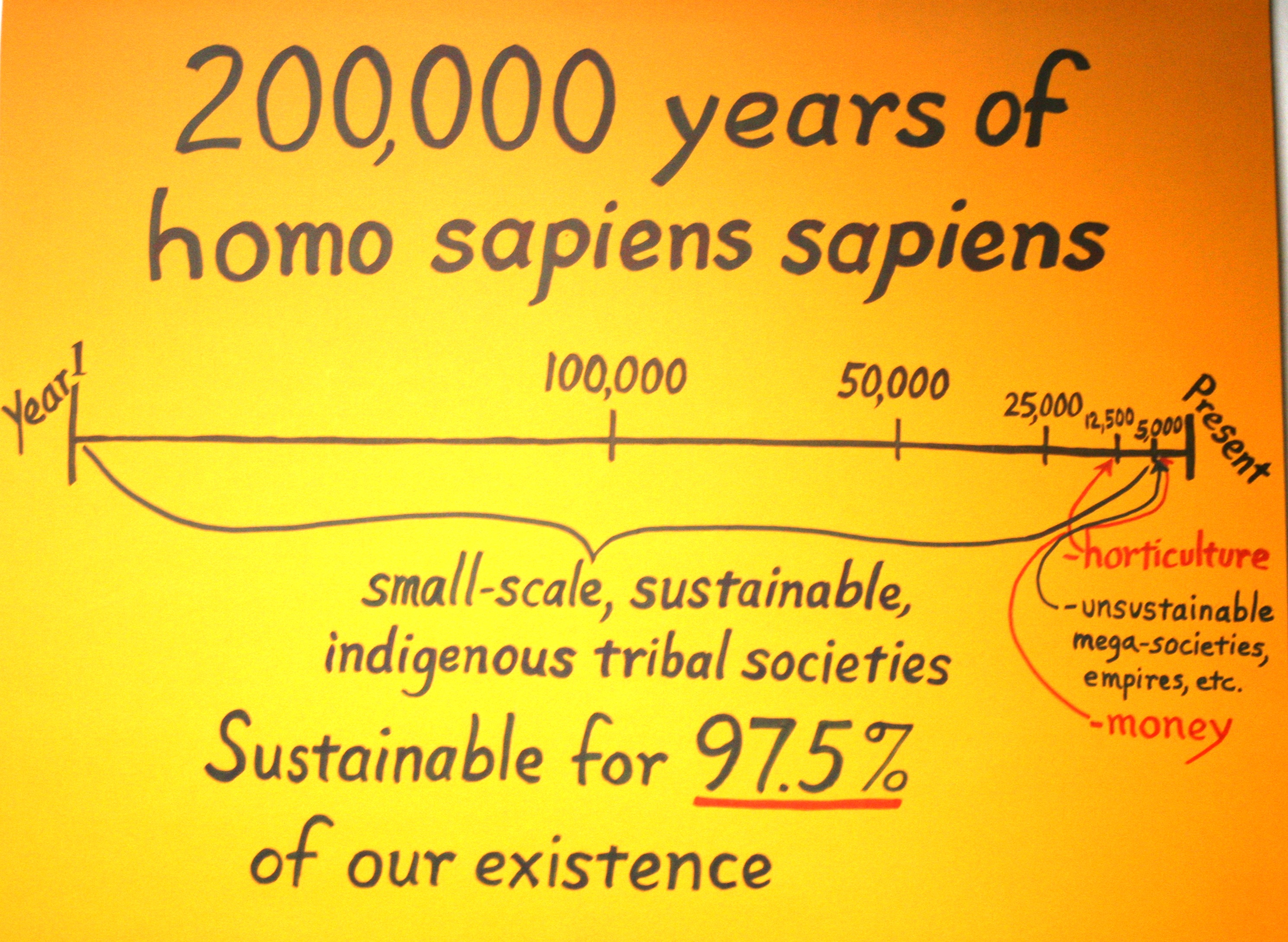

[1] Beck, Peggy V., and Anna Lee Walters, The Sacred: Ways of Knowledge, Sources of Life, Navajo Community College Press, Tsaile, Arizona, 1992. Clark, Ella E., Indian Legends From the Northern Rockies, University of Oklahoma Press, Norman, OK, 1966, 1977.

[2] The recent COP 26 debacle, which intentionally excluded participation by many Indigenous and other heavily-impacted peoples from the global south, and the infrastructure bill passed by the U.S. Congress that same week provided us with fresh examples of that futility, which many of us have long realized is the case.

[3] To be clear and fair, the word, “perfect,” in 16th century English, usually meant “complete” or “absolute,” although in certain contexts could be interpreted as “flawless” or something more like the way we define “perfect” today.

[4] Raphael Hythlodaye, Thomas More’s fictional friend who tells the story of his time in Utopia, is said to have gone there with Amerigo (a.k.a., “Alberico”) Vespucci. More’s Utopia: The English Translation thereof by Raphe Robynson, printed from the second edition, 1556, page viii.

[5] Utopia, pp. 164 and 165.

[6] As you may already know, More did eventually serve Henry VIII as a counselor, until Henry had him beheaded for refusing to publicly agree with him on the topic of divorce and remarriage.

[7] See, Anitra Nelson and Frans Timmerman, eds., Life Without Money: Building Fair and Sustainable Economies, London, Pluto Press, 2011.

[8] More’s Utopia: The English Translation thereof by Raphe Robynson, printed from the second edition, 1556, page 171. One of the minor characters in the book writes a poem speaking on behalf of the nation of Utopia personified, saying, “Wherfore not Utopie, but rather rightely my name is Eutopie, a place of felicitie.”

[9] Beginning with the radio.

[10] Thomas B. Edsall. “The Trouble With That Revolving Door”, New York Times, December 18, 2011. That and 176 other reference citations, along with an extensive list of “further readings” on the topic, can be found in the excellent Wikipedia entry, “Lobbying in the United States,” https://en.wikipedia.org/wiki/Lobbying_in_the_United_States

[11] Perhaps the only way that the politicians of today would prioritize the needs of the people whom they allegedly represent, over the will of the corporations who lobby them, would be if the people could form their own “Lobby for the Common Good” and that lobby was funded well enough to surpass the enormous dollar amounts in bribery of all of the corporate lobbyists combined. But, increased corruption of the electoral process (gerrymandering, artificially-constructed “gridlock” through the invincible two-party system, “divide and conquer,” etc.) is also making the people’s voice and will less relevant to the concerns of politicians.

[12] The first scholar to clearly demonstrate the inadequacies of so-called “100% green energy” technologies for replacing fossil fuel energy at present scale (and much less adequate at future expanded scales) was Ozzie Zehner, an engineering professor at UC Berkeley, in his excellent 2012 book, Green Illusions: the dirty secrets of clean energy and the future of environmentalism, (University of Nebraska Press). In their 2021 book, Bright Green Lies: How the Environmental Movement Lost Its Way and What We Can Do About It, Derrick Jensen, Lierre Keith, and Max Wilbert echoed much of what Zehner had previously shown while updating the case and adding many more examples and reasons why the so-called green technologies are not nearly green enough to resolve our dire predicament, taking into account all of the fossil fuel energy, mining pollution, and CO2 emissions required to manufacture, transport, install and maintain those “green” technologies at the scale needed to continue with the industrial capitalist high-tech consumer societies. In their 2011 book, TechNo-fix : why technology won’t save us or the environment, Michael Huesemann and Joyce Huesemann describe in great detail the shortcomings and pitfalls of human technological “ingenuity,” including environmental pollution, the many harmful by-products and unintended consequences of many technologies, and the need to fix harm done by many techno fixes. The authors make a very strong argument against the notion that technology and “human innovation” can fix any problem or predicament. A very informative and well-researched study published by three science journalists earlier this year (2021) on exactly what it would take to run the current and growing industrial technological U.S. economy by switching from fossil fuel energy to solar and wind power apparently led to conclusions that were not nearly as rosy or optimistic as the authors had hoped for. The Race to Zero: can America reach net-zero emissions by 2050?, by Oliver Milman, Alvin Chang and Rashida Kamal, The Guardian, March 15, 2021, delivers some startling facts about how much environmentally degrading infrastructure that feat would require, including the need to cover 10% of the surface area of the continental U.S. with solar and wind farms, just to supply the electricity, not to mention all of the other energy productions now done using fossil fuels. We would also need “enough new transmission lines to wrap around Earth 19 times.” That article can be read at this link: https://www.theguardian.com/us-news/2021/mar/15/race-to-zero-america-emissions-climate-crisis?utm_term=75ea2afeff5d052feec5683cc23a9e8f&utm_campaign=GuardianTodayUS&utm_source=esp&utm_medium=Email&CMP=GTUS_email&fbclid=IwAR2Y1IXwzzEzviZY_u8hJ6gcW0ffBiIucDHfbRkjNzDAr5v0mH2vRNGl2oE

Another good, recent scientific article about the inadequacy of “green energy” technologies for resolving our biosphere crises is found here: https://www.scientificamerican.com/article/the-delusion-of-infinite-economic-growth/  Earth system scientists are experts at the big picture of our planet’s condition and trajectory of changes over the broad span of time. One of the best (at least most clearly explained, although there was a little wifi connection fuzziness) presentations on the reality of Earth system collapse was made in an interview with Earth system scientist, Joe Brewer, back in December of 2020. Here is the link for that: https://www.youtube.com/watch?v=j2L_JD2nxbE  OK, that’s enough for one footnote—more, later. Of course, all of these cited items contain references to further sources of good information.
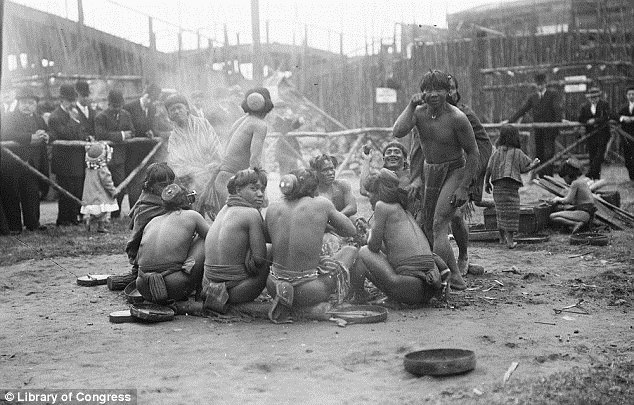
[13] Global CO2 emissions went down briefly, from March to May of 2020, during the big international shutdown of commercial and industrial activity at the beginning of the Covid-19 pandemic, but have gone back up again continuously since then. Stats on emissions for 2021 should be published in February or March of 2022.

[14] See, Nash, Gary B., The Unknown American Revolution: The Unruly Birth of Democracy and the Struggle to Create America, New York, Penguin Press, 2005, and Lynd, Staughton, Class Conflict, Slavery, and the United States Constitution: Ten Essays, Indianapolis, Bobbs-Merrill,1967.

[15] See, Thornton, Russell, American Indian Holocaust and Survival: A Population History Since 1492, University of Oklahoma Press, Norman, OK, 1987. Also, Mann, Charles C., 1491: New Revelations of the Americas Before Columbus, New York, Alfred A. Knopf, 2005.

[16] For this and many more statistics on economic inequality in the U.S. and the rest of the world, visit the Inequality.org website. https://inequality.org/facts/wealth-inequality/

[17] The time frame for the starting point of homo sapiens sapiens, or modern humans in their present form, ranges from 150,000 to 400,000 years ago, depending upon whom you ask. The longer ago that starting point was, the smaller the percentage of our existence that has been spent in unsustainable, life-destructive societies.

[18] All humans have ancestors who were, at some point in the past, indigenous to a particular place.

[19] In contrast to the negative, racist portrayals of all Indigenous peoples made by the ruling class colonialists.

[20] Here is a link to the only free access to the amazing old documentary film on the Kogis, “ From the Heart of the World: The Elder Brothers’ Warning”:

https://www.youtube.com/watch?v=hRgTtrQOiR0 The written introduction to the film at the top of the post, contains an excellent explanation on why the Kogi people do not want to receive tourists or other visitors on their lands. What humans who want to return to our original harmonious ways need to start doing is to work on listening to and following the voices of our relations in the non-human portion of this inter-connected life world. That is an ability that all First Peoples had for most of the time of our existence as humans on this Earth, and it is still the best source of true guidance. Stop looking to modern humans and guru types for the light that we all need that is freely available in our natural, inter-connected world (both within and outside of our bodies).

[21] I am afraid that if I name and give more precise locations for these model Indigenous societies, some eco-tourists, missionaries, or other modern humans might find them and corrupt or destroy them. So, then, how do we learn from them, if we cannot go find them and visit them? Maybe we should just wait until we are invited by these Indigenous peoples to come visit them, when they decide they want to teach us some things. That is how Alan Ereira, the filmmaker of the documentary on the Kogis, got to visit and film the Kogis—they found him and invited him because they had a message that they wanted to send to the world through him. Indigenous people are under no obligation to teach the rest of humanity anything, unless they are persuaded to do so by their relationships with Mother Earth and their natural relations with all species whom they follow or receive guidance from.

[22] I must acknowledge here that, like all human demographic groups, the multitude of Indigenous peoples, world-wide, have much variation among individuals within their unique individual societies—in personal experiences, adaptation to historical circumstances, retaining of cultural traditions, level of wealth or success within the imposed colonialist economic systems, and several other factors that impact cultural resiliency and recovery.

[23] Besides Thomas More, other colonial era European writers who imagined “utopian” societies and were inspired, in part, by what they had heard about Indigenous peoples of the Americas include Jean-Jacques Rousseau (The Social Contract, 1762), Tomasso Campanella (City of the Sun, 1602, English translation, 1623), Thomas Bacon (New Atlantis, 1626), and James Harrington (The Commonwealth of Oceana, 1656). Benjamin Franklin is known to have admired the form of government of the Iroquois (Haudenosaunee) Confederacy and to have recommended to his fellow revolutionaries that they copy the Haudenosaunee, to some extent. See, Donald A. Grinde, Jr. and Bruce E. Johansen, Exemplar of Liberty: Native America and the Evolution of Democracy, UCLA American Indian Studies Center, 1991, pp.96-98, but really, the whole book.

[24] There are presently about 9 million species of animals and 391,000 species of plants in Earth. See, “Our World in Data,” “Biodiversity and Wildlife.” ourworldindata.org/biodiversity-and-wildlife 

[25] Daniel R. Wildcat, Red Alert: Saving the Planet with Indigenous Knowledge, Golden, Colorado, Fulcrum Publishing, 2009, pg. 75.

[26] Robin Wall Kimmerer, “Hearing the Language of Trees,” excerpt from The Mind of Plants: Narratives of Vegetal Intelligence, edited by John C. Ryan, Patricia Viera, and Monica Galiano, published by Synergetic Press (2021), re-printed in Yes!, October 29, 2021.

[27] If not a need or dependency, such trade could remain optional, to preserve good relations with neighbors, and provide things not available in the community location that would do no harm if brought in to the community.

[28] For more on why we should stop using money and on possible alternative economic systems see my essay, The End of Money: The Need for Alternative, Sustainable, Non-monetary Local Economies

[29] Some of us old-timers who tried to go in that direction back in the late 1960’s on through the 1980’s and failed will probably have plenty to say about that. Barb and I lived communally (in shared houses and living spaces) from 1970 until 1973 and in intentional community (separate households on shared land) from 1982 to 1985.

[30] Although I do not agree with them about everything, two people who it has been said are very helpful with that kind of support are Joanna Macy and Michael Dowd (they work separately).

[31] That is enough about the “whys” of this for now, partly because the essay is getting very long. I’ll be glad to hear from others now, in the comments below and elsewhere, and will turn my attention now and in future blog posts to more about the “hows” of it all. But, I know that the real knowledge, wisdom, and joy, will come through the doing, not just the words.

This photo is actually photoshop art by a Kiowa/Choctaw photoshop artist named Steven Paul Judd. Here is a link to his page: https://www.etsy.com/people/kiowachoctaw1?ref=shop_home_header I thought it was a real old photo from around 1940 or so, but since that was only about ten years before I was born, I guess that explains why I didn’t even know there was a whole artistic genre called “photoshop art” and I hadn’t heard of this guy. Very interesting and creative work there. Check it out!
2020: the Year in My Rearview Mirror

2020: the Year in My Rearview Mirror

   When we look in the rearview mirrors of our cars, we don’t usually see very much of all that we just passed. Normally, we just glance back there now and then to see if it is safe to change lanes and pass somebody or to see if there are any police cars behind us when we want to go a little faster than the law allows. In a similar fashion, this look back at the year 2020 will not attempt to deal with everything that came to pass, just those things that did the most to catch my attention and give me something to think about. This is the first time that I have ever written one of these things. I thought about writing one back in June, before we were even halfway through the year, because so many things of higher significance than we usually see in a whole year had already transpired. After giving it much thought, I decided to wait until the year was over. I worked on it over a period of 37 days, researching and writing, and had no idea when I started that I would learn so much by diving in and doing this. I realize that now, in February, 2021, many of us seem to want to forget all about the year 2020. Maybe it is just too soon to deal with what happened during that notable fragment of the time continuum, and that is completely understandable. It was, and is still, very painful. This essay will still be sitting right here for you whenever you are ready for it. It is also one of those pieces of writing that does not necessarily have to be read in its chronological order–you can jump in and out of it at any points that you wish. It is my hope that the thoughts and analyses of those events that I describe here, and the many vital questions raised, will contribute to us humans taking the corrective, life-nurturing, natural life-preserving actions that we so urgently need to take in 2021 and during whatever time after that which we will still have in our hands.

          Something different that you will probably notice about this review of the year, from most others that you may read, is that I pay more attention to and attach more significance to events and phenomena that significantly impacted those fellow beings whom I call “the innocents”: our non-human relations (all other species and every part of our natural habitats) and those humans around the world who do not engage in the modern industrial technological toxic production and over-consumption that we are so accustomed to here in the U.S., and in similar countries. I also include with the innocents the little children who did not ask to be born into over-consumptive, toxic, wasteful industrial societies and, at this point in their lives, “know not what they do.” Most of these stories are rather grim and painful, but, if we can learn from them how to better live and be better humans, then, hopefully, all that we suffered last year will not be in vain.

Siberian tusk hunter. Photo by Amos Chapple

            January.

First, a few major events that rolled on, in continuity, from 2019. Over in the Siberian Arctic, because the climate-warmed permafrost had continued to melt and collapse in large sections that year, people who used to be farmers before their lands became unstable and swampy, continued to engage in their newest occupation: scavenging. https://www.washingtonpost.com/graphics/2019/national/climate-environment/climate-change-siberia/  They search the recently-melted and collapsed former permafrost lands for mammoth and mastodon tusks, from the carcasses which are now exposed, thawing out, and decaying, after being buried deep and frozen for over 10,000 years. Who knows what microbial entities have been released from their ancient slumber among all of the various decaying bodies of long-extinct animals and plants? Perhaps some potentially pandemic viruses? The scavenging residents of the Siberian Arctic sell the mammoth and mastodon tusks that they find to brokers and buyers throughout the world who believe that “medicines” made from these tusks can restore men’s fading or lost virility. About 90% of their customer base consists of men in China, where such beliefs in the power of ivory are more common. https://www.wsj.com/articles/a-mammoth-problem-emerges-in-siberia-11562763878https://www.boredpanda.com/mammoth-tusk-hunting-russia/?utm_source=google&utm_medium=organic&utm_campaign=organic   I am not claiming that Covid-19 came from the thawing Siberian permafrost. Scientists don’t know for sure where it originated but their consensus theory is that it first came to humans in China from a particular species of bat that is common there. One of the favorite foods of bats is the mosquito and there is now a veritable plague of mosquitos in Siberia, which borders with northern China. Mosquitos are also able to pass viruses from animals to humans.

Mosquitos cover photographer Amos Chapple’s feet at the tusk hunters’ camp in Siberia. Photo by Amos Chapple.

Also rolling on from the end of 2019 to begin the new year of 2020, was the feigned attempt by members of the Democratic Party serving in the House and Senate of the United States to impeach what should have been the most easily impeachable (but not by that much) President in the entire history of that miserable nation. The estimated number of impeachable offenses committed by Donald Trump during his first three years in office (January 2017 through January 2020) ranges wildly from about ten to over one hundred, depending on whether one counts each individual violation of the same law or just the number of laws themselves that he violated. Constitutional scholar and former senior official in the Department of Justice, Bruce Fein, concluded that there were twelve separate laws (nine articles of the U.S. Constitution and three other federal laws) which Donald Trump had broken by the time that the impeachment investigation began, and that he committed multiple violations of some of those laws, even dozens of violations of two of them (Abuse of the Powers of the President and Abuse of Public Trust). https://www.commondreams.org/views/2019/11/25/end-rule-law-12-impeachable-offenses-committed-trump Even so, the Democratic legislators chose to only impeach him on two of the multitude of Trump’s criminal offenses: Abuse of Power, and Obstruction of Congress (https://www.congress.gov/116/bills/hres755/BILLS-116hres755enr.pdf ). Disregarding most of the many examples of violations by Trump within those two categories, the Democrats chose to focus only on actions by Trump related to his attempt to get the Ukrainian government to dig up evidence of impropriety against his already apparent future opponent in the 2020 presidential election, Joe Biden. The natural question that arises from that choice is, why choose only that one example of those two major infractions when they had roughly one hundred other impeachable “high crimes and misdemeanors” that they could have used? Was this impeachment trial really an attempt to impeach Donald Trump, or was it actually the first public event in the 2020 Democratic presidential election campaign, designed to promote their long-before-chosen candidate? In the article cited above, Bruce Fein and Chris Hedges provide us with evidence for a very plausible explanation. It would not serve the Biden presidential campaign well to attempt to impeach Trump for crimes that were also committed by the Obama/Biden administration, such as sending U.S. troops into wars that were not declared by Congress, or carrying out illegal surveillance against U.S. citizens, along with several other illegal, power-abusing, impeachable acts. Although the consequences of the failure to impeach Donald Trump may have ended up being nearly the same had Mike Pence become Trump’s replacement, we will never really know how many thousands fewer lives would have been lost to Covid-19 had they actually impeached Trump on something that would have also got him convicted in the Senate. The losses suffered in 2020 by the rest of the natural world due to Trump’s prioritizing of capitalist industrial production and consumption over our natural life-sustaining ecosystems would probably have been no different under Pence, and will probably continue at nearly the same level under Biden.

            On January 7th, China announced that they had identified a new (or “novel”) coronavirus that had sickened some people in Wuhan. The World Health Organization initially named the virus “2019-nCoV,” but later changed the name to “Covid-19.” Two days later, the first person to die of the disease, a 61-year old man, died in Wuhan.

Australian Kookaburra Kingfisher perched in a burnt tree in Australia, 2020. Photo by Adam Stevenson

            The last beginning-of-2020-continuum that I will mention here is the devastating wildfires in Australia, which consumed and destroyed so many lives, from September of 2019 until the last of the fires was extinguished in early May of 2020. The intensity and amount of these fires (15,000 separate fires in all, for just that one season) was enabled by decades of increasingly frequent droughts and record-setting average temperatures, the previous summer of 2018-19 being the hottest summer on record in Australia. https://insideclimatenews.org/news/04032020/warming-climate-implicated-australian-wildfires-new-study-finds/  When the year began, in January, the inferno was reaching its peak, eventually consuming 47 million acres (18.6 million hectares), an area about the size of the U.S. state of Nebraska. https://en.wikipedia.org/wiki/2019%E2%80%9320_Australian_bushfire_season  The cost to Life was over one billion reptiles, mammals, birds and amphibians killed and another two billion injured and displaced due to destroyed habitat. https://www.cnn.com/2020/07/28/asia/australia-fires-wildlife-report-scli-intl-scn/index.html
https://www.statista.com/chart/22396/estimated-number-of-animals-killed-or-displaced-in-australian-bushfires/ 
  I could find no statistics on the losses of fish and insects, but I know that the waters in the fire zones were intensely over-heated and afterward, when the rains came, were filled with ash, eroded soil and bodily remains from the runoff. Thirty four humans were killed by direct contact with the fire and heat and another 445 humans died from smoke inhalation, many in towns and cities long distances away from the actual flames. https://www.theguardian.com/australia-news/2020/may/26/australias-summer-bushfire-smoke-killed-445-and-put-thousands-in-hospital-inquiry-hears  Smoke and ash frequently darkened parts of nearby New Zealand and the smoke plumes even spread at times all the way across the Pacific Ocean to Chile and Argentina.

I have not seen any numbers on the Australian Indigenous traditional medicine and food plants that were destroyed or possibly made extinct in those fires. I do not know how people calculate and translate all of this loss into monetary values, but of course they tried to (mostly measuring “property damage,” including the 3,500 human homes that were destroyed), and that figure came out to $103 billion Australian dollars, and thus the “costliest” natural disaster of any kind in Australian history. https://en.wikipedia.org/wiki/2019%E2%80%9320_Australian_bushfire_season  Has anybody ever measured the cost to inter-connected Life itself from a disaster like this, or the cost to Life created by bringing English colonialism and industrial capitalism to Australia in the first place? How about the long-term psychological damage incurred during and after the fires from hearing the screams and tending to the wounded, of all species?
           

“More than 2,000 koalas may have died in the fires and their bodies may never be found, an ecologist says.” Australian Associated Press Sun 8 Dec 2019 Photograph: Supplied by Jimboomba Police

            February.

            Bernie Sanders learned in 2016 that the Democratic Party leaders would never allow him or any other self-identified democratic socialist to become their party’s nominee for President, and that they would prevent that from happening by any means possible, fair or foul, legal or illegal. So, why did he run again, in the Democratic Party primary in 2020? Did he think that if a large enough number of voters enthusiastically supported him the Democratic National Committee would come to see the light and begin to accept and support the will of the people? Or, was somebody or something else pulling his strings? Well, whatever the reason, he sure got off to a great start in the February primaries. After some days of confusion and delay in counting the votes in Iowa, Bernie won that first primary (I know, “caucus”) of the season (although the party later gave the victory to Pete Buttigieg, without any reasonable explanation, and Joe Biden was given the most delegates in Iowa, even though he came in fourth place). https://www.nytimes.com/interactive/2020/02/04/us/elections/results-iowa-caucus.html Bernie ended up winning 3 out of the 4 February primary contests, until the switcheroo was pulled on him, regarding Iowa. He won in New Hampshire and Nevada, while Joe Biden won the last February primary in South Carolina, making the delegate count at the end of the month come out to 62 delegates for Biden and 60 for Bernie. Millions of Bernie’s supporters were enormously pleased with his much better performance in those early primaries than expected, but apparently that delegate count and all of that progressive enthusiasm was way too close for comfort for the DNC. On February 21st, the Washington Post published a story, citing anonymous “U.S. officials,” saying that the Russians were assisting Bernie Sanders’ campaign in order to help Donald Trump win the 2020 election and remain in office. https://www.washingtonpost.com/national-security/bernie-sanders-briefed-by-us-officials-that-russia-is-trying-to-help-his-presidential-campaign/2020/02/21/5ad396a6-54bd-11ea-929a-64efa7482a77_story.html 

https://greenwald.substack.com/p/after-the-deep-state-sabotaged-his

            Meanwhile, the fires in Australia gradually diminished in February, due largely to some strong rains, and on February 9th Antarctica experienced its hottest day ever recorded, hitting a high of 69.35 degrees Fahrenheit (20.75 degrees Celsius) at Marambio research base, on Seymour Island, a team of Argentine researchers reported. Massive icebergs continue to break off of the continent at an increasing rate and journey out into the warming seas. https://www.livescience.com/antarctica-record-high-temperature.html 

On February 27th, Donald Trump said about the Covid-19 virus: “It’s going to disappear. One day – it’s like a miracle – it will disappear.”

Democratic presidential candidate Sen. Bernie Sanders, I-Vt., waves to supporters after a campaign rally in Chicago’s Grant Park Saturday, March 7, 2020. (AP Photo/Charles Rex Arbogast) (Copyright 2020 The Associated Press. All rights reserved)

            March.

            March 3rd was “Super Tuesday” for the Democratic Presidential Primary contest, which was called that because there were 15 primaries in that one day. Bernie Sanders won five of them, including California (the largest one in the nation, by delegate count), Colorado, Democrats Abroad, Utah and Vermont. He also came in a close second in a few of the other contests, picking up significant amounts of delegates there, too. Joe Biden won the other 10. After all of the Super Tuesday votes were counted, Bernie had a total of 623 delegates and Biden had 746, with the vast majority of primaries still to come and nearly three thousand delegates still to be voted for and counted toward the 1,991 delegates needed to win the nomination. A victory for Bernie Sanders in the Democratic presidential primary election was still easily mathematically possible. Even so, within the next week after Super Tuesday, mainstream corporate media outlets were harmoniously declaring Joe Biden to be “the presumptive Democratic nominee,” in spite of the math and the many outraged objections to that from campaigners for Sanders. https://www.sourcewatch.org/index.php?title=Joe_Biden  By Thursday, March 5th, the other three leading contenders had all dropped out of the race: Pete Buttigieg on Sunday, the 1st; Amy Klobuchar on Monday, the 2nd; and Elizabeth Warren on Thursday. Buttigieg and Klobuchar endorsed Biden immediately upon their exits, and Warren waited until April 15th to endorse him. On the last day of that momentous week, Saturday the 7th, Bernie Sanders announced that he and his campaign organizers were considering the cancellation of all of their currently-scheduled campaign rallies, due to their concerns about the rapidly growing Covid-19 pandemic and their desire to not help spread it further. Bernie’s campaign rallies were the largest of any presidential candidate (including the Republican candidate’s rallies) and a major promotional force for his campaign.

            Coinciding with this major shift in the Democratic primary dynamics was the rapid increase in the spread of the coronavirus, Covid-19. On March 15th, the total number of cases of Covid 19 in the U.S. was 4,191, which put the U.S. in eighth place among all the nations of the world in active cases. Just eleven days later, on March 26th, the U.S. leaped over China into first place in number of active cases in the world, with 86,613 cases and 1,206 deaths! The nation has remained in first place for number of cases and number of deaths ever since, far ahead of the second and third place nations (India and Brazil) and many times more than all of the other nations, and is still surging further and further away from them all, as I write this in mid-January of 2021.

During those first two weeks of March, two very credible investigative journalists for CNN, Daniel Dale and Tara Subramaniam, counted 33 different lies and misleading statements that Donald Trump told to the American people about Covid-19, in what Trump claims was an attempt by him to keep the people from panicking. https://www.cnn.com/2020/03/22/politics/fact-check-trump-coronavirus-false-claims-march/index.html https://www.theguardian.com/us-news/2020/sep/09/trump-bob-woodward-book-rage-coronavirus  The lies, twists, and spins from Trump included statements such as: “We have very low numbers compared to major countries throughout the world. Our numbers are lower than just about anybody.” (March 6th, to reporters at signing of a coronavirus appropriations bill, when the U.S. was ranked tenth among all nations in the world in numbers of cases, and relatively few Americans were being tested); “Anybody that wants a test can get a test. That’s what the bottom line is.” (March 6th, when doctors all over the country were saying that there were not enough testing kits available, and there were many restrictions and limitations on who could get tested); “..we’re having to fix a problem that, four weeks ago, nobody ever thought would be a problem.” (March 11th to reporters at a coronavirus meeting with bankers. Trump had been briefed as early as late January on the seriousness and potential disaster that the pandemic could be to the U.S. and the world.); “This is a very contagious–this is a very contagious virus. It’s incredible. But it’s something that we have tremendous control of.” (March 15th, at a coronavirus press conference). That is just four out of thirty-three examples over a period of two weeks. On March 19th, Trump told Bob Woodward in an interview, “I wanted to always play it down. I still like playing it down, because I don’t want to create a panic.”

This intentional deception was possibly Trump’s most serious crime committed while in office (with the continued enabling of the genocide in Yemen—initiated under Obama—possibly worse, in number of lives lost, which is very difficult to measure) https://www.mintpressnews.com/yemen-genocide/243247/ , and ultimately cost hundreds of thousands of American lives. Of course, I am not saying that Trump is responsible for all of the Covid-19 deaths in the U.S.. I am not sure how to go about doing the math to compute what percentage of the total deaths (over 425,000, as I am writing this now) can be reasonably attributed to Trump’s lies, deception, lack of leadership, lack of concern for the danger of the virus and for the sufferings of people other than himself, but surely some significant percentage exists. Whoever takes on that grand mathematical puzzle would not only have to figure out how many people contracted Covid-19 because they believed Trump’s lies and didn’t take precautions, but also how many people who did not believe Trump and did take precautions were infected due to the actions of Trump’s followers. Another big factor that makes the puzzle even more complex, is the historical and systemic circumstances, in existence since long before Trump was even born, that surely contributed to the U.S. Covid-19 death rate, rooted in the health disparities created by vast economic inequality, racial discrimination, and all the ravages of unrestrained predatory capitalism itself. The repeated refusal of U.S. politicians to even seriously consider and discuss adapting a universal health care system, like the ones that helped bring much better results in the battle against the pandemic to most of the other industrialized nations of the world, is a prime example of that. https://www.usatoday.com/story/news/health/2021/02/11/lancet-commission-donald-trump-covid-19-health-medicare-for-all/4453762001/ We could also try to figure out how many lives might have been saved if Bob Woodward would have revealed what Trump told him about his reckless disregard for the danger of the coronavirus, and his intentional misleading of the people he was sworn to protect, back then, in March, instead of waiting until his book was published in August.

            After the world, including the U.S., began to respond to the pandemic with shutdowns of business as usual, and the U.S. stock market took its deepest dive ever on March 9th, the U.S. Congress began to formulate and debate some sort of action for economic relief and the salvation of capitalism. Realizing that this was no time to resist a little emergency socialism (although they didn’t dare use that word for it), the House created and passed the first Coronavirus relief bill, the Coronavirus Aid Relief and Economic Security (CARES) Act, and sent it on to the Senate for further debate and tweakage, where it finally passed again on March 25th. That bill provided for $1,200 checks to Americans making under $75,000, families to receive $500 for each dependent child, an additional $600 per week for four weeks for people who had been laid off, to supplement their unemployment checks, $100 billion for the nation’s hospitals, $150 billion in relief funds for all the states, and a $500 billion loan program to give “relief” to allegedly “struggling” corporations like those in the airline industry. https://www.usnews.com/news/politics/articles/2020-03-26/senate-passes-historic-2-trillion-relief-to-combat-coronavirus-pandemic

In this country, socialism of various sorts is considered allowable in cases of emergency, such as FEMA assistance after a hurricane or devastating wildfires, or, in normal conditions, to fund fire and police departments, or even for non-emergency essential public services, such as public schools and public libraries. In most other “western,” “civilized” countries, free public health care would also be included among those last examples. But, in the U.S., the largest non-emergency government spending from the common treasury of all Americans (which is a form of socialism) goes in the form of subsidies and tax breaks to the largest corporate business entities, along with funding military activities that are mostly not related to the constitutionally-ordained purpose of the military: to protect and defend the nation from both foreign and domestic attackers, in wars declared by Congress. So, in summary, the acceptable practice is minimal, mostly emergency socialism for the working class majority of Americans, and the maximum socialism (or raiding of the common treasury) that the ruling class can get away with for the most wealthy and powerful Americans. The Congresspersons, the President, and the Supreme Court members also get 100% of their medical needs covered from the common treasury for the rest of their lives, after gaining office. Bernie Sanders spoke strongly in the Senate for the Coronavirus Relief Bill, but did not take advantage of that amazingly “teachable moment” to say at least a few words about how this great bill that they were passing to meet so many dire needs of the American people (and a couple of not-so-dire “needs” of the corporate elites) in a time of crisis was a form of socialism. Why not?

April.

As Covid 19 rapidly surged throughout the world during the months of March and April, many nations began to respond to it in ways similar to China’s successful response back in January and February. Restrictions on normal activities of all kinds were put into place by about 54% of the world’s human population, from total lockdowns to reductions of varying degrees on travel, work, shopping, and in-person socializing. A study published at the end of April by the International Energy Agency https://www.iea.org/reports/global-energy-review-2020 revealed that the impacts of these shutdowns and reductions produced the only example of humans actually doing what really needs to be done to resolve the climate crisis that we have ever witnessed! The data compiled by the IEA clearly shows us the only likely way that we will accomplish the 7.6% reduction in CO2 output per year for the rest of this decade that was urged by the IPCC. https://www.ipcc.ch/sr15/  Basically, what their findings revealed was that the reductions in industrial production, consumption, and travel that the industrialized world carried out between January (beginning in China) and April 28th, when they completed their report, reduced CO2 output by an estimated 8% worldwide!!

https://www.yesmagazine.org/environment/2020/05/02/coronavirus-carbon-emissions-turned-back-10-years/?utm_medium=email&utm_campaign=YESDaily_20200505&utm_content=YESDaily_20200505%20CID_6bddd1df1e1d3e71fd84a9cdfbd6609f&utm_source=CM&utm_term=Read%20the%20full%20story&fbclid=IwAR2FVa_qOVdoLewUOCUN7fJJTj9nltNV1lBuvpuyWHmJbp_yKgREUEuc5pY

As the above chart shows us, we have never seen anything close to this level of CO2 and energy output reduction in the entire modern industrial era! Even with all of the wind turbine and solar panel installations around the world, over the last few decades, CO2 levels have continued on a steady rise, until now. This is a profound illustration of what many of us have been saying for years: to resolve the climate, biosphere, and extinction crisis, we will have to actually stop or dramatically reduce the activities and habits that have created the problem. Unfortunately, what happened next—in May, June, and ever since then—masses of people in the U.S. and elsewhere refusing to continue with restrictions once they saw a little improvement in the Covid-19 crisis, shows us how unlikely it is that enough humans are willing to sacrifice some of their personal comfort and consumption habits even to save themselves and their offspring from deadly disease or biosphere collapse.

It was reported on April 7th that, “Australia’s Great Barrier Reef has experienced its most widespread bleaching event on record, with the south of the reef bleaching extensively for the first time. This marks the third mass bleaching event on the reef in just the last five years and scientists say that the rapid warming of the planet due to human emissions of heat-trapping gases are to blame.” https://www.cnn.com/2020/04/07/australia/great-barrier-reef-bleaching-2020-intl-hnk/index.html

On April 8th, the day after the number of Covid-19 cases in the U.S. surpassed 400,000, and the number of dead had grown to 12,790, Bernie Sanders announced that he was suspending his campaign for president. Bernie explained that the deadly seriousness of the pandemic had much to do with his decision and that it would be a better use of his time and abilities to fight that battle. “As I see the crisis gripping the nation, exacerbated by a president unwilling or unable to provide any kind of credible leadership, and the work that needs to be done to protect people in this most desperate hour, I cannot in good conscience continue to mount a campaign that cannot win and which would interfere with the important work required of all of us,” Sanders said. Even though he said that he “cannot win,” he assured everybody that his name would remain on the ballot throughout the rest of the primaries, in hope that he would gain enough votes to show the considerable popular support for his policy goals and help push the Democratic Party in a more progressive direction. At that point in time there were still 26 primaries left (about half of them) and 1,506 delegates still up for grabs, so it still seemed like anything was possible before the primaries would end in June. But, less than a week later, on April 13th, Bernie publicly endorsed Joe Biden for president. How many of his supporters did he think would then continue to show up and vote for him in the primaries? Did he really think that this early surrender to Joe Biden and the DNC would even nudge the party one micro-millimeter to the left of anything? So, we come back to the question, “Why did Bernie run in 2020?” Who or what entity actually benefitted from all of that extraordinary effort and enthusiasm from so many determined and hopeful people who energetically campaigned for him and from the millions who voted for him?

A field of onions waiting to be buried in Nyssa, Idaho on April 10, 2020. (Joseph Haeberle / The New York Times)

Innocent, “naïve” child: “Mommy, why don’t the farmers just give all of those onions to the hungry and starving people, instead of just throwing them away?

“Well-adjusted,” “sensible” mother: “That’s not how capitalism works, honey. To give the food away could destroy capitalism.”

Innocent, “naïve” child: “Well, it sounds to me like capitalism doesn’t work. Maybe it SHOULD be destroyed.”

At around that same time, the middle of April, the closing of most restaurants in the country due to the pandemic, along with the increased purchasing of foods from grocery stores as more people ate at home, caused some severe economic difficulties in the commercial food supply chain. Many farmers, processed food manufacturers, and freight transportation companies were not able to adjust to the changes in demand and distribution in ways that would allow them to make sufficient profits. That led to people sitting in their cars in very long lines waiting to pick up food (either purchased or freely distributed) and farmers having to dump large quantities of produce that they could not sell or transport at a profit, rather than distributing it to free food distribution centers.  That would have been a great opportunity for Bernie Sanders to talk to people about the necessity for some socialistic intervention by the government to assist those industries as well as the millions of Americans then experiencing food insecurity, while teaching them a little bit about what socialism really is. https://www.chicagotribune.com/coronavirus/ct-nw-nyt-coronavirus-food-waste-20200413-x5n6sbmrh5an3cilo6hxozrkj4-story.html?fbclid=IwAR1_h32r_D-tgcajt2KSmM7p9kuz7hb09whMWhouMEM5dAxwzrSC5ryZ_fw   Does anybody remember hearing Bernie say one word about the meaning of socialism while he was allegedly trying to push the Democratic Party further to the left?

Back during the first week of this month of April, Trump began to lay the ground work for claiming the election would be fraudulent if he lost, by claiming that mail-in ballots are subject to a much higher rate of fraud than in-person voting. Trump said that after Democrats had begun to question the safety of voting in-person for the rest of their primary elections, due to the pandemic. https://www.npr.org/sections/coronavirus-live-updates/2020/04/07/829323152/fact-check-is-mail-ballot-fraud-as-rampant-as-president-trump-says-it-is  It was clear to the Republican Party leaders that since more Democrats were taking Covid-19 seriously and taking precautions than Republicans generally were, Democrats would be much more likely to use mail-in ballots in the general election in the fall (which also indicates that they were aware then that the pandemic would not just “go away like magic” before Fall). But Republican politicians had also known since at least as far back as the 1980s that higher voter turnouts generally favored the Democrats and voter suppression tactics generally favored themselves. https://www.theguardian.com/us-news/2020/mar/30/trump-republican-party-voting-reform-coronavirus

On the last day of April, inspired by, and with the vocal support of their president, both heavily-armed and unarmed citizens of the state of Michigan, were allowed into the state capitol building by police (but not into the actual legislative chamber) to protest and shout down a state legislative hearing on whether to continue the Covid-19 safety regulations that they had put into place a little over one month earlier, during the initial surge of the pandemic. Many in the crowd seemed to be primarily concerned about the economic ramifications of the partial shutdown, while some of them seemed more concerned about government taking away their liberty to just do whatever the heck they want to. The fact that very few in the crowd of hundreds wore masks or distanced themselves indicated that the actual dangers of Covid-19 were of as little concern to them as to their commander-in-chief. https://www.vox.com/policy-and-politics/2020/4/30/21243462/armed-protesters-michigan-capitol-rally-stay-at-home-order

https://www.salon.com/2020/05/01/trump-declares-support-for-armed-protestors-storming-michigan-capitol-these-are-very-good-people/

Dress rehearsal for insurrection at the Michigan State Capitol, April, 2020 Photo by Nicole Hester of MLive.com

In mid-April, a team of scientists from Columbia University published a long-term analytical research report showing that the mega-drought (an extremely dry, wide-spread pattern that endures over two decades or longer) in the western U.S. is nearly equal to the worst mega-drought in the last 1,200 years, and on course, due to climate change, to soon become the worst ever on record. This current mega-drought began in 2000. https://www.cbsnews.com/news/climate-change-drought-california-western-united-states-study/

On the 50th anniversary of Earth Day, April 22nd, a new documentary film was released called, “Planet of the Humans,” which caused much debate, antagonism, and even calls by some environmentalists to censor or ban the film. There were many reasons for the turmoil, one being that the filmmakers dared to reveal that switching to solar and wind power while still using fossil fuels to mine the materials, transport them, manufacture the “green energy” devices from those materials, and transport the devices to their markets and installation sites, would not reduce CO2 emissions sufficiently for meeting even the modest Paris Accord objectives, even if done so on a grand scale. The filmmakers basically said that what we really need to do is reduce industrial production and consumption to the levels recommended in 2018 by the IPCC https://www.ipcc.ch/sr15/  and numerous other climate scientists https://systemchangenotclimatechange.org/article/ipcc-report-first-thoughts-next-steps , as the Covid-19 shutdowns were already showing us could be done (see above). To try to resolve the crisis with green energy devices alone would be way too little too late. It would be like driving a car toward a cliff and not slowing down sufficiently or applying the brakes hard enough to stop in time to prevent flying over the edge. A little bit of slowing down and a light application on the brake pedal would ultimately be a meaningless and pointless gesture. The driver and passengers would not “feel good that at least we did something” while melting in flames at the bottom of the ravine. The chart below (made in 2016) illustrates the science on the urgency of our current global ecological circumstances very clearly:


            May.

            In the spring, many people who had not done so before, started growing their own food. More people fished, hunted and gathered wild berries in 2020, too. That was, in part, a response to the food insecurity generated by the pandemic shutdowns, but it was also part of an ongoing conjunction of social movements going back to the late 1960s. First there was the counter-status quo-culture “back to the land” and health food movements. Then, in the 1980s in Mexico, there was the Indigenous La Campesina food sovereignty movement, which was also a response to food insecurity, as well as to the ravages that corporate commercial agriculture was continuously committing against the land and the people. That movement gradually spread throughout Latin America and into other parts of the world, among mainly traditional and Indigenous farmers. The food sovereignty movement has experienced a revival in North America over the last decade or so, mainly among Indigenous peoples, but influencing non-Indigenous people as well. As the name suggests, “food sovereignty” means the power to create and maintain food systems that can operate locally and independently from the failed, toxic industrial commercial system that currently dominates the industrialized world and imperils all of the world. The food sovereignty movement differs from survivalist movements in that it is community-centered, cooperative, and also, in many cases, eco-centered, rather than individualistic and self-centered. This is part of what some of us are doing to move forward, past the collapse of a dying system and culture, into a new, Earth/Water/Sun-centered, inter-connected, eco-harmonious living world.

Photo by Faith Price


                When Bernie Sanders left the 2020 Democratic presidential primary race, the Democratic Party desperately needed to find a way to bring enough of Bernie’s supporters on board with the Joe Biden campaign to help him win in November. What could they say and do to encourage active, if not enthusiastic, support among progressive Democrats, Democratic Socialists, and left-leaning independents for their chosen candidate? The Democratic Party elites could sense somehow that saying “at least Biden is better than Trump” might not be enough to win them over. To make the matter even more challenging, some of Sanders’ supporters still hoped that Bernie was kidding about the “suspension” of his campaign and his endorsement of Biden, and speculated that Bernie may have some sort of secret plan to insert himself back into the campaign before the Democratic national convention. Using the mainstream corporate media to amplify the horror of the idea of another four years of Trump, with plenty of help from Trump himself and his shockingly inept gestures at handling the worse medical crisis in American history (“maybe we could inject some of that disinfectant into the lungs?”), might do the trick, but they sensed that they probably needed something more. Even though a hold-your-nose-while-voting-for-the-lesser-evil vote counts just about the same as an enthusiastic, I-just-LOVE-this-candidate vote, the enthusiasm really helps gain more votes during the months of campaigning before an election. But what could the progressives and democratic socialists be enthusiastic about that the DNC could put into the Democratic presidential platform and get Biden to promise in his campaign speeches? The DNC would never allow Biden to run on promises of Medicare For All, higher taxes on the rich, or anything that even hinted of socialist reform of the economy, including the demands of the most serious, science-believing climate activists to go beyond just reducing the use of fossil fuels and actually reduce industrial production and consumption, which would violate the gospel of endless economic growth and maximization of monetary profit. So, which of the many progressive demands of the Bernie supporters could be safely co-opted for the Biden campaign and didn’t need any adherence to or mention of socialism to accomplish (or at least promise) them? The equality and inclusion issues (within the limits of only those opportunities possibly available under status quo capitalism), such as anti-racism, LGBT rights, humane treatment of immigrants and their children, diversity in hiring—including in Joe Biden’s cabinet and staff appointments, along with many vague references to “social justice” thrown in here and there, for good measure, had long proven useful on such occasions in the past. All of that, plus being a little bit better than Trump, and actually believing in science, especially during the horrific pandemic, might be the ticket to success and Democratic victory in November.

            On May 5th a video surfaced and went viral on the internet showing a present-day lynching of a young Black man, Ahmaud Arbery, who was jogging in a suburban neighborhood in Georgia. The murder actually happened back on February 23rd, but, like many in the very long history of murders and lynchings of Afro-descended human beings in America, this murder went unreported and unnoticed in the press for those two and a half months. But nowadays we have cellphones with very high quality cameras and video recorders in just about everybody’s hands and that, along with the fact that the majority opinion in America shifted away from support for murdering Black people with impunity about sixty years ago, is getting to be a bit of a problem for white supremacist murderers who don’t want to be incarcerated. That includes white supremacist policemen and former policemen like one of the two murderers of Ahmaud Arbery. Those two murderers were arrested the day after the video surfaced. https://www.cnn.com/2020/05/05/us/ahmaud-arbery-jogging-georgia-shooting/index.html

            On May 13th another police murder, this time of a Black woman, Breonna Taylor, unarmed, at home, in her bed, surfaced in the national press exactly two months after the murder occurred on March 13th. Breonna Taylor was an emergency services technician who lived in Louisville, Kentucky. https://www.cnn.com/2020/05/13/us/louisville-police-emt-killed-trnd/index.html

            On May 25th another murder occurred, by an active duty policeman, with support from three police accomplices, far away from the Deep South, in St. Paul, Minnesota. The victim was George Floyd and the graphic videos detailing the entire incident, combined with the two above-mentioned murders earlier in the month, pushed masses of Americans over a tipping point and into action. The videos of this murder began to go viral on the internet the same night, and it was covered in the press beginning the next day. https://minnesota.cbslocal.com/2020/05/26/george-floyd-man-dies-after-being-arrested-by-minneapolis-police-fbi-called-to-investigate/  People also began to fill the streets of St. Paul in protest that day, along with many other cities and states in the days and months that followed.

A protester holds up a portrait of George Floyd during a “Black Lives Matter” demonstration in front of the Brooklyn Library and Grand Army Plaza on June 5, 2020 in Brooklyn, New York | Angela Weiss/AFP

            What brought so many thousands of people into the streets for about three consecutive months, all over the country, was a culmination of many forces, circumstances and determinations. In America, the use of various types of policing forces to protect the plunder of colonialists and capitalists and to keep oppressed peoples subordinate and/or terrorized, began with the building of forts to protect land stealers, moved on to the employment of “patrollers” to pursue and re-capture escaped enslaved persons, the use of marginalized immigrants to police other marginalized working class people in the industrial north, on through the KKK and local police enforcing Jim Crow segregation, and into the present enforcement of the old white power institutional structures as they transition into multi-ethnic but monocultural capitalist ruling structures, or, in other words, the guard not really changing, just changing colors. So, the viral videos of police murders and lynchings were not signifying anything new, and the resistance represented by the Black Lives Matter movement was also part of a long-enduring continuum of resistance and opposition to racist institutional structures and practices. One somewhat remarkable aspect of this particular wave of resistance in 2020 was its diversity of participants. I don’t know if anybody has actually done a formal study of the crowd demographics, but, from what I observed, it looked like a much higher proportion of white-identified people joined in these protests than we had back in the “Mississippi Freedom Summer” Black voter registration movement in the summer of 1964, which was quite a high percentage (again, I don’t know the exact numbers for back then, just a fuzzy memory). Several of the young white activists that I talked to last summer indicated to me that they were embarrassed about and just sick of seeing so much racism still present in 2020, when it seems to them that “everybody should know that’s wrong by now.” They were also embarrassed about and sick of having a president who encouraged and promoted it. Of course, what was also at work on their feelings was the customary “guilt by association” that America’s deeply-engrained custom of racial classification and racial bonding brings, along with their relatively new-found awareness of systemic race-based advantage and disadvantage. The police response to these anti-racism protests in the spring and summer of 2020 was similar in excess to the police response in the south in the 1960s, but more in the style of the militarized police brutality demonstrated at Standing Rock in 2016.

            The Black Lives matter, anti-racism, anti-police brutality protests of 2020 could have been a useful entity for the Democratic Party to latch onto and even co-opt, to some degree (to the extent that the organizers of individual demonstrations would have allowed or enabled that), to try to reach out to progressives and alienated Bernie supporters. Did the Democrats actually try to do that, to any significant degree? As was the case with Democrats being able to politically advantage Trump’s mishandling of the pandemic (as described above), Trump did more to disadvantage himself with his atrocious response to both the protests and the police violence that surrounded them than Joe Biden and his advisors did anything to advantage himself with his weak, non-committal, middle of the road remarks. Biden basically played both sides—calling for racial justice and equal treatment under the law, while trying to assure the conservatives that he stood for law and order (against protester violence more than against police violence) and “would never recommend defunding the police.” https://www.usatoday.com/story/news/politics/elections/2020/06/08/joe-biden-against-defund-police-push-after-death-george-floyd/5319717002/

            At the end of this month of May, on the 29th, the world got to see (well, those of us who happened to stumble upon any news media that actually covered it) another frightening example of what the collapsing permafrost can bring about. At a power plant in the Siberian city of Norilsk, Russia, above the Arctic Circle, the permafrost dramatically shifted again, causing severe damage to a diesel fuel storage tank and spilling 20,000 tons of diesel oil into the  Ambarnaya River, then flowed into a lake, into two other rivers, and on into the Arctic Ocean. Cleanup of the spill is expected to take about 10 years and cost about $1.5 billion, but the cost to innocent life in that region is harder to measure. The toxins released into water and land from the spill will remain for decades to come, harming fish, birds, reindeer and other innocents. Earlier in that month, temperatures had risen 18 degrees F higher than normal in Siberia, as the rest of the Arctic Circle also continued to be the most rapidly-warming part of the planet (but Antarctica might be catching up). Man-made structures containing oil and many other toxic products, exist throughout the permafrost regions and these types of catastrophic spills will happen more frequently.   https://weather.com/news/news/2020-11-30-2020-year-in-review-worst-environmental-disasters-climate-change 

A flooded street after water from the Tittabawassee River breached the Edenville Dam on May 20, 2020,
in Sanford, Michigan. (Photo by Gregory Shamus/Getty Images)

           After some extreme rainfall in Michigan on May 19 and 20th, two dams spilled over and flooded the towns of Edenville, Sanford and Midland, washing out trees, bridges, roads, houses and businesses and forcing more than 11,000 people from their homes. Heavy precipitation events, fueled by the extra moisture in the atmosphere due to the warming climate, have increased almost 40% across the upper Midwest in recent decades, according to the U.S. Global Change Research Program.

June.

Fashionable fascism dominates the scene

When the ends don’t meet it’s easier to justify the means

Tenants get the dregs and the landlords get the cream

As the grinding devolution of the democratic dream

Brings us men in gas masks dancing while the shells burst

The trouble with normal is it always gets worse

The trouble with normal is it always gets worse

– Bruce Cockburn, “The Trouble With Normal” © 1983, Rounder Records

Yearning for “normal,” which meant many different things to many different people, was perhaps the most commonly-shared motivating force throughout the pandemic-devastated, climate change-devastated, and warfare-devastated world, as the month of June began. For some of us, the part of normal we missed most was being able to socialize without wearing masks, along with not being in constant fear of catching a deadly disease. To the unprecedented number of people recently laid off from their jobs, normal meant relief from the fear that they might soon become homeless and unable to feed their families. Others hoped for, more than anything, to be free from the fear that their parents, grandparents, and most physically vulnerable loved ones would not have to die miserable deaths, alone and isolated from their loved ones in hospitals. Some people just yearned mostly to be able to go to restaurants, bars, and movie theaters again. Others yearned mostly for the freedom to go wherever they want and do whatever they wanted to do, without having to be concerned about the well-being of others. Many of those people decided to just go ahead and do that, regardless of scientific reality and the likely disastrous, deadly consequences. The white supremacists amongst those folks found additional encouragement for their recklessness after they heard news reports stating that the coronavirus disproportionately impacts people of color. If the media had instead reported more accurately that increased vulnerability to Covid-19 correlates to poverty, less access to health care, industrial waste sites located in and near low-income neighborhoods (including some trailer parks inhabited by many impoverished white-identified people), and other forms of oppression by class, rather than just attributing it to race, and made it clear that poor white-identified people are just as vulnerable to Covid, perhaps we could have seen a little more cautious behavior from that particular demographic group. https://en.wikipedia.org/wiki/Protests_over_responses_to_the_COVID-19_pandemic 

We also had to deal with the people for whom “normal” meant putting monetary profit, their ability to maintain an unquestioning, submissive, over-consumptive society, and the preservation of the capitalist power structure which supports them, above all else, including life itself. The ruling class couldn’t stand to see masses of their usually obedient subjects, cease from traveling, cut back on shopping and consumption, and be prevented from working for low wages while maintaining the “essential services” to the industrial economy that the rulers depend upon for their excessive, degenerate “lifestyles.” And the rulers certainly did not want to see the working class use their newly-acquired “idle” or “free” time to think, read and communicate with each other about things like systemic inequality, alternative economic systems, ecological reality and possibilities for either revolution or abandonment of the prevailing system.

Some of us who shared the more humane of those universal yearnings of that moment, also hoped that it would be a moment in which the worst parts of “normal” would begin to be widely and deeply questioned, challenged, resisted, disassembled, and replaced by the best societies that we humans can possibly create. It seemed, to many of us, that the moment was ripe for it and full of amazing potential. While people were taking to the streets and to social media to cry out against systemic racism, we hoped that they would also cry out against the rest of it and develop strategies for revolutionary reformation of society, throughout the industrialized world. Were we wrong or deluded to hope and work for that? Are we wrong to continue to do so now, even though the Orange Plague has been removed from the WH for another changing of the neo-liberal corporate guard? Is it time to relax and drift back into over-consumptive, oblivious sleep, just as long as our precious careers and businesses remain intact?

Back to normal at a bakery shop in New Zealand, June, 2020. Getty Images, 2020

            While the U.S. Senate was bickering over a three trillion dollar coronavirus relief bill that had passed in the House three weeks earlier and which the Senate, ultimately, would never pass, and while some U.S. states around the country were loosening Covid restrictions and people in other states were just ignoring them—even though the numbers of cases and deaths were still rapidly rising—the nation of New Zealand actually, safely got back to normal. They were able to end all coronavirus restrictions (except for keeping their borders closed to all foreign travelers and requiring returning New Zealanders to quarantine for 14 days before going out in public) in their country on June 8th, after there had been no new cases in their country for seventeen days prior to that date and all of their previously infected citizens had recovered. https://www.bbc.com/news/world-asia-52961539  The New Zealanders were able to do that because, soon after the first cases appeared in their country (back in late February) and the facts about the danger of the virus became known, they followed the science and collectively—both their government and their private citizens—did what they knew they needed to do for their common good and their public health. On March 25th, after creating a science-based plan with four different stages of restrictions, their country went into the severest stage of near-complete lockdown immediately—closing most businesses, all schools, and any unnecessary ventures out into public spaces, for five weeks. The New Zealand government also did not hesitate to use their common national treasury for the common good and well-being of their people and spent over 4% of their GDP, beginning well before the shutdown, on subsidizing their people for potential lost income by essentially making generous payments to businesses and workers which allowed them to afford to stay home. https://www.theguardian.com/world/2020/mar/17/new-zealand-launches-massive-spending-package-to-combat-covid-19  After the five weeks at stage 4, they were able to gradually move on through the other, less-restrictive stages to complete opening of their normal economic and social life. The whole process took a total of about ten weeks. A couple of months later, in late August, a few new cases of Covid-19 appeared in New Zealand, but, because they already had a successful plan for dealing with it in place, they were able to again completely eliminate the virus, in a little over six weeks this time, through their cooperative efforts. Another thing that New Zealand had in its favor, was a humane, intelligent, empathetic prime minister, Jacinda Ardern, and a very capable Director-General of Health, Ashley Bloomfield, who both told their people the truth about the pandemic and clearly explained the science so that the people understood why the shutdown was necessary. https://www.bbc.com/news/world-asia-52344299  In sharp contrast to that, the four nations that have had the four highest numbers of both cases of Covid-19 and Covid deaths, from June 2020 on to the end of the year, the United States, Brazil, Russia and India, were all ruled by pathological, racist, autocratic, self-obsessed men. Here are the Covid-19 statistics for those four worse-hit nations of the world on June 30th, halfway through the year: USA- 2,633,466 cases, 130,096 deaths; Brazil- 1,402,041 cases, 59, 594 deaths; Russia- 646,929 cases, 9,320 deaths (likely, a severe undercount); India- 566,840 cases, 17,410 deaths (also, likely, a very inaccurate undercount). Those are still the four worse today (1-25-21). https://www.bbc.com/news/world-51235105     

https://epidemic-stats.com/coronavirus/usa

            July.

People watch and record as protesters pull down a statue of Confederate General Albert Pike during an event to mark Juneteenth in Washington, D.C., on June 19, 2020. Jonathan Ernst / Reuters

            The summer of 2020 could be called “the summer of toppling statues.” Beginning with the earliest Black Lives Matter protests at the end of May and running on through the first week of September, nearly 200 statues, monuments and memorials that glorified slavery, slave-holders, slavery-defenders, genocide, racism and colonialism were either torn down or defaced by the People, taken down by city governments, or removed by people who wanted to protect those icons from potential destruction by protesters. Most of these monuments and statues were made to honor Confederate insurrectionists and many were statues of Christopher Columbus and other land stealers and murderers of Indigenous people. The reason that these monuments to white male supremacy existed in the first place was not just to honor historical figures who contributed to the establishment of white power in America, but also to remind people of color of the terror that those figures and the people who inherited their power wield over them today, as well as to keep all subjects of this empire in awe and submission. (Most of those Confederate statues were put up during the Jim Crow era, between about 50 to 100 years after the Civil War over.) The pigeons of America never got that message, though, and in the summer of 2020, many humans declared loudly in those public spaces that they adamantly rejected that message, too, and that it has no place in the America that they want to create and live in. The people who expressed themselves by taking down those statues and monuments were letting everybody know that they want to live in a nation that honors, nurtures and protects all life, and that a nation which honors the horrors and injustice that those statues and monuments represented is very sick, indeed.

Indigenous anti-racism, “Land Back” activists stand up for truth and justice in the face of Trump, in the Lakota homelands at the Black Hills. Photo by Willi White

            On the 3rd day of July, Donald Trump went to the largest and possibly most offensive white supremacist, pro-colonialist, true history-denying monument of all, Mt. Rushmore, to rally his base and attempt to gain support from more American racists, for the purpose of keeping himself in power. Trump had actually been doing this for weeks, focusing on the violence against these American icons and trying to get other people and the media to focus on that also, instead of on the legacy of American racism and genocide, or on his disastrously inept “handling” of the pandemic. In his speech that day, Trump proclaimed that, “Our nation is witnessing a merciless campaign to wipe out our history, defame our heroes, erase our values, and indoctrinate our children. Angry mobs are trying to tear down statues of our founders, deface our most sacred memorials, and unleash a wave of violent crime in our cities.” https://www.vox.com/2020/7/5/21313762/trump-mount-rushmore-speech-independence-day  How in the hell did Confederate monuments, which are memorials to secessionist enemies of the United States, to people who would rather not be citizens of the United States than give up their claimed ownership of other human beings whom they had been holding in total, predatory, brutal bondage for many generations, which they also fought a war against the United States for, which cost more American lives than any other war before or since, become “our most sacred memorials”?!! What was the process of indoctrination and mass delusion-building that led to that bizarro-world statement, or to similar statements echoed by many of Trump’s followers? How does that sort of twisted belief become “normal” in any culture or society? That sort of process actually takes a lot of effort and time, combined with enabling by the failure of a large part of the population who see the wrong to speak up and resist it.
            Before Trump and his people arrived that day at the site they call “Mt. Rushmore,” a large contingent of mostly young Indigenous American social justice and anti-racism activists filled the road that leads to that monument with their bodies, signs, and voices, and attempted to educate the American public as to why this particular Trump campaign event, and the Mt. Rushmore memorial itself, was such an offense to justice and humanity. Many of these activists represented the recently-organized “Land Back” movement, which actually is part of a continuous movement going back over the last 500+ years, which found revived energy in 2020, thanks to the vision, courage and determination of these young spiritual warriors. Krystal Two Bulls, a Northern Cheyenne and Oglala Lakota woman from Montana, who is one of the leaders of the Land Back movement, clearly and concisely articulated their position: “There are a few central demands of our campaign: First is to dismantle white supremacy, period, and the systems and institutions that uphold it. Second is to defund all of the mechanisms that enforce white supremacy — the military-industrial complex, the police, ICE, border patrol. And then return. Starting with public lands, return them to the original stewards. Lastly, consent. This speaks to a shift in mindset, where we are no longer asking permission for these things. If you don’t get consent based on your decisions that are going to impact our lives and our connection to the land, then we have the right to say `no.’” https://grist.org/fix/indigenous-landback-movement-can-it-help-climate/?emci=f155270f-0430-eb11-9fb4-00155d43b2cd&emdi=caa8f1b8-0430-eb11-9fb4-00155d43b2cd&ceid=128642&fbclid=IwAR0pjaFG9QO2qkGmmiWlaRFB5WvT797KS1_zWE4Bdpush_XmNXMonEKP9hY

The Six Grandfathers
Mt. Rushmore


            Most Americans know very little about the history of the Black Hills of South Dakota and why it was such an offense and injustice for the gigantic Mt. Rushmore monument to be dynamited and carved into those hills in the first place. For thousands of years before the arrival of the United Statesians into their homelands, the Paha Sapa (Black Hills in Lakota language) was a very sacred medicine and spiritual place for the Lakota, Dakota, Nakota, Cheyenne, Crow, Hidatsa, Assiniboine and several other Indigenous tribal nations. Peoples of many neighboring tribal nations would travel long distances to go there at least once a year to pray and gather medicines from plants. Some tribes have origin stories connected to those hills that say that they were created there. When the United States forced the Fort Laramie Treaties of 1851 and 1868 on over 40 tribes in that region, they promised that they would leave the Paha Sapa to the Lakota people (which, due to the traditional customs of the Lakotas, as land-keepers or “stewards,” would thereby protect that sacred place for the continued use of the other tribes who held it sacred, too), while the U.S. took vast expanses of the lands surrounding that area. In 1876, gold was discovered by some of the soldiers and then by other Americans traveling through the Black Hills the next year, and soon they were all over the place, in violation of those treaties. The language of the treaties says that the land that is not taken by the U.S. is “reserved for the exclusive use and habitation of the tribes named herein (in the specific treaty).” That word, “reserved” is where the word “reservation” comes from—small pieces of their homeland that is left for the Indigenous peoples from the rest of the land that was stolen—not some kind of “gift to the Indians” from the U.S. government, as so many Americans have been misleadingly taught. The U.S. made 370 treaties with American Indian nations and broke 370 of those treaties, usually by violating that “exclusive use and habitation clause,” but also in many other ways.

            The particular mountain in the Paha Sapa upon which the Mt. Rushmore desecration was made, was called for thousands of years by the Lakota and Dakota people “the Six Grandfathers,” in recognition of six spirit beings who lived at the top of that mountain and could be seen in certain rock formations up there. As I said earlier, almost all of the Confederate monuments and statues, along with the Columbus statues and other memorials upholding and honoring white supremacy in the U.S., were created during the Jim Crow era of the 20th century, and so it was with Mt. Rushmore. The gargantuan monument was commissioned by a few “leading citizens” of the state of South Dakota, but eventually paid for (mostly) by the U.S. government, in 1927, and took 14 years to construct. This was at a time when KKK membership was at its peak, with branches in all 48 states. The lead sculptor for the project was a man named Gutzon Borglum, who had previously worked on a very large Confederate memorial at Stone Mountain, Georgia, which was meant to be a recruitment tool for KKK membership. Borglum was an outspoken white supremacist and KKK member. It was Borglum who made the decision to carve the monument in place of the Six Grandfathers after another place in the Black Hills had been previously chosen by the people who hired him. The commissioners of the project had also originally wanted Borglum to carve a memorial to the myth of the “settling of the wild West,” with sculptures of George Armstrong Custer, Meriwether Lewis, William Clark, and perhaps one Indigenous leader, and Lakota Chief Red Cloud was suggested for that. Borglum also nixed that idea, recommending that the carvings be a memorial to the entire span of “Manifest Destiny,” which means the “right” of the “superior white race” to take the homelands of any people in the world whom they deem as “inferiors,” and he chose the figures that ended up being in the monument: George Washington, Thomas Jefferson, Theodore Roosevelt, and Abraham Lincoln—all of whom played significant roles in the taking of Indigenous American land, from coast to coast. That is what Trump, and others who spoke there at his campaign event were trying so adamantly to defend. https://discover.hubpages.com/education/Mount-Rushmores-Insult-to-Native-Americans     https://www.democracynow.org/2020/7/2/nick_tilsen_mount_rushmore_trump

            When some folks hear or read this kind of obnoxious history, all they can say in response is, “Why even bring up this sordid past? It happened so long ago,” which implies that it only exists in the past, is not recurring in the present, there is nothing of value that we can learn from this, and even that it is all somehow excused. For people who say things like that, I offer this little story:

            Imagine a gangster who, beginning at the age of 19, rapidly worked his way to the top of a big crime syndicate by stealing, murdering, brutalizing and terrorizing people in all sorts of ways. Eventually, by the age of 40, he had billions of dollars, owned a few very lucrative businesses, and had all of the wealth that he desired, so he decided to retire and turn the crime syndicate over to others to run. He would no longer be involved with organized crime and just be a model citizen and superficially generous philanthropist, instead. That went on well for him until after he turned sixty, and the relatives of a few of his murder victims from almost 40 years earlier, along with some former crime associates whom he had betrayed, got together and decided to release a heap of evidence to the district attorney’s office and see to it that the man paid for those crimes. During the murder trial, the man’s defense attorney said, “We admit to the crimes, but they were done so long ago and my client is now such a widely-respected, well-honored, valuable citizen of this city, we ask that you, the jury, forget all the wrong that my client did in his past, and all of the suffering, hardship and misery that he caused for so many people, or at least accept our excuses and justifications for it all, and find him not guilty.” What sort of a jury would agree to that? What laws say that the passing of time and the social popularity of a criminal turns guilt into innocence and makes the continued suffering of many people as a result of those crimes irrelevant (at least in the case of murder, where there is no “statute of limitations”)?

            But, the taking and desecrating of Paha Sapa, and the consequences of that, does not only exist in the past. In 1980, the U.S. Supreme Court decided, in the United States v. Sioux Nation of Indians, et al. case, that the Black Hills were wrongfully “appropriated” (stolen), but instead of ordering the U.S. to return the stolen land, the court ordered the U.S. to pay the Lakota nation about $106 million dollars, with interest. The Lakota people, who have one of the highest poverty rates in the nation, responded that they would rather have the land back than have the money. That was forty years ago and the interest that has accrued since then puts the figure well over $1.3 billion now, but the Lakota nation’s position on having the land back is still the same. https://www.salon.com/2014/02/17/we_must_give_the_land_back_americas_brutality_toward_native_americans_continues_today/   What other legal standard makes the stealing of Indigenous lands 150 or more years ago (400 years ago for my Wampanoag ancestors and other east coast tribes) relevant today, besides the violation of treaties? Every jurisdiction in the country, be it town, city, county, state, tribal, or federal, has laws against knowingly receiving and holding stolen property. Such laws are used every day to apprehend and convict accomplices of thieves, who did not commit the actual robbery, burglary, or whatever, but benefitted from the crime in some way. Every person who lives on, or has EVER lived on, any of the land claimed by the United States has benefitted to some degree from the wealth acquired through this stolen property. Think about that.

            They say patriotism is the last refuge

To which a scoundrel clings

Steal a little and they throw you in jail

Steal a lot and they make you king

-Bob Dylan, from “Sweetheart Like You,” 1983

            What happened during the two months after the 2020 presidential election was already easily predictable in July. A July 21st CNN report stated, “Voting experts and political strategists from across the political spectrum are increasingly alarmed about the potential for a disputed presidential election in November, one in which one candidate openly questions the legitimacy of the results or even refuses to concede.” The signs for that go back to at least 2016 and Donald Trump’s first attempt to run for a public political office of any kind. Even when he won the Electoral College vote, he blamed “election fraud” for the fact that he did not win the popular vote, claiming, without any evidence, as he usually does, that millions of “illegal aliens” were probably brought in to vote for Hillary Clinton.When the early polls in the 2020 race consistently all showed him to be about an average of 9 points behind Joe Biden, and he saw that many people were voting by mail in the Democratic primaries, to be safe from contacting the coronavirus, he began to attack mail-in voting and claim that the only way that he could lose in November would be by fraud. It was also very informative to hear Trump’s niece, https://en.wikipedia.org/wiki/Nationwide_opinion_polling_for_the_2020_United_States_presidential_election#May_3_%E2%80%93_June_30,_2020

https://edition.cnn.com/2020/07/20/politics/disputed-election-crisis-trump/index.html

Mary Trump (who is also a clinical psychologist), say in interviews (after her book came out in July) how her grandfather, Trump’s dad, made Trump believe that he could never allow himself to lose at anything, or ever show weakness of any kind, or even admit if he was sick. That really explains a lot about Trump, including his insistence on denying any realities that do not fit within his father’s rules and demands. The voice of his abusive, controlling, intolerant father is probably ever-present in his mind.

            So, the government spying agencies and federal law enforcers, as well as the leaders of both the Democratic and Republican parties knew all about that, at least by July, and they knew about the threats of violence against the government made in public online forums for many years by white supremacist groups and how those threats were increasing that summer and fall as it began to appear likely that Trump would lose in November. They also witnessed a sort of “dress rehearsal” for the coming insurrection during the armed invasion of the Michigan state capitol building back in April (see above).  Yet they didn’t proactively attempt to avert the threat, either then or shortly before the recent attack on the U.S. Capitol. Why do many Americans seem to feel more threatened when in the presence of an unarmed Black or Brown teenage male wearing a hoodie than when they are walking past dozens of white-identified males carrying assault machine guns, wearing camouflage pants, and actually trying to look scary? This brings me to one more comment about the insidious destructive power of the white supremacist statues and monuments all over this country, along with the white male supremacy iconography found in most U.S. Christian churches, in their stain glass windows and the Sunday school literature (the image of God being a white male, or, actually, two white men and a white bird of unknown gender, along with a brown or sometimes black image of the devil. OK, I know that their holy book, the Bible, does not say anywhere within it that God is a white man, and it actually does say in one passage of that book that, “God is not a man.” But, ever since that religion was co-opted and institutionalized by the Roman Empire, followed by other European nations and empires, their rulers and clerics have continuously promulgated the conceptual image of a God-figure who closely resembles themselves, in a very transparent attempt to sanctify their positions of power, wealth and authority.). All of those aforementioned icons, as part of a system and culture of institutional racism, create an atmosphere and a sort of spiritual nutrient base that people breathe in and ingest without even realizing it, every time that they are in the presence of such icons. One of the effects of that is to create a deeply-engrained sense within most Americans (including even some Americans of color) of white innocence, authority and safety, alongside the sense of assumed guilt (or suspicion of guilt), ineptitude, malevolence, and danger assigned to black and brown-skinned people. We all saw many examples of that and received many lessons about it last summer regarding the actions of some American police officers, but there was not as much discussion and exploration of how that phenomena plays out throughout society, although the conversations have begun. The recent insurrection at the Capitol building, along with the continuum of similar events that will probably happen next (unless the threat is taken seriously and sufficient preventative action is taken), might force America to really begin to deal with it all and hopefully begin to deconstruct all of our life-destroying institutions.

            August.

Beginning in late May, and continuing through November, global warming and ocean warming in particular brought us the biggest, most record-setting, hurricane season on record.

Courtesy of NOAA, National Oceanic and Atmospheric Administration:

One of the most remarkable characteristics of the 2020 North Atlantic hurricane season was its extremely high level of activity. The season saw 30 named storms (storms with winds of 39 mph or greater) develop, including 13 hurricanes (storms with winds of 74 mph or greater) and six major hurricanes (storms with winds of 111 mph or greater). This makes 2020 the most active season on record and breaks the previous record of 28 storms set back in 2005, which includes an unnamed subtropical storm discovered in post-season analysis.

Other seasonal records of note: 

  • Twelve separate storms made landfall in the contiguous U.S. during the 2020 season, beating the previous record of nine set in 1916.
  • Of those 12 landfalls, five occurred in the state of Louisiana, setting another record for most landfalls in a single state in a season.
  • Ten storms formed in the month of September, the most in any single month on record. 
  • 2020 was only the second year in history that Greek letter names were used as storm names after exhausting the usual rotating list of 21 names (2005 is the only other year this has been done). 
  • Two major hurricanes, Eta and Iota, formed in the month of November, marking the first time this has happened. 
  • Iota also attained Category 5 intensity on November 16, 2020, making it the strongest storm to occur so late in the season. 
  • 2020 marked a record fifth consecutive year with at least one Category 5 hurricane.”

https://www.ncei.noaa.gov/news/2020-north-atlantic-hurricane-season-shatters-records

            Hurricane Laura hit Louisiana on August 26, and was the strongest hurricane, measured by sustained wind speed, to hit there since 1856.

On August 9th, a Japanese cargo ship that had run aground on a coral reef in the Indian Ocean, off the coast of Mauritius, a couple of weeks earlier, began leaking oil. Altogether, the ship spilled about 1,184 tons of oil, killing many innocent living beings. While not as large of a spill as the one in Siberia earlier in the year (see above), this one, too, will take decades to clean up and the area may never fully recover its previous, healthy condition.

This aerial view from Aug. 9, 2020, shows the site of containment operations for the leaked oil coming from the vessel MV Wakashio off the coast of southeastern Mauritius.   (AFP via Getty Images)

            Also in August, the Democratic and Republican Parties held their presidential nominating conventions and officially nominated the two candidates that had been chosen for them over a year and a half earlier.

            By the middle of August, after a long summer of super-spreader events and all sorts of reckless, rebellious, self-centered behavior, school districts and parents all over the country were debating how they were going to go back to school, in the middle of the seemingly endless, unrelenting Covid-19 pandemic. Back in March, Texas Lt. Governor, Dan Patrick, had suggested that the grandparents of America should be willing to sacrifice themselves to the coronavirus for the sake of opening up business-as-usual and saving the U.S. economy. Now, America was debating whether or not to sacrifice her children and teachers for the same cause. Some parents were afraid that if their children had to learn at home, by computer, instead of at school, they might somehow lose their competitive edge or positions of advantage in the ultra-competitive, cutthroat, capitalist world. Some parents also feared losing the entertainment value and vicarious thrill provided by school sports competitions. Some still believed the virus was a fake conspiracy. Other parents were worried about who would watch their kids if they had to go back to work and there was no school. Various types of combinations of at distance and in-person learning were experimented with. By mid-September, many young people, mostly middle school through college age, came down with the virus and many schools that had tried in-person learning had to switch to at-distance. It was, and still is, a very difficult situation to resolve.

            September.

            Worldwide, 2020 was the worst wildfire year on record. I already covered the Australian fires (scroll up to January), so now I will go to the Amazon Forest and Pantanal wetlands and grasslands in South America. For those who haven’t heard of the Pantanal (like me, until yesterday) it is an amazing biologically rich and diverse area right in the geographic center of South America, mostly in Brazil, but also partly in Bolivia and Paraguay. It is the largest tropical wetland area in the world. There are many rare and some endangered species of animals, plants, birds and other beings there, such as the Tapir, Capybaras, the endangered Pantanal Jaguar, Yacare Caimin, the Giant Anteater, and others. https://en.wikipedia.org/wiki/Pantanal  The Amazon forest had another rough year for fires, but the Pantanal was hit much worse. The fire season in Brazil went from towards the end of May through most of September in the Amazon, and was still going in the Pantanal in early December, having moved up into the mountains there. There were 44,013 separate fires in Brazil for the season: 6,315 in the Amazon and 37,698 in the Pantanal, which is more fires in the Pantanal than in the previous six years combined. Over 30% of the Pantanal (approximately 8,000 square miles, or a little over the size of the state of New Jersey) had burned up by December, and final data on the devastation might not be available until late February or March, 2021. I have found no statistics yet on the devastation of these fires to wildlife, but, as happened in Australia and elsewhere, loss of habitat always means further loss of life (and sometimes loss of species) for those beings that cannot recover before the habitat is restored. Who knows how long that will take, as the Earth continues to warm and all habitats fall under further future endangerment? https://news.mongabay.com/2020/10/fire-burns-pantanals-upland-heart-and-threatens-natures-fragile-balance/         https://www.nature.com/articles/d41586-020-03464-1

https://en.wikipedia.org/wiki/2020_Brazil_rainforest_wildfires

Volunteers rescue a sedated tapir with critical leg burns from wildfires in the Pantanal, Brazil. Credit: Gustavo Basso/NurPhoto/Getty

            As temperatures continued to rise in the Siberian Arctic, reaching a record high of 100 degrees F (38 degrees C) in June, a massive amount of wildfires spread through the forests and peatlands in and near the Arctic Circle. Between May and early September, 18,591 fires consumed an estimated 35 million acres (14 million hectares) of those lands. Both peatlands and boreal forests are very important carbon sinks for the balance and survival of life on Earth, but peatlands store ten times more CO2 than forests, for the same volume of land. Therefore, burning peatlands release proportionally much more CO2 when they burn than forests. Together, in 2020, these Siberian forests and peatlands released a record 250 megatonnes of CO2 into the atmosphere, which is 35% more than the Siberian Arctic fires of the previous year. To put that into a little more of a big picture perspective, 250 mt is one quarter of a gigatonne and the world only has less than 600 gigatonnes left in its total carbon budget (see chart above, at the end of the month of April), in order to stay under the 1.5 degree C limit of warming advised by the IPCC, or less than 800 gt for the more reckless goal of 2 degrees C. The “feedback loop” factor is also very important to consider here with these annual Siberian and other Arctic Circle fires. As the Earth warms and peatlands and forests become dryer earlier each year, the fire seasons continue to grow more intense and destructive, releasing higher volumes of CO2 into the atmosphere and causing more, accelerated global warming. 
https://www.nature.com/articles/d41586-020-02568-y    https://www.usnews.com/news/news/articles/2020-12-08/vast-wildfires-in-siberia-linked-to-warming-arctic      https://en.wikipedia.org/wiki/2020_wildfire_season

In the map below, you can observe and compare the density of the peatlands in North America, especially south of Hudson Bay, but also in other places just south of the Arctic Circle, to the peatlands in Siberia and the rest of Russia or northern Asia. There is plenty of potential for catastrophic wildfire in the American Arctic, too.

Sources: Copernicus Atmosphere Monitoring Service/European Centre for Medium-Range Weather Forecasts; Hugelius, G. et al. Proc. Natl. Acad. Sci. USA 117, 20438–20446 (2020)

            I will not say much about the 2020 wildfire season in the western U.S., since most of my readers will probably be more familiar with that one than with those in the other parts of the world that I just covered. (I am also getting kind of tired of writing this essay, which has grown way beyond the bounds that I had originally imagined.) Overall, the 2020 fire season was not a record year for the entire western U.S., but some individual mega-fires did set records in the states of California, Oregon, and Colorado. It should also be noted that the raging Coronavirus in the U.S. created additional complications to the situation. When tremendous amounts of smoke drifted more into heavily-populated urban areas than usual for wildfires, that inflicted respiratory problems on many people, thus causing increased vulnerability for many Covid-19 patients. Also, in California, the state’s usual reliance upon convict labor for a large portion of their wildland firefighting workforce was hampered by the severe outbreaks of Covid-19 in most California prisons.   https://en.wikipedia.org/wiki/2020_Western_United_States_wildfire_season

Smoke over San Francisco at midday, September 9, 2020. Photo credit: Christopher Michel

            On September 15, the U.S. surpassed 200,000 Covid-19 deaths, with 6.7 million cases. The statistics for the entire world on that day were 29.4 million cases and 937,988 deaths.

            During the first debate between Joe Biden and Donald Trump, on September 29th, Trump appealed to the assumption of white male innocence and harmlessness that I referred to earlier, and which is generally assumed by most of Trump’s followers, by refusing to condemn white supremacists, when asked to do so several times by the debate moderator, Chris Wallace. In one response, Trump said, “I would be willing to do that, but everything I’m seeing is from the left wing, not from the right wing.” In other words, Trump did not see “right wing” white supremacists as a problem. He regarded them as harmless. He also regarded them as his allies, and even implied that they were under his command, when, after denying he knew what kind of groups that Wallace was referring to, and Wallace answered him by naming the Proud Boys as an example, Trump said, “Proud Boys, stand back and stand by.” The events that followed after election night, along with further remarks by Trump and his son, Trump Jr., who called for “Total war,” on the day after the election, if Biden were to be declared the winner, made it clear what Trump Sr. wanted the Proud Boys to “stand by” for. All of this was surely known and understood by every federal government security and defense official at that time, and probably long before then. https://www.forbes.com/sites/rachelsandler/2020/09/29/stand-back-and-stand-by-trump-doesnt-condemn-white-supremacists-but-gives-shoutout-to-right-wing-proud-boys/?sh=33c5447b3b29     https://hillreporter.com/donald-trump-jr-calls-for-total-war-over-election-results-84411

            The next day, the last day of September, the U.S. House of Representatives passed another Coronavirus relief and stimulus bill that they knew that the U.S. Senate would not pass. At that point in time, the House had passed three such bills since the pandemic hit and the Senate had only approved one of them, back on March 25th (and the Senate would not pass another such bill until December 21st). During the whole time between March 25th and the end of September, unemployment in the U.S. fluctuated between a high of 16% and low of about 8%. After September, the figure leveled out to about 7%, where it has remained ever since. Before the pandemic hit, unemployment in the U.S. was half what it is now, at about 3.5%. The following chart represents a slight undercount, since the U.S. Bureau of Labor Statistics has mistakenly classified many workers who were laid off work due to COVID-19-related business closures, or other Covid-19-related hardships (like catching Covid-19 or staying home to care for sick relatives) as “employed but absent from work” instead of unemployed or temporary laid off. But the two following charts are the best that I could find.
https://www.pewresearch.org/fact-tank/2020/06/30/unemployment-rate-is-higher-than-officially-recorded-more-so-for-women-and-certain-other-groups/

https://www.statista.com/statistics/273909/seasonally-adjusted-monthly-unemployment-rate-in-the-us/

https://www.bls.gov/opub/mlr/2020/article/employment-recovery.htm

            I could not find similar charts for worldwide unemployment that did not either have a freaking paywall, were likely inaccurate, or not updated past last summer. Probably a big reason for that is that most other nations of the world, unlike the Big Sick Four (U.S., India, Brazil, and Russia) had experienced some significant level of recovery by the end of last summer. Besides unemployment, we have had to deal with small business closures, food insecurity, evictions (even with the modest protections from eviction put into the relief bill), continued deportations of brown people, continued police executions and assaults upon black and brown people and upon left-leaning protesters of all colors, homelessness, diseases other than Covid-19 and injuries going untreated due to overwhelmed hospitals and fear of leaving home for treatment, increased right wing terrorism, various climate-related disasters, continuing toxic industrial pollution, along with increased psychological stress, due to the entire mess and to the inability of most humans to identify and resolve the problem.

            What usually goes overlooked and rarely discussed, when considering topics related to poverty, economic inequality, or even economic system change, is the potential impact on the climate crisis if most proposed “solutions” are implemented. Specifically, people fail to consider what “economic justice,” or the much-needed uplifting of the economic conditions of the world’s poor humans, thus significantly increasing most humans’ ability to purchase and consume more industrial products, while increasing industrial CO2 and toxicity output, would do to the planet, without a simultaneous drastic reduction of the income, consumption, and production of the world’s over-consuming human minority. If we really want to get to “net-zero” CO2 emissions by 2030 or `35, as the scientific consensus now says we must (see charts above, under April), we have to reduce overall emissions by 7.5% each year, from now until 2030. Each year that we fail to do so, that percentage will have to be set proportionately higher for the remaining years of this decade! The final statistics for the first year of the decade have not come in yet, but preliminary reports show that, even though we got off to a great start during the initial peak of the pandemic (8% reduction), things drifted way south when people ended shutdowns, opened up economies or just recklessly demonstrated how much they don’t care about actually ending the pandemic. (The way that many people “think” these days is that when you want to get rid of a problem you just have to deny that it exists.) What the old-time socialists and various communitarians used to refer to as an “economic levelling” will not be enough of a solution, without an overall net reduction of nearly all industrial economic activities. That is what is referred to in circles where this vital reality is actually openly discussed, as economic “de-growth,” https://www.irishtimes.com/opinion/mindless-growth-robust-scientific-case-for-degrowth-is-stronger-every-day-1.4011495?fbclid=IwAR2iKnTmVHP40Rs6ykZUceRhEx_ZCqsjRGIf5LgmJsJTRquTv1tLKopvyf4 https://www.jasonhickel.org/blog/2017/11/22/why-branko-milanovic-is-wrong-about-degrowth-ii

which is an essentially forbidden and censored topic in mainstream media and government circles. Ten years from now, people everywhere will probably be saying, “How come nobody ever told us about this?”

October.

The FBI found out about a right-wing militia plot to kidnap Michigan Governor, Gretchen Whitmer, and then hold a mock trial for her, followed by a real execution. Using infiltrators and surveillance, they closed in on them and arrested 13 men on October 8th. The men had been motivated to do so ever since Governor Whitmer ordered some standard Covid-19 safety measures back in April, like wearing masks in public, temporarily closing some non-essential businesses and all schools, and encouraging people to stay home, if possible. They were also inspired in their wretched plot by several personal attacks that Donald Trump made against the governor during the spring and summer. Actually, Trump’s animus against Gov. Whitmer can probably be traced back to when she gave the official Democratic Response to Trump’s State of the Union Address on February 4th. Around that same time in February, Whitmer also began to show much more leadership in her state in taking the pandemic much more seriously and organizing aggressive action to protect her citizens than Trump was doing at the national level. Trump did not declare the pandemic a national emergency until March 13th, three days after Whitmer had already done so for the state of Michigan. Whitmer criticized Trump for dumping all responsibility for handling the pandemic crisis on the states and doing nothing at the federal level. They exchanged criticisms through the media for the next few days, and Trump has attacked her continuously ever since. In addition to all that, I am sure that Trump was not pleased that Whitmer was also the national co-chair for Joe Biden’s presidential campaign.

https://apnews.com/article/michigan-checks-and-balances-archive-gretchen-whitmer-da09ca66cd8d5f36722021d3593425ff

https://www.mlive.com/public-interest/2020/03/trump-slams-michigan-gov-gretchen-whitmers-response-to-coronavirus-response-amid-statewide-shutdown.html

            After the plot was foiled and the suspects taken into custody, Trump continued to verbally attack Whitmer, blaming the victim and showing no compassion or empathy for a servant of the people who had just been seriously shaken by this absolutely undeserved and horrific personal threat.  https://www.usatoday.com/story/news/politics/2020/10/08/trump-slams-gretchen-whitmer-not-saying-thank-you-she-did/5932028002/  

            November.

            The presidential election and its horrific aftermath went as expected. We all got to reap what the failures of the American political power structure—the corporate lobbyist-owned two party system that got Donald Trump elected in the first place, back in 2016—had sown. In a society and culture in which beliefs are more important than facts, where unacceptable truths can be easily made to disappear through denial, and, by ancient tradition, the accumulation and preservation of money and power is always justified by any means that can be hidden or denied, the natural consequences of the error of those ways could be seen clearly by all. Lies piled on top of more lies, wicked webs more tightly woven, as so many people labored so hard to deceive themselves and others. Will this be the new customary aftermath of most future elections in the U.S. before the final collapse of the empire–one side celebrating and dancing in the streets while the losing side screams and cries in uncontrollable grief and anger, refusing to ever accept the results because they believed that they could never lose or possibly ever be wrong? Part of the problem of course is the delusion that there are many more people who think like ourselves than there really are, due to increasingly sophisticated, high tech surveillance-based, targeted media advertising and selective social networking. A more successful method of divide-and-conquer has never been created (with the possible exception of racial identity theory), nor did it even enter the dreams of the corporate elites, just 60 or 70 years ago, that their subjects could be so easily controllable, constantly deflected from seeing the real culprits as they keep looking at their so-called “enemies” on the other side. We now live in a society where difference of opinion is considered “treason” and punishable by death, in the minds of many, and few people have the ability to carefully dissect and expose a fallacious, illogical argument. It is even rare to find people who can write complete sentences, with all the words spelled out correctly and no use of newly-devised acronyms or abbreviations. To “win” an argument, one just has to shout the loudest, or use ALL CAPS and extra exclamation marks when one tries to write, and whoever gets the most “likes” and followers wins. But, in the world of facts, natural laws, and logical consequences, a mass delusion is still a delusion, no matter how large the mass. Mother Nature, our source of real, inter-connected life, will ultimately have the last word, and all human delusions will be lost in oblivion. (More on this in the next section, December.)

Graphic courtesy of The Weather Channel, November 16, 2020

            Late season Hurricane Iota was the final and strongest hurricane of the record-breaking 2020 Hurricane season (scroll back up to August for more details on the whole season). Many people in Nicaragua and Honduras lost loved ones and homes.

            December.

            Globally, 2020 was a year of many protests and uprisings in the streets. There was much for people to be unhappy about, and many things to be deeply frightened of and extremely angry about, as well. If you would like to skim through the wide variety of troubling issues that people were alarmed about all over the world in 2020 (and the three years before that), I found this very interesting website that has a large volume of compiled data on that in a user-friendly, interactive format. It is called the “Global Protest Tracker” and it was developed and is maintained and updated by the Carnegie Endowment for International Peace: https://carnegieendowment.org/publications/interactive/protest-tracker  If you only want to view the information on protests in 2020 (or one of the other particular years) just click on “Start Date” at the top of the third column and scroll down. I counted 84 separate protest categories listed for 2020. For each category event, such as the police brutality protests in the U.S., they give the duration length of the protests (days, weeks, months, etc.), but they don’t break it down into each individual protest event in each particular city. Some protest events only happened for one day, in one city, and in such cases the particular city is usually given.
            I also found a Wikipedia page on worldwide protests exclusively related to the Coronavirus pandemic, usually as a complaint or criticism of how their particular government (local and national) was handling the crisis. There were all kinds of issues, from too many restrictions to not enough care available, to “no care centers so close to our homes,” and many more. Here is an interesting example from Bulgaria: “On 30 March 2020 The Bulgarian Health Ministry issued an order that made not wearing a face mask in public punishable by law, at a time when no masks were available for purchasing in the country. After strong public unrest, the order was recalled on the following day.” There are so many protests listed on that page, it makes me think that the other website I mentioned probably missed quite a few. https://en.wikipedia.org/wiki/Protests_over_responses_to_the_COVID-19_pandemic#United_States 

            Being a longtime veteran of street protests myself, from an anti-war protest in 1966 to the solidarity with the water protectors at Standing Rock street protests, fifty years later, and many others in-between those, I have often wondered about how effective our uprisings were. I know that much good came out of all of that and there have been many positive changes, but, looking at the state of the world today and the enormity and urgency of what remains to be done, I wonder what better, more effective paths to actually getting to the root of the problems can we engage ourselves in now? I have observed, throughout my lifetime, people picking away at the symptoms of the human societal disease, but not really dealing with the source or root issues (kind of like popping zits but never changing one’s diet). Dealing with the economic and cultural roots of our dilemma, which always implies a need for drastic change in social structure and many of our customary habits and comfort zones, is just not somewhere that most people want to go. Historically, the only things that take people there are the forces of politics (including laws, police and militaries) and the forces of nature (disasters and scarcity). Seldom do human societies make necessary, drastic, structural change willingly and democratically, even though most of us would prefer that to sudden, unplanned, chaotic upheaval. But the social and economic structure that we know as “normal” is not sustainable for Earth’s living natural systems that all life, including ours, depends upon, so the empire will end soon and be replaced by something, one way or another, with our cooperation, or not. What is it about us and our circumstances that prevents us from going where we would really rather be, and democratically, cooperatively creating the types of societies or local communities that we would really rather live in? I have written about this and asked these questions of other people pretty often over the last decade or so, but not many people are willing to engage with this.  https://learningearthways.net/2016/01/01/the-problem-with-money-2/  (There are links to several other peoples’ writings on that topic in the essay and on the blog.) file:///C:/Users/George%20Price/Downloads/MoneyDegrowth18082016.pdf

For some reason, possibly, in part, as a way to save the Republican Party from the possible impacts of the insurrection that everybody in high places must have seen coming, the Senate finally approved a version of a Coronavirus relief bill previously passed by the House, on December 27th. I won’t talk much about the events of January 6, 2021 now, even though 2020 was still going then on some of the human calendars of the world, but since it is all a continuum, I will say a few words about what led to that insurrection. I don’t think that, especially by mid-December, when the Electoral College finalized the November election, the continuing Trump Cult protests against the counting of votes was really about actually trying to reverse the results of the presidential election any more, if that ever was what the protests were really intended to do (except, maybe in the mysterious mind of Trump himself). I surely don’t think the Republican Party establishment officials were willing to risk the relatively good results that they achieved in many of the down-ballot elections (Georgia excepted) by nullifying the whole election and having to have the votes either recounted again (with everybody watching) or an entirely new election at a time when Trump approval and Republican Party approval was sinking. The fix that the Republicans were in by mid-December was connected to the deep divisions and mass delusions I referred to earlier. Because the Trump Cult base of the Republican Party is now (and has long been) the majority of their party (having replaced the old Reagan Trickle Down Theory Cult base), the Republican politicians are now forced to appeal to the Trump base, especially as they prepare for the next round of primary elections (which starts for both parties immediately after the general elections, since campaigning, keeping their jobs, and staying on the corporate lobbyist gravy train is the primary interest and most common form of actual work done by probably at least 97% of everybody in Congress). Therefore, the Republican politicians must now cavort in the looney bin of their base for the primary campaigns, and save any modicum of rational, fact-based human discourse that they still have left for the generals, when they are running against Democrats. So, if promoting insurrectionist conspiracies to keep on the good side of the base is what the situation seems to call for, that is what they will do. Trump himself, though, who has no allegiance to the Republicans or any political party, or anyone other than himself, had his own reasons for continuing with the insurrectionist movement. When it becomes apparent to most Republicans that they can no longer keep power through democratic, electoral processes, especially if the Trump Cult splits off and forms a third party (why are all of the other parties besides the two majors called “third parties”—did people forget how to count past the number three?), violent overthrow of the government—at all levels, federal, state, and county—will be their only resort. The Trump Cult might already believe that. At that point, the rest of the Republicans will have to decide which other party they will turn to. The Democrats, in both houses of Congress, now have time to decide if they really have to actually do some things that are needed for the working class majority, and also take climate change and equality issues—including economic inequality—seriously, or just relax, assured that the woes now facing the Republican party will be severe enough to keep themselves in power while they continue to do next to nothing to create real, progressive change (as Joe Biden promised the world back during their primary season, when he said, “nothing would fundamentally change” if he is elected.).  https://www.salon.com/2019/06/19/joe-biden-to-rich-donors-nothing-would-fundamentally-change-if-hes-elected/  Unfortunately (in terms of the potential suffering and bloodshed), a sudden mass re-awakening to relative sanity, concern for the common good of all, or even national unity seems much less likely to occur. The other thing about “normal” is it never comes back.

            Back to the fate of the innocents in 2020. The following article provides us a detailed list of 164 species of plants and animals that scientists declared to have become extinct, or likely extinct, during the year: https://www.ecowatch.com/species-extinct-in-2020-2649768697.html?rebelltitem=2#rebelltitem2   Extinction statistics are always an undercount because there are so many unknown, not-yet-discovered species in some remote corners of the world. Also, there are not enough scientists who specialize in counting species populations out in the field to keep up with everything. On December 2nd, United Nations Inspector General, António Guterres, gave a heartfelt, stirring speech to the world in which he said, “Humanity is waging war on nature. This is suicidal. Nature always strikes back – and it is already doing so with growing force and fury. Biodiversity is collapsing. One million species are at risk of extinction. Ecosystems are disappearing before our eyes … Human activities are at the root of our descent toward chaos. But that means human action can help to solve it.” Can we? We won’t know the answer to that unless we honestly give everything that we can, or that we need to, to making the necessary changes. Notice that Guterres said “solve it,” not just “slow the collapse down a bit.” Not just back off a little on the accelerator and gently tap on the brakes. The destructive institutions, actions, and habits must come to a complete stop, if Earth’s—meaning OUR—life systems are to have a chance to recover. That will also require some deep change in our normal ways of thinking about the place of humans and role of humans in the natural world, among other things. https://www.theguardian.com/environment/2020/dec/02/humanity-is-waging-war-on-nature-says-un-secretary-general-antonio-guterres

            It is with good reason that we don’t spend that much of our driving time looking back in our rearview mirrors. Our focus, while on our journeys, rightly should be more on looking forward. Yet, as both a long-time driver and a retired academic historian, I know that there is some great value to occasionally looking backward. When driving a car, that value is mainly safety, and so it also is—safety for all life—as we make our journey together through the current, unprecedented time of crisis. Another value to looking backward is that we can learn from what we, as a species, probably did wrong, as well as to learn from what we used to do right, some important lessons that we can apply to our future, as either preventers of global collapse or as the few who might possibly survive it.

The End of Money: The Need for Alternative, Sustainable, Non-monetary Local Economies

This is a revised version of a long ago post, formerly titled, “The Problem With Money,” and it now includes a “Part 2” on actual alternatives to money-based economic systems (now in place and being practiced), as well as some others which may be possible. I hope that these additions to this essay will give people a better sense of what really is possible regarding Earth-friendly, sustainable, systemic change.  If the description in Part 1 of our current crisis and its origins becomes too disturbing for you, I recommend skipping ahead to Part 2 and finding some relief in the descriptions of positive alternatives for really living in sustainable, life-affirming societies. But Part 1 explains why we really need to go to and create the types of societies described in part 2.

This is my final revision (2-1-2019) of this essay. Until we come up with a better plan for avoiding extinction and/or replacing the life destroying social and economic systems, this will be pretty much all that I can propose. Now I can just go back to writing about what we are actually doing–on our farm, other farms, and in our local communities–to create the truly eco-sustainable alternatives that life on Earth needs. I look forward to interacting further with other, like-minded activists, as well as anybody who just has questions and thoughts about this topic, and responding to your comments, questions and ideas. I also left the older version on the blog (item #2 on the linked Table of Contents in the menu bar, or just click here) to preserve the conversation that followed it. I hope that this one generates even more conversation and, better yet, some positive, revolutionary action.

CT  CT cons-save-dirty-money0001.jpg

Photo illustration of dirty money in the Tribune Studio on Wednesday, 11 Jan 2012 for the features section. (Bill Hogan/ Chicago Tribune)

The End of Money: The Need for Alternative, Sustainable, Non-monetary Economies

Part 1: What Is the Problem?

A passage from a very popular book says, “The love of money is the root of all evil.” Now and then, we hear somebody misquote that passage, or accurately quote somebody else who misquoted it, saying, “Money is the root of all evil.” In my not-so-wise, or more-naïve-than-I-am-today, younger years, I would sometimes rush to correct the misquoters and tell them, somewhat self-righteously, “It is not money itself, but the love of money that is the problem. Money is a value-neutral object and can become positive or negative depending on how we use it.” Maybe so or maybe not, but in recent years I am thinking more and more, not. Of course, if there was no money, if we had an economy in which we did not use currency, then nobody could fall in love (or lust) with it. That is not a complete or seamless argument for doing away with money, and I don’t think that anybody can logically argue that if there was no money there would be no greed, or no evil at all. Even so, when we consider all of the harm that has come to humanity, other species, and the planet itself due to the amoral, predatory and sometimes horrific practices that have spawned from the pursuit of money, along with the possibility that even the more humane uses of currency enable the destructive uses, it might be a good idea at this time of seemingly imminent peril for all life on Earth to at least seriously contemplate some non-monetary ways of engaging in economic life.

What is the point of discussing the idea of a world, or even a small local economy, without money, especially when most humans today cannot even imagine such a world and consider the use of currency to be one of the most inescapable, inevitable realities in all of existence? Even though it seems to most people that money “has always been with us,” the fact is that money has only been a part of the world of homo sapiens sapiens for about 2.5% of our existence (about 5,000 out of 200,000 years).[1] Our species has always had economic practices, or ways of acquiring and utilizing the material goods that we need for life, but for 97.5% of our existence as a social species we have done so through direct, sustainable interactions with the natural world, without the need for using currencies. The advent of exchange currencies was a result of scarcity caused by societies becoming unsustainable to their homeland bases, through overpopulation and/or over-harvesting, thus losing their economic independence, and therefore becoming compelled to depend on trade with other societies. Before arriving at that crucial point, some human societies occasionally engaged in trade for natural resources and/or human-crafted products, but more out of desire than actual necessity. They desired to enhance an already abundant, or, in lean times, at least sufficient way of life with the luxury of a little more variety, while simultaneously meeting the need to maintain harmonious, stable relations with neighboring tribal societies. The economic focus of those ancient societies was to maintain the balanced, reciprocal, life-sustaining relationships between human communities and their natural world or local ecosystems. If their populations became too large, or unsustainable for the carrying capacity of their homelands, tribal societies would split and move part of their society to another location far enough away to maintain sustainability, while still being close enough to maintain contact and interaction with their relatives.[2] The failure of some tribal societies to split and relocate (after attempts to maintain sustainable population levels had also failed) was probably the primary reason for the initial human forays into unsustainability, dependence on trade and the aggressive practices of empire-building. When trade became a necessity for survival, rather than a take-it-or-leave-it luxury, monetary systems soon followed, and many human societies eventually became more attached to and enamored with money than with the real source of life and well-being that we had always known before: the natural world itself.

200,000 years, color version

The advent of unsustainable mega-societies and empires is at the root of most of the severe problems and horrendous circumstances that we humans and all other species of life are dealing with today. As the early mega-societies departed from their prior indigenous ways of living, which were based in respectful reciprocity with the natural world, and moved into a disrespectful mode of seeking to dominate and control nature, including other humans, as well as all other species, “wealth” (well-being) became increasingly associated with both currency and dominant physical force. This departure from their ancient indigenous spiritual and physical traditions required them to devise ideological and religious justifications for this major change. From that dilemma arose patriarchal, violent god-figures and religions to replace their traditional earth-centered, matriarchal, nurturing, Earth Mother-centered indigenous beliefs and practices. Consequently, the status and roles of women were diminished in such societies and leadership roles became the almost exclusive domain of males with sufficient wealth and force to command authority.[3] Empire after empire reinforced that norm, although occasionally the daughter of a patriarch emperor or king was allowed to rule, usually for lack of any suitable male offspring to take the patriarch’s place. From unsustainable empires sprang not only sexism and misogyny, but also colonialism, slavery, ethnocentrism, racism, religious exclusionism, anthrocentrism, the commodification of nature, capitalism and numerous other means and justifications for the ruthless exploitation and oppression of every type of “other” (other than self) in the natural world. The power to treat the world that way has always been reinforced and facilitated by the accumulation of money and militaries, which also increases the pressure to create more powerful weapons and pursue unlimited increase in one’s own supply of such objects.

After colonialism and empire-building crossed the Atlantic and Pacific oceans, the level of ruthless, predatory competition increased exponentially, creating a rapid increase in the rate of so-called technological “advances” that could provide a competitive edge in the practice of pillaging and plundering, leading to modern industrial capitalism by the early 19th century, coinciding with the rise in CO2 levels and numerous other deep wounds and permanent scars on Earth and Water. As all of these processes continued, and their negative impacts were normalized and accepted by the masses of citizens, world-wide, another major obstacle to progressive change was also created: many people became too alienated and insulated from Nature to recognize her as their Source of Life, that role and title having long ago been replaced by money. Does this help you to understand why we now have masses of people who place a higher value on money and the unnatural social construct called “jobs” (which long ago replaced meaningful, useful, natural work) than on the climate and the biosphere itself?

There may have been a time (or particular times and circumstances) when money was a relatively harmless or neutral inanimate object, void of any intrinsic character (good or evil), but now—in this time like no other before it—things have changed. The problem with money—in our current dire dilemma, as the Earth and all who dwell therein are facing the likelihood of the worst catastrophe in human history—is the power that money has been given to perpetuate the engines of the monstrous machine that has actually created the imminent catastrophe.[4] The economic system that most humans in the world today live under is dependent upon the continued production and consumption of things that are actually toxic to our personal and environmental health. The personal human health issues brought to us by junk foods, junk pharmaceuticals, and toxic petro-chemical agriculture are better-known, more widely-acknowledged and easier to talk about than the over-riding, all-inclusive health issue created by the continued and still increasing emissions of CO2 through the use of fossil fuels. But the climate issue–the destruction of Earth’s atmosphere and biosphere–should be our primary concern, for, without a drastic change to our industrial, economic and consumptive activities, it will ultimately bring extinction to the healthy and unhealthy, alike. That monstrous machine, the money-fed, toxic industrial production and consumption system, has brought and continues to bring us phenomena like: the disappearance of glaciers, arctic ice and permafrost; the accelerating releases of methane; the increased frequency of droughts, floods and other extreme, abnormal, unpredictable weather patterns; the daily mass extinctions of species of animals, plants and microorganisms; rising seas engulfing small islands and bearing down upon the majority of human cities, which are located upon the world’s coasts; new migrations of humans and other species as “climate refugees,” newly released viruses and epidemics, and many other evidences of climate disaster that continue to accelerate beyond the rates that scientists predicted just a few years ago. The prevailing system is also dependent upon keeping us enslaved to itself through financial debt and media brainwashing, which includes convincing people that there is no possible better system, and that the best we can hope for is to mildly tweak the system we have, working through the “proper channels.” But those channels are corrupt governments that are also enslaved by the multinational industrial corporate elites. This system is designed, structured, and intentionally maintained to perpetuate itself and continually bring the “benefits” of disproportionate material rewards and political power to a very tiny percentage of the people of this planet.[5] Under these conditions, our continued entrapment in currency-based artificial economies—whether capitalist, socialist, or other—continues to push us further away from any possibility of resolution to this crisis.

Anitra Nelson, an Associate Professor in the School of Global, Urban and Social Studies at RMIT University in Melbourne, Australia, provides us with a clear analysis of how capitalist as well as other monetary-based economic systems are locked in to perpetuating the current global crisis:

This insecure environment of prices, supplies and markets for their goods and services makes capitalists play a game, like all games using skill, knowledge, experience and luck. The profit imperative evolves from uncertainties around input and output prices, especially future prices. Because of all the uncertainties of this game, owner–managers are forced to set an asking price that is likely to be the maximum current price that purchasers are likely to be prepared to pay. Thus the incessant focus on trade, making of profits and expanding production for trade under capitalism, the escalation of private ownership and social reproduction of monetary values, all of which contribute to growth in monetary terms. Growth is not optional but rather implicit in the ordinary, everyday running of a market-based economy.[6]

As many observers of the relationship between economic growth, increased production of toxic products, and the increase in CO2 output have already written,[7] we cannot continue growth in the existing industrial market-based economies and simultaneously reverse the process of global warming. Nelson goes further and explains how socialist reforms, co-operative exchange, and non-profit industrial models also perpetuate economic and industrial growth (and thereby perpetuate global warming) as long as those models are enacted within the structures of market-based, monetary systems:

Even replacing capitalist enterprises with ‘not-for-profit’ cooperatives, does not extricate us from a profit-making system or growth economy. So-called ‘not-for-profit’ enterprises must aim to make profits and only distribute them in ways that depart from normal business practice with, say cooperative members distributing profits to local communities. Like those following voluntary simplicity in an over-consuming society, businesses that might try to practice degrowth, say making less money than they did the year before, would be wholly vulnerable to market forces and would risk losing control over, rather than reappropriat[ing] means of production.[8]

Money itself has become the corporate industrial monster’s ultimate weapon, as well as the shackling chains by which the “1%” has the rest of us in bondage, while most of us humans sit and watch “helplessly” as they ravage and plunder the only planet that we have. Monetary economic systems (whether you are under the semi-socialist system in China or the capitalist system of the U.S.A, or any other unsustainable mega-nation or empire) and our subjection to them give these corporations, governments and banks their leverage and their force. The very fact that they have us physically and legally in debt to, and psychologically bound to, these corrupt, unnatural, arbitrary and unnecessary monetary systems is what makes people go to work in toxic, destructive places like the tar sands of Alberta or the Bakken “oil fields,” the Monsanto laboratories, or the Fukushima nuclear plant. People don’t work in oil fields, toxic chemical plants, or coal mines because they love the stench and the filth of those places, and the negative impact on their health. The workers, managers and CEOs are all there for the money. It is money and the leverage of the monetary systems, especially debt and credit, but also the psychological fear generated by market insecurities, that stimulates ruthless competition (for profits or jobs) and makes even the best of the politicians in this world either completely subject to the will of the corporations, or impotent in their attempts to regulate or stop them. It is money that perpetuates the commercial brainwashing of these mostly submissive, unquestioning, unimaginative, stupefied human cultures and makes us believe that we’ve “gotta have it,” “can’t live without it,” and therefore must ruthlessly compete with each other and submit to the system, even when it orders us to compromise our consciences and participate in activities that we know are wrong, or even deadly. The currency systems, in which all products and us people, too (not just our labor, but also our time, our energy and our health), must be bought and sold for a monetary price based on arbitrary, unstable market values, in an extremely competitive market, often compel people to lie and deceive, or steal outright, and sometimes even kill. The powers of the money world, especially bosses and banks, have perpetuated fear and insecurity about the potential “disaster” of not having enough money, while simultaneously convincing people that there can be no other way to live than in submission to their system and their rules. But, again, more importantly than all of the above, these monetary systems also alienate us from the true source of all wealth and all life—the natural world—and deceive us into thinking that these human-crafted strange objects we call “money” are the real wealth that we must covet and pursue endlessly, and that there is no other alternative.

Is the continued use of money and the deadly, life-sucking bondage of our current economic systems really inescapable or perpetually locked-in? One thing that most humans do not realize, in part because the pursuit of money is so normalized and unquestioned and, in part, because relatively few people have heard it, is that we humans lived fairly well, most of the time, during the 97.5% of our existence that we lived without money. It was normal throughout most of human history (including what most Eurocentric elites call “pre-history”)[9] for people all over the world to live in small, sustainable, earth-friendly societies with abundant natural resources and a deep knowledge of, and reciprocal relationship with, the natural wealth of the Earth’s living systems. We had plenty of varieties of healthy natural food, clean water, teas, and juices to drink, and a vast store of knowledge about natural medicines. We lived in small, well-insulated, comfortable, earth-friendly houses (why call them “huts?”) when we needed shelter, and delighted in spending most of our time outdoors. We knew how to gather and make everything we needed without harming our world. Contrary to popular misinformed opinion, we were not “scraping to get by,” always in danger of starvation or attacks by wild animals, or constantly “at each other’s throats,” engaged in endless, perpetual wars (that would much better describe the present state of homo sapiens sapiens). The slanders and misrepresentations about the state of being and quality of life of first peoples, worldwide, were intentionally perpetrated by the justifiers of colonialism, genocide and empire building, including the early academic anthropologists of the 19th century. During the same era in which the atmospheric and surface temperatures of our planet began their dramatic and steady rise, due to increased industrialization, these people hoped and predicted that indigenous peoples and their Earth-friendly ways would soon become extinct. One of the clearest of the many examples of that sort of thinking and its perpetuation was presented at the St. Louis World’s Fair of 1904 (officially called, “The Louisiana Purchase Exposition”), where they put live indigenous people from around the world on display, with descriptive commentary declaring their racist, imperialist lies.[10]

Louisiana Purchase Exhibition, 1904, Ingorrots of the PhillipinesIngorrot indigenous people of the Philippine Islands on exhibit at the Louisiana Purchase Exhibition (a.k.a., the St. Louis World’s Fair), St. Louis, Missouri, 1904.
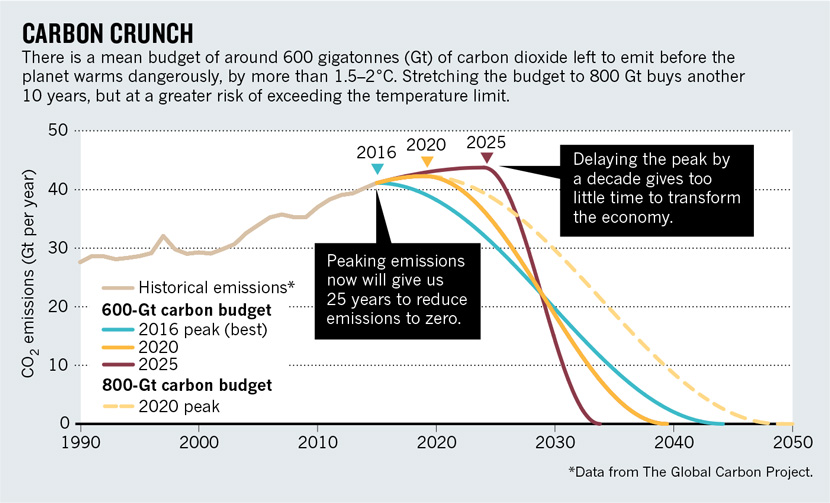
Although the view that I present here is the opposite of what most people have been taught about so-called “prehistoric,” or, actually, pre-unsustainable, human societies of indigenous peoples, many anthropologists over the last forty or fifty years have confirmed this newer view to be accurate.[11] These more recent anthropologists have reported, based on their field observations of such societies that still exist and who have a sufficient amount of their homelands still with them, that the people in those societies work less hours, have more leisure time, and are happier and healthier than most people in modern industrial technological societies. If we can relearn some of these ancient, life-nurturing and life-sustaining ways and combine them with any clean, sustainable technologies that we have created since the time that our ancestors departed from those ways, we can also re-organize ourselves into small, cooperative, Nature-directed, sustainable societies (and larger allied networks of such societies), and free ourselves from any need for, or attachment to, monetary systems. That may seem improbable to most people who have known nothing but the current prevailing social constructions, and who have been grossly misinformed about the real life ways and circumstances of small-scale, sustainable indigenous societies (both past and present). To that I will simply say that there is much for us all to learn about Earthways and our untapped human potential, and so much that we don’t yet know. We are still the same species and this is still the same planet (all changes considered), so, if we did it before, why can’t we do at least something like that again? Of course there are questions about current human population size and ecosystem carrying capacities, that we probably cannot resolve definitively without actually making the attempt to redirect ourselves toward true sustainability and begin (or continue, for those who are already on this path) the learning processes. We would also need to have many serious, democratic discussions about which familiar modern technologies and “conveniences” we would need to give up, either temporarily or permanently. What other viable (for the long term) choices do we have?

What I am talking about here is actually the ultimate form of “going on strike” and the ultimate boycott. By creating such alternative, local, non-monetary economic systems, in harmony with Earth’s systems, and getting enough of the human population, worldwide, to join into such systems, we could then effectively disarm the corporate industrial/financial death machine and stop the destruction of our planet. Our independence from the death machine mega-nations, their currencies, and their toxic products, which we will no longer need, will make their industries unprofitable (reducing sales way below their acceptable profit margins and allowable risks), and eventually crash their economies, removing all of their leverage over us, and simultaneously breaking all of the chains by which they have had us bound for so long! That would be a true declaration of independence and a very real non-violent revolution! The independence gained from our worldwide boycott of the system could lead to a restored interdependence, or, reciprocity, with all parts of the natural systems of Life, for our interconnected, mutual benefit. We can and must unite our energies, minds, and abilities and come up with alternative, Earth-based, non-monetary economic ways and technologies, and wean ourselves from the use of toxic machinery and products, in the small window of time that remains in which we are still able to save life on Earth. I would rather do this, and take the matches out of the hands of these corporate arsonists who are burning up our planet, than to continue with futile and inadequate efforts to put out the innumerable individual fires now raging against life on Earth through our acts of protest and attempts to pass regulatory laws.

While patient pursuit of gradual, incremental change, “working through the proper channels” might have been a reasonable, pragmatic method of attaining progressive social evolution in times past, we are now in a time like no other our species has ever known, and in a crisis that demands much more immediate and drastic action. I strongly doubt that the purveyors of the global ecological and economic crises, who continue to increase the tightness of their grip on the U.S. and other national governments, through laws like “Citizens United” and treaties like the nearly-ratified TPP, will allow us to vote away their power through democratic political processes. Historically, that is just not what empires do. For the many reasons that I outline here, I am persuaded that we must, “vote with our feet,” with our actions and with how we choose to live on this Earth, and that the actions that I propose here, and many actions that are already in motion around the world, really do have the potential to make the changes that must be made. The following scientific chart helps to illustrate why immediate and drastic action is now called for. (This chart was made in 2017 and I am now writing this final edit of this essay in January, 2019.) [12]

climate, needed rates of reduction chart, best, 2016

[13]

I realize that this path will initially seem too daunting, and even impossible to most of us modern humans, and also undesirable and even appalling to many of our species who are so alienated from nature and acclimated to the unnatural, “modern way of life.” But, as more and more people tune in to alternative sources of information and become aware of worldwide phenomena like the accelerating impacts of climate change that I previously mentioned, along with accelerating wealth inequality, wars waged solely for economic profit, police brutality and a host of other societal ills that they also find troubling, they are becoming more open to the idea that radical social change may actually be necessary. I know that among the greatest fears that we humans carry are the fear of the unknown and the fear of the loss of what is familiar, what we have prepared for, and what we have already committed ourselves to—in short, the only way of life that we really know. Consequently, those among us who are the most deeply invested in the “success” of the current system, who see their own personal success as deeply intertwined with the perpetuation of the status quo, and in many cases feel that their investment in the system has actually rewarded them significantly, will have an especially difficult time hearing any of this. And then there is the majority of us, who may not feel significantly rewarded by or fond of the system at all, but have been persuaded to accept the idea that there is no way out, or no realistic alternative to the dominant, entrenched patterns of “modern life.” As awareness of the deteriorating global circumstances brings people to start looking for possible alternatives, there is something even more powerful and compelling than fear of catastrophe that might motivate them to engage in that pursuit. I call it “the appeal of the potential good,” or the anticipation of great pleasure and relief from a heavy, oppressing burden, accompanied by the possibility of a life of real joy and peace. This appeal manifests itself most and proceeds to increase when people begin to view and experience actual models of ideal, alternative, nature-based, sustainable communities. I will now devote the rest of this essay to describing some of these types of models that are already in existence, around the world.

Part 2: Models and Possibilities for New, Sustainable, Non-Monetary Economic Lifeways

Perhaps the best and most widely-visible examples of the development of sustainable, community-based economics which can empower independence from the commercial, industrial market system, can be found within the organic farming-based local food movement. This movement has much of its roots in the “back to the land” and “grow your own” movement of the late 1960s and early `70s, but the 21st century has seen a real surge in this kind of action and thought, perhaps even more serious or earnest than that earlier phase. The movement  for growing and consuming our own food, rather than purchasing it with money, is not as large as the complimentary local food movement, in which people try to buy as much of their food as possible from local farmers. That is probably due to the difficulty of finding time for farming and gardening with as much time as people have to put into the work that they do for money, in this increasingly competitive and insecure job market. In 2014 there were 8,268 farmers’ markets in the U.S., which was a 180% increase from 2006. “In 2012, 163,675 farms (7.8 percent of U.S. farms) were marketing foods locally, defined as conducting either direct-to-consumer (DTC) or intermediated sales of food for human consumption, according to agricultural census data.”[14] “Intermediated sales” refers to practices like local grocery stores and restaurants purchasing and selling food raised by local farmers. The United States Department of Agriculture report, from which I found the above statistics, confirms that the local food movement has caught the government’s attention, but the report only covers market concerns regarding the movement—issues of profitability and monetary trends—and demonstrates no interest in the increasing number of people growing their own food for direct consumption, rather than for money.

In my own experience, as an organic food grower since 1970 and a permaculturalist since the mid-1980s (long before I had even heard the word “permaculture”), it seems to me that the permaculturalists and the Native American “food sovereignty” activists are the food growers and wild food caretakers who are, in general, the least interested in growing food for money, and most interested in doing those activities as part of a quest for alternative, sustainable ways of life. [15]  The recently-formed, and still forming on several American Indian reservations in the U. S., food sovereignty movement is a Native American movement to take back control of our food sources and our own health through cultivating our own culturally traditional foods, as well as becoming more familiar with the traditional wild foods and medicines of our own lands and cultures. In that sense, food sovereignty has great potential for becoming a part of, or even possibly a leading example of, the international declaration of independence from the corrupt systems that I mentioned earlier. However, because most reservation communities are still battling many severe economic as well as health-related issues which resulted from European and U.S. colonialist impositions on their lives and local worlds, the focus there has been on more immediate solutions that still involve increased cash flow and working with the current, prevailing economic system. Getting away from the monetary system, then, is not yet even on the radar for most Indian reservation communities, although some conversations along those lines have started, here and there, with the help of the food sovereignty movement and the Earth/Water protector activists. Most non-Native permaculturists whom I know or have heard of have not moved that far away from still using money, either.[16]

If one is familiar with indigenous perspectives and practices of horticulture (growing food for direct consumption rather than for a commercial or monetary market), it is not difficult to see the indigenous roots of permaculture. Indigenous cultivation of the land for crops, worldwide, throughout history, has always followed the principle of working with their specific ecosystems rather than trying to alter them, which is also a guiding principle of what is now called permaculture.[17] Although we vary somewhat in our individual approaches to it, by definition permaculturists are committed to allowing our local ecosystems to guide and shape our interactions with the land and water, instead of us shaping those spaces only as we see fit. We are engaged in caretaking and preserving the native food and medicine plants and trees on the lands we live on, and planting and cultivating only those crops that are compatible with our ecosystems: the land and water and everything that lives there. We treasure bio-diversity and have deep respect for everything that belongs to the land and water that we live with. All of the living things that belong here[18] have an equal right to be here and multiple purposes for being here. They fit together and reciprocate each other and have been doing so since long before we humans arrived. It is our goal to fit in with those life-giving natural systems, to be a reciprocating part of it all—not to force the ecosystem to fit into the unnatural world of modern humans and their artificial, monetary ways of being. We would not enter into a land-water system and say, “this looks like a good place to grow ___________, and we should do so because that crop can bring us much money.” When first coming to live on a place of land and water, we would seek to learn what that place asks of us—what good could we do for that place so that it can continue to freely share its gifts of life with us and the other species who are a part of this place? How do we become a useful, helpful part of it all? How can we right-fully belong to this place? Knowing these natural systems are greater, healthier and more real-life-giving than any human-created economic system, we humbly and prayerfully plant our compatible crops right along-side and interspersed with the native crops, wherever there might be enough room and water. Although we sometimes move water around to service the crops (irrigation), we realize that it is best to plant seeds or transplant plants into the naturally wetter places where nature will bring water to the plants, if possible. There are many other ways in which the harmonious methods of permaculture take shape and merge with the various ecosystems, worldwide. These methods are both ancient and new, rooted in the ways of First Peoples going back to the ages before the advent of unsustainable megasocieties.

So, if most people in the local food movement—with the exceptions of some subsistence permaculturalists, some indigenous food sovereignty activists, home gardeners and some non-monetary trading done in community garden spaces—are still selling their crops for money, where do we find examples of people who are doing other things for the purpose of freeing ourselves from the monetary systems? One would think that some good models for moneyless local economies could be found in the barter fair movement. Bartering has always been a part of human interaction, but began to spread more widely as an active form of resistance to the industrial capitalist system in the early 1970s, with large outdoor gatherings often called names like “The Barter Faire” (that spelling of “Fair” reflects a previous movement called the “Renaissance Faires”). Barter fairs were kind of like “counter culture” swap meets, with an intention of economic sharing and exchange, avoiding the use of money. Over the years, the commitment toward not using money at the barter fairs waned and so did the barter fair movement. One of the first and biggest of the counter culture barter fairs, the “Barter Faire,” of Okanogan, Washington, founded in 1974, eventually dropped the word “barter” from its name and is now called the “Okanogan Family Faire.” Whereas originally everything was (mostly) moneyless and free, now “vendors” pay for spots and customers pay for admission tickets, just so they can go in and shop, making it even more money-oriented than most swap meets or art festivals. Some bartering does occur at the few remaining barter fairs, but mostly between the vendors. The old barter fair movement may have faded away, but the good news is that bartering is by no means dead. It is actually thriving and growing and the primary locale for this new bartering movement is the internet. There is also a new, 21st century upgrade of the old outdoor barter fair movement (without the bartering or any direct exchange), an international phenomenon called, the “Really, Really Free Market,” which holds much more promise as a movement for actual systemic economic change than the old hippie barter fairs did.

Before I return to describe the RRFMs in more depth, I will first comment more on the phenomenon of online moneyless trading. In a short essay by Christopher Doll, a research fellow at the United Nations Institute of Advanced Studies, titled, “Can We Evolve Beyond Money?,” Doll describes how the internet has created the infrastructure for greater, more widespread possibilities for economic sharing and moneyless “collaborative consumption”:

…the internet has reduced the friction costs of searching for what is available and massively enabled peer-to-peer transactions to be done on a far wider scale than has ever been seen before…If, as it is frequently argued, Generation Y is the first generation of digital natives and sharing is their norm, could it be that collaborative consumption rather than consumer capitalism will be their norm? If so, what will the next generation bring?[19]

This is very exciting. I remember when the internet was first coming into popular usage, back in the early 1990s, and a conservative radio commentator was freaking out over his perception that too much was being given away for free on the internet and he did not see enough people using it to make money. Hearing that comment, coming from a truly repugnant individual who embraces nearly everything about our societal system that I loathe, actually gave me the nudge I needed then to step away from my slightly Luddite skepticism of that new electronic communication medium and give it a chance. Ever since then, the internet has been one of my most indispensable tools for communication. The free flow of ideas and information, so many people creating their own “broadcast channels” and being able to do so and interact with multitudes of others for free (except for equipment and access charges), usually without any government censorship, has created opportunities for revolutionary change way beyond any media that we had prior to the internet. (Even so, there are other environmental and health-related costs to using the internet and the electronic devices for accessing it that we will eventually need to weigh out when we debate what technology to keep and what to leave behind.) Two generations of humans who are now used to all of this “free”[20] access—to ideas, to goods, and to services—has made it more possible than ever to enable and equip people for substantial, systemic transformations of all kinds, including world-wide, non-violent economic revolution. There is a compilation of bartering and swapping websites in an article by David Quilty, titled, “36 Bartering and Swapping Websites—Best Places to trade Stuff Online,” posted on a financial advice website called, “Money Crashers.”[21] There are many more than just these 36 sites, which is revealed in the comments after the article, as person after person writes about sites that the author missed. Some of these sites allow for some use of money, but most are focused on barter and sharing. Some of the sites have a socio-political agenda for avoiding the use of money (like “Freecycle” and the “Freegans,” whom I will describe below), while many others seem to be just trying to save money or mitigate circumstances related to poverty. As the social change advocates interact more with the simply economically-straddled people on these websites, seeds of revolutionary thinking are most certainly being sown. Every time a person experiences economic benefit without the use of money, a new sense of what might be possible is further developed and strengthened.

From my perspective, the two most interesting websites on the list, which do the most toward addressing the pertinent systemic issues and working toward creating the possibility for an international boycott of the system, are Freecycle and the Freegans.[22] Freecycle (http://www.freecycle.org) describes their organization as, “..a grassroots and entirely nonprofit movement of people who are giving (and getting) stuff for free in their own towns. It’s all about reuse and keeping good stuff out of landfills.” Founded in Tuscon, Arizona in 2003, by a recycler named Deron Beal, Freecycle is now a very large network (5,289 groups in 32 countries, and 9,105,322 members) of local, volunteer-run sites.[23] Connections are made for giving and receiving online. There are two categories of posts, “Wanted” or “Offer.” Users have to be registered members to reply to posts and make their own arrangements for contacting each other. Membership is free “and everything posted must be free, legal and appropriate for all ages.”

The Freegans organization is a little more direct and explicit about their revolutionary motivation for abandoning the prevailing economic system. This is how they describe themselves on their web page:

Freegans are people who employ alternative strategies for living based on limited participation in the conventional economy and minimal consumption of resources.

Freegans embrace community, generosity, social concern, freedom, cooperation, and sharing in opposition to a society based on materialism, moral apathy, competition, conformity, and greed. After years of trying to boycott products from unethical corporations responsible for human rights violations, environmental destruction, and animal abuse, many of us found that no matter what we bought we ended up supporting something deplorable. We came to realize that the problem isn’t just a few bad corporations but the entire system itself.

Freeganism is a total boycott of an economic system where the profit motive has eclipsed ethical considerations and where massively complex systems of productions ensure that all the products we buy will have detrimental impacts, most of which we may never even consider. Thus, instead of avoiding the purchase of products from one bad company only to support another, we avoid buying anything to the greatest   degree we are able.[24]

It looks like the Freegans and I think a lot alike, but I had never heard of them until a few days before I began writing this section of this essay. Apparently, one of the strategies that they are well known for is “dumpster diving” (a.k.a., “urban foraging”), a practice that I also used to engage in, back when I belonged to a certain communal society (which I will not name) in the early 1970s, when I was about the same age as many of the Freegans that I saw pictured on their webpage. But rest assured, the Freegans are engaged in much more than just dumpster diving. Their wide range of activities include: widely and freely distributing and recycling the wide variety of good quality thrown away products that they find in waste bins; creating free organic soil for gardeners by composting the spoiled food and other organic matter that they find; creating and freely distributing biofuel from disposed restaurant cooking oil and other vegetable oil; repairing and redistributing broken mechanical items and equipment; they “occupy and rehabilitate abandoned, decrepit buildings” to provide homes for the homeless and to create community center gathering places; create organic urban free food gardens on vacant lots; foraging for wild plant foods and medicines; sharing surplus vegetables, fruits and nuts produced by local farmers, and several other related activities. Freegans work with other recyclers and re-users, and with other, like-minded organizations, such as Food, Not Bombs, homeless shelters, and the Really, Really Free Markets. The Freegan website gives much information and links about what they believe and what they do, but not any personal information or history of how their movement began. Also, to be clear, even though the Freegans have a great website, by which they connect many sustainability activists, young and old, most of what they do is done offline, in the streets and various public spaces. Freeganism has spread internationally and there are now Freegan groups in the U.S., France, Brazil, Norway, Greece and Lebanon.

The Really, Really Free Markets are not actually barter markets, because no direct exchanges are allowed there. No money, no deals, no selling, no trading, just “Take what you need, and bring what you don’t.” A chalkboard sign put up at one of the RRFMs says, “Do not compete for an item. This is a no-money market. No trade, swap, barter, or sale.” Participants can offer their skills and services, as well as material goods, and the events are held in public parks and other public spaces. The RRFMs are examples of what is known as a “gift economy,”[25] in which every material need is met for free, based on a perspective that there is truly “enough for everybody,” if we properly take care of and manage our abundant resources. Of course, such a perspective can only be successfully applied if we eliminate resource insecurity and greed, which raises the question of what happens when a greedy, insecure, or capitalistically well-conditioned person goes to a Really, Really Free Market? (I’ll leave that question unanswered for now, partly because I suspect that it has a wide variety of possibly valid answers.) The compatibility between Freegans and the RRFMs is glaringly obvious and it is easy to see why they collaborate so well and why so many Freegans are involved with organizing and running RRFMs. These intertwined movements both seek to stop the destructive and wasteful effects of the capitalist system and introduce people to different forms of economic practice, as well as of human interaction. The first RRFM occurred in Christchurch, New Zealand in 2003, and the idea sprang forth from a meeting of the free food/anti-hunger organization, Food, Not Bombs. That same year, two more RRFMs were held, one in Jakarta, Indonesia, the other in Miami, Florida. Since then, RRFMs have been held in dozens of U.S. cities, and Canada, Australia, Malaysia, Taiwan, England, South Africa, and Russia. The movement is very popular in Russia and has spread through many cities there.

RR Free Market 1

Although there are many more examples of non-monetary economic practices and organizations that are working towards that end, I will just mention one more here: time banking. The time bank idea was conceived and developed in the early 1980s by Edgar Cahn, a professor at the University of the District of Columbia School of Law. Cahn calls time banking, “an alternative currency system in which hours of service take the place of money,” and provides this further explanation:

[time banking is] a mode of exchange that lets people swap time and skill instead of money. The concept is simple: in joining a time bank, people agree to take part in a system that involves earning and spending “time credits.” When they spend an hour on an activity that helps others, they receive one time credit. When they need help from others, they can use the time credits that they have accumulated.[26]

In the twenty-four years since Edgar Cahn founded TimeBanks USA, time banking has spread to more than 30 countries—including “China, Russia, and various countries in Africa, Europe, North America, and South America.” In the United States, there are “about 500 registered time banks, and together they have enrolled more than 37,000 members. The smallest of them has 15 members; the largest has about 3,200.” Time banking is easily facilitated by a computer database that enables members to register the skills or services that they can offer and find people who can provide them skills or services that they might need. Hours of time credit and time debt are also kept on the database and each local community time bank has their own database.  “Worldwide, time bank databases document more than 4 million hours of service. (And that figure understates the true scope of time bank participation: Survey data indicate that at least 50 percent of time bank members do not record their hours of service regularly),” Cahn writes. That last remark, in parentheses, contains evidence of a very powerful phenomenon that occurs frequently in these moneyless, community-connecting, local economic activities: the intrinsic rewards, like having your own skills valued by others, making connections and friendships through giving and receiving, and developing social trust or “social capital,” become more valued than the extrinsic rewards from receiving services or material gain. Examples of that profound experience are expressed over and over by people involved in freeganism, the RRFMs, time banks, Food, Not Bombs, Freecycles, and many other community-based, alternative economic efforts. Christopher Doll describes “social capital” very well:

What is intriguing about collaborative consumption is that the credit rating upon which so much of our access to goods and services currently depends will be replaced by a new rating—our own personal trustworthiness rating. That is to say, our access to goods becomes, in part, a function of our social capital rather than our financial one. This is an incredibly powerful concept in helping us understand personal wealth in broader terms and indeed, what we might use in place of money. Social capital accumulates over time: the more you share properly, the higher your rating rises, which in turn promotes good social conduct. This is all good in theory, provided that personal freedoms and identities aren’t compromised in the process.[27]

It is in this process of cultivating “social capital,” or what could also be called “relationships of trust,” or, “trustworthy reputations,” that we find the personal accountability within moneyless systems. People naturally want to be trusted and accepted and they want to interact with other people whom they can trust and rely upon as dependable and caring persons. When requests for money (whether it be a market price or for a charitable cause) are involved in our interpersonal and public interactions, there is always some degree of suspicion as to the motivations, legitimacy, or actual need of the person or organization making the request. That particular burden would eventually become very rare, or perhaps even disappear, in a moneyless, reciprocal exchange, or gift economy, as people get to know each other in their local communities better. What also becomes clear when observing and considering how these moneyless systems actually succeed, is that they function best at the local, small community level, rather than in the context of the anonymity of a sprawling, unsustainable mega-society. To create systems like these in large towns or cities, would likely necessitate the division of the populations into manageable neighborhood-sized economic cells, if urban life will be feasible at all after the collapse of the current mega-societies. Hopefully, what the development of local, moneyless, natural life-connected economic systems will do for us and our planet is restore much of what we all had 5,000 years ago, before the advent of mega-societies, empires and money.

Even though I live on a farm 37 miles north of the town of Missoula, Montana, I belong to the Missoula Time Bank. I recently interviewed two of my friends, Susie Clarion and Carol Marsh, who were part of the small core group who founded the Missoula Time Bank, back in the Spring of 2013. There are now 141 members in the MTB and 2,647 hours exchanged, as recorded in the database, but Carol told me that she and others she knows sometime fulfill requests for services and then do not record the hours, which again reflects the perspective that the experience of the transaction, or interaction, is often reward enough in itself. In the Missoula Time Bank we also have what is called a “Community Chest,” through which we can donate some of our hours for community service group projects, like building houses with Habitat for Humanity. My friends also pointed out another lesson they have learned through their time bank experiences: it is just as valuable to ask for and receive services as it is to give. We spread that good feeling of having our gifts and skills valued by others through being available to receive from others. Mutual benefit and reciprocity are major values in the time bank system, as expressed in this quote from the website, “The question, `How can I help you?’ changes to `How can we help each other build the world we both want to live in?’ Time banking is based on equal exchanges. Everyone benefits because every member both gives and receives.”[28] As Susie Clarion said to me, “Providing services through the time bank is not just doing a job. It is the interaction and bonding, the listening and teaching, which are the true values of the time bank experience. What people seem to enjoy most about their time bank experiences is making good friends.”[29] There are also occasional social events for time bank members and anybody who might be interested. Edgar Cahn provides us with this clear summary of what time banks can do:

“Each transaction flows from a relationship, and such relationships create a spirit of trust that allows people to reweave the fabric of community. A currency that treats all hours as equal does more than simply provide an alternative to market price as a measure of value. It empowers people whom the market does not value and validates their contribution to society.”[30]

When I peruse these sorts of examples of alternative, non-monetary, community-based economics, which are already in place and spreading, I become more confident that an international boycott or abandonment of the current prevailing economic system is possible. We are already laying the foundations and creating the infrastructure of what can replace it, and the momentum is building up. That may be cause for inspiration or even celebration, but I caution all who might be willing to go forward with this movement, there is good reason to publicly temper our exuberance and to welcome public skepticism. If this revolutionary strategy sounds unlikely or impossible to most modern humans, consider this: it would have to be laughable to work. It really must be laughable. Any non-violent[31] revolutionary strategy which intends to bring to a halt the destructive forces of our current political and economic systems and replace those systems with their opposite—a life-supporting, sustainable, Earth biosphere-led, humane, just, interconnected and mutually, equally beneficial to all living beings, new international network of local, ecologically-specific economic systems—has got to be laughable, scoffed at and easily dismissed by the oligarchs and the tools who serve them, if we don’t want our movement to be brutally squashed and destroyed. If they hear about what we are doing, we want them to laugh, mock us, call us “crazies,” question our intelligence, dismiss us as fools, and then ignore and forget about us. “They think that they can grow all of their own food and medicines, make their own clothes, build their own houses and other structures, transport themselves sufficiently without fossil fuels, create their own electricity, and boycott all of our industrial products! That’s insane! And get people all over the world to do that? That’s even crazier!” Yes, that’s what we want them to think and say to themselves and each other. Right. Nothing to see here, Comfortable Ruling Class. Just go on with your obliviousness and your delusions. Entertain yourselves and spend your money while it is still worth something. Then, one day, you will come to us waving your silly, worthless currencies in your hands, asking us to feed you and clothe you, or give you shelter, and we will say, “That is not how we do things here, in this new world. We belong to Life and to each other. We take care of this living world that gives us life together. We work together, play together and share everything. Freely we have received and freely we give. If you are ready to learn and experience what it means to truly live, come and join us.”

We won’t know what is possible until we give this revolutionary transformation our greatest, unified (or at least mutually supportive) effort. There might be many more people, worldwide, who are ready for this (including those who do not yet realize that they are ready for this!) than we have been led to believe.[32]

[1] I date the use of currencies as beginning shortly after the first unsustainable mega-society arose. The earliest one on record is that of the Mesopotamians about 5,000 years ago, but they are not necessarily the first. There were probably some slightly smaller, less ecologically-disruptive megasocieites before them who did not leave as much archeological evidence of their existence and have yet to be found. The first Egyptian empire may have spewed forth about the same time period as Mesopotamia.

[2] This practice was applied by the more mobile or “nomadic” tribes as well as the more sedentary, village-oriented tribes. It is also one reason why many tribal nations, worldwide, have several related branches or subdivisions of their tribe. The ancient focus of pre-currency tribal societies on harmonious relations with their ecosystem, including other tribes, as well as other species, obviously contradicts the prevailing belief of western colonialist minds that tribes were always either at war with each other, or in a state of tension and hyper-vigilance in between wars. The word “tribal” has even become synonymous with “war-like,” which is a gross misconception created to justify and normalize centuries of brutal western colonialism and empire-building. The stereotype is actually much more apropos in application to western capitalist, colonialist empires. Traditional tribal societies, before the disruptions of colonialism (but even since then for many), have always bonded and maintained peace with neighboring tribes through inter-marriage, gift-giving, and in some cases, even shared ceremonial activities.

[3] Riane Eisler, The Chalice and the Blade: Our History, Our Future, N.Y., Harper-Collins, 2011. David C. Korten, The Great Turning: From Empire to Earth Community, Berrett-Koehler Publishers, 2007.

[4] For a detailed description of the present crisis, with source links, see, George R. Price, Thinking About the Unthinkable, in Learning Earthways, https://georgepriceblog.wordpress.com/2013/12/28/thinking-about-the-unthinkable/ . More recent updated information can be found in Bill McKibben, “Recalculating the Climate Math,” The New Republic, September 22, 2016Here is one of the best sources online for scientific articles and discussion on climate change, by climate scientists: http://www.realclimate.org/index.php/archives/2007/05/start-here/comment-page-6/#comments

[5] How small that percentage might be is a subject for much more research and examination on a worldwide perspective than is usually done. The familiar claim that these benefits go primarily to “the 1%” may turn out to be a high figure if we were to examine and measure it from a global perspective. If we measure benefits and costs beyond just monetary statistics and across all species, not just for humans, the figure for who receives significant net benefit from our economic system might be infinitesimally small.

[6] Anitra Nelson, Non-Monetary Degrowth is Strategically Significant, Paper delivered to the 5th International Degrowth Conference in Budapest (Corvinus University), 30  August–3 September, 2016, pg. 5.

[7] See, for example, Herman Daly, Beyond Growth: the Economics of Sustainable Development, Boston, Beacon Press, 1997; Naomi Klein, This Changes Everything: Capitalism vs. The Climate, New York, Simon & Schuster, 2015; Giorgos Kallis, “The Degrowth Alternative,” Great Transition Initiative, February 2015; and Jason Hickel, “Why Growth Can’t Be Green,” Local Futures, September 18, 2018, https://www.localfutures.org/why-growth-cant-be-green/

[8] Nelson, 2016, pg. 6.

[9] Although many other historians designate the pre-literate or pre-written records period of the 200,000 year existence of homo sapiens sapiens as “prehistoric,” I do not. There are oral traditions, archeological findings, anthropological analyses, and other sources that assist in piecing together a pre-literate historical record.

[10]  For more on the Louisiana Purchase Exhibition of 1904, in St. Louis, Missouri, see, Eric Breitbart, A World on Display: Photographs from the St. Louis World’s Fair, 1904, Albuquerque, N.M., University of New Mexico Press, 1996. Vine Deloria, Jr., Red Earth, White Lies: Native Americans and the Myth of Scientific Fact, New York, Scribner, 1995.

[11] Marshall Sahlins, Stone Age Economics, Chicago, Aldine/Atherton, Inc., 1972. Richard B. Lee, The !Kung San: Men, Women and Work in a Foraging Society, Boston, Cambridge University Press, 1979. Elizabeth Marshall Thomas, The Old Way, A Story of the First People, New York, Farrar Straus Giroux, 2006.

[12] We blockaded the “megaloads” of tar sands equipment trucks four times during the winter of 2014 and then the megaloads stopped. But what did they do instead? The oil companies spent approximately 2 billion dollars (pocket change to them) retrofitting their haulers to go on the freeways, thus avoiding any future blockade protests, and they simultaneously built manufacturing plants in Alberta to reassemble the larger equipment up there, continuing the devastation of the dirtiest, deadliest industrial project on Earth. In the late Spring of 2015, the beautiful kayak and canoe protesters in the Puget Sound slowed down the Shell Oil drilling platform ship for a little while, but it too, ultimately, proceeded on to its infernal business. A few months later, Shell decided not to drill for oil in that section of the Arctic, for the time being, for pragmatic reasons related to the profitability of the project, not necessarily because of any concerns related to the protests.

[13] Christiana Figueres, Hans Joachim Schellnhuber, Gail Whiteman, Johan Rockström, Anthony Hobley and Stefan Rahmstorf, “Three years to safeguard our climate,” Nature, 28 June, 2017. The 600-800 Gt carbon budget is way too high and too risky, because a 2 degree C global temperature increase is too big of a risk. We need to keep it at or below 1.5 degrees, and for that the budget needs to be closer to 200 Gt.

[14] Low, Sarah A., Aaron Adalja, Elizabeth Beaulieu, Nigel Key, Steve Martinez, Alex Melton, Agnes Perez, Katherine Ralston, Hayden Stewart, Shellye Suttles, Stephen Vogel, and Becca B.R. Jablonski. Trends in U.S. Local and Regional Food Systems, AP-068, U.S. Department of Agriculture, Economic Research Service, January 2015, pp. 7 and 5.

[15] A good overview of the permaculture movement and many details about the practice can be found on the blog, Permies.com (https://permies.com/). The information exchange in the well-used discussion forums on the blog is extremely useful.

[16] The “sovereignty” element of the name, “food sovereignty,” is a reference to the fact that American Indian tribal nations were sovereign nations long before the arrival of Europeans in the western hemisphere, probably thousands of years for some tribal nations and hundreds of years for others. Tribal sovereignty is upheld and confirmed by the U.S. Constitution, several Supreme Court rulings, and the fact that the United States has made treaties with hundreds of individual tribal nations, something which is only done between sovereign nations. That historical context and the continued existence of treaty-established, tribally-controlled reservation lands, allows tribal nations to be uniquely situated for developing food sovereignty programs into something that can actually begin a process of creating independence from the corrupt systems of colonial capitalist toxic industries.

[17] In the recent documentary film, “Abundant Land: Soil, Seeds and Sovereignty,” directed by Natasha Florentino, one of the co-founders of the modern permaculture movement, David Holmgren, is quoted as saying that he and the other founder were inspired largely by the indigenous Hawaiian cultivation and harvesting methods that are shown in that film.

[18] This concept of “belonging to this place” is debatable and sometimes contentious. The reasons for that include the fact that we modern humans, for the most part, do not know the places where we live intimately enough to really understand why anything belongs to a specific place. The topic of “invasive species,” for example, usually involves arguments over how to get rid of species that traveled to a place (intentionally or accidentally) by the transport of humans, the general assumption being that the introduction of new, non-native species to a place can only be unnatural or wrong. Rarely, in these kinds of discussions is it taken into consideration the many ways in which Nature herself introduces new species to old places. This happens mostly through seeds being temporarily attached to those grandest of travelers, the bird species, but also through the strength of great winds like hurricanes and tornadoes. Or, how about the various species who, through their very natural activities, create habitats that welcome new plants or new insects and other species, like our friends, the beavers, the termites, and the gophers?

[19] Christopher Doll, Can We Evolve Beyond Money?, 2011, DEVELOPMENT & SOCIETY: Energy, Economics, Business, Finance, United Nations University, “Our World,” https://ourworld.unu.edu/en/our-world-3-0-can-we-evolve-beyond-money  “Can We Evolve Beyond Money?” by Christopher Doll is licensed under a Creative Commons Attribution-NonCommercial-ShareAlike 3.0 Unported License.

[20] “Free,” as in unregulated or uncensored, but not without cost—the cost of purchasing access and equipment, as well as the environmental cost of this technology.

[21] David Quilty, “36 Bartering and Swapping Websites—Best Places to Trade Stuff Online,” posted on Money Crashers website, http://www.moneycrashers.com

[22] I say this while admitting that I still have more to examine more thoroughly, including the many websites mentioned in the comments after the article. Freecycle.org, http://www.freecycle.org The Freegans, http://freegan.info/

[23] On the Freecycle website it says, “the Freecycle concept has since spread to more than 110 countries,” but their trademark is registered in 32 countries.

[24]  http://freegan.info/

[25] Genevieve Vaughan, Shifting the Paradigm to a Maternal Gift Economy, Women’s Worlds, Ottawa, July 7, 2011. Kaarina Kailo, Sustainable Cultures of Life and Gift Circulation—a New Model for the Green/Postcolonial Restructuring of Europe?, Sustainable Cultures – Cultures of Sustainability, BACKGROUND PAPER 9.

[26] Edgar S. Cahn and Christine Gray, “The Time Bank Solution,” in, Stanford Social Innovation Review, Summer 2015, Stanford University, Palo Alto, California.

[27] Doll, 2011

[28] Missoula Time Bank website, http://www.missoulatimebank.org/

[29] Interview with Susie Clarion and Carol Marsh, July 30, 2016, Missoula Montana.

[30] Cahn, 2015.

[31] I rule out a violent revolution because it is just impractical, or maybe impossible, against the most heavily-armed empires, with the most sophisticated weaponry, that the world has ever seen. These are no longer the days of the Bolsheviks versus the Czar, or the Cuban revolutionaries versus the Battista oligarchs, when both sides had relatively similar weaponry. Besides the brutally violent weapons technology of recent decades, just the level of surveillance and the automated, robotic military technology, which takes the decision-making processes of military action more and more out of the hands of humans with consciences who might hesitate or fail to act, makes the odds against violent revolution succeeding infinitesimally small. The United States and its allies are not continually engaged in endless war because they are not militarily capable of defeating some alleged “enemies.” Endless war is “good for business,” generating massive profits for the arms industry and its subsidiaries and financiers.

[32] If we fail to bring down the system soon enough to avoid ecological catastrophe and near-extinction, our building of alternative systemic infrastructures might provide some of us with means for being among the few survivors. We just don’t know.

For those readers who imagine salvation coming through the big “green” technologies of solar and wind, and therefore find my proposal too drastic or unnecessary, I urge you to read Ozzie Zehner’s book, Green Illusions: the dirty secrets of clean energy and the future of environmentalism, Lincoln, NE, University of Nebraska Press, 2012. You might also want to take a look at a website called, “Wrong Kind of Green,” http://www.wrongkindofgreen.org/about-us/ Neither one of those sources are perfect, of course, but the high quality of the research that they have done and the critical information that they have provided us should raise some very important questions about what activities and technologies are actually green enough to prevent us from continuing on the path to the 6th extinction.

For those who may wonder why I did not mention Jacque Fresco’s “Venus Project” in an article about moneyless economies, especially since that is usually the first thing that comes up when you Google search “moneyless economies” and the first example many people think of regarding that topic, I’ll just say this. I think that the Venus Project is too focused on human technology as a solution and it is not really centered on Earth sustainability. I also could have given some mention of the Transition movement and some of the intentional eco-communities in existence around the world. As far as I know, some of the Transition towns and communities have developed their own alternative currencies, but none that I know of have gone totally moneyless or even have that as a community goal. Even so, they have successfully created some community infrastructures that could lead to local, moneyless economies. https://transitionnetwork.org/ I also don’t know of any intentional communities that are moneyless, but I plan to continue with research on that topic. I mentioned the need for degrowth early in the first part of this essay, but did not discuss the growing eco-socialist degrowth movement in the second part. That was because I only recently found out that there are many people in that movement (such as Anitra Nelson, whom I cited earlier) who also have come to the conclusion that we must demonetize. When I have done more reading of, research on and interaction with these non-monetary degrowth allies, I will probably write more about that. For now, I will just say that what little I have read of their work, so far, suggests to me that the eco-socialists are a little more socialist than “eco” (or “environmentalist”) and also have a more Euro-centric analysis of the movement, with little regard for the indigenous models that preceded Marx by many thousands of years. My own approach is more ecologically and indigenous culture-based, but I see no reason why we cannot all work together towards our common goals.

One problem that those of us who are attempting to create moneyless farming communities have to face is that we at least have to generate enough currency to pay our property taxes, since no county assessor’s office that I know of will accept payment in fruit or vegetables. For most of us, there is also the issue of mortgage debt and other types of debt, or currency commitments. May all of those legal commitments to the use of currency soon be gone, one way or another.

Problem With Money illustration 2, Animal Radio Newsroom

The photo above comes from a really funny story about a guy whose dog ate five $100 dollar bills and the guy retrieved them from his dog’s poop, washed them and pieced them back together as best as he could. Because we can’t live without it, right? Photo credit and the rest of that story from Animal Radio News website, http://animalradio.com/Animal_Radio_Network_Newsroom.php

Here is a direct link to the original source of the article on the money-eating dog. It is easier than scrolling down the above link to find it amongst all the other funny pet stories:

http://www.nydailynews.com/news/national/man-lost-500-hungry-dog-reunited-money-article-1.1474100

Thank you for reading this, and I welcome constructive comments, ideas, and discussion in the comments section below. A much shorter version of this article was published as a chapter in an anthology on radical environmental alternative practices and possible solutions to the global climate crisis. The book is titled, Perma/Culture: Imagining Alternatives in an Age of Crisis, Edited by Molly Wallace and David Carruthers, New York, Routledge Press, 2018.